

The killing of tupac sha.., p.14
The Killing of Tupac Shakur,
p.14
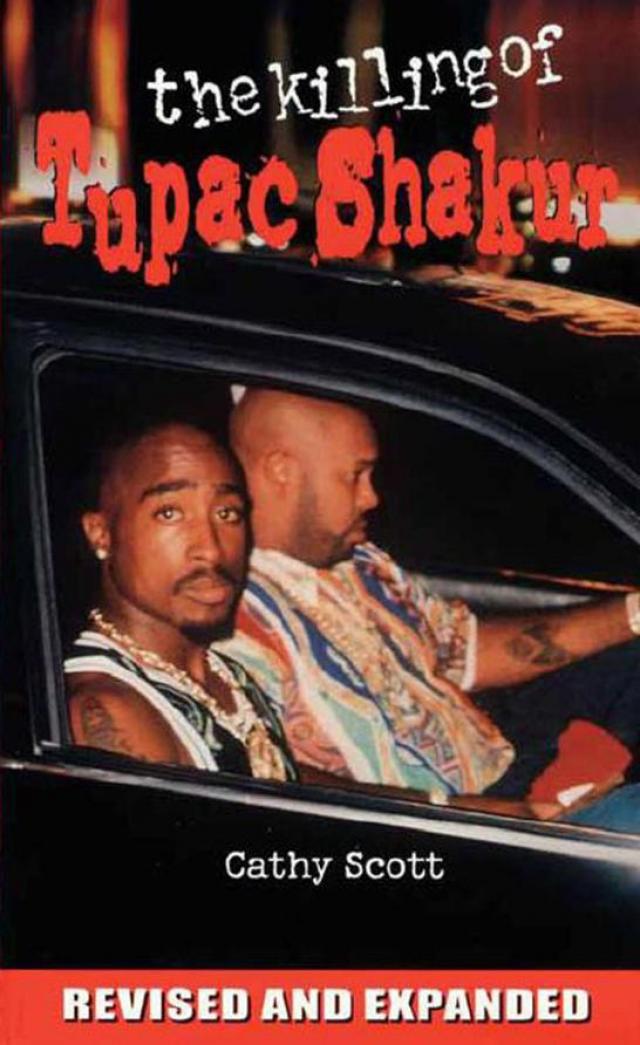


Suge’s coaches say he left UNLV his senior year, without graduating, when the football season ended. He was drafted by the Los Angeles Rams, where he played part of a season. He crossed the National Football League’s picket line during a contract strike and played several games for the Rams before he was released.
He told Vibe magazine that he loved the game and still played sometimes, but that it wasn’t meant to be for him. He had moved on.
Part of what Suge moved on to was trouble. In October 1987, Sharitha Lee Golden, mother of Suge’s first child, obtained a restraining order in Los Angeles against her then-boyfriend that covered her, her sister, her mother, and her aunt.
“Once I refused to talk to him, he began to threaten me and my family ... tamper with my car,” Golden wrote in a court document.
(Suge and Sharitha later reconciled and, according to Clark County marriage license records, were married on Friday, November 3, 1989, at the Candlelight Wedding Chapel, advertised as “the No. 1 choice of recording, stage, and movie personalities in the heart of the Las Vegas Strip.” Sharitha later headed Suge’s management company, and they had a second child together.)
In November 1987, a month after Sharitha got the restraining order against Suge, he was arrested at his Las Vegas apartment for attempted murder, grand larceny auto, carrying a concealed weapon, and use of a deadly weapon to commit a crime. According to the crime report, Suge got into a fight with a man on Halloween night at Suge’s home, at the Rancho Sahara Apartments at 1655 East Sahara Avenue, unit No. 3119.
The arrest report said that at 8 p.m. on October 31, “an altercation broke out between the above subject and another man, during which time Knight shot the victim twice—once in the wrist and once in the leg—with a handgun, then continued to chase him. After Knight shot the victim, he then got into the victim’s vehicle, which was at the scene, a 1986 Nissan Maxima . . . and drove away without the victim’s permission to take the vehicle.”
Afterward, two LVMPD officers, Kathleen Alba and S. Stubbs, were called to the apartment complex to talk to Suge, but he wasn’t there. At 10 p.m., a security guard called officers to tell them Suge had returned to his apartment. Officers Alba and Stubbs returned.
“When we arrived,” the officers’ report stated, “we saw Knight coming out of the area of his apartment and when he saw us, he turned around and walked quickly back toward his apartment door where he removed a 38-caliber revolver from inside the waistband of his pants, which was covered up by the jacket he was wearing.” The LVMPD officers confiscated the .38 Smith & Wesson Special.
Suge was arrested and kept overnight in a crowded and dirty holding cell. He was booked on November 2nd into the Clark County Detention Center in downtown Las Vegas at Bridger Avenue and Second Street.
Suge Knight pleaded out to a misdemeanor in exchange for a suspended two-year sentence and was placed on three years’ probation. He was fined $1,000.
Then, on June 6, 1990, Suge was charged with breaking a man’s jaw in a scuffle outside a friend’s house in Westside, the predominantly black area of town, when the man apparently said the wrong thing. Suge was accused of holding a gun to the man’s face, while demanding an apology. The man apologized, but Suge hit him in the jaw anyway, first with his fist and then with a pistol. Suge was charged with felony assault with a deadly weapon and eventually pleaded guilty, according to the court record. He received a $9,000 fine, a two-year suspended sentence, and three years’ probation. The judge also ordered Suge to complete “a temper-control counseling program.”
• • •
Suge Knight was neither a rapper nor a musician and had no early connection to the music industry. He was a bodyguard in Los Angeles. While working security for rhythm-and-blues singer Bobby Brown, singer-actor Whitney Houston’s husband, Suge spent time behind the scenes. He learned the ropes backstage at concerts and was sharp enough to recognize a good opportunity when it was right in front of him. After awhile, he’d spent enough time around the L.A. rap scene to see its potential for making big money.
Suge became friendly with Tracy Curry, who rapped under the stage name D.O.C. and put out albums for Ruthless Records. When D.O.C. was injured in a car accident, Suge took care of him.
“I’ve seen Suge do some shit to some motherfuckers that’s out of this world,” D.O.C. told L.A. Weekly. “Once, we were leaving a club and I was standing there waiting for my car to come, and some nigga run up on me like he’s fixin’ to hit me in the jaw, and Suge just tore his ass up—broke him down to his very components. Suge was a different nigga when he was doing his business.”
In 1990 Suge began promoting shows in Los Angeles, where he became friendly with rap producer Andre “Dr. Dre” Young, whom journalist Joe Domanick in L.A. Weekly called “the greatest producer and best ear in the history of hip-hop music.” While Dre was under contract with Ruthless Records, he was unhappy with the label. Suge talked him into forming an alliance with him.
Ruthless had been started by Eazy-E, a streetwise rapper known for his record “The Boyz N the Hood” who later died of AIDS. Suge planned to produce an album for D.O.C. and took Dre and D.O.C. to meet Dick Griffey, the chairman and founder of Solar Records and cofounder of the television show “Soul Train.” Griffey was considered a player and an insider in the record industry. Griffey and Suge reportedly intimidated Eazy-E, allegedly threatening him with pipes and baseball bats, into releasing Dre, D.O.C., and R&B singer Michel’le (once Dr. Dre’s wife who later became Suge’s second wife) from their contracts.
Suge denied the allegations. Still, the artists were released from their contractual obligations and Suge obtained copies of the signed releases. Subsequently, however, Ruthless Records sent out letters to major record companies telling them that the releases were signed under duress and should not be honored. As a result, no one would sign Dre, D.O.C., or Michel’le. Suge did what he had to do; he started his own label.
“We called it Death Row ‘cause most everybody had been involved with the law. A majority of our people was parolees or incarcerated. It’s no joke,” Suge later said.
Money, as always, was an issue. A start-up record label can cost millions of dollars to get it off the ground. The company has to pay all the costs of recruiting talent, recording albums, and setting up a company infrastructure before any revenue comes in. Suge needed start-up capital.
The start-up money was secured, if perhaps from some sources that seemingly were less than legitimate. As a result, Death Row was the target of an investigation launched in 1995 by the Los Angeles Police Department, FBI, and three other federal law-enforcement agencies. The feds looked into whether the seed money had come from Michael “Harry-O” Harris, a major investor and drug dealer currently serving time on convictions for attempted murder and drug offenses. Harris’ lawyer was David Kenner, who also at the time was Death Row’s attorney of record. (The federal racketeering probe into allegations that Knight and his label committed acts of murder, drug trafficking, money laundering, and gun-running resulted in a pair of misdemeanor tax charges. Under a plea-bargain arrangement filed Tuesday, January 15, 2002, in U.S. District Court in Los Angeles, Death Row pleaded guilty to failing to submit an income-tax return. In exchange, the label paid a $100,000 fine and reimbursed the government an unspecified amount of unpaid taxes.)
Suge has stated that corporations such as Death Row’s distributor, Westwood-based Interscope Records, were the source of the capital. Interscope for a time was owned by Time Warner. Time Warner sold its 50-percent stake in Death Row back to Interscope. Interscope, in turn, sold that share in 1996 to MCA Music Entertainment Group (now known as Universal) for a profit of roughly $100 million. Funding for day-to-day operations for the label since the beginning has been by Interscope.
Wherever the seed money came from, Suge Knight and Dr. Dre signed heavyweights Snoop Dogg (Calvin Broadus), Hammer, The Dogg Pound, Nate Dogg, Samm Sneed, Hug, KURUPT, K-Solo, Tupac Shakur, and others, and turned them into virtual money machines. Early on, Suge had dreams of making Death Row the Motown of the ‘90s. By 1995, his record company had become the largest rap label in the world. In just a few short years, Death Row was grossing more than $100 million annually.
It’s been said that signing with Death Row is like taking a blood oath. Death Row has been likened to a Mafia-like gang, with Suge Knight as the kingpin, or don.
“Death Row is a way of life,” Suge told The New York Times. “It’s an all-the-time thing. And ain’t nobody gonna change that.”
“Knight has successfully created a myth around himself as an executive not unlike a Hollywood mob figure who has strong-armed his way into the entertainment industry,” Kevin Powell wrote in the October 31, 1996, issue of Rolling Stone magazine. “Many people inside the music business, afraid of his perceived power, were reluctant to speak on the record for this article.”
Suge built his reputation on intimidation tactics. As an example, to get into Death Row’s studios, most visitors, including reporters, were searched for weapons; a guard at the door ran a hand-held metal detector over visitors’ bodies before he’d let them in. Even reporters were scanned. If people in the music industry had appointments with Suge, he’d often leave them waiting for hours, including top executives. It worked. People were afraid of Suge.
Knight, in a biographical profile released by Death Row, described himself as “12 o’clock.”
“That’s a street saying, ‘12 o’clock.’ It means that I’m straight up and down,” Suge once told a reporter. “If I promise you I’m going to do something, you can believe it’s going to happen. Mark my words, Death Row is going to be the record company of the decade.”
Dr. Dre left Death Row to start a record label of his own. (Dr. Dre cut off any connection to Death Row; in 2001 he took out a restraining order against Suge and anyone associated with Death Row.) Distributor Interscope Records, too, severed all ties with the label, as did Time Warner. Still, Death Row had staying power. The label expanded into rhythm and blues, reggae, and jazz. Suge changed its name to Tha Row.
Suge defended his reputation in a Vibe interview, saying, “My mission is helping young black talent see their dreams happen. That’s my ultimate purpose in this business, so fuck anybody who can’t understand or deal with that. I know how I am and what my heart is like. I leave my judgment to God.”
• • •
The music industry has been good to Suge Knight. As he made more money, he spent it lavishly. He purchased 34 vintage and luxury cars, symbols of his wealth. He also invested in real property.
On April 29, 1996, Suge purchased a 5,215-square-foot Las Vegas estate, built in 1968 and substantially remodeled in 1990. It sits on a 1.33-acre parcel overlooking a large section of Sunset Park in southeast Las Vegas. The single-story, red-brick, luxury home cost Suge $1,625,000. The estate, in the Sierra Vista Rancho Estates on Monte Rosa Avenue, sits in the horn of a cul-de-sac and beside a luxury golf course in an exclusive gated community just outside the Las Vegas city limits. It features four bedrooms, six full baths, three fireplaces, and a swimming pool and spa.
At a guard’s booth to the entrance of Suge’s neighborhood in December 2001, a security officer said, “Mr. Knight still lives here.” Knight’s name, indeed, was listed on the roster of residents. The first time he was seen at his home in several years, the officer said, “was just after he got out of prison the first time. I haven’t seen him since he was released the second time [from federal prison].”
Suge’s mansion is across the street from Mike Tyson’s custom home. Also across the street is singer Wayne Newton’s 57-acre Shenandoah Ranch, which covers the corner and more than a city block at Tomiyasu Lane, Sunset Road, and Pecos Avenue. Friends have said that Suge bought the property so he could be neighbors with Tyson and that Mike had encouraged him to move there.
Suge’s house was filmed in the motion picture Casino. It was used to shoot the home-scene footage of Frank “Lefty” Rosenthal, a mob associate and former executive of the Stardust Hotel and casino, played by actor Robert DeNiro.
A real estate agent, who asked that her name not be used, said that after Suge purchased the residence, he “redecorated like crazy.” One of the first changes he made was to paint the sides of the pool blood red—which promptly turned orange from exposure to the chlorine and desert sun. The deck was also red, as was the master-bedroom carpet. Suge also drove around town in a blood-red Rolls Royce Corniche.
Red is the color of the Bloods street gang.
The agent added, “The guy wears a seven-carat diamond in his ear, and I thought, ‘Oh my God, is he for real?’ He and his entourage come in [to Las Vegas] once a month and throw huge parties.”
• • •
On May 19, 1998, Suge’s Las Vegas house was transferred into his new wife’s name, listed with the county assessor’s office as “Michel’le D. Toussant.” The assessor’s office lists Michel’le (pronounced Mish-a-LAY) as paying $1.2 million for the home, even though it was owned by her husband, whom she married while he was in a California prison.
At the time of Tupac’s death, Suge had been living in Las Vegas part-time and his friends and associates had been frequent visitors, especially during boxing weekends. His rappers, including Tupac, were often spotted at Club 662.
It has been widely—and incorrectly—reported that Suge was the owner of the club, at 1700 E. Flamingo Road. In fact, Club 662, which had county business and liquor licenses pending at the time of the shooting, was owned by Las Vegas businesswoman Helen Thomas, president of Platinum Road Inc. The nightclub, originally built in 1972 on two acres, was leased to her. The club’s attorney, George Kelesis, said Suge had shown an interest in buying it. The September 7th party was allowed to be held there because of a special one-time-only permit granted by the county.
Six months after Tupac’s shooting, a “For Lease” sign was posted in front of the property, advertising it as a “restaurant/ nightclub over 10,000 square feet.” The once well-manicured grounds had weeds growing through the desert landscape that surrounded the club. Dozens of cocktail glasses, some shattered, were strewn on the floor in the back storage area. Just months earlier it had been an exclusive, invitation-only hotspot. (Today, it once again operates as a dance club. It has been renamed the SRO Cafe and is a popular spot on the nightclub circuit.)
Thanks to his success, Suge Knight’s world encompassed his Tarzana studio (also done up in blood red), mansions in Encino and Las Vegas, a rented penthouse in Westwood, and a house in Compton. He often drove the 300 miles from Los Angeles, across the Mojave Desert via Interstate 15, to spend weekends in Las Vegas, going to prize fights and nightclubs.
But Suge’s love affair with Las Vegas, which began when he was barely out of his teens, may have soured on September 7, 1996.
For Suge Knight, on his way to a benefit party at Club 662 with his friend and main hit maker Tupac Shakur by his side, Las Vegas must have represented everything good about the world. A few violent moments later, as Tupac’s blood spilled from fatal bullet holes, it surely must have seemed like hell itself. Las Vegas is good for some and bad for others, with nothing in between.
• • •
Knight said he waited four days after the shooting of Tupac Shakur to talk to detectives because he needed time to collect his thoughts and to recover from the head wound he’d received. Two days after his meeting with homicide investigators, on the day Tupac died, David Chesnoff, one of his Las Vegas attorneys, drove Suge downtown to Sixth Street. Chesnoff said it was the FBI who had reminded Suge he needed to register as an ex-con. The 300-pound ex-linebacker walked into the fingerprint section of the Metropolitan Police Department and registered for the first time with the state of Nevada as a convicted felon.
A long-time Nevada state law requires felons to register within 72 hours of arriving in the state. “Probably because of gaming,” surmised Elizabeth Wright, supervisor of LVMPD’s convicted-person registration office. “They want to keep track of people coming into the state, the ones who have convictions.”
Las Vegas police admittedly give preferential treatment to celebrities, at least when they register as felons. They’re given the red-carpet treatment by the director of the section. Famous people don’t have to stand in line for 30 minutes to three hours like the general public. If celebrities, or their attorneys, make a phone call in advance telling the director’s office they’ll be in, they’re ushered through a back entrance so they don’t have to mingle with the common folk. That’s what Mike Tyson did when he was released from prison after serving out his sentence for a sexual-assault conviction.
Suge Knight was fingerprinted, his mug shot was taken, and he was interviewed by investigators. Police then ran his name in two national databases to see whether he had any new arrests or convictions. Seeing none, he was issued a wallet-sized convicted-felon card to carry with him and he was on his way.
• • •
Death Row issued a statement following Tupac’s murder. “Suge Knight and the entire Death Row Records family are saddened by the passing of our brother and star rap recording artist Tupac Amaru Shakur,” the company said officially.
Unofficially, Knight told the Los Angeles Times: “If I could change things, I would give up Death Row, I would give up this lifestyle, I would give up a life to bring him back. Me and Tupac was joined at the hip.”
Knight told reporter Jordan Pelaez that Tupac had spoken to him from his death bed. “We were in the hospital, and I was sittin’ on the bed, and he called out to me and said he loved me,” Suge told Pelaez. Suge, however, was admitted at the same time as Tupac, and rode in the ambulance with him, so it could have happened shortly after arriving at the hospital.
Hospital officials, however, said Tupac never awakened from his coma and that he never spoke to anyone after he was admitted to the Trauma Unit.


