

The killing of tupac sha.., p.6
The Killing of Tupac Shakur,
p.6
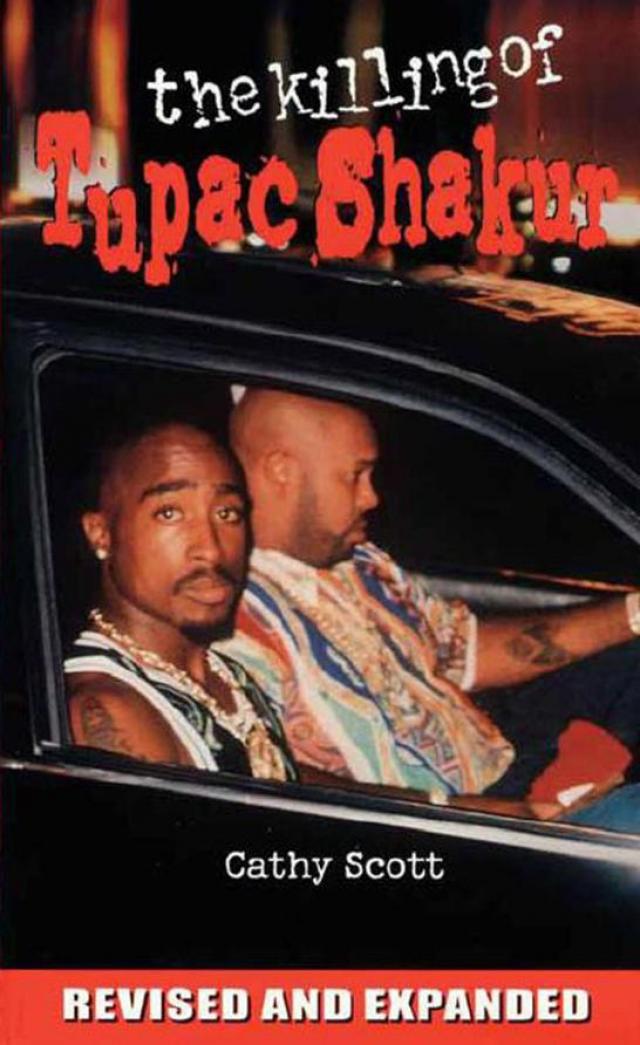


As part of the operation, Los Angeles and Compton police mapped out an early-morning raid, which included plans to serve a search warrant at Orlando Anderson’s house. Las Vegas homicide detectives Brent Becker and Mike Franks were notified and invited to be there so they could question Orlando. They arrived in L.A. the day before the raid.
On October 2, approximately 300 L.A.-area police and federal agents, most clad in riot gear—black masks, helmets, combat boots, and bullet-resistant vests—raided 37 homes, including Anderson’s. LVMPD Detective Becker talked with Orlando Anderson outside the house he shared with relatives, while Los Angeles-area police searched inside the house.
Becker, sitting in his car while Anderson stood nearby, said he talked casually with the young Compton resident about the MGM surveillance tape of the scuffle between Tupac, Suge, and other Death Row Records’ associates. Becker told me he questioned Orlando only about the scuffle at the MGM the night Tupac was shot, and said he didn’t touch on the homicide that followed.
Later, in a CNN interview, Orlando accused Las Vegas police, specifically Detective Becker, of telling him he was a suspect in Tupac’s murder. “I want to let everybody know—you know what I’m sayin’?—I didn’t do it,” he told CNN. “I been thinkin’ that maybe I’m a scapegoat or somethin’.”
Appearing on CNN with Orlando, his lawyer Edi Faal said, “This young man is almost acting like a prisoner now. He is very careful where he goes. He is very careful when he goes out.”
Becker and his supervisors maintained that Anderson was merely asked about the fight that was captured on the casino surveillance tapes, and that Orlando was reading more into the encounter with Becker than was there. Becker later said it must have been his simply talking with a Las Vegas detective that had made Orlando nervous.
LVMPD homicide Lieutenant Wayne Petersen defended Becker and strongly denied Anderson’s allegation. “When Brent went to Los Angeles to talk to Anderson, he asked Anderson questions only about the fight at the MGM,” Petersen insisted. “He never asked him about the homicide. If he wanted to ask him questions about the homicide, he would have had to read him his Miranda rights.” Becker told Petersen that “Anderson asked [him] if he was going to take him back to Vegas, and Becker’s response was, ‘Why should I?’”
The Los Angeles police raid of gang houses netted 23 arrests, including Anderson, on various weapons and drug-possession charges. Also confiscated from one of those arrested was a Death Row pendant (it has yet to be revealed by police which suspect the pendant was taken from). Orlando Anderson was held for questioning in connection with a 1994 murder, as well as for questioning by Las Vegas Metro police about the scuffle at MGM. But Compton police said they didn’t have enough evidence on the 1994 gang-related murder to hold Anderson. He was released the next day without being charged.
LVMPD detectives, too, had decided not to charge Orlando Anderson with a murder, this one of Tupac Shakur.
• • •
The scuffle at the MGM Grand had serious legal ramifications and repercussions for Suge Knight. He ended up being charged with a serious infraction of probation for an earlier conviction.
On October 18, 1996, a warrant for Suge’s arrest was issued for failing to submit to periodic drug tests, one of the conditions of his probation.
On Tuesday, October 22, 1996, 45 days after the Tyson-Seldon and Shakur-Anderson fights, Suge surrendered to Los Angeles police for violating probation, to which he was sentenced in 1995 after pleading no contest to assaulting two rappers at a Hollywood recording studio. (In 1992, brothers George and Stanley Lynwood, two aspiring rappers, used a telephone at Suge’s studio without first asking permission. Suge walked in and caught them. He beat one of them with a gun and threatened to kill them both. He also forced the brothers to remove their pants. The Lynwoods filed a police complaint against Knight. Suge was convicted on assault charges and sentenced to probation.) Suge was jailed without bail. In early November, he was in court to answer charges that his involvement in the MGM Grand altercation was a violation of his probation.
• • •
The small neighborhood of Compton, a largely African-American suburb in South Central Los Angeles, is where Suge Knight grew up (the youngest of three, with two older sisters) and where, cops say, he became affiliated with the Bloods street gang. Suge sports a tattoo that reads “M.O.B.” which some say stands for “Member of the Bloods”; others say it’s for “Money Over Bitches” (one of Knight’s known mottos); still others say it stands, simply, for “Mob,” as in the Mafia. The letters “M.O.B.” also coincide with numbers 662 on a telephone number pad. The significance is in the name Club 662, the nightspot Tupac and Suge were heading to the night of the deadly shooting.
After Orlando Anderson’s October arrest in the L.A. gang sweep, several people who were arrested with him told Compton police that Suge had been the intended target.
In an affidavit filed on November 5, 1996, with Los Angeles Superior Court Judge J. Stephen Czuleger, probation officer Barry Nodorf recommended that Knight’s probation remain revoked and that the defendant remain locked up pending a formal violation hearing.
Judge Czuleger viewed the MGM Grand security videotape in his courtroom. The tape shows a man identified as Suge Knight pushing down another man and kicking him.
“There are compelling reasons to believe that another probation violation has occurred,” probation officer Nodorf said in his seven-page report.
“This fact, coupled with the defendant’s potential threat to the community and the possibility of his being a flight risk, leaves the probation officer with no alternative but to make the recommendation” that the defendant remain in jail, where he would spend four months awaiting the hearing’s outcome, he said.
Suge’s attorney, David Kenner, denounced the report. “The allegation that Suge Knight beat someone up at the MGM is meritless,” Kenner told reporters.
Knight is visible on the tape, but his actions are obscured by other people and objects. According to Nodorf, however, a hotel security guard identified Knight as one of the aggressors in the scuffle. Suge said he was trying to “break up the rumble.”
His assertion, oddly enough, was backed by Orlando Anderson, who testified during Suge’s probation-violation hearing that Suge was the only one who helped him that night. Earlier, however, in another court proceeding, Anderson identified Suge as one of those involved in the scuffle. When pressed, Orlando couldn’t give a reason why he flip-flopped his testimony, later naming Suge as the one who came to his rescue.
Had someone gotten to Orlando? If so, was it Suge? That’s what investigators speculated, but wouldn’t say for the record and never produced any evidence thereof. Someone, they privately surmised, was persuasive enough with Orlando to make him do an about-face in his sworn testimony. Suge Knight sat in the defendant’s chair with a smile on his face while Anderson testified.
The judge was not impressed. He sentenced Suge to nine years in state prison.
4
THE INVESTIGATION
As far back as anyone in the Las Vegas Metropolitan Police Department can remember, the Tupac Shakur murder case is the biggest Las Vegas has ever seen. (Since then, the Ted Binion homicide case is said to be one of the largest and most notorious; that, and mob cases before it.) Even though it’s one of the largest and most highly publicized, the killing of Tupac Shakur no doubt will never be solved. Even the former lieutenant of the homicide section, Wayne Petersen, who took over the homicide bureau shortly after Tupac died, does not believe the murderer will be captured, nor will the case ever be prosecuted.
It’s an investigation the LVMPD probably wishes never came its way, for more reasons than the obvious, the murder of a famous young man. The handling of the investigation has been criticized from start to finish by participants and observers alike who contend the police haven’t done everything they could or should have.
According to authorities, it has not been for a lack of effort, but rather, for lack of cooperation from just about everyone involved: witnesses, Tupac’s friends and associates, Suge Knight, and even police from other departments and jurisdictions.
Back in 1996, seven homicide teams—made up of a sergeant and two detectives—rotated on an on-call basis at Metro. Each three-man team investigated an average of 25 murder cases a year. (Tupac’s was one of 207 homicides within the Las Vegas valley and one of 168 within the jurisdiction of the Las Vegas police that year. The 1996 numbers marked a record year for the highest number of homicides ever for the valley, up 38 percent from the 150 total cases the year before. In LVMPD’s jurisdiction, which includes Las Vegas and unincorporated areas of Clark County, there was a 25-percent jump—from 1995’s 134 to 1996’s 168 cases.) The night Tupac was shot, the team on call consisted of Sergeant Kevin Manning, Detective Brent Becker, and then-active Detective Mike Franks, all veteran investigators, but not veteran homicide cops.
Brent Becker worked in the robbery section before being moved to the homicide bureau. At the time of Tupac’s murder, he’d been working the homicide detail for about two years. His partner, Mike Franks, had been working in homicide for four years. Before that, Franks had worked in the narcotics unit with Manning. (Mike Franks retired in February 2001, at 53 years old, after 30 years on the force, some spent tracking the mob and trying to solve murder cases.) Sergeant Manning, early in his police career, was a part of LVMPD’s first street narcotics unit. He’d also worked in the gang detail. When Tupac was shot, Manning, although he’d had experience as a supervisor in other units, had been a homicide sergeant for just a year and a half.
The Clark County Sheriff’s Department merged with Metro in 1973 and became the Las Vegas Metropolitan Police Department, or LVMPD. Franks and Manning had been hired by Metro and Becker by the sheriff’s department before the two departments merged.
“Brent was one of my trainees [at Metro] when I was a training officer,” Manning said. “I worked with Mike in narcotics. We’re all friends.”
Overseeing the Shakur murder investigation was Lieutenant Wayne Petersen, who joined the Las Vegas Metropolitan Police Department on August 27, 1979. Petersen was promoted to sergeant in 1988 and served stints in patrol and the detective bureau before moving to Criminal Intelligence for two-and-a-half years. There, in 1994, he was promoted to lieutenant. In late 1996, shortly after the Tupac shooting, Petersen was put in charge of the homicide section. During his tenure there, he oversaw the investigations of 600 homicides, including Tupac’s. In November 2001, at 47, he left the homicide unit after five years for the department’s traffic bureau.
The homicide bureau at the LVMPD is a somewhat casual bunch. It’s an elite group; working homicide is a sought-after assignment. But Las Vegas detectives don’t dress the part. They don’t wear white shirts, neckties, and black slacks like many of their counterparts in other cities. Here in the desert, they’re more likely to be seen wearing golf shirts and Dockers.
Manning, Becker, and Franks were called to the scene at Las Vegas Boulevard and Harmon Avenue about an hour and a half after the shooting. The homicide lieutenant at the time, Larry Spinosa, was out of town; otherwise he would have been there too.
In the days and weeks following the homicide, the team interviewed a couple dozen people who were friends or associates of Tupac, some of whom were part of the entourage, and they talked to “literally thousands of people” about the case, Manning said.
Throughout the investigation, police say, witnesses uniformly refused to cooperate. The detectives were frustrated from the very beginning, stunned by the number of witnesses who claimed not to have seen the assailants, or anything else for that matter.
The witness statements were pretty similar: “I didn’t see nothin’. I didn’t know nobody. I wasn’t even there,” Lieutenant Wayne Petersen commented, mocking the language.
No one on East Flamingo Road that night, including Suge Knight, admitted to seeing anything that aided investigators in their efforts to find the killer or accomplices. Police assumed that Suge, who was driving the car and sitting next to Tupac, would probably be their best eyewitness. They were wrong.
Petersen said, “He’s obviously a prime witness in this, also a victim, and we’ve gotten no cooperation from him. We believe we know who’s responsible for this. The problem we have with this case is we don’t have anyone willing to come forward and testify to it. The gangster-rap mentality that they don’t want to talk to police is definitely hurting this case.”
Sergeant Kevin Manning agreed. “He doesn’t care. It’s the code of that mentality. They just don’t care.”
“Every September,” Lieutenant Petersen said later, “on the anniversary of Tupac’s death, worldwide media call asking what’s going on with the case. I always have to tell them, ‘Nothing.’ We had a lot of people in position to see a lot of stuff, and all we ever had was a description of a hand sticking out of a window with a gun. None of them wanted to be seen as cooperating with the police.”
When Suge Knight was asked by an ABC “Prime Time Live” reporter whether he would tell the police who killed Tupac if he knew who it was, he answered slowly, but directly, “Ab-so-lute-ly not. I mean, because I don’t know. It’s not my job. I don’t get paid to solve homicides. I don’t get paid to tell on people.”
“There’s a potential for God knows how many witnesses that night,” Lieutenant Petersen commented. “It was a Saturday night. It was a fight night. It was close to the Strip. How many hundreds of people were at that intersection? Say there were a hundred. Nobody was able to provide us with an accurate description of the shooter and the vehicle? The best anyone on the scene could tell investigators was that the Cadillac was light-colored, probably white.
“Most of the witnesses said the car was white. How many white Cadillacs are there in this town?”
Investigators were also given what they called “misinformation” by “unreliable sources” who said that everyone in the Cadillac was wearing masks. But that didn’t correspond with what the lone cooperative witness, Yafeu Fula, told police in a brief interview immediately after the shooting. Yafeu said the gunman’s face was not covered. And bodyguard Frank Alexander said the gunman was wearing a skull cap. His face was uncovered, he said, but all he saw was his profile.
Early in the Shakur investigation, Sergeant Manning told a reporter, “The shooting was not a random act of violence.”
But that’s about all investigators seemed sure of. Perhaps most frustrating, the members of the entourage were close-mouthed about the shooting, claiming they saw only the Cadillac and not the assailants. Several bodyguards were in the group, and their lack of detailed information took LVMPD investigators by surprise. After all, they were being paid to protect Tupac and Suge.
“It amazes me,” Manning said, “when they have professional bodyguards who can’t even give us an accurate description of the vehicle. You’d think a personal bodyguard would have seen something. It’s a murder, and the people closest to the scene should be able to help us, but they say they didn’t see anything. So far they haven’t enlightened us as to a suspect or a motive, and that’s the bottom line.”
The night of the shooting, about eight detectives were on the scene, Petersen said, including general-assignment detectives, a watch commander, and patrol officers “trying to deal with the mass of witnesses and the large crime scene.” One crime-scene analyst was called because “it was an attempted homicide,” said Lieutenant Brad Simpson, who oversees Metro’s criminalistics section. “[Tupac] didn’t die right away, or we would have sent two technicians. We approached it as an attempted homicide, so we only sent one senior crime-scene analyst.”
That’s not how it usually works, Simpson said. “On average,” he explained, “there are a minimum of two, probably three, criminalists on a homicide scene. One is a crime-scene supervisor and one a senior crime-scene analyst, which means they’ve been on [the job] for at least four years. Their job is to collect the forensics evidence. In the Tupac Shakur case, they would look at the bullet holes in the vehicle, the trajectory of the bullet holes hitting the car and him, blood-splatter evidence, which shows the direction of high-velocity wounds. They would photograph the crime scene, taking overall views. They would probably go back within a week to take an aerial shot to get a better perspective of what’s going on. They would diagram the crime scene.”
An aerial photograph, however, was never taken. (Aerial photos are used for court. If there’s an arrest, photos of the street will be taken from a helicopter. The police didn’t take an aerial photo that night “because it was dark,” Sergeant Manning said. He didn’t say why one wasn’t taken later.)
A Metro K-9 (canine) team was dispatched to the Strip and Harmon Avenue to search for a gun police believed may have been thrown into the center divider. Later that night, however, they learned that the shooting had actually taken place a mile away. So the dogs were sniffing for 15 minutes in the wrong place at the wrong scene. A helicopter (LVMPD had three at the time) wasn’t used in the investigation to search for the shooter’s Cadillac. By the time the police realized where the shooting had taken place, too much time had elapsed to dispatch a helicopter. They figured the getaway car was long gone.
When investigators learned that the gunman had fled south on Koval Lane, detectives checked to see if any other shootings had occurred in that area; there were no reports of any. And no fights or disturbances were reported involving black men in a Cadillac.


