

The killing of tupac sha.., p.2
The Killing of Tupac Shakur,
p.2


“Sal [Suge’s friend] whispered into Tupac’s ear and Tupac took off running,” Frank continued. “Tupac ran up to Anderson and swung at him. Anderson swung back and a chain fell off of Tupac’s neck. Tupac bent down to pick up his necklace. I went down as he did and grabbed Tupac and put him against the wall.”
After security guards broke up the encounter, Tupac, Suge, and their crew immediately left. They headed for the lobby of the MGM Grand, then to the valet area in front of the hotel. They walked south on the Strip toward the Luxor Hotel-Casino, where the group was staying and where they had parked their high-priced cars. It’s a 15-minute walk.
Las Vegas police were called by hotel security for backup. No one from Tupac’s group was stopped or questioned by security or police. Tupac and his group, as recorded by surveillance cameras, simply walked away. No report was filed by Las Vegas police. After the scuffle, Orlando was seen on videotape talking to LVMPD and security officers. He was standing up and did not appear to be injured. Security guards offered him first aid. He declined. They also asked him to go with them downstairs to the security office to file a complaint. He declined.
This question has never been answered: Even though Orlando declined to file a complaint, why didn’t police file a police report? In the state of Nevada, victims don’t have to file a complaint for charges to be filed against a perpetrator. Suge was later imprisoned for violating parole because of his involvement in the scuffle, so, obviously, authorities felt a crime had been committed. And security guards were witnesses. Yet no crime or incident report was ever filed.
Meanwhile, back at Luxor, a block south of the MGM, Tupac went to the room he was sharing with his girlfriend Kidada Jones, Quincy Jones’s daughter, which Suge Knight had booked for the weekend.
There, Tupac changed his clothes from a tan designer silk shirt and tan slacks to a black-and-white basketball tank top, baggy blue jeans, and black-and-white leather sports shoes. Around his neck on a heavy gold chain hung a large, round, solid-gold medallion. It wasn’t the medallion Suge had given him when he bailed Tupac out of prison a year earlier. That one featured a diamond-studded Death Row insignia of a hooded prisoner strapped into an electric chair. The medallion Tupac wore to the fight was the size of a paperweight – and probably just as heavy – picturing a haloed and winged black man wrestling a serpent with one hand and holding a gun in the other.
Tupac didn’t pack a weapon that night. He left his hotel unarmed. He also didn’t wear a flak (or bullet-resistant) jacket or vest. Tupac’s friends said he sometimes wore a Kevlar vest out of fear of being shot. But not that night. He always felt safe visiting Las Vegas. After all, it was a party town and he was going there to “kick it” and watch his homey Iron Mike kick butt. Besides, a flak jacket would be too hot in the desert heat. That’s what he told Kidada when she packed his clothes earlier that day in California. It would turn out to be a fatal decision, but one to which Tupac didn’t give another thought as he and his girlfriend prepared to leave for Vegas.
But to one of Suge’s bodyguards, Tupac said otherwise. Frank Alexander, Tupac’s personal bodyguard for the weekend, said, “There is a bodyguard who is a close friend to me, and Tupac told him he didn’t feel good about going to Vegas and that he felt like his life was in danger. He didn’t say it to me. But he did say it to this particular bodyguard.” Alexander declined to name the bodyguard.
Still, it was rare for Tupac to wear a flak jacket, issued by the record company. Alexander said that “Tupac only wore it one or two times.”
While waiting for their cars in the Luxor valet area, Tupac and his crew were videotaped on a tourist’s camcorder, smiling and chatting casually with a couple of women. Kidada Jones remained in their hotel room upstairs.
When the cars were delivered a few minutes later, the group piled in and drove to Suge Knight’s Las Vegas residence in the southeastern valley, on Monte Rosa Avenue in the Paradise Valley Township. The Las Vegas subdivision boasts some of the oldest estates in the Las Vegas valley and is home to many of the wealthiest and most powerful Las Vegans.
Las Vegas Metropolitan Police Department Sergeant Kevin Manning, who led the homicide investigation, said the group went to Suge’s house to relax. But Frank Alexander told me they went to Suge’s specifically so Suge could change his clothes.
According to Sergeant Manning, the group planned on attending a benefit party at a Las Vegas special-events night spot, located at 1700 East Flamingo Road, known then as Club 662, where Tupac was to perform with Run DMC. After his fight with Seldon, Tyson also planned to make an appearance at the nightclub, which Suge ran.
At about 10 p.m., the entourage left Suge’s house and headed back to the action. Tupac rode shotgun with Suge behind the wheel of a car Death Row had just obtained: a $46,000 1996 black 750 BMW sedan, with darkly tinted windows, chrome wheels, leather upholstery, and a sunroof. The music was cranked up on the car stereo (this particular BMW model is known for its superb sound system). They were in a party mood as the caravan of luxury cars – a Lexus, a BMW wagon, a Miata, and a Mercedes Benz – carrying friends and bodyguards, followed closely behind.
Alexander, a former Orange County Sheriff’s Department reserve deputy (now an author and producer), was the only bodyguard riding in the caravan. The rest of the dozen or so private security guards were waiting for the group a few miles away at Club 662. Frank was sitting in the driver’s seat of a Lexus owned by Kidada Jones, behind Suge and Tupac’s BMW. At the last minute, Frank decided to drive Kidada’s car instead of his own. Frank’s personal handgun was in his car, which he left in the Luxor parking garage. That decision left Frank, the only bodyguard with Tupac, unarmed.
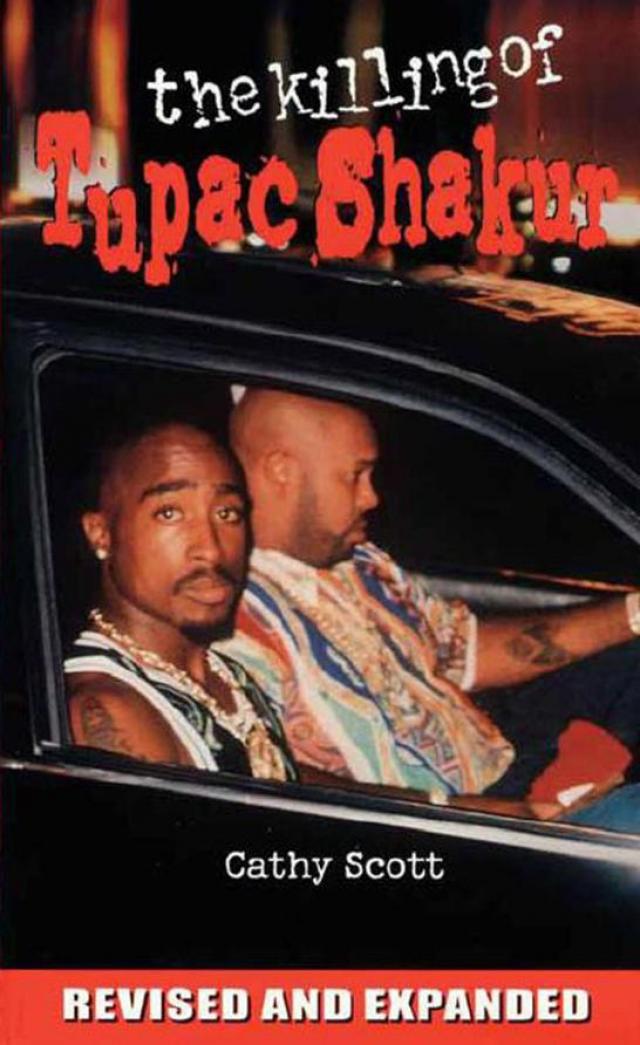
The group cruised four-mile-long Las Vegas Boulevard, commonly called the Strip, which was jammed with the kind of stop-and-go traffic that is the norm for a Saturday fight night. The sunroof of the BMW was opened and the windows rolled down. Suge and Tupac were hollering above the hip hop blaring from the car’s speakers. Tupac and his crew, easily recognized, were turning heads on the Strip. A photographer shot a frame of Tupac and Suge sitting in the black BMW. The photo later garnered between $800 and $5,000 each time it was sold for publication in entertainment and business magazines and to air on TV tabloid and news shows. It’s also pictured on the cover of this book. It was the last photo taken of Tupac alive.
At 11:05 p.m., Suge Knight was stopped on the south end of the Strip by a Las Vegas bicycle cop for playing his car stereo too loudly and for not having license plates displayed on the BMW. (That’s when the photo of Suge and Tupac sitting in the BMW was taken.) The officer asked Suge to get out of the car and open the trunk. Suge did. He and the officer talked. A few minutes later, the officer let Suge go without ticketing him. Tupac and Suge laughed about it as they rounded the corner onto Flamingo Road, heading past Bally’s hotel-casino toward Club 662 just two miles away.
They never made it.
• • •
None of Tupac’s bodyguards, including Frank Alexander, and associates armed themselves before leaving for Club 662. The other bodyguards, all former or off-duty cops, including LVMPD police who were moonlighting that night, had been hired to guard Tupac and his entourage during their stay in Las Vegas. For out-of-state security officers to carry guns, Nevada law requires them, in advance, to obtain temporary concealed-weapons permits. According to Frank Alexander’s account of the events that night, that advance permitting had not been done.
After Tupac and the bodyguards arrived in Vegas, they were disappointed to learn that the proper permits allowing them to carry firearms had not been applied for by Wrightway Security, a firm used by Death Row Records that hired only off-duty cops. A Las Vegas attorney for Death Row informed the bodyguards before the Tyson fight that they would not be legally allowed to arm themselves while guarding the Death Row entourage in Nevada. That left them as little more than unarmed rent-a-cops.
If they’d been caught packing weapons without permits, the police could have charged them and they could have faced stiff penalties. The majority of the security guards were accustomed to carrying sidearms. But not that night.
While they may have felt the same as Tupac, that they were going to a party in a town far removed from the street-gang violence long associated with Los Angeles, they had to make a hard choice. In the end, on the advice of Suge’s attorney, the bodyguards left their guns behind.
Had the group decided to ignore the law, they no doubt could have walked undetected into the MGM Grand Garden that night with guns if they’d wanted to. According to John Husk, executive director of the MGM’s arena operations, “There were no metal detectors used at the Mike Tyson fight on September 7th.”
Las Vegas police were out in droves and private security was heavy at the Grand Garden Arena before, during, and after the fight. Sergeant Ron Swift, with LVMPD’s Special Events Section, said officers were assigned inside the casino near the boxing arena to strengthen the hotel’s own security force.
“On property, we had some officers augmenting hotel security at the event itself,” Swift said. “We do it at every major fight, as well as at concerts, rodeos, and parades.”
The arena was not the only place cops were assigned to provide a show of force that night. Special Events officers, working overtime, were stationed at the private gate to Suge’s neighborhood, which Metro, because of a county ordinance, does not patrol. The homeowners associations of many gated communities in Las Vegas Valley hire private security officers to patrol inside their walls. Las Vegas police were also contracted to be present at Club 662 after the fight. Overtime for the off-duty Metro officers was billed to Death Row Records.
“[Death Row] asked us to do it,” Sergeant Swift said. “My only concern at the time was traffic and public safety. If a company comes in and asks for extra security, we provide it. Death Row requested it formally from Metro.”
One officer said that Death Row had also asked that African-American cops only be assigned to work Club 662 and Suge’s house. “The request was made for only black police officers,” the source said. “As far as I know, we complied.”
But Swift couldn’t confirm it, saying, “I’ve never heard that Knight requested black officers. The request may have come in, but I didn’t hear about it.” Still, the same source revealed that a black sergeant, along with six to eight other black officers, were assigned to the party at Suge Knight’s house following the fight.
Tupac felt safe as he rode in the BMW toward Club 662 – Suge was driving, friends and bodyguards were nearby, and Las Vegas cops were stationed at the house and the club. In fact, the event at Club 662 was sponsored by LVMPD Officer Patrick Barry, a retired professional boxer, to raise money for Barry’s Boxing Gym on Vanessa Drive in the southwest area of the city. Tupac, Run DMC, and Danny Boy were scheduled to perform at the charity event, intended, ironically, to raise money to keep children away from violence. Club 662’s marquee advertised the event as “Barry’s Boxing Benefit, produced by SKP (Suge Knight Productions). A line started forming outside the club at 5:30 p.m. Hundreds of people paid $75 each to get in.
Barry’s Boxing Benefit, organized by Las Vegas attorney George Kelesis, who once represented Suge, was also intended to help Tupac stay out of prison by fulfilling a court order and condition of probation in one of his criminal cases, in which he was ordered to perform community service in lieu of jail time.
The convoy was headed east on Flamingo Road when it stopped for a red light at Koval Lane, a busy intersection only a half-mile from the Strip across from the Maxim Hotel. One driver in the caravan pulled up a car length ahead to the right. Another car stopped directly behind them; in it were rapper Yafeu “Kadafi” Fula and two associates, Out-lawz rapper Malcolm “E.D.I.” Greenridge and bodyguard Frank Alexander. Another car was behind theirs. Riding in it, along with a couple of other people, was Tupac’s friend Chris “Casper” Musgrave. Still another car was in front of the BMW at the stoplight. The sidewalk and street were busy with pedestrians. The BMW was boxed in.
Four young black women, sitting at the same intersection in a Chrysler sedan to the left of the BMW, turned, smiled at Suge and Tupac, and caught their attention.
A moment later, a late-model Cadillac with three to four black men inside pulled up directly to the right of the BMW and skidded to a stop. A gunman sitting in the back seat on the driver’s side stuck a weapon out of the left-rear window of the white Caddy, in full view of the entourage. The gunman tracked Tupac from the back seat.
Suge and Tupac saw the Cadillac, but had no time to react.
Suddenly, the sounds of the night were shattered by the pop, pop, pop of a killer inside the Cadillac emptying a magazine from a high-powered semiautomatic handgun. At least 13 rounds were sprayed (that’s how many bullet holes and casings investigators counted) into the passenger side of the BMW. Five bullets pierced the passenger door; some shattered the windows.
Startled and panicky, Tupac tried frantically to scramble into the back seat through the well between the front seats. But he was seat-belted in. In doing so, he exposed his middle and lower torso to the gunfire and took a round in his right hip. Suge grabbed Tupac, pulled him down, and covered him. He yelled, “Get down!” That’s when Suge was hit with a fragment in the back of his neck.
Tupac was plugged with bullets at close range. Three rounds pierced his body. One bullet lodged in his chest, entering under his right arm. Another went through his hip, slicing through his lower abdomen, and ended up floating around in his pelvic area. Yet another bullet hit his right hand, shattering the bone of his index finger and knocking off a large chunk of gold from a ring he was wearing on another finger. (Tupac wore three gold-and-diamond rings on his right hand that night.) The gunfire nailed Tupac to the leather bucket seat. Glass and blood were everywhere.
Suge was grazed in his neck from the flying shrapnel and glass fragments. A fragment lodged in the back of his skull at the base of his neck. Bullets also blew out two of the BMW’s tires.
The gunfire ended as quickly as it had begun. The shooting of Tupac Shakur, executed in cold blood, was over in a matter of seconds.
“You hit?” Suge asked Tupac.
“I’m hit,” Tupac answered.
Frank Alexander said, “All I saw was the position of the shooter. He was in the back seat. I saw the arm of the shooter come out. I saw a silhouette of him, which was a black person wearing a skull cap, a beanie cap.
“I ran up to the back of the BMW. I got to the trunk of the car. Then the car [Suge’s] took off and made a U-turn. I was shocked the car moved. There was no way to have seen all of that gunfire and then for someone to still be alive. The Cadillac made a right turn on a green light. It was the only car making a right turn.” Frank ran back to his car, jumped in, and followed Suge.
Some reports and LVMPD sources said members of the entourage immediately returned fire. Although no other casings were found, police said revolvers may have been used, which leave no tell-tale shells behind.
Sergeant Manning admitted, “We did hear reports that gunfire was returned, but we were unable to validate it. There was no evidence.”
Two LVMPD bicycle patrol officers were on a call concerning a stolen vehicle on the second floor of the parking garage at the Maxim when they heard the first shots fired at 11:17 p.m. Officer Paul Ehler and his partner immediately hopped on their mountain bikes and pedaled toward the street, where they heard more gunfire. They saw the black BMW driver about to flee the gunman.
The driver of the Cadillac, in the meantime, floored it and fled. The Caddy made a right turn onto Koval Lane and vanished. It happened so quickly that by the time the bicycle cops arrived seconds later, there was no trace of the Cadillac. The shooter and his associates escaped under the cover of darkness.
Other drivers who witnessed the shooting stopped and stared, dumbfounded. Shocked drivers maneuvered their cars around the BMW, driving over the crime scene and the spent bullets. Horrified pedestrians milled about the busy sidewalks.
Paul Gillford, a sound man for a syndicated TV show broadcast live from the Imperial Palace, was just getting off work and was on Koval Lane at Flamingo when the shooting took place. He said he, too, watched as all the cars left the scene in different directions.
At least six cars behind Tupac tried chasing the Cadillac as it sped south on Koval Lane, away from the scene. The rest of the crew stayed with Tupac and Suge.
Suge panicked. He knew he had to find a doctor for Tupac, and fast. Tupac looked like he was dying, bleeding to death. Suge was splattered with both Tupac’s and his own blood. Tupac’s breathing was labored and shallow. But his eyes were opened wide and he was alert.
Suge had a flip Motorola cellular telephone with him, resting on the sedan’s console, but he didn’t use it to call 911 for help. With adrenaline pumping and Tupac bleeding heavily as he sat slumped in the front seat, Suge somehow managed to make a U-turn in the heavy traffic, even though his car now had two flat tires. But the sedan had a powerful 4.4-liter V-8 engine, so Suge floored it and got out of there, flat tires and all.
“[The bike cops] saw about ten cars pull U-turns and head west on Flamingo at a high rate of speed,” then-Sergeant Greg McCurdy told the Las Vegas Sun. Not all the cars stayed with Suge, though, once they saw they were being followed by the cops. Three followed him all the way to the Strip.
Both bicycle cops were pedaling fast, tailing the BMW. Why one officer didn’t follow Suge while the other stayed behind at the shooting – the scene of the crime – was more than surprising. The officers said it was because they didn’t know what had gone down at that point. They’d heard shots being fired, but they made a split-second decision not to stay and secure the crime scene. They felt it was more important to follow Suge, one of the victims, not a suspect, and his entourage. It would prove to be the first of several questionable decisions made early on in the criminal investigation. One of the first lessons taught to cadets is to secure a crime scene until investigators arrive. The bike officers did not.


