

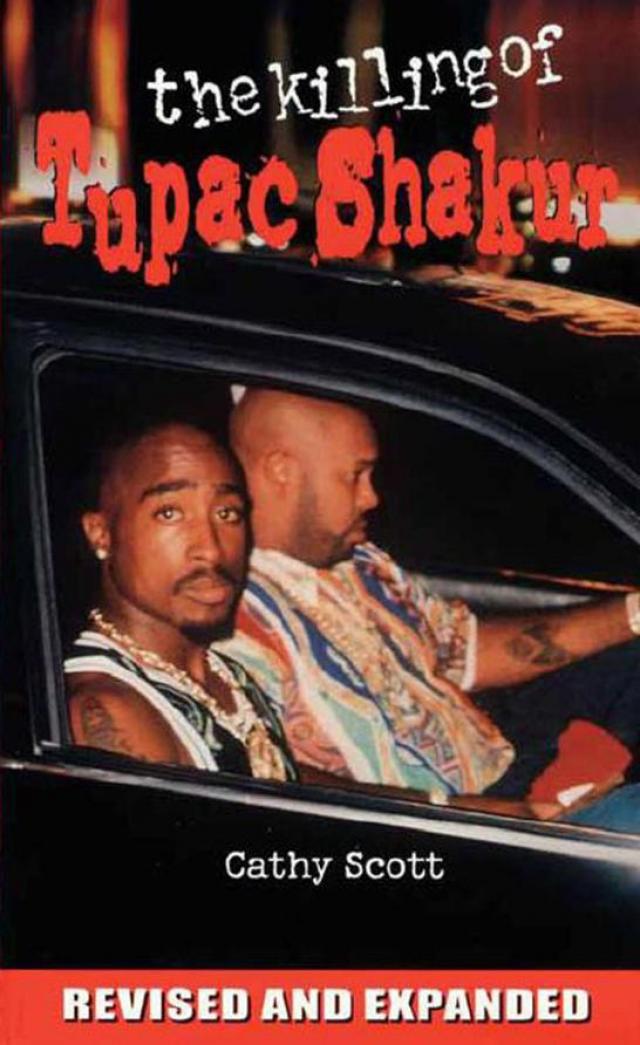
The killing of tupac sha.., p.24
The Killing of Tupac Shakur,
p.24


In another statement, this one a news release issued the day after Biggie’s death, Quincy Jones said he was “absolutely stunned.”
“This death, as well as the death of Tupac Shakur, Eazy-E [from AIDS], Marvin Gaye [murdered by his own father], and so many more young people who we never hear about, are senseless acts that should never have happened.
“I spent my formative years growing up in ‘Gangster Central’ on the Southside of Chicago, so I am no stranger to random violence. If life continues to imitate art this way, it will result in self-inflicted genocide. We all need to reevaluate what our priorities are or else we have nothing to look forward to except more of this madness.”
He said he had developed a “close personal relationship” with “the superstar rappers” over the last 10 years. “It’s witnessing their genius and compassion that makes incidents such as these particularly disturbing to me,” he said.
• • •
No public funeral service was ever held for the slain Tupac Shakur. This was at the request of his family, who said he would not have wanted one. In fact, the family told reporters that Tupac had talked about his death and had specifically stated that he did not want a funeral if he were to die. In high school he told friends they could snort his ashes and get high off of him. His mother took his ashes home to Georgia to the house Tupac had bought for her (through Death Row). Later, she scattered them over a neighborhood park in Los Angeles.
Spontaneous celebrations of Tupac’s life were held all over the country. At the Civic Center in Atlanta, Georgia, friends remembered him shortly after his death. They called it “Keep Ya Head Up! The Celebration of Tupac Shakur,” a three-hour tribute of speeches, poetry readings, dance, and music.
“I know people are sad, but I am here and we are here to celebrate Pac and continue on with his spirit,” Afeni Shakur said of her son.
Shock G and Money-B, members of Digital Underground where Tupac’s professional music career began, issued this statement:
“If you want to mourn, do it for you own personal loss. Don’t mourn for Pac. Remember him for his art and don’t be sad for his death. Pac lived a short, fast, concentrated, and intense life. He lived a 70-year life in 25 years. He went out the way he wanted, in the glitter of the gangsta life, hit record on the chart, new movie in the can, and money in the pocket. All Pac wanted was to hear himself on the radio and see himself on the movie screen. He did all that—and more.”
Tupac was also mourned at his boyhood church, the House of the Lord Pentecostal Church in Brooklyn, New York, which he joined at age 15 with his mother and sister. Tupac left Brooklyn in his teens, but was still listed as a member of the congregation until his death.
“Who will weep for Tupac Shakur?” the Reverend Herbert Daughtry asked mourners at the memorial service. “I will weep for Tupac. I will weep for all our youth.
“He had the genes, he had the ability. Could we have provided the society that would have made him blossom?”
Daughtry said that Tupac’s self-proclaimed ambition to be a revolutionary against injustice to blacks “was just as real as Martin’s and Malcom’s,” referring to Martin Luther King and Malcolm X.
“I know that there are those who say he went about it the wrong way, joining the ‘gangsta’ culture he glorified in his lyrics,” Daughtry said. “But it’s not for me to judge.”
Mikal Gilmore, in a Rolling Stone article shortly after Tupac’s death, wrote that he suspected “Shakur’s death will be cited as justification for yet another campaign against hardcore rap and troublesome lyrics.
“So a man sings about death and killing, and then the man is killed,” he wrote. “There is a great temptation for many to view one event as the result of the other. And in Tupac Shakur’s case, there are some grounds for this assessment. He did more than sing about violence; he also participated in a fair amount of it. As Shakur himself once said, in words that Time magazine appropriated for its headline covering his murder: ‘What goes ‘round comes ‘round.’ Still, I think it would be a great disservice to dismiss Shakur’s work and life with any quick and glib headline summations. It’s like burying the man without hearing him.”
Writer Kevin Powell put Tupac’s life and death in perspective when he eulogized Tupac in the same issue of Rolling Stone.
“He was a complex human being; both brilliant and fooling; very funny and deadly serious; friendly and eager to please, but also bad-tempered and prone to violence; a lover of his people and of women, but also a peace divider and a convicted sex offender; generous to a fault but also a dangerous gambler when it came to his personal and professional life; incredibly talented but at times frivolously shortsighted. To me, Shakur was the most important solo artist in the history of rap, not because he was the most talented (he wasn’t), but because he, more than any other rapper, personified and articulated what it was to be a young black man in America.
“But the demons of Shakur’s childhood—the poverty, the sense of displacement, the inconsistent relationship with his mother, the absence of a regular father figure—haunted the rapper all his life. In his song, ‘Dear Mama,’ he sings, ‘When I was young, me and my mama had beefs/Seventeen years old, kicked out on the streets.’
“Now that Tupac Shakur is gone, some will charge that it was the music that killed him or that he had it coming because of the choices he made in his life. Those are cop-out, knee-jerk responses. Shakur, in spite of his bad-boy persona, was a product of a post-civil rights, post-Black Panther, post-Ronald Reagan American environment. We may never find out who killed Tupac Shakur, or why he did the things he did and said what he said. All we have left are his music, his films, and his interviews. Shakur lived fast and hard, and he has died fast and hard. And in his own way, he kept it real for a lot of folks who didn’t believe that anyone like him (or like themselves) could do anything with his life.”
Keisha Morris, Tupac’s ex-wife with whom he remained friends, told People magazine, in an issue released while Tupac was still in a coma, “He’s an entertainer, not a gangster. As a person, Tupac is very misunderstood.” After his death, Keisha told Rolling Stone, “I thought he was going to walk out of the hospital just like he did before.”
“At the end ... you kind of had that feeling he was going to die, according to his preaching,” writer Tony Patrick said in Thug Immortal. “He seemed to have taken up power and weapons, his posse lifestyle, as his deity. Tupac went from one extreme to the other. There was really no middle ground with him. It was age without maturity, knowledge without wisdom, order turning to chaos. Tupac Shakur should stand as a living testament in the Hip Hop Nation as the pinnacle of greatness achieved, but at the same time, the frailties of human weakness and tragedy.”
His stepfather, Mutulu Shakur, penned a letter, “To My Son,” from inside a Florence, Colorado, federal penitentiary, the night Tupac died. Excerpts were reprinted on the Internet by Double J Productions.
“I love you whenever, forever. Tupac, so much I needed to say, so much you wanted to say. Many conversations between us within the other ...
“The pain inflicted that scarred your soul but not your spirit gave force to the rebellion. Many couldn’t see your dreams or understand your nightmares. How could they, Tupac? I knew your love and understood your passion. But you knew of your beginning and saw your end, racing towards it.
“You taught and fought through your songs and deeds. Ratt-tatt-tatt of words penetrating the contradiction of our existence ...
“Who cares? We cared, Tupac. The Shakurs have been guided by struggle, prepared or not, whenever, forever. We’ve exposed our existence, naked from fear, to those who would hear the positive. Who would witness the stress, wear and tear of this lonely path? You couldn’t have evaded the effect or the changes. You inherited it; it was in your genes.
“Friday the 13th didn’t mean a thing. Life is for living and dying well ... You understand the pain of disappointment in the ones we love. You pushed so many away. Burnt so many bridges so they wouldn’t follow you into battles against the demons you were facing. Knowing well to what lengths you would go. This battlefield of reality is littered with many meaningless casualties.
“You never yelled out, ‘Somebody, save me!’ You only asked for your soul to be free, whenever, forever. You told us to keep our head up, knowing the pain was coming. Knowing to look for the strength in the heavens. Set your soul free, Tupac Amaru.
“The victories—we will teach your mission. We are thankful for you. We love you, Tupac Shakur. We ain’t mad at you. We’ll be better because of you.
“So now I give you my tears so I might assimilate your loss and I can live on in peace.
“Knowing I will feed your spirit with unconditional love, knowing you will need it on your next journey. May Allah bless you for your deeds and forgive your errors. Tupac, come to me and give me strength.
“Love always,
“Your father, friend, comrade, Mutulu.”
Billy Garland, Tupac’s biological father, said in an exclusive interview with Kevin Powell for Rolling Stone that his son did not deserve to be criticized.
“My son is dead, and he don’t deserve to be talked about like some common criminal,” Garland said. “He wasn’t perfect, but he did do some great things in a little bit of time.”
After Suge Knight’s release from prison, nearly five years after his star performer was killed, Suge had this to say, to the BBC: “Tupac is what you call a superstar. There’s a difference between being an artist and a superstar. You get guys on other labels [who] could probably go and sell some records, but they’re not a star. Tupac was a star. When he walked in a room, the room lit up. He could still be a thug and still talk about thuggish things, but he can still take his shirt off and be a pillar to the women. There’s a difference between being a thug and a street punk. Tupac is and always will be a legend. Even when he was alive he was a legend, because he had his own spiritual flava, his own vibe, and that’s one of the best things you can look for in a guy like Pac.
“There isn’t ever going to be another Tupac. There will be a lot who imitate it, but not duplicate it. He’s in a class by himself.”
And, finally, Tupac Shakur’s mother Afeni spoke about her only son.
“Tupac has always been the person who’s made up the game—always,” she told Vibe magazine before his death and after one of Tupac’s many court arraignments. “He would have make-believe singing groups, and he would be Prince, or Ralph in New Edition. He was always the lead.”
And after his death, she told a Vanity Fair magazine reporter, “From the moment he was born, I measured his life in five-year periods. When he was five, I was so grateful. When he was ten, I thanked God he was ten. Fifteen, 20, 25. I was always amazed he’d survived. He was a gift.”
The killing of Tupac Shakur remains unsolved.
And the retaliation killings continue.
APPENDIX:
OFFICIAL CORONER’S REPORT
ABOUT THE AUTHOR
Cathy Scott was a full-time police reporter for the Las Vegas Sun. A reporter for over a decade, Scott has received more than a dozen journalism awards. Her articles have appeared in the Los Angeles Times and the New York Times. Scott covered the Los Angeles riots, Operation Restore Hope in Somalia, and the Republic of Panama’s drug interdiction program. She holds a bachelor of science degree from the University of Redlands. Other books by Cathy Scott include: Murder of a Mafia Daughter: The Life and Tragic Times of Susan Berman; The Murder of Biggie Smalls; Death in the Desert: The Ted Binion Homicide Case; Seraphim Rose: The True Story and Private Letters.
ShopLVA.com
For Other Great Books on Crime and Las Vegas
Huntington Press is a specialty publisher of gambling- and Las Vegas-related books and periodicals, including the award winning newsletter Anthony Curtis’ Las Vegas Advisor. Visit us on the Web at ShopLVA.com to view our complete selection of books about Las Vegas.
Visit ShopLVA.com for the online catalog,
or call 800-244-2224 for the ShopLVA catalog.
Visit
LasVegasAdvisor.com
for all the latest on gambling and Las Vegas
Free features include:
• Articles and ongoing updates on gambling
• Up-to-the-minute Las Vegas gambling promotion announcements
• Question of the Day offering in-depth answers to gambling and Las Vegas related queries.
• Active message boards with discussions
on blackjack, sports betting, poker, and more!
Or become a Las Vegas Advisor Member and get our exclusive coupons and members-only discounts.
Table of Contents
PREFACE
AUTHOR’S NOTE
1. THE KILLING OF TUPAC SHAKUR
2. THE AFTERMATH
3. THE SCUFFLE
4. THE INVESTIGATION
5. ABOUT TUPAC SHAKUR
6. ABOUT THE MUSIC AND MOVIES
PHOTO SPREAD
7. NEW YORK SHOOTING
8. ABOUT SUGE NIGHT
9. THE MURDER OF YAFEU “KADAFI” FULA
10. THE MURDER OF BIGGIE SMALLS
11. MURDER IN COMPTON
12. GANGSTA RAP AND HE RECORD INDUSTRY
13. VIOLENCE IN RAP AND GANGS
14. MOTIVES
15. THE AUTOPSY
16. DEAD OR ALIVE?
17. EULOGY
APPENDIX: Official Coroner’s Report
Scott, Cathy, The Killing of Tupac Shakur


