

Sisters of tomorrow, p.1
Sisters of Tomorrow,
p.1


SISTERS OF TOMORROW
publication of this book is funded by the
BEATRICE FOX AUERBACH FOUNDATION FUND
at the Hartford Foundation for Public Giving
SISTERS OF TOMORROW
THE FIRST WOMEN OF SCIENCE FICTION
Edited by LISA YASZEK and PATRICK B. SHARP
With a Conclusion by KATHLEEN ANN GOONAN
WESLEYAN UNIVERSITY PRESS Middletown, Connecticut
Wesleyan University Press
Middletown CT 06459
www.wesleyan.edu/wespress
© 2016 Wesleyan University Press
All rights reserved
Manufactured in the United States of America
Designed by Richard Hendel
Typeset in Chaparral, Gill Sans, and Typeface Six by Tseng Information Systems, Inc.
publication of this book is funded by the
BEATRICE FOX AUERBACH FOUNDATION FUND
at the Hartford Foundation for Public Giving
Published in part thanks to a special grant from the
Ivan College of Liberal Arts at the Georgia Institute of Technology.
Credits
C. L. Moore, “Shambleau,” Weird Tales, Nov. 1933. Copyright © 1933 by Popular Fiction Publishing Company; renewed 1961 by C. L. Moore. Reprinted by permission of Don Congdon Associates, Inc.
Virginia Kidd, untitled poem, Fantasy Fan, Dec. 1933. Copyright © 1933, 1961 by Virginia Kidd. Reprinted by permission of the Author’s Estate and the Estate’s Agents, the Virginia Kidd Agency, Inc.
Mary Gnaedinger, “Editorial Note,” Famous Fantastic Mysteries, Sept.–Oct. 1939. Copyright © 1939, 1966 by Popular Publications, Inc. Reprinted by permission of Argosy Communications, Inc.
Mary Gnaedinger, “The Editor’s Page,” Famous Fantastic Mysteries, Mar. 1940. Copyright © 1940, 1967 by Popular Publications, Inc. Reprinted by permission of Argosy Communications, Inc.
Mary Gnaedinger, “The Editor’s Page,” Famous Fantastic Mysteries, Mar. 1943. Copyright © 1943, 1970 by Popular Publications, Inc. Reprinted by permission of Argosy Communications, Inc.
Library of Congress Cataloging-in-Publication Data
Names: Yaszek, Lisa, 1969– editor. | Sharp, Patrick B., 1967– editor. | Goonan, Kathleen Ann.
Title: Sisters of tomorrow: the first women of science fiction / edited by Lisa Yaszek and Patrick B. Sharp; with a conclusion by Kathleen Ann Goonan.
Description: Middletown, Connecticut: Wesleyan University Press, 2016. | Includes bibliographical references and index.
Identifiers: LCCN 2015034455| ISBN 9780819576231 (cloth: alk. paper) | ISBN 9780819576248 (pbk.: alk. paper) | ISBN 9780819576255 (ebook)
Subjects: LCSH: Science fiction, American—History and criticism. | Science fiction—Women authors—History and criticism. | Fantasy literature—Women authors—History and criticism. | Women and literature—United States. | Women journalists—United States.
Classification: LCC PS374.S35 S57 2016 | DDC 813/.08762099287—dc23
LC record available at http://lccn.loc.gov/2015034455
5 4 3 2 1
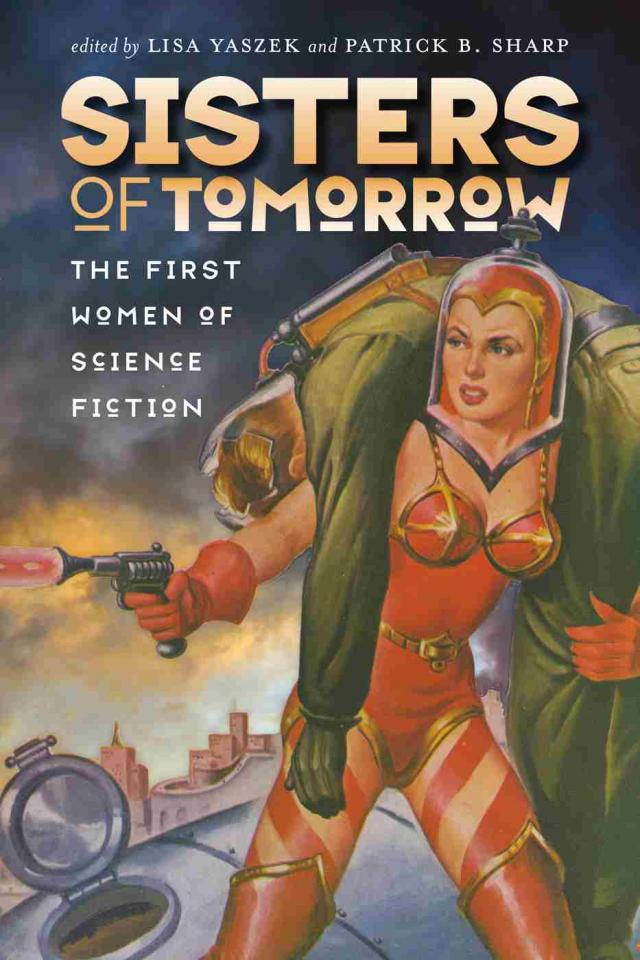
Cover illustration by Milton Luros. Appeared originally on the cover of the November 1950 issue of Future 2.4.
Lisa dedicates this book to her grandmothers, Betty Repko and Wanda Yaszek, for showing their children that women can succeed everywhere from the kitchen to the shop floor, and to her mother, Gloria Yaszek, for introducing her to science fiction and teaching her that girls can do everything boys can do—plus they get to wear both pants and skirts.
Patrick dedicates this book to his grandmother, Delpha Sharp, a riveter in the Los Angeles shipyards during World War II, and his mother, Savonia Sharp, for her unwavering support of his science fiction fandom from the beginning.
CONTENTS
List of Plates xi
Acknowledgments xiii
Introduction: New Work for New Women xv
1. AUTHORS 1
Clare Winger Harris 8
“The Evolutionary Monstrosity” (1929) 9
Leslie F. Stone 26
“Out of the Void” (1929) 27
Lilith Lorraine 106
“Into the 28th Century” (1930) 108
L. Taylor Hansen 142
“The Man from Space” (1930) 144
C. L. Moore 164
“Shambleau” (1933) 166
Dorothy Gertrude Quick 191
“Strange Orchids” (1937) 192
Amelia Reynolds Long 212
“Reverse Phylogeny” (1937) 213
Leslie Perri 223
“Space Episode” (1941) 224
Dorothy Louise Les Tina 230
“When You Think That … Smile!” (1943) 231
2. POETS 237
Julia Boynton Green 242
“The Night Express” (1931) 243
“Evolution” (1931) 244
“Radio Revelations” (1932) 244
Virginia Kidd 247
“Untitled” (1933) 248
Leah Bodine Drake 249
“They Run Again” (1939) 250
“The Wood-Wife” (1942) 251
“Sea-Shell” (1943) 252
Tigrina 253
“Defiance” (1945) 254
“Affinity” (1945) 255
Lilith Lorraine 256
“Earthlight on the Moon” (1941) 257
“The Acolytes” (1946) 257
“Men Keep Strange Trysts” (1946) 258
3. JOURNALISTS 259
Ellen Reed, Fran Miles, Henrietta Brown,
Lynn Standish, and Laura Moore Wright 265
Ellen Reed, “Natural Ink” (1942) 267
Fran Miles, “Oil for Bombing” (1944) 267
Henrietta Brown, “Marine Engineering in the Insect World” (1945) 268
Lynn Standish, “The Battle of the Sexes” (1943) 269
Lynn Standish, “Scientific Oddities” (1945) 271
Laura Moore Wright, “Sunlight” (1946) 273
L. Taylor Hansen 275
“Scientific Mysteries: The White Race—Does It Exist?” (1942) 278
“Scientific Mysteries: Footprints of the Dragon” (1944) 282
H. Malamud, I. Berkman, and H. Rogovin, “A Protest” (1943) 286
L. Taylor Hansen, “L. Taylor Hansen Defends Himself” (1943) 288
4. EDITORS 290
Mary Gnaedinger 301
“Editorial Note” (1939) 302
“The Editor’s Page” (1940) 303
“The Editor’s Page” (1943) 304
Dorothy Stevens McIlwraith 306
“The Eyrie” (1940) 308
“The Eyrie” (1940) 308
“The Eyrie” (1941) 312
Lilith Lorraine 314
“Cracks—Wise and Otherwise” (1943) 315
“Training for World Citizenship” (1946) 315
“The Story of Different” (1950) 320
5. ARTISTS 331
Olivette Bourgeois 336
Lucille Webster Holling 337
Margaret Johnson Brundage 338
Dorothy Louise Les Tina 341
Dolly Rackley Donnell 342
Conclusion: Challenging the Narrative,
Or, Women Take Back Science Fiction 343
Kathleen Ann Goonan
Notes 363
Bibliography 371
Index 383
Color plates follow page 334
PLATES
5.1.
Cover of the Black Cat by Olivette Bourgeois for the January 1917 issue
5.2.
Cover of Oriental Stories by Lucille Webster Holling for the Autumn 1931 issue
5.3.
Cover of Weird Tales by Margaret Brundage for the October 1934 issue
5.4.
Cover of Weird Tales by Margaret Brundage for the April 1935 issue
5.5.
Cover of Weird Tales by Margaret Brundage for the March 1937 issue
5.6.
Interior art by Margaret Brundage for the April 1945 issue of Fantastic Adventures
5.7.
Interior art by Dorothy Les Tina for the December 1942 issue of Future Fantasy and Science Fiction depicting a scene from “The Leapers,” by Carol Grey (pseudonym of Robert A. W. Lowndes)
5.8.
Interior art by Dorothy Les Tina for the December 1942 issue of Future Fantasy and Science Fiction depicting a scene from the John B. Michel story “Claggett’s Folly”
5.9.
Interior art by Dolly Donnell for the Summer 1944 issue of Thrilling Wonder Stories
ACKNOWLEDGMENTS
First and foremost, Lisa Yaszek wants to thank Doug and Case Davis for their love, support, and sharp editorial eyes—you guys are the best! As a close second, Lisa thanks her colleagues at Georgia Tech for every kind of support possible. She is particularly grateful to Nihad Farooq, Narin Hassan, Carol Senf, Jay Telotte, and Kathy Goonan for provocative conversations about science fiction (SF) across media and in relation to other generic forms; Adam Le Doux, Matt Guzdial, and everyone else at the Sci Fi Lab on 91.1 FM WREK radio for providing airtime to discuss this project; Shawn Sorenson, Paul Zaitsev, Keith Johnson, and Lorin Young for tracking down amazing stories and weird tales about the women featured in this anthology; Whitney Rusedale and Amelia Shackleford for heroic typesetting and database compilation efforts; and, as always, Katharine Calhoun, Shirley Dixon, and all the people of Georgia Tech’s Interlibrary Loan
Program for service above and beyond the call of duty. Lisa also thanks the Center for the Study of Women, Science, and Technology and the Ivan Allen College for funds to support both her own and her students’ research. The women of early SF believed that educated men and women could work together to build better futures; you all are collective proof that this is happening today, in our own present.
Patrick wants to thank Sharon Sharp for her love and support and for her invaluable insights on art history and SF in visual culture. He certainly owes her those future trips to Ireland and Italy. Patrick also thanks his colleagues at California State University, Los Angeles (CSULA)—particularly the faculty of the Liberal Studies Department and the program in Women, Gender, and Sexuality Studies—for their support and encouragement of SF in the curriculum and on campus. Patrick appreciates the financial support of Dean Peter McAllister and the American Communities Program at CSULA during the various stages of this project. Patrick is thankful for the students, staff, and community members at EagleCon for their enthusiasm and support for this anthology. Patrick would like to acknowledge the CSULA librarian Romelia Salinas for her assistance with chasing down images used in this volume, as well as Romelia’s colleagues Brian Miller at Ohio State University and Tim Edward Noakes at Stanford University. Patrick also thanks Sara Stilley in Special Collections at the library of the University of California, Riverside for her assistance in getting high-quality reproductions from the holdings of the Eaton Collection. Special thanks go to CSULA alumnus Gerrymi Bernardo for his work in preparing the images for publication. For their assistance with research and typesetting, Patrick would like to thank Michelle Blackwell, Marissa Elliott-Baptiste, Jeffery Anderson, and Joe Aragon.
Lisa and Patrick also want to recognize the support they have received from the greater SF community. Lisa is particularly grateful to Bob Weinberg of Argosy Communications, Vaughne Hansen of the Virginia Kidd Literary Agency, and Cristina Concepcion of Don Congdon Associates, Inc. for reprint permissions and to Ron Unz of Unz.org, Patrick Belk and Nathan Madison of the Pulp Magazines Project, Bud Webster of the Science Fiction and Fantasy Writers of America’s estates project, and Johnny Pez of Johnnypez9.blogspot.com for generously sharing their time and expertise regarding early SF copyright. Both Lisa and Patrick thank Melissa Conway, Rob Latham, and Sherryl Vint at the University of California, Riverside and Andy Sawyer and David Seed at Liverpool University for ensuring that their research trips to these two institutions were both fun and productive. Lisa and Patrick also thank the Science Fiction Research Association for providing seed funds to begin this project, as well as conference and print venues in which to share ideas about women’s work in SF, the SF archive, and the digital turn in SF studies with others.
Finally, Lisa and Patrick thank the entire editing and production staff associated with Wesleyan University Press. We are particularly grateful to Parker Smathers for guiding us through the writing and production process; Suzanna Tamminen for feedback on the book title and cover image; and Susan Abel and Mary Becker for their sharp (and impassioned!) editorial eyes. Lisa and Patrick are also grateful to Joanne Sprott of Afterwords Editorial Services for her indexing services. We hope that our readers enjoy this book as much as we’ve enjoyed working with you to make it happen.
INTRODUCTION
NEW WORK FOR NEW WOMEN
In a 1974 speech delivered to the Baltimore Science Fiction Society, Leslie Frances Silberberg—better known to science fiction (SF) fans by her pen name, Leslie F. Stone—cheerfully noted that “while I cannot claim myself as the pioneer SF woman, since Mary Wollstonecraft Shelley beat me to it in 1818 with Frankenstein … I do happen to be one of the first woman writers in the fantasy pulps” (Stone, “Day” 100). As an author in the “fresh and new” genre magazine community of the early twentieth century, Stone was able to accomplish a number of firsts, including the creation of the first woman astronaut, the first black hero, and the first alien civilization to win a war against human characters (100). These innovations did not go unnoticed. Fans debated the merits of Stone’s action-packed but socially provocative stories in the letters pages of the early SF magazines, and at least one such fan—a young man named Isaac Asimov—was so inspired by her 1936 story “The Human Pets of Mars” that he “decided to try, for the very first time, [writing] science fiction” (Asimov, Before 773).
While Stone was one of the first women in “the fantasy pulps,” she most certainly was not alone. More than 450 known women published SF in professional and amateur venues between 1926, when Hugo Gernsback created the first dedicated SF magazine, and 1945, when the end of World War II ushered in a new constellation of practitioners and periodicals. As such, they made up approximately 16 percent of the SF community in the first two decades of its formal existence.1 Most of these women (like their male counterparts) were fiction writers. However, they took on work as SF artists, poets, journalists, and editors as well.2 In doing so, they helped shape their chosen genre at a critical moment when its meaning and value were hotly debated throughout the nascent SF community. Sisters of Tomorrow: The First Women of Science Fiction is an introduction to their collective accomplishments.
So who were these women? Most were born and raised at the turn of the century, when progressive political ideals—including first-wave feminism—were opening new doors for women as social, economic, and even sexual subjects. In many ways they were exemplars of the “New Woman.” As the U.S. public intellectual Randolph Bourne put it in a 1915 letter, such women “are all social workers, or magazine writers…. They have an amazing combination of wisdom and youthfulness, of humor and ability, and innocence and self-reliance, which absolutely belies everything you will read in the storybooks or any other description of womankind. They are of course all self-supporting and independent, and they enjoy the adventure of life; the full, reliant, audacious way in which they go about makes you wonder if the new woman isn’t to be a very splendid sort of person” (qtd. in Stansell, 231). This was certainly true of the two dozen women featured in this anthology, who embraced their work as writers, artists, and editors. The author L. Taylor Hansen, the poet Leah Bodine Drake, and the editors Mary Gnaedinger and Dorothy Mc-Ilwraith spent decades in the SF community, while the author/poets-turned-editors Lilith Lorraine and Virginia Kidd dedicated their entire lives to their chosen genre. Clare Winger Harris and C. L. Moore received awards for writing excellence from their peers in SF and fantasy, while Drake and Lorraine earned numerous poetry prizes and the fan poet Tigrina (the pen name of journalist and folk singer Edith Eyde) was inducted into the Lesbian Hall of Fame for her pioneering work in gay news reporting.
The first women of SF were New Women in other ways as well. Most were middle class and white, with the notable exceptions of Lorraine and Hansen, who proudly claimed Indigenous American ancestry. Many achieved independence through education: more than half the women featured in this anthology attended art school or college, and Hansen and Long pursued graduate work as well. Still others, including Hansen, Harris, the author/illustrator Dorothy Les Tina, and the poet Julia Boynton Green, pursued “the adventure of life” through extensive travel across North America, Mexico, Europe, Greece, and Egypt. The adventure continued for some in second careers outside the SF community: Gnaedinger and Tigrina worked as journalists; Les Tina wrote domestic and children’s fiction; Moore taught creative writing and produced television scripts; the writer Leslie F. Stone was a prize-winning gardener and ceramicist who also worked at the National Institutes for Health; and the author Amelia Reynolds Long served as curator for Harrisburg’s William Penn Museum.
A number of these women were also social activists who connected their art to their politics. The artist Margaret Brundage participated in the Chicago African American arts movement, the author-turned-journalist L. Taylor Hansen encouraged Amazing editor Ray Palmer’s interest in Indigenous civil rights activism, Tigrina modeled the first U.S. lesbian newsletter on the SF fanzines published by her friend Forrest J Ackerman, and Lorraine was the first—and, as far as we can tell, only—person to have an FBI file opened for the dissemination of seditious speculative poetry. Taken together, these achievements suggest that women working in the formative years of genre fiction imagined brave new worlds in their art precisely because they were forging such worlds in their own lives.


