

Studio of screams, p.1
Studio of Screams,
p.1
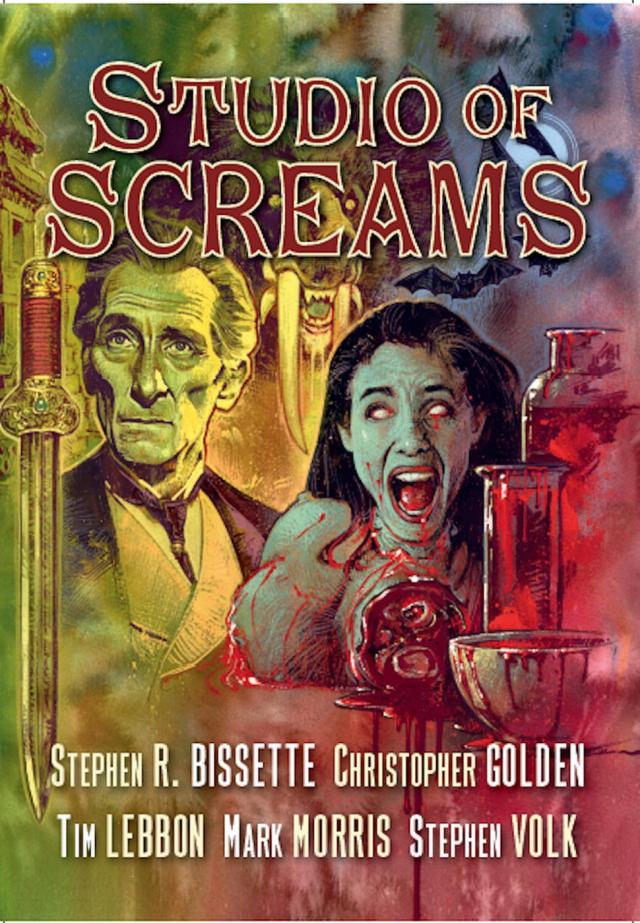


Table of Contents
Studio of Screams
PROLOGUE
SWORD OF THE DEMON
PART ONE:
PART TWO:
INTERVIEW THE FIRST:
THE DEVIL’S CIRCUS
1
INTERVIEW THE SECOND:
CASTLE OF THE LOST
INTERVIEW THE THIRD:
THE SQUEAMISH
INTERVIEW THE FOURTH:
EPILOGUE:
ACKNOWLEDGEMENTS
STUDIO OF SCREAMS
STEPHEN R. BISSETTE
CHRISTOPHER GOLDEN
TIM LEBBON
MARK MORRIS
STEPHEN VOLK
PROLOGUE
A COAT OF ARMS
STEPHEN R. BISSETTE
MY FIRST MOVIE theater experience with Blythewood—a moniker I had no reason to associate with anything, really—was at a children’s matinee my stepmother had dumped me and my older stepbrother Ralph off to see back in the early 1980s. It was one of those mall cineplexes situated next to a gaming arcade, which is where we were to meet Mom after the show.
Having entrusted Ralph with money for movie popcorn, soda, and a couple of videogames after the show, but not trusting Ralph enough to purchase our tickets for the matinee herself, she confirmed with the spotty-faced teenager at the concessions counter what time the second feature concluded. Mom then set the time we were to be picked up, and we were not to be late. She then hustled away, leaving Ralph somewhat forlornly in charge of little old me.
After staring longingly at the lobby poster for the movie he wished we were seeing—a Clint Eastwood outing called FIREFOX—and making sure no one he knew was in eyeshot, Ralph grudgingly saw to our purchase of two jumbo popcorns, two oversized sodas, and a couple boxes of Juicyfruits before ushering the pair of us into our designated destination: a double-bill of MOLLY & ME and DIGBY, THE BIGGEST DOG IN THE WORLD. Both were older movies from the 1970s, trotted back out as cheapjack kiddy matinee fodder as schools were closing that June of ’82. The talking cat movie, MOLLY & ME, was shown first.
Like the Hercules and Sons of Hercules movies I’d seen on TV, the words being spoken didn’t quite match the characters’ lip movements: the film had been redubbed with American voices (apparently the US distributor considered the original cast’s British accents an offense or obstacle for potential American audiences). Though I couldn’t have articulated it at the time, my recall now is that both movies looked more than a bit washed-out and tattered: the soundtrack crackled and popped unexpectedly, the action was interrupted at times by odd leaps forward (indicative of clumsy splicing of, and missing footage from, the well-traveled prints), and the giant-sheepdog fun of DIGBY was marred by a dancing bright green line that wiggled about the picture for most of the beginning, returning for an annoying encore in time for the finale, in which the military (looking not at all like American soldiers: they were the British military, natch) try to destroy Digby with artillery firepower.
After the previews (including, much to Ralph’s continuing agony, one for FIREFOX, which indeed looked wwwaaaaaayyyyy more exciting than what we were about to suffer) and the “And Now Our Feature Presentation” onscreen fanfare, a pair of crossed knives fell over one another against a bright red velvet backdrop, accompanied by the metallic sound of razors kissing and keening. I jumped in my seat, startled, and Ralph laughed. It was the first time I saw (and heard) the Blythewood Studios company logo blaze in full color across a movie theater screen, and it inexplicably sent my heart racing (I had seen this company imprimatur once before: in black-and-white, on television, before a World War I film my father watched one afternoon; more on that, shortly).
The film that followed—released as MOLLY & ME (a title pilfered from a 1945 Gracie Fields/Monty Wooley comedy) and THE CURIOUS CASE OF THE TALKING CAT in America, known as MOLLY’S MOGGY in its native release across the pond—was entertaining enough, chronicling the misadventures of a little girl about my age and the “haunting” of her family’s farm by a talking barn cat given to gossip about the neighbors. This leads to all manner of silly adult slapstick, from a running gag involving a mysterious ancient-looking miniature golden “treasure chest” that seemed to be the source of the talking cat’s speaking abilities, to borderline life-and-death setpieces, including a runaway tractor sent over a seaside cliff, and one harrowing sequence involving a “slurry pit” (a pit filled with brown soup that prompted Ralph to lean over to me and say, “it’s a shit pit!,” which got us both snickering, dissipating the suspense: Ralph was always good to me, in his way). The whole affair concluded with a lightning-and-rain-lashed midnight near-lynching of Molly’s kitty before the end titles. Walt Disney fare, this was not, despite the eventual obligatory happy ending (later in life, I recognized the elements in the film lifted from H. H. Munro a.k.a. Saki’s story “Tobermory,” but I didn’t back then, not as a kid—I hasten to add, Molly’s cat didn’t suffer the fate of Saki’s Tobermory).
I mentioned earlier my having seen the Blythewood Studios company logo once before the MOLLY & ME matinee. I’d seen it on television one Sunday afternoon, in black-and-white, not in color, heralding the beginning of a WWI movie my father seemed quite eager to see.
Except for the peculiar opening quote the film kicks off with (on a dinner plate, of all things, posted in a position of honor on a restaurant wall, fading from the Latin text to an English translation, a prayer to St. George), ARROWS OF LIGHT (1960, original British title: MIRACLE OF THE BOWMEN) started like a number of war movies I’d caught on TV with Dad. Once the first few minutes established that the war story we were about to endure was being told by an aging veteran—moved to tell his tale by the Latin prayer on the fancy plate—the movie flashed back to the muddy trenches of WWI and the plight of the flat-helmeted “Tommies.” These British soldiers were enough to keep me watching, a novelty compared to the American grunts I was more familiar with from WWII and Korean War movies my father more often inflicted upon me. What kept my interest was the mounting intrusion of supernatural elements: a frail shell-shocked Tommy haunted by ominous premonitions of death (lots of muddy skull imagery); a sequence in which bayonet-wielding Germans crawling beneath expanses of barbed wire appear in a waking vision as vermin (literally, shots of live rats and a scorpion or two wearing tiny German helmets and uniforms, some with little bayonet-spiked toy rifles affixed to their bellies, slinking over a miniature battlefield); and a violent rainstorm capped by a climactic vision of medieval archers firing a hail of arrows into the German ranks, as if Robin Hood and his Merry Men had suddenly usurped the climax.1
My confusion over all this prompted a lengthy sit-down with my father who patiently explained this was a true story, which only elevated the experience out of the realm of “what a weird war movie” to something like a confounding, blessed event.
I didn’t know it at the time, but I’d just savored my first dose of Blythewood Studios blood-and-thunder. MOLLY & ME was my second experience, and I was inexplicably hungry for more.
MIRACLE OF THE BOWMEN was one of a trio of low-budget war films Blythewood had completed in the early 1960s. All were incredibly cheapjack affairs, constructed around as much vintage newsreel footage and purchased war footage from better-funded older movies, but they had a morbid conviction to them and some startlingly bizarre imagery.
MOLLY’S MOGGY was one of Blythewood’s stabs at family fare dating from the early 1970s. Filmed in 1970 on the Isle of Man and released in the UK about a year before DIGBY, MOLLY’S MOGGY was the sort of fare Blythewood depended upon for their bread-and-butter, much as the now-revered Hammer Films coffers were utterly dependent upon their ON THE BUSES comedies, spin-offs from the popular ITV comedy TV series set on and about the famed double-decker buses, chronicling the hijinks of their drivers and conductors. The ON THE BUSES films were boxoffice smash-hits in the UK, but they were never shown in the United States. Blythewood was similarly dependent on feature film TV spinoffs and comedies—movies that simply didn’t “translate” into American markets—that were moneymakers in the UK, Australia, and New Zealand, sometimes in Canada, but remained largely unknown and unshown in America. MOLLY’S MOGGY a.k.a. MOLLY & ME had somehow slipped in under the cover of pre-E.T. matinee fodder, scoring sporadic playdates across the country from 1974 well into the 1980s. Theaters glommed onto such titles as flat-fee rentals, dirt-cheap, counting on popcorn and concession sales to boost revenues on otherwise lazy weekend afternoons.
Don’t let all that distract you, however. For over a decade, Blythewood were far better known for something else. To a select group of fans here in the States, the crossed-blade Blythewood logo primarily meant one thing: Blythewood Bloodshed.
After the late 1950s/1960 war trilogy, a couple of pirate movies, a spate of cloak-and-dagger adventure thrillers, and one miserly Arthurian opus, and just before their easing into non-controversial 1970s family fare, Blythewood spilled gallons upon gallons of stage blood in a procession of provocative horror and borderline-horror exploitation films. Beginning with the comparatively tame (compared, that is, to Blythewood’s subsequent films) ASHES TO ASHES (1963, released stateside three years later as BLACK OF NIGHT), Blythewood became one of the most extreme providers of imported horrors, willing to indulge more adult themes and imagery in ways only Italian filmmakers seemed equally eager to exploit. For attentive genre fanatics like myse
lf, the crossed knives against the red backdrop meant we were in for something heavier than Hammer Films or their competitors seemed to offer: more buxom women in period garb than in other British imports, more intricately sadistic twists and turns in the stories, more inventive use of medieval weaponry and implements of torture, and much more savage explosions of horror—the gorier, the better.
Beginning with their production of war films, Blythewood evidenced another distinctive attribute. A pronounced and at times very unusual attention to historical accuracy set Blythewood apart: press releases promoting their films claimed that a sibling of Blythewood’s founder-producer was an archeologist, often consulted, suggesting and approving locations, and even providing ancient artefacts (for recreation by the prop department, or for actual onscreen appearances and action) to lend more “authenticity” to Blythewood’s period horrors. Certain props were almost fetishized onscreen, lingered over in closeups, often commented upon in the film dialogue (including the repeated use of the archaic miniature “treasure-chest” that played a part in MOLLY’S MOGGY).
By upping the implicit and explicit mayhem and overt perversities onscreen, Blythewood competed for a time with the likes of Hammer Films and Amicus Studios, as well as the British studios and non-studios whose names didn’t register at the time as brand-names: Anglo-Amalgamated, Tigon, the short-lived Tyburn, producers like Richard Gordon, the occasional horror from production outfits like the Danziger Brothers, Robert Baker and Monty Berman, and so on. Quite unlike the cozy familiarity bases like Bray Studios gave the classical Hammer outings, Blythewood thrived upon its rootlessness as much as its narrative ruthlessness: the always-changing locations and atmospheric environs lent each individual Blythewood movie its own distinctive regional flair and flavor, and one rarely saw a repeat performer in the casts.
Seen over time, the Blythewood films provided an impromptu snapshot of places all over the United Kingdom, framing the far corners and depths of the UK amid their always-exploitation-savvy titles and tales. The faces in the crowds seen in Blythewood films were the faces of locals (usually sporting ill-fitting wigs and costumes), the voices and accents varied and largely unfamiliar to American ears, and this, too, set their films apart. In more ways than one can easily summarize, Blythewood proved to be more of a chameleon than any other transatlantic studio of its era, shifting with the mercurial cultural and pop-cultural winds of the 1960s and early 1970s with more ease and accuracy than their more renowned competitors.
Why, then, are the films of Blythewood so impossible to see today?
Rumors abound that the mysterious head of Blythewood Studios pulled the films out of circulation in the 1980s and destroyed all prints after relocating to Canada.
If true, Blythewood isn’t particularly unique in this regard. Horror fans still gnash their teeth and tear their clothing over the fate of the vital elements (including the original negative and interpositives) of as prominent a cinematic landmark as THE WICKER MAN (1973), reportedly buried beneath the M4 motorway by vindictive EMI and British Lion executives who personally reviled the film. There are less celebrated, less visible examples: British producer-director Robert Hartford-Davis was so despondent over the backlash against his 1972 NOBODY ORDERED LOVE that he eventually withdrew from the industry, moved to America, and ordered all the elements and prints of his body of work destroyed upon his death, which came in 1977. While elements of Davis’s genre features—THE BLACK TORMENT (1964), CORRUPTION (1968), INCENSE FOR THE DAMNED (1971), THE FIEND (1972)—thankfully have survived, NOBODY ORDERED LOVE is indeed now a lost film, apparently irretrievably gone, as if it had never existed, leaving only the promotional materials as evidence of its release.
Such was the case with Blythewood—but not with one film: the whole of Blythewood’s output vanished completely.
In terms of British cinema, the published histories have long shunned the exploitation fare that sustained the various incarnations of the British film industry, prominent among them Hammer Films. David Pirie’s seminal 1973 A Heritage of Horror was the rehabilitative text that wedged Hammer and certain critically reviled filmmakers (Terence Fisher, Michael Reeves, etc.) into any future critical texts. Since that time, even the likes of the obscure Danziger Studio have enjoyed DVD or Blu-ray studio resurrections for diehard fans.
But I cannot think of a single motion picture studio or company before Harvey Weinstein’s that has been so utterly “wiped” from any and all histories the way Blythewood has been. While there are many corporate-era orphans—cinematic bodies of work that have or would have lapsed into public domain long ago, studio productions abandoned and lost to neglect with no surviving heirs or owners to maintain (much less promote, repackage, and keep bringing to market) legacies—Blythewood is different. Blythewood seems to have been deliberately and aggressively obfuscated and obliterated.
Attempts to mount film festival retrospectives and various revivals have all been discouraged by the apparent inaccessibility of 35mm prints, with only the occasional random home video release in other international markets—murky pan-and-scan Beta, PAL, and VHS video transfers cut-and-dubbed for regional release, the original English soundtracks supplanted with foreign language tracks: Dutch, German, Malaysian, Greek—offering what little exposure the Blythewood product has had over the past few decades. Over time, bootlegs of Blythewood titles commanded high prices in the “gray” collectors market; the risks, dealers whispered, were considerable, the punishment more Draconian than those suffered by those trafficking in Video Nasty list titles in the UK back in the 1980s, or selling bootleg Disney SONG OF THE SOUTH and SNOW WHITE videocassettes in the US. Someone, somewhere, was prosecuting any “leaks” in the Blythewood self-banishment in North America and the UK. Police busted a “video nasty” dealer who advertised in the fanzine Samhain only after a Blythewood title popped up in their list; that was that, they were gone from the zine’s pages for good. Two video dealers were arrested at a Midwest US convention, and one of them soon disappeared from the convention scene altogether; the other opened a tobacco shop, avoiding the convention scene and refusing any and all overtures for interviews or information. A Canadian label proprietor who dared to list two Blythewood titles in his catalogues was prosecuted and did jail time—or so it was said.
More curious still, there are very few traces of Blythewood’s product even on the internet. There’s nothing on Youtube, not even preview trailers, and nothing on the various illegal streaming sites that thrive on providing illicit access to forbidden films. It’s as if the kind of censorship that constrains access to the world-wide web in countries like China and North Korea had extended their reach across all continents and targeted Blythewood as something to be blasted from memory, scorched out of existence, and even sowing salt over whatever vestige remained of its obscure but once-fertile legacy.
It wasn’t just my own fan-flamed memories of the Blythewood Studio films I’d seen growing up, or my own curiosity, that prompted my tracking down any surviving participants in, or players for, Blythewood.
It was my work as a university professor, preparing a few years ago what would (by 2018 and after) become a controversial class on “Cancel Culture” or “Sandblasting Pop”—subtitled, in either case, “Expunging & Expunged Pop Culture”—that led to my research and the pilgrimage that eventually led me to an afternoon sit-down with the former head of Blythewood Studios in a remote corner of Quebec.
In terms of the class requirements, my meeting with Blythewood’s surviving co-founder was uneventful and inconsequential. Simply put, while the meeting more than satisfied my own curiosity about Blythewood—it did, in fact, put me off ever wanting to know more—I wasn’t permitted to bring any evidence of Blythewood’s legacy into the classroom.
I wouldn’t have, either, even if there had been some way to...
But I am getting ahead of myself. Before I was done writing the initial syllabus, I’d poured over six years of work into preparations before the first class convened. In short, my class was to offer an overview of once-essential pop culture artefacts by creative individuals whose pop images and/or real-life politics, actions, and/or outrages/crimes resulted in their work being “expunged” and rendered unpalatable. The new 20th and 21st century blacklists, in other words. I began by formulating an “A” list in infamy—Fatty Arbuckle, Charlie Chaplin, Ingrid Bergman, the infamous HUAC blacklists, Alan Freed, Chuck Berry, Jerry Lee Lewis, Stepin Fetchit, Mantan Moreland, Roman Polanski, Pee Wee Herman, Woody Allen, Victor Salva, The Dixie Chicks (with mention of the 1960s Beatles record burnings), Don Imus, Jimmy Savile, Rolf Harris, Gary Glitter (Operation Yewtree investigations, Oct. 2012), Charlie Rose, Garrison Keillor, Al Franken, Kevin Spacey, Bill Cosby, Louis C.K., Roseanne Barr, Harvey Weinstein (Miramax/Weinstein Company), John Kricfalusi, R. Kelly, Michael Jackson, etc.—the list goes on and on. I persevered, building upon that initial list to create a curriculum and concoct a syllabus.


