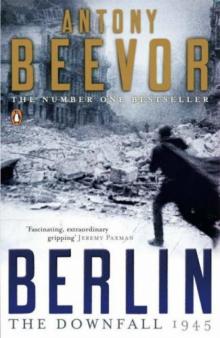
Berlin the downfall 1945, p.10
Berlin: The Downfall 1945,
p.10


Even General von Seydlitz, who had proposed the airlift of anti-Nazi German prisoners of war to start a revolution within the Reich, thought that ‘the ripping away of German lands to create a safety barrier will not be fair’. All the captured generals now realized that the anti-Nazi League of German Officers had just been exploited by the Soviet Union for its own ends. ‘I am tormented by a terrible anxiety,’ said Seydlitz, ‘whether we have chosen the right course.’ The Nazi regime had labelled him ‘the traitor Seydlitz’ and condemned him to death in absentia.
‘All Hitler thinks about,’ said Paulus, ‘is how to force the German people into new sacrifices. Never before in history has lying been such a powerful weapon in diplomacy and policy. We Germans have been cunningly deceived by a man who usurped power.’
‘Why has God become so angry with Germany,’ replied Strecker, ‘that he sent us Hitler! Are the German people so ignoble? Have they deserved such a punishment?’
‘It is two years since the Stalingrad catastrophe,’ said Paulus. ‘And now the whole of Germany is becoming a gigantic Stalingrad.’
Himmler’s threats and exhortations did nothing to save the situation. That very night Soviet rifle battalions led by Colonel Esipenko, the deputy commander of the 89th Guards Rifle Division, reached the Oder and crossed the ice during darkness. They fanned out, forming a small bridgehead just north of Küstrin.
Berzarin’s men from the 5th Shock Army crossed the frozen Oder early on the morning of Sunday 31 January, and entered the village of Kienitz. They had crossed the ice following the tracks of farmers who had been collecting firewood on the eastern bank. Only the baker and his assistant were awake. The Soviet troops under Colonel Esipenko captured a train with six anti-aircraft guns, thirteen officers and sixty-three young conscripts from the Reich Labour Service. A small group, clad in no more than the clothes in which they had been sleeping, managed to escape across the snowfields to warn the nearby town of Wriezen of the enemy coup de main. Soviet troops were now within seventy kilometres of the Reich Chancellery.
On the same day, just south of Küstrin, the ebullient Colonel Gusakovsky crossed the Oder with his 44th Guards Tank Brigade, forming another bridgehead. He thus won his second gold star of Hero of the Soviet Union. Soviet troops on both bridgeheads immediately began digging trenches in the frozen marshy ground of the Oderbruch, the Oder flood plain between the river and the Seelow Heights. Artillery regiments were rushed forward to give them support. They expected a rapid and furious counter-attack, but the Germans were so shaken by what had happened — Goebbels was still trying to pretend that fighting was going on close to Warsaw — that it took them time to rush in sufficient ground forces. Focke-Wulf fighters, however, were in action over the Oder the following morning, strafing the freshly dug trenches and anti-tank gun positions. The Soviet anti-aircraft division which had been promised did not turn up for three more days, so Chuikov’s men, laying ice tracks across the thinly frozen river, were extremely vulnerable. They managed nevertheless to pull anti-tank guns across on skis to defend their positions.
The news of Soviet bridgeheads across the Oder was just as much of a shock to soldiers as to local civilians. Walter Beier, who had been spared from the Feldgendarmerie’s trawl of leave-takers on the train from East Prussia, was enjoying his last days at home on the Buchsmühlenweg, between Küstrin and Frankfurt an der Oder. ‘Happiness in the bosom of the family did not last long,’ he recorded. On the evening of 2 February an agitated neighbour came running to the house to say that about 800 Russians had taken up position in an oak wood only 500 metres away.
There were no troops in the area except for a few Volkssturm companies armed with nothing more than rifles and a couple of panzerfausts. Commanded by an old headmaster, they kept their distance. They found that Soviet snipers had climbed into the oak trees. An alarm battalion of anti-Soviet Caucasians, stiffened with some Germans from the 6th Fortress Regiment, was hurried to the spot from Frankfurt. Beier, as a frontline soldier, was put in charge of a group by an officer.
While Beier was observing the wood with them from a ditch, one of the Caucasians pointed at it and said in broken German, ‘You no shoot, we no shoot there. We no shoot at comrades.’ Beier reported this and the Caucasians were disarmed and sent back from the front line to dig trenches instead. Their fate, when captured later by the Red Army, would not have been softened by this refusal to fire at their own countrymen.
The scratch German force was joined by a group of very young trainee soldiers of the Panzergrenadier Division Feldherrnhalle. Most of them were between sixteen and eighteen years old. They began to mortar the oak wood, one of the few patches of deciduous woodland in the area. There were around 350 of them in a chaotic array of uniforms. Some had steel helmets, some had Käppis, or sidehats, others wore peaked caps. Many had nothing more than their Hitler Youth uniforms. They were intensely proud of their task, yet many of them could hardly pick up a full ammunition box, and they could not hold the rifles properly into the shoulder, because the butts were too long for their arms. On their first attack, the Soviet sharpshooters picked them off with deliberate aim. The unit commander fell with a bullet through the head. Only a handful of the soldiers returned alive.
Beier managed to slip back to his parents’ house. He found that a dressing station had been set up in the cellar and all their sheets were being torn up for bandages.
More weighty reinforcements arrived to attack the bridgehead as Chuikov’s men pushed forward to seize the Reitwein Spur, a commanding feature which looked up the whole Oderbruch and across to the Seelow Heights on its western edge. On 2 February the 506th SS Heavy Mortar Battalion moved north to the edge of the bridgehead and in three days and nights it fired 14,000 rounds. A battalion of the Kurmark Panzer Regiment was also brought up. On 4 February the battalion, recently re-equipped with Panther tanks, was sent in to attack the Reitwein Spur from its southern end. The tanks, however, failed disastrously because the thaw predicted by meteorologists had started, and they slipped and slithered on the muddy hillsides.
* * *
News of Red Army troops crossing the Oder shocked Berlin. ‘Stalin ante portas!’ wrote Wilfred von Oven, Goebbels’s press attaché, in his diary on 1 February. ‘This cry of alarm runs like the wind through the Reich capital.’
National Socialist rhetoric became fanatical, if not hysterical. The guard regiment of the Grossdeutschland Division was paraded. They were told that the Oder bridgeheads must be recaptured for the Führer. Berlin city buses drove up and they were taken out to Seelow, over-looking the Oderbruch.
A new SS Division was also formed. It was to be called the 30. Januar in honour of the twelfth anniversary of the Nazis taking power. This division was given a core of SS veterans, but many of them were convalescent wounded. Eberhard Baumgart, a former member of the SS Leibstandarte at a recuperation camp, received orders to parade along with the other SS invalids. An Obersturmführer told them of the new division. Its task was to defend the Reich’s capital. The new division needed battle-hardened veterans. He called on them to volunteer and yelled the SS motto devised by Himmler at them: ‘Unsere Ehre heisst Treue, Kameraden!’ — ‘Our honour is called loyalty.’
Such fanaticism was becoming rare, as senior members of the SS recognized with alarm. On 12 February, Obergruppenführer Berger reported to Himmler that the organization was becoming thoroughly disliked both by the civil population and by the army, which strongly resented its ‘marked uncomradely attitude’. The army, he concluded, was ‘no longer on speaking terms with the SS’.
Even SS volunteers felt enthusiasm dissolving when they reached the Oderbruch, a dreary expanse of waterlogged fields and dykes. ‘We’re at the end of the world!’ one of the group earmarked for the 30. Januar announced. They were even more dispirited to find that this new formation had no tanks or assault guns. ‘This is no division,’ the same man remarked, ‘it’s a heap that’s just been scraped together.’ Because of his unhealed wounds, Baumgart was attached as a clerk to divisional headquarters, which was established in a requisitioned farmhouse. The young wife of a farmer, who was serving somewhere else, watched in a daze as their furniture was manhandled out of the parlour and field telephones and typewriters were installed. The new inhabitants soon discovered, however, that the tile-roof of the farmhouse provided a clearly visible target for Soviet artillery.
Baumgart found himself hunched over one of the typewriters, bashing out reports of interviews with three Red Army deserters. They had apparently decided to cross to the German lines after being made to wade through the icy waters of the Oder, carrying their divisional commander on their shoulders to keep him dry. The Volga German interpreters at divisional headquarters later read out articles from captured copies of Pravda. The communiqué published at the end of the Yalta conference described what the allies intended to do with Germany. The idea of defeat appalled Baumgart and his comrades. ‘We simply have to win in the end!’ they said to themselves.
On 9 February 1945, the anti-Soviet renegade General Andrey Vlasov, with Himmler’s encouragement, threw his headquarters security battalion into the bridgehead battle. This Russian battalion, as part of the Döberitz Division, attacked the Soviet 230th Rifle Division in the bridgehead just north of Küstrin. Vlasov’s guard battalion fought well, even though the attempt was unsuccessful. The German propaganda account described them as fighting with ‘enthusiasm and fanaticism’, proving themselves as close-quarter combat specialists. They were supposedly given the nickname ‘Panzerknacker’ by admiring German units, but this may well have been the touch of a popular journalist turned propagandist. Their commander, Colonel Zakharov, and four men received the Iron Cross second class, and the Reichsführer SS himself sent a message to congratulate Vlasov ‘with comradely greetings’ on the fact that his guard battalion had ‘fought quite outstandingly well’.
Such marks of favour to those who had previously been categorized and treated as Untermenschen was a good indication of Nazi desperation, even if Hitler himself still disapproved. On 12 February, Goebbels received a delegation of Cossacks ‘as the first volunteers on our side in the battle against Bolshevism’. They were even treated to a bottle of ‘Weissbier’ in his offices. Goebbels praised the Cossacks, calling them ‘a freedom-loving people of warrior-farmers’. Unfortunately, their freedom-loving ways in north Italy brought to Berlin bitter complaints about their treatment of the population in the Friuli district from the German adviser for civil affairs. The Cossacks, however, refused to have anything to do with Vlasov and his ideas of old Russian supremacy, as did most of the SS volunteers from national minorities.
The Führer’s response to the onrush of Soviet tank brigades towards Berlin had been to order the establishment of a Panzerjagd Division, but in typical Nazi style, this impressive-sounding organization for destroying tanks failed to live up to its title. It consisted of bicycle companies mainly from the Hitler Youth. Each bicyclist was to carry two panzerfaust anti-tank launchers clamped upright either side of the front wheel and attached to the handlebars. The bicyclist was supposed to be able to dismount in a moment and be ready for action against a T-34 or Stalin tank. Even the Japanese did not expect their kamikazes to ride into battle on a bicycle.
Himmler talked about the panzerfaust as if it were another miracle weapon, akin to the V-2. He enthused about how wonderful it was for close-quarter fighting against tanks, but any sane soldier given the choice would have preferred an 88mm gun to take on Soviet tanks at a distance of half a kilometre. Himmler was almost apoplectic about rumours that the panzerfaust could not penetrate enemy armour. Such a story, he asserted, was ‘ein absoluter Schwindel!’.
With the enemy so close, it appears that the Nazi leadership had started to consider the possibility of suicide. The headquarters of Gau Berlin issued an order that ‘political leaders’ were to receive top priority for firearms certificates. And a senior executive in a pharmaceutical company told Ursula von Kardorff and a friend of hers that a ‘Golden Pheasant’ had appeared in his laboratory demanding a supply of poison for the Reich Chancellery.
Hitler and his associates now finally found themselves closer to the very violence of war which they had unleashed. Revenge for the recent executions of men associated with the July plot arrived in unexpected form less than two weeks after the event. On the morning of 3 February, there were exceptionally heavy US Air Force raids on Berlin. Some 3,000 Berliners died. The newspaper district, as well as other areas, was almost totally destroyed. Allied bombs also found Nazi targets. The Reich Chancellery and the Party Chancellery were hit and both Gestapo headquarters in the Prinz-Albrechtstrasse and the People’s Court were badly damaged. Roland Freisler, the President of the People’s Court, who had screamed at the accused July plotters, was crushed to death sheltering in its cellars. The news briefly cheered dejected resistance circles, but rumours that concentration camps and prisons had been mined made them even more alarmed for relatives and friends in detention. Their only hope was that Himmler might keep them as bargaining counters. Martin Bormann in his diary wrote of the day’s air raid: ‘Suffered from bombing: new Reich Chancellery, the hell of Hitler’s apartments, the dining room, the winter garden and the Party Chancellery.’ He seems to have been concerned only with the monuments of Nazism. No mention was made of civilian casualties.
The most important event on Tuesday 6 February, according to. Bormann’s diary, was Eva Braun’s birthday. Hitler, apparently, was ‘in a radiant mood’, watching her dance with others. As usual, Bormann was conferring privately with Kaltenbrunner. On 7 February, Gauleiter Koch, apparently forgiven for having abandoned Königsberg after all his orders to shoot those who left their place of duty, had discussions with Hitler. That evening, Bormann dined at the Fegeleins. One of the guests was Heinrich Himmler, whom he, Fegelein and Kaltenbrunner were seeking to undermine. The situation at the front was disastrous, yet Himmler, although commander-in-chief of Army Group Vistula, felt able to relax away from his headquarters. After supper Bormann and Fegelein talked with Eva Braun. The subject was probably her departure from Berlin, for Hitler wanted her out of danger. The next night she held a small farewell party for Hitler, Bormann and the Fegeleins. She left for Berchtesgaden the following evening, Friday 9 February, with her sister Gretl Fegelein. Hitler made sure that Bormann escorted them to the train.
Bormann, the Reichsleiter of the National Socialist Party, whose Gauleiters had in most cases stopped the evacuation of women and children until it was too late, never mentions in his diary those fleeing in panic from the eastern regions. The incompetence with which they handled the refugee crisis was chilling, yet in the case of the Nazi hierarchy it is often hard to tell where irresponsibility ended and inhumanity began. In an ‘Evacuation Situation’ report of 10 February, they suddenly realized that with 800,000 civilians still to be rescued from the Baltic coast, and with trains and ships taking an average of 1,000 people each, ‘There are neither enough vessels, rolling stock nor vehicles at our disposal.’ Yet there was no question of Nazi leaders giving up their luxurious ‘special trains’.
6. East and West
On the morning of 2 February, just as the first German counter-attacks were launched against the Oder bridgeheads, the USS Quincy reached Malta. ‘The cruiser which bore the President,’ wrote Churchill, ‘steamed majestically into the battle-scarred’ Grand Harbour of Valetta. He went on board to greet Roosevelt. Although Churchill did not acknowledge that the President was ill, his colleagues were shaken to see how exhausted he looked.
The reunion between the two men was friendly, if not affectionate, yet Churchill’s foreign secretary, Anthony Eden, was worried. Tension had continued to grow between the Western Allies over the invasion of Germany from the west. Now they were about to fly to Yalta in the Crimea to decide the post-war map of central Europe with Stalin. They were divided on this too, while the Soviet leader knew exactly what he wanted. Churchill and Eden were most concerned about the independence of Poland. Roosevelt’s main priority was the establishment of the United Nations for the post-war world.
In separate aircraft, the President and the Prime Minister took off in the early hours of 3 February. Escorted by long-range Mustang fighters, and with no cabin lights showing, they flew east towards the Black Sea, following a fleet of transport aeroplanes carrying the two delegations. They arrived after a flight of seven and a half hours at Saki near Eupatoria. There, they were met by Molotov and Vyshinsky, the former prosecutor at the show trials and now deputy foreign minister. Stalin, who suffered from a terrible fear of flying, did not arrive until the next morning, Sunday 4 February. He had travelled down from Moscow in his green railway carriage, still with some of its Art Nouveau decoration from Tsarist days.
The American chiefs of staff were housed in the Tsar’s former palace. General George C. Marshall found himself in the Tsarina’s bedroom, with a secret staircase allegedly used by Rasputin. Their British counterparts were in Prince Vorontsov’s Castle of Alupka, an extravagant mid-nineteenth-century mixture of Moorish and Scottish baronial. President Roosevelt, to save him any more journeys, was installed in the Livadia Palace, where the main discussions were to take place. So much had been wrecked during the fighting in the Crimea and the German withdrawal that major works, including complete replumbing, had been carried out at great speed by the Soviet authorities to make these palaces habitable. Amid the terrible war damage, no efforts were spared to entertain their guests with banquets of caviare and Caucasian champagne. Churchill could not resist calling this coast of ghostly summer palaces the ‘Riviera of Hades’. Not even he suspected that all their rooms had been bugged. The NKVD had also positioned directional microphones to cover the gardens.