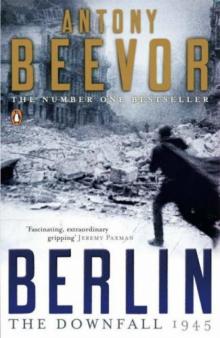
Berlin the downfall 1945, p.6
Berlin: The Downfall 1945,
p.6


A small group of pro-Soviet German officers was taken to visit East Prussia. They were appalled by what they saw. One of them, Count von Einsiedel, vice-president of the NKVD-controlled National Committee for a Free Germany, told fellow members on his return, ‘Russians are absolutely crazy about vodka and all alcoholic drinks. They rape women, drink themselves into unconsciousness and set houses on fire.’ This was rapidly reported to Beria. Ilya Ehrenburg, the fieriest of all propagandists, was also deeply shaken on a visit, but it did not make him moderate his ferocity in print.
Red Army soldiers had never been well fed during the war. Most of the time they had been permanently hungry. If it had not been for the huge shipments of American Spam and wheat, many of them would have been close to starvation. They had inevitably resorted to living off the land, although it was never an official policy in the Red Army as it had been with the Wehrmacht. In Poland, they had stolen the seed corn of farmers and slaughtered for meat the few remaining animals missed by the Germans. In Lithuania the desperate urge for sugar had led to soldiers raiding beehives: in their ranks the previous autumn, many were conspicuous with faces and hands dramatically swollen by bee stings. But the well-ordered and well-stocked farms of East Prussia offered a bounty beyond their dreams. Cows mooing in agony from swollen udders because those who milked them had fled were frequently shot down with rifles and machine guns to be turned into improvised steaks. ‘They ran away and left everything behind,’ wrote one soldier, ‘and now we have lots of pork, food and sugar. We have so much food now that we won’t eat just anything.’
Although the Soviet authorities were well aware of the terrible retribution being exacted in East Prussia, they seemed angered, in fact almost offended, to find that German civilians were fleeing. Countryside and towns were virtually depopulated. The NKVD chief of the 2nd Belorussian Front reported to G. F. Aleksandrov, the chief ideologist on the central committee, that there were ‘very few Germans left… many settlements are completely abandoned’. He gave examples of villages where half a dozen people remained and small towns with fifteen people or so, almost all over forty-five years of age. The ‘noble fury’ was triggering the largest panic migration in history. Between 12 January and mid-February 1945, almost 8.5 million Germans fled their homes in the eastern provinces of the Reich.
In East Prussia, a number went to hide in the forests, especially Volkssturm men and vulnerable women, praying for the fury to pass. The vast majority, on the other hand, had started to flee just ahead of the invasion. Some left messages for their menfolk. ‘Dear Papa!’ Dmitri Shcheglov found hurriedly chalked in a childish hand on one door. ‘We must escape to Alt-P. by cart. From there on to the Reich by ship.’ Hardly any were to see their homes again. It was the abrupt and total destruction of a whole region, with its own marked character and culture, emphasized perhaps because it had always been at the extremity of Germany on the Slav frontier. Stalin had already planned to take the northern half with Königsberg as part of the Soviet Union. The rest would be given to a satellite Poland as partial compensation for the annexation of all of its eastern territories as ‘western Belorussia’ and ‘western Ukraine’. East Prussia itself was to be wiped from the map.
Once Rokossovsky’s 5th Guards Tank Army had cut through to the Frisches Haff, the only routes out were by sea from Pillau at the south-west tip of the Samland Peninsula, or over the ice to the Frische Nehrung, the long sandbar enclosing the lagoon from the Danzig end. Perhaps the most unfortunate fugitives were the ones who fled into Königsberg, which was soon cut off on the landward side. Escape from the city proved far from easy, mainly because the Nazi authorities had made no preparations for the evacuation of civilians, and it took some time before the first ships appeared at Pillau. Meanwhile, the siege of the East Prussian capital became one of the most terrible of the war.
The refugees who reached the Frische Nehrung, the sandbar of the lagoon, the only route still open to the west, received little pity from Wehrmacht officers. They forced them off the road, insisting that it was for military use only. Trekkers had to abandon their carts and belongings and stagger through the dunes. Many never even reached the Frische Nehrung. On the mainland, Soviet tank columns simply crushed any refugee farm carts in the way and raked convoys with machine-gun fire. When a detachment of tank troops overtook a refugee column on 19 January, ‘the passengers on the carts and vehicles were butchered’.
Even though East Prussia contained none of the Nazis’ most notorious concentration camps, an NKVD detachment checking an area of forest near the village of Kumennen found 100 civilian corpses in three groups in the snow. They were presumably victims of a death march. Himmler had ordered the evacuation of camps when the Red Army approached. ‘The majority are women aged 18–35,’ the report stated, ‘and clad in torn clothes with numbers and a six-pointed star on the left sleeve and on the front of their clothes. Some of them wore clogs. Mugs and spoons were fastened to their belts. Their pockets contained food — small potatoes, swede, grains of wheat etc. A special commission of investigation formed by doctors and officers established that they were shot at close range and all the executed women were half-starved.’ Significantly, they were not identified by the Soviet authorities as Jews, despite the mention of six-pointed stars sewn on their clothing, but as ‘citizens of the USSR, France and Romania’. The Nazis killed around 1.5 million Soviet Jews simply because they were Jewish, but Stalin did not want anything to divert attention from the suffering of the Motherland.
4. The Great Winter Offensive
When German generals addressed their men in familiar tones they called them ‘Kinder’ — children. This came from a Prussian sense of paternalism which extended to the whole state. ‘The soldier is the child of the people,’ said General von Blumentritt at the end of the war, but any idea of a family tie between military and civilian society was by then wishful thinking.
Anger was rising at the futile sacrifices. People were now prepared to shelter deserters. A Polish farmer who had been in Berlin on 24 January witnessed women shouting at the officers and NCOs marching a column of German soldiers through the streets, ‘Let our husbands come home! Make the Golden Pheasants [senior Nazis] fight instead!’ General staff officers in their uniforms with thick red stripes down their trousers started to attract cries of ‘Vampire!’ when spotted by civilians. But this did not mean that revolution was in the air, as in 1918, the year which so obsessed the Nazis. The Swedish military attaché observed that there would be no revolt before the food ran out. This was acknowledged in a popular Berlin saying, ‘The fighting will not stop until Göring fits into Goebbels’s trousers.’
Few had any illusions about what lay ahead. The Berlin health department ordered hospitals to provide another 10,000 bed spaces for civilians and another 10,000 for military use as ‘catastrophe beds’. This decree was typical of Nazi bureaucracy: it made no allowance for the effects of bombing and the scarcity of resources and trained medical staff. It was one thing to provide bed spaces, but doctors and nurses were already desperately overstretched, and they simply did not have the personnel to move patients down into cellars during the nightly air raids. Meanwhile, hospital administrators were having to waste time negotiating with different Nazi Party departments to allow their staff to be excused call-up for the Volkssturm militia.
The Volkssturm itself had been born the previous autumn out of Nazi ideology and petty power struggles. Hitler’s suspicions that the army’s leadership was both treacherous and defeatist made him determined that control of this mass militia should be kept out of its hands. Himmler, head of the Waffen SS and commander-in-chief of the Replacement Army since the July plot, was an obvious candidate, but the ambitious Martin Bormann was determined that the Volkssturm should be organized locally by the Nazi Party Gauleiters who came under him. Since almost all German males between seventeen and forty-five had already been called up, the Volkssturm was an amalgam of teenagers and the elderly.
Goebbels, now also Reich Defence Commissar for Berlin, whipped up a propaganda campaign with slogans such as ‘The Führer’s call is our sacred order!’ and ‘Believe! Fight! Win!’ Cinemas showed newsreels of marching men, elderly and young shoulder to shoulder, Volkssturm detachments receiving panzerfaust rocket-propelled grenades, then swearing the oath of allegiance to the Führer in massed ranks. The camera lingered on the faces of those listening to Goebbels’s speech. There were many believers, ignorant of military reality, who were convinced by this show of determination. ‘All the peoples of the world have hatched a plot against us, but we will show them what we are capable of,’ a wife wrote to her soldier husband. ‘Yesterday there took place here the swearing of the oath for everyone from the district. You should have seen it. I will never forget the impression of strength and pride. We don’t yet know when they will be sent into battle.’
The morale of soldiers at the front was not, however, raised by all this. Many were appalled to hear in letters from home that their father, in some cases grandfather, or young brother was being drilled and given weapon training every Sunday. In fact most Germans, with their innate respect for professional specialization, were deeply sceptical. ‘The people were predominantly of the opinion,’ General Hans Kissel later told his captors, ‘that if the Wehrmacht was unable to cope with the situation, then the Volkssturm would not be able to do so either.’
Most members of the Volkssturm guessed that they were to be thrown senselessly into battle for symbolic purposes and had no hope of making any impression on the Soviet onslaught. Some forty Volkssturm battalions raised in Silesia were allocated to defend their eastern and north-eastern frontiers. A few concrete emplacements were built, but since they had almost no anti-tank weapons, Soviet tank forces went straight through them.
In the industrial areas of Upper Silesia, the centre of ‘gold’ indicated by Stalin, German company directors became increasingly anxious. They feared a revolt among the 300,000 foreign workers, mainly Poles and forced labour from the Soviet Union, and insisted on ‘security measures against enemy alien workers’ before the Red Army’s advance encouraged them to rise in revolt. But Marshal Konev’s tanks were even closer than they thought.
The Soviet advances also prompted the evacuation of prisoner-of-war camps as well as concentration camps. Guards and prisoners trudged through bleak, snow-covered landscapes without any idea of direction or purpose. Late one afternoon, a column of British prisoners of war passed a large group of Soviet prisoners with rags wrapped round their bare feet. ‘Their white starved faces,’ wrote Robert Kee, ‘contrasted horribly with the black unshaven growth of beard which covered them. Only their eyes shone out as something human, distressed and furtive but human all the same, flashing out a last desperate SOS from the person trapped inside.’ The British took what they had in their pockets, whether soap or cigarettes, and threw it across. One of the packets of cigarettes fell short. As a Russian prisoner bent to pick it up, a Volkssturm guard ran up to stamp on his outstretched fingers. He then kicked the man and began to strike him with his rifle butt. This provoked ‘a wild roar of rage’ from the British column. ‘The guard stopped beating the Russian and looked up astonished. He had obviously become so hardened to brutality that it no longer occurred to him that human beings had any right to protest.’ He then began to bellow and wave his gun threateningly, but they roared and jeered all the more. Their own guards came pounding up to restore order and push the Volkssturm man back towards his own prisoners. ‘My God!’ said one of Kee’s companions. ‘I’ll forgive the Russians absolutely anything they do to this country when they arrive. Absolutely anything.’
With Göring utterly discredited, the main struggle for power within the Nazi leadership was principally between Bormann and Himmler. The July plot had greatly increased Himmler’s power. He was in charge of the only organizations — the Waffen SS and the Gestapo — which could control the army. With Hitler’s physical and mental state gravely shaken by the same event, he was in a strong position to succeed as Führer, but whether he had the qualities to play Stalin to Hitler’s Lenin, as some feared, was a different matter.
Himmler hardly looked the part. His ‘chief physical characteristics were a receding chin, heavy jowls, and eyes which appeared not so much bespectacled as glazed in’. For so cold a man, so alien to any sort of humanity, the Reichsführer SS could be astonishingly naïve and complacent. Himmler, certain that he was next in line to the throne, gravely underestimated Martin Bormann, the bull-necked and round-faced secretary who had schemed his way into Hitler’s confidence and now controlled access to him. Bormann secretly despised Himmler, and referred to him sarcastically as ‘Uncle Heinrich’.
Bormann had long suspected that Himmler, the improbable creator of the Waffen SS, secretly longed to be a military commander in his own right. Offering the means to satisfy this fantasy was a good way of getting him out of Berlin and away from the centre of power. In early December, almost certainly on Bormann’s suggestion, Hitler appointed Himmler commander-in-chief of a small army group on the upper Rhine. The Reichsführer SS refused to acknowledge that Field Marshal von Rundstedt, the commander-in-chief West, was his superior. But buried in south-west Germany in the Black Forest, Himmler did not realize that he was rapidly losing power back in Berlin. Kaltenbrunner, the head of the Reich Security Head Office, whom he himself had raised up after Heydrich’s assassination in Prague, had been won over by Bormann, who gave him direct access to Hitler to receive his instructions in person. Himmler also did not realize that his liaison officer at Führer headquarters, SS Gruppenführer Hermann Fegelein, had also secretly joined Bormann’s camp.
* * *
While Nazi leaders were scheming among themselves, the Vistula front had completely collapsed, as Guderian had predicted. The Soviet tank brigades did not stop at dusk. They pushed on through the hours of darkness, one commander explained, because they were ‘less vulnerable in the dark, and our tanks are terrifying at night’.
Soviet point units were sometimes advancing by sixty to seventy kilometres a day. ‘A German general,’ claimed Colonel Gusakovsky, ‘having checked enemy positions on the map, would take his trousers off and go to bed peacefully. We would hit this general at midnight.’ Even allowing for a degree of boastful exaggeration, there can be no doubt that the momentum of the Soviet advance upset the German staff system. Reports on enemy positions at last light, passed back up the chain of command, reached army group headquarters at 8 a.m. Then OKH had to prepare its digest and situation map in time for Hitler’s noontime conference. This might go on for some time. Freytag von Loringhoven, Guderian’s military assistant, remembered one which lasted for seven hours. So orders issued on the basis of Hitler’s instructions did not reach frontline units until twenty-four hours after their reports on the situation.
In this theatre of power politics, outsiders’ contributions to operational discussions were seldom constructive. They were usually self-serving, especially if there was a chance to score a point over a rival at court. Göring now seemed devoid of Machiavellian finesse. He had no idea of military strategy yet would hold forth at length, his vast bulk bent across the map table, rendering it invisible to everyone else. Then, having made a fool of himself, he would retire to a chair nearby. An astonishingly long-suffering Hitler did not reprimand him when he went to sleep in full view of everyone present. On one occasion, Freytag von Loringhoven observed Göring fall asleep in a chair. The spare map folded over his face made him look like a pre-war commercial traveller snoozing on a train.
Soviet tank drivers were so exhausted that they too frequently fell asleep, but a T-34 or Stalin tank could clearly withstand rather more than an ordinary vehicle if it blundered into something. The padded leather or canvas tank helmets were certainly needed inside the lurching steel monsters. The crews were kept going to a large degree by the exhilaration of pursuit. The sight of German equipment abandoned brought fierce pleasure. ‘He’s not going to be allowed a chance to rest,’ they swore. They revelled above all in the surprise they were achieving in the German rear.
At the slightest sign of determined resistance, Soviet commanders brought up their heavy artillery. Vasily Grossman observed ‘disciplined German prisoners’ marching themselves to the rear, some still shell-shocked from the massive artillery bombardments. ‘One of them straightens his jacket and salutes every time a car passes,’ he jotted in his notebook.
Zhukov’s armies continued their virtually unopposed thrust north-westwards during the third week of January. The 2nd Guards Tank Army and the 5th Shock Army continued their partnership on the right, while the 1st Guards Tank Army and the 8th Guards Army cooperated closely on the left. Even the 1st Belorussian Front headquarters could not keep up with their progress, sometimes issuing orders for objectives which had already been seized. When General Vasily Chuikov’s 8th Guards Army sighted the industrial city of Lódź on 18 January, five days ahead of schedule, he decided to attack without consulting Front headquarters. But as his rifle divisions deployed for their attack in the morning, they were very nearly bombed by Red Army aviation. The city was in their hands by evening. German soldiers lying dead in the streets had in many cases been killed by Polish patriots, carrying out ‘their merciless but just executions’.
On 24 January, Chuikov, considered the best general for city fighting as a result of his Stalingrad experience, received orders to seize Poznan (Posen). On receiving the signal, he wondered whether Zhukov’s head-quarters knew anything about this massive fortress.