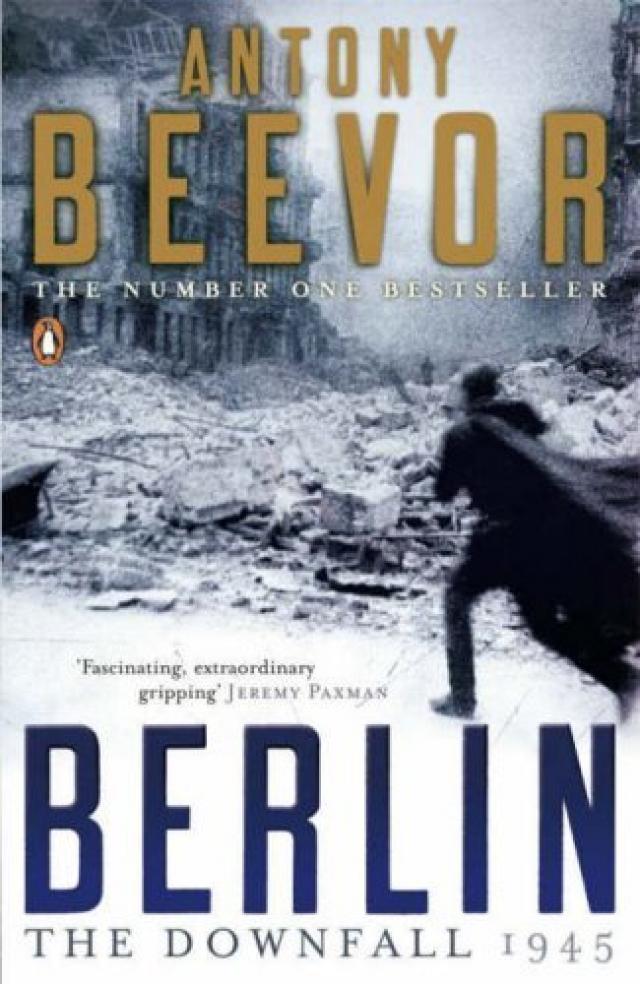
Berlin the downfall 1945, p.53
Berlin: The Downfall 1945,
p.53


The new line-up in the Cold War allowed many of the old guard from the Third Reich to believe that all they had been guilty of was bad timing. Yet some three decades after the defeat, the combination of a difficult historical debate and Germany’s economic miracle enabled the vast majority of Germans to face up to the nation’s past. No other country with a painful legacy has done so much to recognize the truth.
The government in Bonn was also extremely vigilant to prevent any shrine to Nazism and its leader. Yet Hitler’s corpse remained on the other side of the Iron Curtain long after the Stalinist campaign of disinformation, suggesting that he might have escaped to the West in the last moments of the battle. In 1970, the Kremlin finally decided to dispose of the body in absolute secrecy. The funeral rites of the Third Reich’s leader were indeed macabre. Hitler’s jaws, kept so carefully in the red box by Rzhevskaya during the victory celebrations in Berlin, had been retained by SMERSH, while the NKVD kept the cranium. These remnants were recently rediscovered in the former Soviet archives. The rest of the body, which had been concealed beneath a Soviet army parade-ground in Magdeburg, was exhumed at night and burned. The ashes were flushed into the town sewage system.
Hitler’s corpse was not the only one which lacked an identifiable grave. Countless victims of the battle — soldiers on both sides as well as civilians — had been buried by bombs and shells. Each year around 1,000 bodies from 1945 are still being found along the Seelow Heights, in the silent pine forests south of the city and on construction sites in the new capital of a reunited Germany. The senseless slaughter which resulted from Hitler’s outrageous vanity utterly belies Speer’s regret that history should emphasize ‘terminal events’. The incompetence, the frenzied refusal to accept reality and the inhumanity of the Nazi regime were revealed all too clearly in its passing.
Illustrations
1. Hitler Youth during the fighting in Lauban in Silesia, 30 March.
2. Part of the Grossdeutschland Corps being inspected in an East Prussian forest before the Soviet onslaught of 14 January.
3. Volkssturm captured in Insterburg, East Prussia, 22 January.
4. Berliners after a heavy air raid.
5. A ‘trek’ of German refugees from Silesia fleeing before the Red Army.
6. Red Army troops march into an East Prussian town, January.
7. Soviet mechanized troops enter the East Prussian town of Mühlhausen.
8. Red Army troops occupy Tilsit.
9. A Soviet self-propelled assault gun breaks into Danzig, 23 March.
10. A Hitler Youth at a Volkssturm parade taken by Goebbels.
11. Two German soldiers in the defence of the besieged Silesian capital, Breslau.
12. SS Panzergrenadiers before a counter-attack in southern Pomerania.
13. Goebbels decorates a Hitler Youth after the recapture of Lauban, 9 March.
14. German women and children trying to escape westwards by rail.
15. Famished refugees collecting beechnuts in a wood near Potsdam.
16. Eva Braun after the wedding of SS Gruppenführer Hermann Fegelein to her sister Gretl, Berchtesgaden, June 1944.
17. Red Army doctors care for Auschwitz survivors.
18–19. A German engineer after committing suicide with his family before the arrival of the Red Army.
20. A German soldier hanged on the orders of General Schörner, whose motto was ‘Strength through fear’. The placard reads, ‘Whoever fights can die. Whoever betrays his fatherland must die! We had to die!’
21. Hitler Youth tank-hunting squad with panzerfausts clipped to their bicycles.
22. Reichsführer SS Heinrich Himmler, who seldom touched a gun yet dreamed of being a military leader.
23. Marshal Stalin and Winston Churchill at Yalta.
24. A T-34 of Marshal Zhukov’s 1st Belorussian Front crosses the Oder.
25. Soviet sappers bridging the Oder to prepare the assault on Berlin.
26. Red Army soldiers retrieving an anti-tank gun on the waterlogged Oder flood plain.
27. Soviet women released from forced labour near Berlin by the Red Army.
28. An improvised graveyard in the ruins of Berlin.
29. Hitler caresses one of his youngest defenders, watched by Artur Axmann, head of the Hitler Youth.
30–33. The Red Army fighting street by street to capture the ‘lair of the fascist beast’.
34. Across the Moltke bridge to attack ‘Himmler’s House’ — the Ministry of the Interior — then the Reichstag.
35. Soviet assault gun firing down a Berlin street.
36. A riddled Volkswagen by the Reich Chancellery.
37. Forces of the 1st Ukrainian Front sent to crush the Ninth Army in pine forests south of Berlin.
38. German soldiers surrendering to the Red Army in Berlin.
39. Soviet mechanized troops having a wash in a Berlin street.
40. Cooking in the ruins.
41. Red Army meets US Army: Colonel Ivanov proposes a toast, while Major General Robert C. Macon of the 83rd Infantry Division listens.
42. German civilians escaping the Red Army cross the ruined rail bridge over the Elbe to American territory.
43. The end of the battle for Hans-Georg Henke, a teenage conscript.
44. A wounded Soviet soldier tended by a female medical assistant.
45. General Stumpff, Field Marshal Keitel and Admiral von Friedeburg arrive at Karlshorst to sign the final surrender, 9 May.
46. A Red Army soldier tries to seize a Berliner’s bicycle.
47. Marshal Zhukov takes the victory parade on the horse which had thrown Stalin.
48. Zhukov watched by General K. F. Telegin, head of the political department, and General Ivan Serov, the NKVD chief.
49. Visiting the battleground inside the Reichstag.
Endpapers
German prisoners of war being marched past the Brandenburg Gate on their way to captivity.
PHOTOGRAPHIC ACKNOWLEDGEMENTS
AKG London: 3, 6, 7, 8, 9, 13, 17, 22, 24, 26, 28, 34, 37, 40, 42
Alexander Ustinov/Bildarchiv Preußischer Kulturbesitz, Berlin: 27
Bildarchiv Preußischer Kulturbesitz, Berlin: 16, 21, 39, 43
Bundesarchiv Bild, Koblenz: 2 (146/85/22/20), 47 (183/K0907/310)
Chronos, Berlin: 18, 19, 36
Hilmar Pabel/Bildarchiv Preußischer Kulturbesitz, Berlin: 15
Hulton Getty: 46
Imperial War Museum, London: 10 (FLM 3345), 29 (FLM 3351), 30 (FLM 3349), 31 (FLM 3348), 32 (FLM 3346), 33 (FLM 3350)
Jürgen Stumpff/Bildarchiv Preußischer Kulturbesitz, Berlin: 45
National Archives and Records Administration, Maryland: 20 (111-SC-205221), 41 (111-SC-205367), 49 (306-NT-885-C2)
PK-Benno Wundshammer/Bildarchiv Preußischer Kulturbesitz, Berlin: 1
Private Collection/Novosti/Bridgeman Art Library: 23, 25
Ullstein Bild, Berlin: 4, 5, 11, 12, 14, 38, 44
Victor Tiomin: Endpapers, 35
Every effort has been made to contact all copyright holders. The publishers will be glad to make good in future editions any errors or omissions brought to their attention.
References
ABBREVIATIONS
AGMPG Archiv zur Geschichte der Max-Planck-Gesellschaft, Berlin
AWS Art of War Symposium, ‘From the Vistula to the Oder: Soviet Offensive Operations’, Center for Land Warfare, US Army War College, 1986
BA-B Bundesarchiv, Berlin
BA-MA Bundesarchiv-Militärarchiv, Freiburg-im-Breisgau
BLHA Brandenburgisches Landeshauptarchiv, Potsdam
BZG-S Bibliothek für Zeitgeschichte (Sammlung Sterz), Stuttgart
GARF Gosudarstvenny Arkhiv Rossiiskoy Federatsii (State Archive of the Russian Federation), Moscow
HUA-CD Humboldt Universitätsarchiv (Charité Direktion), Berlin
IfZ Institut für Zeitgeschichte, Munich
IMT Trials of the Major War Criminals before the International Military Tribunal (Nuremberg)
IVMV Istoriya vtoroi mirovoi voiny, 1939–1945 Vol. x, Moscow, 1979
KA-FU Krigsarkivet (Försvarsstaben Utrikesavdelningen), Stockholm
LA-B Landesarchiv-Berlin
MGFA Militärgeschichtliches Forschungsamt library, Potsdam
NA National Archives II, College Park, Maryland
PRO Public Record Office, Kew
RGALI Rossiisky Gosudarstvenny Arkhiv Literatury i Iskusstva (Russian State Archive for Literature and the Arts), Moscow
RGASPI[6] Rossiisky Gosudarstvenny Arkhiv Sotsialno-Politikeskoi Istorii (Russian State Archive for Social-Political History), Moscow
RGVA Rossiisky Gosudarstvenny Voenny Arkhiv (Russian State Military Archive), Moscow
RGVA-SAf[7] The ‘Special Archive’ of captured German documents in the RGVA
SHAT Service Historique de l’Armée de Terre, Vincennes
TsAMO Tsentralny Arkhiv Ministerstva Oborony (Central Archive of the Ministry of Defence), Podolsk
TsKhlDK Tsentr Khraneniya i Izucheniya Dokumentalnykh Kollektsy (Centre for the Conservation and Study of Historic Document Collections), Moscow
ViZh Voenno-istoricheskii Zhurnal
VOV Velikaya Otechestvennaya Voina (The Great Patriotic War), Moscow, 1999, Vols. III and IV
INTERVIEWS, DIARIES AND UNPUBLISHED ACCOUNTS
Shalva Yakovlevich Abuladze (captain, 8th Guards Army); Gert Becker (Berlin civilian, Steglitz); Richard Beier (newsreader, Grossdeutscher Rundfunk); Nikolai Mikhailovich Belyaev (Komsomol organizer, 150th Rifle Division, 5th Shock Army); Klaus Boeseler (Deutsche Jungvolk, Berlin); Ursula Bube, geb. Eggeling (student, Berlin); Hardi Buhl (civilian, Halbe); Henri Fenet (battalion commander, SS Charlemagne Division); Anatoly Pavlovich Fedoseyev (magnetron and electronics expert sent to Berlin); Edeltraud Flieller (secretary, Siemens); Generalleutnant a.D. Bernd Freiherr Freytag von Loringhoven (military assistant to General Krebs in Fuhrer bunker); Vladimir Samoilovich Gall (captain, 7th Department, 47th Army Headquarters); Hans-Dietrich Genscher (soldier, Twelfth Army); Elsa Holtzer (Berlin civilian); Oberst a.D. Hubertus Freiherr von Humboldt-Dachroeden (Ia, headquarters, Twelfth Army); Svetlana Pavlovna Kazakova, (headquarters, 1st Belo-russian Front); Oberst a.D. Wolfram Kertz (captain, Grossdeutschland Wachtregiment, 309th Berlin Infantry Division); Major General I. F. Klochkov (senior lieutenant, 150th Rifle Division, 5th Shock Army); Ivan Varlamovich Koberidze (captain, 1st Ukrainian Front artillery); Ivan Leontievich Kovalenko (signaller, headquarters 3rd Belorussian Front); Anatoly Kubasov, (3rd Guards Tank Army); R. W. Leon (Intelligence Corps attached to US Ninth Army CIC); Erica Lewin (Rosenstrasse survivor); Generalmajor a.D. Rudolf Lindner (Fahnenjunker Regt 1241, Division Kurmark); Lothar Loewe (Hitler Youth); Hans Oskar baron Löw-enstein de Witt (Rosenstrasse survivor); General Ulrich de Maizière (general staff colonel, OKH); Georgy Malashkia (captain, 9th Tank Corps); Nikolai Andreevich Maltsev (lieutenant, 3rd Guards Tank Army); General Anatoly Grigorievich Merezhko (captain, headquarters 8th Guards Army); Rochus Misch (Oberscharführer, SS Leibstandarte in Führer bunker); Gerda Petersohn (secretary, Lufthansa, Neukölln); Oberst a.D. Günther Reichhelm (chief of staff, Twelfth Army); Frau Helga Retzke (student, Berlin-Buch); Sergei Pavlovich Revin (junior sergeant, 4th Guards Tank Army); Yelena Rzhevskaya (Kogan) (interpreter SMERSH department, 3rd Shock Army); Alexander Saunderson (captain, war crimes investigator and Jowett’s aide at Nuremberg); Erich Schmidtke (Berlin Volkssturm evader); Ehrhardt Severin (civilian); Shota Shurgaya (junior lieutenant, 16th Aviation Army); Wolfgang Steinke (lieutenant, 391st Security Division, Ninth Army); Shota Sulkhanishvili (captain, 3rd Shock Army); Frau Waltraud Süssmilch (schoolgirl); Frau Marlene von Werner (civilian, Wannsee); Magda Wieland (actress); General a.D. Markus Wolf (Ulbricht Group); General a.D. Wust (lieutenant, Luftwaffe training battalion, 309th Berlin Infantry Division, Ninth Army).
There are also three other interviewees whose contributions must remain anonymous.
Source Notes
PREFACE
p. xxxiii ‘History always emphasizes…’, Speer interrogation, 22 May, ΝA 740.0011 EW/5–145
p. xxxiii German teenagers, see Die Woche, 8 February 2001
p. xxxiii ‘with the breakthrough…’, 9 November 1944, reprinted in Volkssturm, BLHA Pr. Br. Rep. 61A/363
p. xxxiv ‘culmination of all the operations’, RGALI 1403/1/84, p. 1
1 BERLIN IN THE NEW YEAR
p. 2 ‘Learn Russian quickly’, Klemperer, ii, 4 September 1944, p. 431
p. 2 ‘Bleib übrig!’, Loewe, conversation, 9 October 2001
p. 2 ‘like a stage-set…’, Kardorff, p. 153
p. 4 Schmidtke, conversation, 15 July 2000
p. 4 ‘Volksgenossenschaft’, NA RG 338 B-338
p. 4 ‘I have such faith…’, SHAT 7 Ρ 128
p. 6 ratios of enemy superiority, AWS, p. 86
p. 7 ‘It’s the greatest imposture…’, Guderian, pp. 310–11
p. 8 ‘I know the war is lost’, Below, p. 398
p. 8 ‘wishes for a successful…’, ibid., p. 399
p. 9 rumour of Hitler’s madness and Göring’s flight, SHAT 7 Ρ 128
p. 9 Goebbels dinner, Oven, p. 198
p. 9 foreign doctors, HUA-CD 2600 Charité Dir. 421–24/1 Bd x, p. 125
p. 9 ‘catastrophic losses’, IfZ MA 218, pp. 3,725–49
2 THE ‘HOUSE OF CARDS’ ON THE VISTULA
p. 11 6.7 million men, IVMV, p. 38
p. 11 ‘We are lost…’, SHAT 7 Ρ 128
p. 11 ‘We no longer fought…’, Sajer, p. 382
p. 12 ‘You do not need…’, TsAMO 233/2374/337, p. 64
p. 12 attack before Christmas, TsAMO 233/2374/337, p. 64
p. 12 ‘Mein Führer, don’t believe that…’, Freytag von Loringhoven, conversation, 4 October 1999
p. 12 ‘completely idiotic’, Guderian, p. 315
p. 13 ‘weather for Russians’, General Schaal debriefing, 20 February 1946, 2e Bureau, SHAT 7 Ρ 163
p. 13 ‘strange winter’, Stalin to Harriman, 14 December 1944, NA RG334/Entry 309/Box 2
p. 13 ‘heavy rain and…’, RGVA 38680/1/3, p. 40
p. 14 ‘At that time’, quoted Senyavskaya, 2000, p. 174
p. 14 ‘The Russian infantryman’ and ‘First state…’, Senyavskaya, 1995, p. 111
p. 14 ‘cavalrymen, artillerymen…’, Grossman papers, RGALI 1710/3/51, p. 221
p. 14 ‘You will harvest…’, RGALI 1710/3/47, p. 19
p. 15 ‘disconcertedness’, VOV, iii, p. 232, n. 8
p. 15 Konstanty Rokosowski, I am most grateful to Norman Davies for supplementary information
p. 15 ‘Why this disgrace?’, Rokossovsky, p. 297
p. 16 ‘I know very well…’, Zhukov, p. 174
p. 16 ‘wicked little eyes…’, Beria, p. 130
p. 16 Korsun, see Erickson, pp. 177–9
p. 17 16th Panzer Division, 21st Army, TsAMO 233/2374/337, p. 70
p. 17 ‘fire-storm’, Colonel Liebisch, AWS, p. 617
p. 17 ‘Forward into the fascist lair!’, VOV, iii, p. 236
p. 17 ‘Gold’, Konev, p. 5
p. 18 Sochaczew, TsAMO 307/246791/2, pp. 225–7
p. 18 ‘with their tracks’, TsAMO 307/15733/3, pp. 37–8
p. 18 ‘two or three hours’, Grossman papers, RGALI 1710/3/51, pp. 237–8
p. 18 ‘because of the big advance…’, Bormann diary, GARF 9401/2/97, pp. 32–48
p. 19 ‘very stupid’, ‘a prestige garrison’, NA RG334/Entry 309/Box 2
p. 19 ‘to start the advance’, ViZh 93, No. 6, pp. 30–31
p. 20 ‘Stalin emphasized…’, ΝA RG334/Entry 309/Box 2
p. 20 ‘Ah, what a life…’, RGALI 1710/3/47, p·14
p. 21 ‘Our tanks move faster…’, Grossman papers, RGALI 1710/3/51, pp. 237–8
p. 21 ‘ear battalion’, Duffy, p. 103
p. 21 ‘You must stop everything!’, Humboldt, conversation, 11 October 1999
p. 21 ‘That evening’, Humboldt, conversation, 11 October 1999
p. 22 ‘the situation in the east…’, GARF 9401/2/97, pp. 32–48
p. 22 ‘half an hour before…’, Guderian, p. 327
p. 22 ‘We saw the destruction of Warsaw…’, Klochkov, p. 28
p. 22 Warsaw population figures, VOV, iii, p. 240