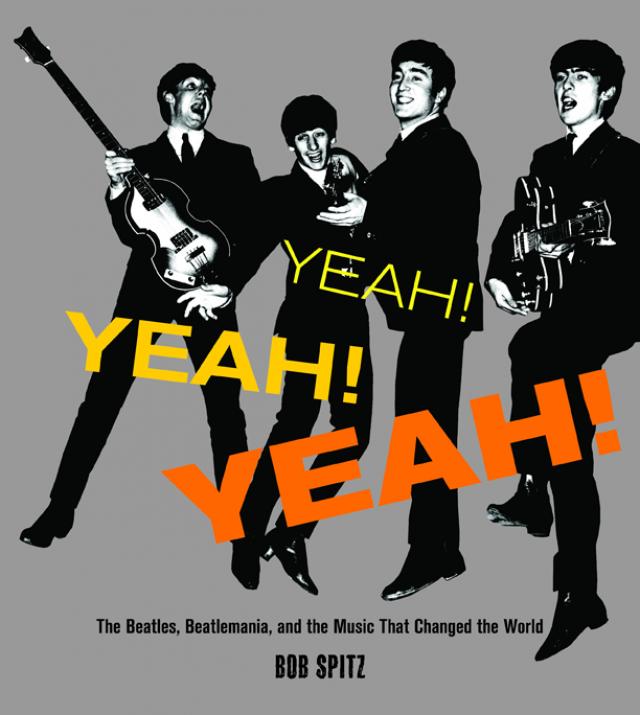
Yeah yeah yeah, p.11
Yeah! Yeah! Yeah!,
p.11


The work itself was more demanding than they’d expected. For one thing, they had to report for costumes and makeup at six o’clock in the morning, which meant getting up at five. The Beatles were used to sleeping until noon, so it took everything they had to make it to the set on time. And learning their lines was an uphill battle. Instead of memorizing the script, they made it up as they went along. According to another actor in the movie, “You never knew what they were going to say or do.” But somehow it all came together wonderfully. The Beatles were funny. They were naturals in front of the camera. The only thing missing was a good title for the picture.
Everyone had been referring to the film as “The Beatles Movie” until something more suitable came along. Despite lots of good effort, however, no one could come up with something that sounded as if it belonged on a theater marquee. There are several versions of how the title was finally arrived at. What they all agree on is that it occurred during a lunch break at the movie studio. Paul and George were talking about how Ringo abused the English language, saying things seriously that came out funny. They called them “Ringoisms.” One in particular always made them laugh. Following a late-night performance, they explained, Ringo had sighed and said he’d “had a hard day’s night that day.” When the movie’s producer heard that, he clapped his hands and said, “We’ve just got our title!” And from that moment on, their movie was called A Hard Day’s Night.
The Beatles on location for A Hard Day’s Night, March 1964. © MIRRORPIX
Of course, that meant John and Paul had to write a song to go with the title. They were swamped with work, acting and recording, but the next morning, only ten hours after the producer had requested it, they’d already completed the task, writing what became one of their most famous songs. “A Hard Day’s Night” was recorded the next day, on April 16, 1964, and from the extraordinary opening chord, it was evident that the Beatles had raised the bar for all pop songwriting. The energy the song delivers is explosive, full of fireworks, and musically it was as daring as anything they’d ever done.
The gang celebrating Paul’s birthday: Arthur Kelly with a date (left), Gerry Marsden (middle), George Harrison and Pattie Boyd (right). © MIRRORPIX
During the filming, George became infatuated with one of the extras in the film, a beautiful young model named Pattie Boyd whose face was well-known because of a famous television ad for potato chips. She had been cast in the movie, along with her younger sister, Jenny, as a way of dressing up the scenery around the Beatles. According to friends, Pattie not only had an eye on George on the set, she had been following his career from a distance since the start. George picked up the signals on the very first day of production, during a scene in which Pattie appeared as an immodest schoolgirl. “When we started filming, I could feel George looking at me,” she recalled, “and I was a bit embarrassed.” It might have been less awkward had she not been “semi-engaged” to a boyfriend with whom she’d been living for two years. At the time, the boyfriend said he felt “confident about [his] relationship with her,” but within a week, Pattie and George were making their own plans.
It was easy to understand George’s attraction to her. Pattie was an angelic-looking young woman, pleasant and unpretentious, with a style that was as natural as it was alluring. In a genuine, matter-of-fact way, she seemed to be a reference point for all the new fashion that was percolating in London: chic and funky clothes, shaggy haircut, sexy miniskirt, pale makeup, antique jewelry. “Whenever fashions changed, Pattie was in there first with all the right gear, looking beautiful as ever,” Cynthia Lennon wrote in one of her memoirs. She always managed to look fabulous with very little effort, and George fell in love with her because of her beauty, style, and easygoing personality.
In those days, it was taboo for the press to publish a picture of one of the Beatles with his wife or girlfriend. The band’s private lives were strictly off-limits. But once Pattie came on the scene, all bets were off. A reporter for the Daily Mirror, one of London’s leading papers, got wind that John and George were about to fly off on a weekend holiday, one of them with a new girlfriend in tow, and the newspaper was determined to break the story. Reporters eager to identify the young woman swarmed the hotel, looking for the two couples. It got so bad, they became prisoners in their rooms. “In the end, Cyn and I had to dress as maids,” Pattie recalled. “They took us out a back way, put us in a laundry basket, and we were driven to the airport in a laundry van.”
Paul and John backstage at East Ham in 1963, perusing reviews of their shows. The Beatles avidly read all press reports of their exploits. © JANE BOWN/CAMERA PRESS LONDON
Somehow, Ringo’s steady girlfriend, Maureen Cox, was spared. For a long time, she remained in Liverpool, where she worked as a hairdresser. Although she spent a lot of time visiting Ringo’s Montagu Street flat in London, the press, as of yet, had not caught on.
It seemed as though everyone in London followed the Beatles like a favorite soap opera. Not a day went by that didn’t offer ample stories about their adventures, even if they were only rumor and gossip. Papers reported on where they were last seen and with whom, how they were dressed, what they had for dinner, and when they went home (and with whom). The gloves had come off; the Beatles’ private lives were now considered fair game.
After the band wrapped up work on the movie and new album, they left for a tour of Scandinavia, following it by leapfrogging several continents, then zooming through New Zealand and Australia. Wherever they went, they were welcomed like heroes. Their arrival in Amsterdam was greeted by an elaborate motorcycle escort that wound through the city, flanked by units of police and the civil guard. Afterward, the Beatles took a glass-topped boat for a ten-mile trip through the Amstel Canal. “We passed at least 100,000 cheering people who lined the streets on each side to wave, and sometimes almost touch, the Beatles as they passed,” wrote a reporter who accompanied them. Fans leaped from canal bridges as the boat passed underneath.
Every city, every situation, brought out people who wanted to touch the Beatles. And the fans—everywhere the Beatles went, fans expected, demanded, some sort of personal response: sign this, wave, say hello, touch me, kiss me. They stopped at nothing: invading the Beatles’ hotel suites, throwing themselves in front of their cars, jumping from balconies, following Cynthia and the other musicians’ girlfriends. It never let up. In Australia, it really got crazy. When the Beatles landed in Adelaide, they were loaded into a convertible and paraded along a nine-mile stretch of highway lined by 250,000 people, nearly half the city’s population. An additional 30,000 fans crammed into the square outside the gates of Adelaide’s Town Hall, where the Beatles were awarded the key to the city. The same thing occurred in Melbourne, where another 250,000 people lined the route from the airport to the Beatles’ hotel.
Police holding back crowds of fans waiting to see the Beatles, July 1964. © MIRRORPIX
Fans at the ABC Theatre as the Beatles arrive. © MIRRORPIX
Occasionally, the situation became dangerous. Things turned very scary when Ringo’s car was surrounded by 3,000 fans, many pressing up against the windows, pounding on the doors, and screaming. A police officer built like a bulldozer slung Ringo over his shoulder and made a beeline for the hotel, but he stumbled. In a flash, they went down. Ringo was knocked to the ground and engulfed by the crowd. By the time he was rescued, he was scuffed and badly shaken. Later that same afternoon, 20,000 people stood outside the band’s hotel, chanting, “We want the Beatles!” while 4,000 policemen held them back. It was “frightening, chaotic, and rather inhuman,” according to a trooper on horseback.
What was going on? the Beatles wondered. How had things gotten so out of hand? And if this was how things were in Australia, what would America be like when they returned there later in the year? In America, Beatles fever was running at an all-time high. Public demand was incredible. In Chicago, 18,000 tickets were sold before a single ad appeared for their concert. The entire block of 12,000 tickets for Philadelphia were sold in seventy hectic minutes. For all of the upcoming twenty-seven US concerts, the same thing: sold out, sold out, sold out.
The Beatles arrived back home in London determined to figure out how things had spun out of control—but first they had a date at the movies.
• • • • •
The premiere of A Hard Day’s Night, on July 6, 1964, wasn’t normal, even by movie-gala standards. By 7:30, an hour before the premiere was to begin, the streets around Piccadilly Circus, in London, were jammed by a crowd of twelve thousand fans struggling to get a glimpse of the shaggy-haired stars. Inside the London Pavilion, the Beatles, dressed in stiffly pressed tuxedoes, stood with their families and the posh crowd. Joining them were Princess Margaret and the Earl of Snowden. Earlier that day, the band had watched a run-through of the film at a private screening with Brian and the producer, who insisted they “behaved like delighted little kids” watching themselves romp across the screen. Slouched down in the orchestra section, with their feet up on the backs of the seats in front of them, they wolfed down popcorn and howled like hyenas or groaned with embarrassment, depending on the scene. The producer, watching from the balcony, was confident they had a hit on their hands.
With few exceptions, the critics agreed that A Hard Day’s Night was a winner. In the usually stiff-lipped New York Times, the newspaper’s movie critic praised it as “a whale of a comedy” that “had so much good humor going for it that it is awfully hard to resist.” Elsewhere, critics called it “offbeat” and “delightfully loony.” Even John said, “I dug A Hard Day’s Night. We knew it was better than other rock movies, though not as good as James Bond.”
The fans obviously agreed with him. The next morning, when the movie officially opened, there were lines around the block at theaters all over that continued every day for months.
It was the perfect time, the Beatles agreed, to revisit America.
• • • • •
The lure of America had once involved a fear of the unknown, but when the Beatles returned on August 18, 1964, there were no surprises. Their records were, according to a midwestern newspaper, “on jukeboxes in a hundred thousand joints and drugstores.” Capitol Records had flooded the market with an unprecedented 2 million copies of their brand-new album, and airplay was nonstop. Meanwhile, A Hard Day’s Night flickered across five hundred screens. Everywhere the Beatles went, crowds amassed in staggering numbers: three thousand, eight thousand, fifteen thousand, twenty thousand, more. “America was now very aware of the Beatles,” said their road manager, Neil Aspinall, “and things were crazy.”
Crazy: it was a word occurring with disturbing frequency in describing the shifting American scene. There was a feeling in the United States that the peace of the 1950s was in rocky disarray. Young people were struggling—often chaotically—to find a means of self-expression. The civil rights movement, galvanized by Martin Luther King Jr., was attempting to dismantle segregation and change the way people lived with one another. The threat of nuclear war aroused greater interest in pacifism. And changing attitudes toward sexuality jump-started a debate concerning public values and private moral choices.
Everything seemed connected to a growing disenchantment with the establishment and was set to a soundtrack by the Beatles. The boys served as hip role models for a restless generation of Americans grappling with questions of individual freedom and expression. Their hair, especially, disturbed adults. According to a journalist, “It was perceived to be threatening the very fabric of American society. And it was intolerable.”
Fans wearing Beatles dresses as they wait for the group at the film premiere of A Hard Day’s Night at the London Palladium, July 1964. © MIRRORPIX
Crazy, indeed. Amid all the blind spots surrounding these issues, the Beatles were a visible target. Parents blamed them for contributing to teenage delinquency. There was no precedent for the kind of mayhem the Beatles provoked. In Los Angeles, a police lieutenant covering the Beatles’ arrival said, “It scares you. It’s just beyond me. I’ve never seen anything like this.”
The scene was the same everywhere. Crowds of kids, mobs of them, screaming and fainting, battling through police lines to touch their beloved Beatles. As for the shows themselves, lasting a scant thirty-one minutes, they were like sitting inside a funnel cloud. The four Beatles would rush onstage unannounced, clutching their instruments like body armor while flashbulbs exploded around them in a hail of blinding light. Most of the kids continued screaming throughout the entire performance. A solid wall of earsplitting sound shook the seats, rumbling through the darkness, wave after wave of it. “It felt like an earthquake,” re-called an astonished eyewitness who would remember the experience for the rest of his life. “It would start at one end of the arena and continue to the other. It was incredible to do nothing but stand there, letting it wash right over you.”
The classic stage routine, with the entire sound output coming from those puny amps. © MIRRORPIX
The Beatles needed relief from the mobs. In most cities, they went straight from the performance to the airport and headed to the next stop on the tour as a way of avoiding the crazy crowd scenes. For convenience and safety, they chartered their own plane. It made road life easier for the Beatles, not having to be pestered by fans and autograph seekers.
The concerts were a different matter. At the concerts, the Beatles left themselves vulnerable to the crowds. “It was pretty scary just about everywhere we went,” recalled a journalist who never strayed far from the Beatles’ side. In New York, at Forest Hills Tennis Stadium, dozens of fans stormed the stage, and at one point Ringo was knocked off his stool by an overenthusiastic girl who had leaped over a line of police kneeling in front of the stage. In Cleveland, as soon as the Beatles hit the stage, jelly beans, toys, and much heavier objects were launched at their heads. And in Boston, a fight broke out that stopped the show.
Fortunately, in Los Angeles, the atmosphere grew calmer. The Beatles played to a worshipful crowd of nineteen thousand people at the Hollywood Bowl, the gorgeous open-air amphitheater at the foot of the Hollywood Hills. Behind them, reaching into the spectacular starlit sky, another ten or fifteen thousand fans were massed in the woodlands. “Welcome to you in the trees!” John shouted, as the other Beatles swung around to look, taking in the human scenery. Everyone was well-behaved. For a change, John recalled, the Beatles could actually hear what they were playing, which made the show a highlight of the tour.
The next day, at a garden party thrown by Capitol Records, it seemed as if every movie star turned up to greet the Beatles. If the Beatles were starstruck, they didn’t show it. Long-time movie fans, they enjoyed meeting their screen heroes. Even Elvis’s manager arrived in a station wagon loaded with presents for the boys.
The American tour dragged on through most of September. The cities sped by in a blur: Denver, Cincinnati, New York, Atlantic City, Philadelphia, Indianapolis, Milwaukee, Chicago, Detroit. Everywhere they went there were greater displays of mayhem, the fans ever more determined to cross the Beatles’ path. The boys had banked a record $1 million from the tour, which seemed amazing considering it wasn’t that long ago that they’d been making $20 a gig. Now, with three gold records and a hit movie to their credit, a newspaper put the Beatles’ earnings at roughly $56 million.
• • • • •
Through it all, John and Paul continued writing songs. Once they returned home, Paul would drive out to John’s new house, where they would spread out in a little attic room overlooking the garden to “kick things around” for two or three hours. Occasionally, when Paul was tired, he arranged to be driven out to John’s in order to spend the travel time relaxing or reading the newspaper. One day, just as the limo was turning into the driveway, Paul put down his newspaper and asked the chauffeur how he’d been. “Oh, working hard,” the man replied, “working eight days a week.” Bells went off in Paul’s head. Eight days a week! “It was like a little blessing from the gods,” he recalled. No sooner had John answered the door than Paul dropped this phrase into his hands. They practically dashed upstairs and began spitting out lyrics, just “filling it in from the title,” as Paul remembered. Bam, bam, bam.
Where’s Ringo?
Paul, John, and George, with Jimmy Nicol, June 1964. © BETTMANN/CORBIS
A shock wave shuddered through Copenhagen Airport on June 4, 1964, as the Beatles’ plane approached the runway. More than two thousand kids had been waiting since dawn for their heroes to arrive, and as the plane taxied toward the terminal, a deafening roar went up. All hell broke loose on the ground as the cabin door popped open and out bounded the Beatles: John, Paul, George—and Jimmy.
There had been no time to inform the crowd that Ringo wasn’t aboard. Only a day earlier, he’d collapsed during a stressful photo session. His throat had been especially sore, but it wasn’t until he was rushed to the hospital that he learned he had laryngitis and would need to have his tonsils out.
Instead of canceling their upcoming tour, Brian Epstein convinced the Beatles to replace Ringo with a session drummer. Jimmy Nicol, who was twenty-four, not only had great hands, he happened to fi t the part as well, with a round, cherubic face, a wicked sense of humor, and long hair like the Beatles. Somehow, Jimmy took it all in stride. “He played well,” Paul said with customary graciousness. But a few days later, when Ringo showed up feeling refreshed and recharged, the Beatles were thankful to have their old mate back behind the drums.