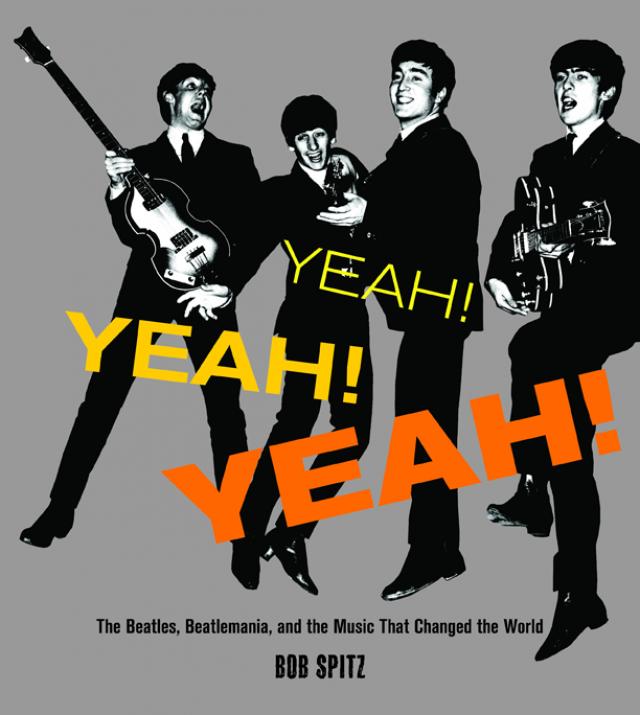
Yeah yeah yeah, p.6
Yeah! Yeah! Yeah!,
p.6


• • • • •
The Beatles had been out of England before—to Scotland, which they considered a pleasant enough place. But Germany was a different world altogether. Maybe even a different planet.
George at the Star-Club, 1962. © K&K STUDIOS/REDFERNS
Hamburg itself was as familiar as their own backyard. A port with a thriving shipping trade conducted under a blanket of perpetual fog, it not only looked, felt, and smelled like Liverpool, the cafés even served a typical sailors’ stew that was cooked back home. But the St. Pauli district, where they would play, resembled a carnival midway, only gaudier and more vulgar. The action was shoulder-to-shoulder, back-to-back: bars, nightclubs, cafés, luncheonettes, clip joints, arcades, dance halls, saloons. And lights—miles of lights—blazed with dizzying intensity. Floodlights lit up the sky; arc lamps washed the street in a strange glow. Here it was bright around the clock.
“It was an ‘anything goes’ kind of place,” recalled a fellow musician who also played in Hamburg, “kind of a Dodge City of the open seas.” Hamburg looked just right to the Beatles, who could hardly believe their eyes. But the club, called the Indra, depressed them. It was a lounge—a girlie lounge— where bleary-eyed tourists sat glumly sipping beer. “We were crestfallen when we saw it,” recalled Pete Best. Still, there was hope. All the place needed was a hot British band to generate some buzz, and the owner had been assured the Beatles were up to the job.
The Beatles knew what to play. John, Paul, and George were a walking encyclopedia of rock ’n roll songs. They could put together an hour’s worth of material without repeating a song. But somehow their performances didn’t click with the crowd. As far as creating excitement went, the Beatles weren’t cutting it. They were as stiff as the customers who trickled into the club. They had no act to speak of, knew nothing of stagecraft, and as performers they weren’t terribly engaging. What’s more, the Beatles were required to play a staggering four and a half hours each night, six hours on weekends. That meant coming up with new material, not to mention the stamina.
“C’mon boys,” Allan Williams exhorted them after the club owner issued a complaint, “make a show!”
Make a show! It was like something a teacher might say before the start of school speech day or a class play. Make a show: it sounded completely inappropriate for rock ’n roll. John couldn’t stop snickering. He lurched around the stage in mock theatrics, diving toward the mike and duckwalking or dropping into a split. Allan, who didn’t realize that John was goofing on him, cheered on the antics. “That’s it! Make a show! Make a show!”
The German club owner also took up the chant, barking at the band in his comic accent, “Mach Schau! Mach Schau!”
The Beatles thought it was a scream. “Mach Schau!” The entire band got into the act, imitating John’s happy horseplay. Paul raised his guitar, fencing with John. George chimed in, stamping and scrabbling his feet like a crazed Cossack. Stuart contorted his body as though dodging bullets. A cyclone of rhythmic unrest swept across the Indra, synced to Pete’s ferocious beat.
It was the breakthrough the band needed. They were in perpetual motion, and in no time they transformed their sorry act into something exciting. Word spread quickly around St. Pauli that the Beatles were all the rage, and crowds thronged to the Indra to check out the newest British sensation. According to a Hamburg teenager who spent his weekends in St. Pauli, “There was no place else in the district that offered such an exciting selection of live music.”
Even though there were breaks planted at forty-five-minute intervals, there was really never any letdown until well after two in the morning. And the breaks were merely breathers. From their opening chords, the Beatles let it rip. All-out rockers soon filled every minute of the set. Paul and John combined to sing a steady string of songs that set a blazing pace. They really turned it on—and up—squeezing all they could out of their two tiny amps. It wasn’t unusual for Pete Best to crawl into place behind his drum set only to have John or Paul whisper, “Crank it up, Pete, we’re really going for it tonight.” After a long night’s work jackknifing across the stage to wild applause, the boys were so pumped up it usually took several hours before they were calm enough to go to bed. Often they didn’t get to sleep until four or five in the morning.
The Beatles worked like mad. They were so good, the club owner moved them across the street to his showplace, the Kaiserkeller, where they shared the stage with Rory Storm and the Hurricanes. From the opening night, October 4, 1960, the two bands commandeered the stage with a red-hot, rough-and-tumble force. For more than seven uninterrupted hours the bands churned out a string of high-octane rockers that left the capacity crowds in a sweaty, beer-soaked frenzy. “Every night was another amazing jam fest,” recalled Johnny “Guitar” Byrne, who played lead for the Hurricanes. “The music got everyone so cranked up, and the whole place just shook, like Jell-O.”
Every night it got louder and longer—seven o’clock in the evening until five in the morning. “Marathon sessions,” as the two bands mutually termed them, with a very friendly rivalry serving to fatten the stakes.
The audiences were rough, much rougher than back home, but the Beatles still made friends, particularly three young German art students who cast a striking presence in the crowd. Stuart was immediately drawn to them. He admitted that it was “extremely difficult to take my eyes off them,” especially the woman, whose name was Astrid Kirchherr, a strong and willowy blond beauty with a full tank of attitude. “I had never met anyone like them,” Stuart recalled.
The attraction was mutual. “We were totally fans, totally in awe,” recalled Jügen Vollmer, one of Astrid’s male companions. “[The Beatles] looked absolutely astonishing. My whole life changed in a couple minutes.”
They watched the Beatles play almost every night of the week, sitting where they knew the band would see them. Astrid, who was a capable photographer, offered to take pictures of the group. The Beatles eagerly accepted. After the first photo session, she took them back to her home, where her mother made the boys dinner. Almost from the start, Stuart was infatuated with her. He began spending all available time with Astrid—and less time with the band. This sowed resentment with the others. John, Paul, and George were devoted to their music and practiced every spare moment they had. Even Pete Best contributed to their developing sound with his pounding drums. Stuart, on the other hand, had no innate feel for music. When it came to playing the bass, he was basically inept, eternally an amateur. Paul, who was a perfectionist, called Stuart the “weak link.” It troubled John as well, but he was unwilling to say or do anything that might hurt his friendship with Stuart. At first. But as time wore on, even John grew disenchanted with Stu’s playing.
Just when it seemed as if they had to do something about the situation, destiny intervened. A new bigger, better, and brassier club called the Top Ten opened around the corner from where they were playing. The Beatles began hanging out—and eventually playing in raucous jam sessions—there. This infuriated the owner of the Kaiserkeller. He wanted them for himself, felt they owed him loyalty. After the Top Ten offered the Beatles a job, the Kaiserkeller’s owner fired them on the spot. George Harrison, who was still seventeen and underage, was deported by the police. “So I had to leave [Germany],” he said. “I had to go home on my own.”
George Harrison in a young, and ultimately underage, portrait during the Beatles’ first residency in Hamburg, 1960. © JüGEN VOLLMER/REDFERNS
Before he left for Liverpool, George worked frantically to teach John the lead guitar parts to their songs so the Beatles could continue to function as a band. But it did them absolutely no good. When the remaining Beatles moved to the Top Ten, the owner of the Kaiserkeller took his revenge, accusing them of trying to burn down one of his buildings. It was a ridiculous charge, but the police were not amused. They arrested Paul and Pete and deported them as well.
John and Stuart remained in Hamburg, but without work permits it was impossible for them to earn a living. Besides, there was no one left to play with. John stayed only long enough to bum money for a train ticket home; Stuart borrowed airfare from Astrid and drifted home several weeks later.
The Beatles arrived back in Liverpool exhausted, broke, and greatly disillusioned. The incredible adventure was over. Meanwhile, each of the boys had to do some fancy explaining to his parents, to whom he’d boasted about fame and riches before setting off for Hamburg. John was completely depressed about their situation. George, too, said he “felt ashamed.” He looked for work, as did Paul, who took a menial job at his father’s insistence. For several weeks afterward, none of the boys touched base with one another. It seemed pointless. They weren’t saying as much, but each of the Beatles was convinced that the band was finished.
• • • • •
A week before Christmas 1960, Pete phoned George and suggested they comb Liverpool for potential gigs. A few days later, they were joined by John, who was also eager to jump-start the Beatles’ stalled career.
Through Allan Williams, the boys met a disc jockey named Bob Wooler, who emceed at all the local rock ’n roll halls and helped young bands get work. Bob was drawn to the Beatles. He sensed their awesome complexity and ambition and thought they emanated heat, signaling some kind of raw, restless talent. Purely on instinct, he decided to book them onto a few important shows during the holiday season, where they were seen by large groups of kids. The Beatles took everyone by surprise. They had changed drastically from when they had last played in Liverpool. Everything about them was different—their look, their sound, their poise. According to one observer, their performance was “a revelation to behold.” No one had ever heard a local band play that hard before. Or look that rugged, in the black leather suits they’d bought in Hamburg. “To act that way on stage and make that kind of sound,” recalled Billy J. Kramer, who would one day record some of John and Paul’s songs, “—I was absolutely staggered.”
Word spread swiftly through Liverpool that the Beatles were the “must-see” band. Even without Stuart, who had stayed behind in Germany with Astrid, the band worked steadily, even furiously, at the plentiful number of dates available each week. They played somewhere almost every night, occasionally doubling up gigs and commuting between them at a dizzying, exhilarating pace. “For the first time people were following us around,” George noticed, “coming to see us personally, not just coming to dance.”
The classic Cavern stage shot, under the club’s distinct brick archway. © MICHAEL WARD/REX FEATURES
Then, in early 1961, their most important job came through. The Cavern, a Liverpool jazz showcase, was a filthy, sweltering, fetid, claustrophobic little firetrap of a club. It was located three stories below ground, in the cellar of an old warehouse that smelled foul and musty from its lack of ventilation. It was insufferably hot; the walls and ceiling sweated absolute humidity. And with eight hundred to a thousand teenagers sardined into a space fit for six hundred, it was an accident waiting to happen. But, oh, what a place to hang out, hear music, and dance! The cellar was in three sections separated by stone archways. The acoustics were great, and the crowd could see the stage from practically anywhere in the club.
The Cavern had always been a jazz only place, but by the end of 1960 its bookers could no longer ignore the popularity of rock ’n roll, which created opportunities for local beat groups. The Beatles had been dying to play there. Its fussy owner, however, had other ideas and refused their advances. After Bob Wooler became the Cavern’s resident deejay, he convinced the owner to give the Beatles a shot at one of the lunchtime sessions.
The Beatles debuted at the Cavern on February 21, 1961, playing to a solidly packed house. Their performance, loud and rocking, made an incredible impact on the club’s regulars and sent the band’s stock soaring. The audience loved what the Beatles had: stage presence and personality in addition to a great sound. The girls locked into it right away, and the boys soon followed suit. Even the club owner caught the vibe, sending word through Bob Wooler that the band was welcome back at the first opportunity.
Suddenly the Beatles were in great demand; work was everywhere. Each fabulous performance led to further offers. Paul and George were earning more money than their fathers, and while Aunt Mimi continued to badger John about certain failure (anything other than school meant failure to Aunt Mimi), she couldn’t have been too disapproving of his £25-per-week income. Everything was going their way. Becoming rock ’n roll stars and making records were still the ultimate goals, but for the time being there was plenty of action to groove on.
• • • • •
Even with their careers on the upswing, the Beatles longed to return to Hamburg. They had loved playing there; the scene was so crazy and fabulous. At first, it seemed as though there were too many obstacles in their path for another visit, but one by one they began to disappear. Stuart got back to Hamburg first and announced his intention to marry Astrid Kirchherr. A few weeks later, the other Beatles followed with a promise of work at the Top Ten—seven hours a night, seven nights a week.
Paul photographed by Astrid Kirchherr, with the ghostly image of Stuart in the background, Hamburg, 1960. © ASTRID KIRCHHERR/REDFERNS
The Top Ten Club in Hamburg. © HELMUT UCKERMANN/REDFERNS
The Top Ten was a definite step up from the Kaiserkeller, with a great sound system and jam-packed crowds. Pretty soon the Beatles were the talk of the town. People stood in long lines outside the club, waiting to hear them play. The sound they put out was “amazing,” recalled a regular, “unlike anything Hamburg ever heard before— or since.”
This new popularity gave the Beatles confidence and allowed them to experiment with new roles and identities. Of all the Beatles, Stuart was most open to new experiences. He was the first to put on flamboyant clothes. And when he showed up at the Top Ten one night sporting a flashy new haircut, it set off a bomb in the Hamburg music world that resonated for years to come. The style was a takeoff on the “French cut,” combed long across the forehead in soft, sculpted bangs. Astrid had styled it for Stuart. Out of ignorance—or envy—the other Beatles responded to his new haircut with childish insults. But two days later, a hesitant George followed suit, brushing his hair into an informal shaggy mop, and like that, the mold for the Beatle haircut was born.
Stuart helped set the trends, but all was not well between him and the other Beatles. “Paul hated Stu,” recalled Dot Rhone, who went out with Paul. In fact, everything Stuart did now seemed to enrage him. There were many reasons for it. For one thing, Stuart had little musical talent and was slowing the band’s progress. Then there were the hair and the clothes. Paul couldn’t stand the way Stuart’s fashion style hogged the spotlight. But most of all he was jealous of Stuart, especially his friendship with John. Finally, unable to take it anymore, Paul had it out with Stuart, not in private but on stage, in the middle of a set, in full view of an astonished German crowd. The fight, which had been brewing for months, was wild and fierce. The two boys rolled around on the floor, punching and stomping each other, while the other Beatles played on until the song ended, at which point John, George, and Pete pried them apart.
The Fashion of the Beatles
By 1965, the whole of London was moving to the beat of the swinging Beatles sound track. Almost everyone credited them with the new and buoyant spirit that seemed to seep into all phases of ordinary city life.
The Beatles sat comfortably on the fringe of the vibrant cultural revolution, having already contributed quite substantially to it. It went without saying that they had reinvented the music scene. Their clothes dominated teenage fashion with round-necked jackets and high-heeled boots. And they appeared daring thanks to their long, shaggy haircuts. “The Beatles changed everything,” wrote a prominent English journalist. “Before them, all teenage life and, therefore, fashion existed in spasms; after them, it was an entity, a separate society.”
Nothing was really settled by the fight, but according to Pete Best, “It was the beginning of the end of Stu as a Beatle.” Stuart realized that the situation was hopeless. There was no place for him on that stage anymore. Paul had made that absolutely clear. And anyway, he’d had enough. He’d ignored his art for too long—he had barely touched a paintbrush in months—and he needed to reclaim that part of his life.
The Beatles always carefully groomed their image. Here they work on those iconic hair-dos before going onstage, 1964. © TERENCE SPENCER/CAMERA PRESS LONDON
Later that week, he turned up at the Top Ten and told the others he was through with the band. It was all very matter-of-fact; there was no lingering resentment. In a magnanimous gesture, he even handed his bass over to Paul, who would go on to become perhaps the best rock ’n roll bass player ever.
With Stuart out of the picture, the Beatles could concentrate on more important matters. Music remained their top priority. Next on their agenda was making a record.
It was only a matter of time before word of their popularity spread to the music business. Bert Kaempfert, a popular German bandleader who also had a record label, invited the Beatles to be the backing band for an artist named Tony Sheridan, whom he was planning to record. The Beatles were stunned and overjoyed by the offer.
The session went so well that no more than two takes were required for any song. Convinced that the sound represented something new and unusual, everyone left the session feeling up-beat, no one more so than the Beatles. They regarded the session as their big break, the break that would lead to inevitable stardom. It didn’t matter that the release was still a long way off or that the spotlight would fall on Tony Sheridan.