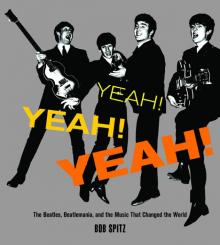
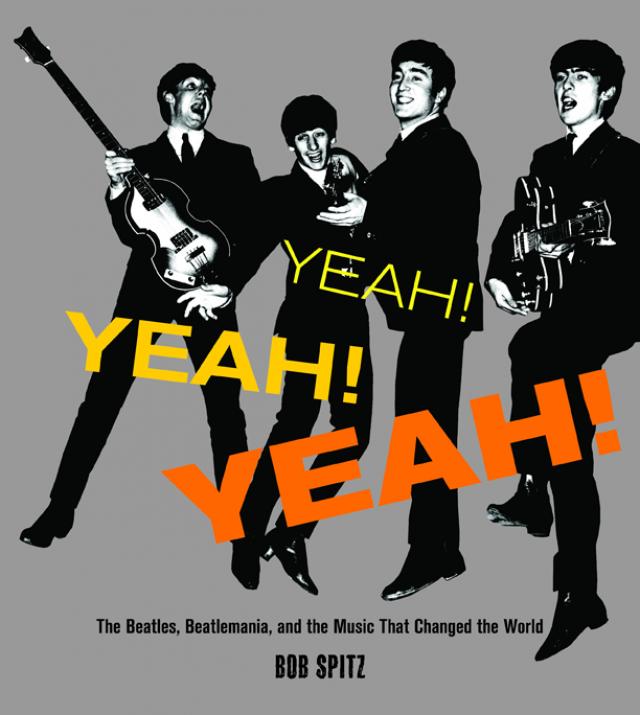
Yeah yeah yeah, p.8
Yeah! Yeah! Yeah!,
p.8


Studio Three, the corner suite, had been reserved for their audition. There was a feverish excitement in the air, and as they walked down the hall, the Beatles established a kind of frisky rapport, joking and firing off quick one-liners at one another to take the edge off their nerves. “We were nervous,” Pete Best acknowledged. “We were feeling the old butterflies.” Still, they threw up a smokescreen so as not to let on about their fears. “We were arrogant, cocky. We’re the Beatles! We weren’t about to let anything show.”
Abbey Road Studio
Located at the intersection of Abbey Road and Grove End in the sleepy London suburb of St. John’s Wood, EMI Studios (always referred to as Abbey Road) wasn’t meant to look like a recording complex. “It’s a house!” the Beatles had groaned upon fi rst setting eyes on it, and indeed it was, a former nine-bedroom Edwardian mansion set off by ample lawns, lilac hedges, and other neatly trimmed bushes.
Be that as it may, the Beatles were awed entering the building and “stepping into another world.” Coming into Abbey Road for the fi rst time, Paul recalled, “We thought, ‘This is a small place,’ but it just kept going on and on.” The place was actually immense. Like a Chinese puzzle box, a block of buildings had been erected, one behind the other, in what was formerly the garden, with corridors leading off at right angles to studios and offi ces.
The Beatles were extremely nervous heading in there to record for the fi rst time, in 1962. “We were feeling the old butterfl ies,” recalled Pete Best, who was still their drummer at the time. Defensively, they clowned around so as not to let on about their fear. “We were arrogant, cocky. You know: We’re the Beatles. We weren’t about to let anything show.”
All that changed, however, when they pushed through the doors to Studio Three. “Look at the size of this place!” they silently beamed to one another, thinking it resembled a football field. The room was wide and airy, with a faint hospital-like smell. Wires snaked along the floor, and there was a sound booth off to the side; otherwise it was empty. What a place!
The Beatles in 1963, performing at an EMI reception launching their first album. © Philip Gotlop/Camera press london
The Beatles set up and ran through thirty-two songs that Brian had selected from their repertoire, barely stopping to catch a breath between numbers. They breezed through them all as though they were playing a lunchtime session at the Cavern, recording two songs cowritten by John and Paul: “Please Please Me” and “Love Me Do.”
As an audition, the session brought mixed results. The Beatles handled themselves well in the studio, but they didn’t impress George Martin or his colleagues at all. Martin enjoyed their voices, but the material troubled him. “They were rotten composers,” Martin thought at the time. “Their own stuff wasn’t any good.” Also, he felt “the drummer was no good and needed to be changed.” Pete had played well enough at their gigs in Hamburg and Liverpool, but when it came to making a professional sound in the studio, he was unable to pull it off.
George Martin, his assistant, and a sound engineer rather mercilessly critiqued the band. The harshness of their response surprised the Beatles, who listened, crestfallen, as the men laid into them for about an hour and were pretty forthright about their performance. They went over everything, from the lack of suitable material to improving their sound to their presence, which had somehow disappointed the record men. They got a real raking-over. When the final blow had been delivered, there was a long, anxious silence. Almost apologetically, George Martin asked the Beatles if there was anything they didn’t like. After a well-timed beat, George Harrison answered, “I don’t like your tie.”
The Beatles Fan Club
Beatles fans in New York on their arrival in August 1964. © MIRRORPIX
Even before the group’s fi rst recording session, the Beatles Fan Club had been organized. A teenager named Bobbie Brown, who followed the band from gig to gig, started it in 1961, sending out monthly chatty newsletters to local girls who paid the fi ve-shilling dues and wrote in requesting intimate information about the lads: the color of their eyes and hair, their height, their ideal girl, car, and food, as well as their upcoming appearances. It was a small, passionate group at fi rst, perhaps thirty-fi ve or forty in all. But by mid-1962, the mail was descending on Brown’s home in bulging sacks, and by the end of that year, the club had more than forty thousand members.
The room went silent. For a split second, nobody breathed. Martin fixed George with a stern look, not certain what tack to take with the cheeky boy. Then he noticed a flicker of a smile at the corner of George’s mouth. A joke! He’d been making a joke! What a perfect icebreaker. Martin’s grin flashed approval ear to ear.
As the sound engineer recalled, “That was the turning point.” The band clicked into Beatle mode, cutting up and peppering the technical staff with wordplay and double-talk in the manner of stand-up comedians. “During that one conversation, we realized they were something special.” Martin and the others laughed so hard that tears soaked the collars of their shirts. “We’ve got to sign them for their wit,” the engineer told Martin after the band had packed up. Martin promised to think about it, but he’d already made up his mind. The Beatles were a go.
He promised them that a proper recording session lay ahead. But first they decided to make some changes. The most important one concerned their drumming situation. They’d known all along that Pete Best was merely adequate, not nearly the musician for a professional rock ’n roll band. For months, the Beatles had had their eyes on the Hurricanes’ drummer, Ringo Starr, and it was time, they decided, to pounce.
Ringo (whose real name was Richard Starkey) had what musicians called chops. He was an excellent drummer with a good feel. He was also very popular with other musicians because he wasn’t a showboat; he played with a nice enough groove that served the songs without taking anything away from them. Plus, his ego never got in the way. Of all the drummers in Liverpool, bands ranked Ringo among the best. But he already had a gig with the Hurricanes, who were close friends of the Beatles.
What they didn’t know was that Ringo had been looking for a better-paying job. He’d been toying with joining the Dominoes, another Liverpool rock ’n roll band, but John and Paul made him an offer he couldn’t refuse: £25 a week, practically a king’s ransom. They also waved around the prospect of a recording contract, which was a big deal to consider. The leader of the Hurricanes, who was disappointed but recognized a golden opportunity when he heard one, refused to stand in Ringo’s way. “You should do it,” he told his drummer. Whereupon Ringo promptly accepted.
The Beatles, who had sensed they were only one man away from being a great band, finally got what they’d always wanted: a world-class drummer.
Forevermore, the Beatles would be John, Paul, George, and Ringo.
Chapter 6
BEATLE MANIA
Ringo’s joining the Beatles wasn’t without bumps. The most violent reaction came from the band’s fans, who were devoted to Pete Best. From the moment Ringo took the stage at his Cavern debut on August 19, 1962, he was greeted by an angry outcry. The crowd chanted, “Pete forever. Ringo—never!” Throughout the band’s set, shouts punctuated the music: “Where’s Pete?” “Traitors!” “We want Pete!” Afterward, when George stepped out of the band room into a dark, crowded passage, someone head-butted him under the eye, giving him a tremendous shiner.
Pete Best had his own wounds to tend to. He was crushed at having been sacked by the Beatles. It hit him suddenly and caught him seriously off guard. All that time he’d put in with the band, their would-be friendship, the dreams. Now, for this to happen—on the eve of a record deal. He considered it a “stab in the back.” And the worst thing was the way in which he’d been dismissed. He’d gotten the news from Brian Epstein, their manager, in the office at NEMS.
“Pete,” Brian told him, “I have some bad news for you. The boys want you out, and it’s already been arranged that Ringo will join the band on Saturday.” It was nothing more than a business decision, he assured Pete in as soothing a voice as was possible. “The lads don’t want you in the group anymore.”
The news knocked Pete sideways. Where were the Beatles? he wanted to know. Why hadn’t they been men enough to tell him themselves?
Pete walked out of the office “in a state of shock.” He’d kept his composure during those difficult minutes, but once he got home, he would admit, “I broke down and wept.”
None of that deterred the Beatles. “Our career was on the line,” Paul recalled, and the band knew how important it was to have a first-class drummer. Besides, it was evident they’d found their man from the moment Ringo took over the beat. Immediately they captured a spark that had eluded them for so long. The energy, the cleverness, the right groove—the magic—breezed into their overall sound.
In contrast to the other Beatles, who were middle- (John) or working-class (Paul and George), Ringo was “ordinary, poor,” a hardship case. “He was not a barefoot, ragged child,” recalled Marie Maguire Crawford, a neighbor who doubled as his surrogate sister, “but like all of the families who lived in the Dingle, he was part of an ongoing struggle to survive.”
The Dingle, which was named by Irish immigrants after the arcadian glade in Ireland, bore little resemblance to its romantic namesake. One of the older inner-city districts in Liverpool, it was grim and really rough, the very edge of civilization, and housed the artisan working class—a mix of carpenters, plumbers, joiners, and others with a trade, who became as tightly intertwined as the project houses.
The Starkeys lived in an unusually roomy—Ringo recalled it as being “palatial”—three-bedroom house at 9 Madryn Street, a narrow alleyway lined with humble plane trees and squares of discolored, cracked pavement. Ringo’s mother, Elsie, had been raised nearby, the youngest of fourteen children. She had learned that a woman should be self-sufficient, that independence meant getting a job, that spare time was devoted to the piano, and that evenings were for going out on the town.
Ringo—or Richard—was born on July 7, 1940. His birth was cause for much celebration on sleepy Madryn Street. Relatives stopped by at all hours to gaze upon the baby with the big, soulful eyes, who everyone agreed was the spitting image of his mum. He had his mother’s long face and sensuous mouth, to say nothing of the thick, dark hair that would serve him handily twenty years hence. Ritchie, as he was called, bore hardly any resemblance to his father, who was quite a handsome man, with curly hair and a thin, narrow smile. He was Elsie’s boy from head to toe, and she doted on him to the point of preoccupation.
Ringo’s father was ill-prepared for fatherhood and even less willing to sacrifice for it, especially those wonderful nights on the town with Elsie. Within months after Ritchie’s birth, things started to unravel for the Starkeys. Ringo’s father withdrew further and further from the family. His nights on the town stretched into days. Often, he didn’t even bother coming home from work, instead heading straight to a pub and then off somewhere crowded, wherever the action happened to be.
No. 10 Admiral Grove, home of Ringo Starr. Dingle, Liverpool, 1964. © BETTMANN/CORBIS
By 1943, the Starkeys’ marriage was over. For his part, Ringo said he had “no real memories of Dad.” He never made any effort to locate his father. Elsie was resourceful enough to pull through. She took a number of lowly jobs—scrubbing floors and doing laundry—until she discovered her calling as a barmaid. Elsie, a gregarious woman by nature, enjoyed pubs and the people who came to them. There was a sense of community inside, and for the next twelve years she was a well-liked fixture in some of Liverpool’s best pubs.
A few days before his seventh birthday, Ritchie complained about an upset stomach, and later sharp pains in his side. By bedtime, the pains persisted and his temperature had soared. His mother called for an ambulance and bundled him off to the hospital, where he had an appendectomy. In the aftermath, he developed peritonitis, a deadly inflammation of the abdomen, and lapsed into a coma. For three days, it was touch and go. Elsie was told to prepare for the worst. Ritchie was very lucky to survive. He underwent a six-month rehabilitation in a crowded hospital ward, then a relapse forced him back to bed, where he remained, barely mobile, for another six months.
Ringo at home with his mother, Elsie, and his stepfather, Harry, before the release of the Beatles’ third album in 1964. © MAX SCHELER/K&K/REDFERNS
Back at home, Ritchie found school a great and terrifying burden. So each morning, after wedging a stack of books under his arm and saying good-bye to his mother, he’d detour into the park and kill time until returning home. This made him something of an outcast in his neighborhood. Families in the Dingle may have been dirt-poor and largely uneducated, but they placed a serious emphasis on self-improvement.
Until he was almost thirteen, Ringo was tutored by Marie Maguire. “He made incredible progress,” she recalled, but then “he got sick again.” It was a disastrous setback. This time it was tuberculosis, and it came as no surprise, considering the epidemic that raged through the filthy Dingle streets. This time, his mother wasted no time getting Ritchie to the hospital, where he remained—“the mayor of the ward,” according to Marie—for almost a year.
The young patients were encouraged to join the hospital band. Ritchie played the drums, using “cotton bobbins to hit on the cabinet next to the bed.” There was a natural feel to the way he held his hands, the impact of the wooden sticks on the wooden surface, and the patterns that emerged. He didn’t just make noise; there was more to it than that, a complex range of sounds he could produce just by experimenting with his wrists. The more he played, the better he became, letting the energy take over.
Ritchie returned home in the fall of 1953, having “grown into a young man, but much frailer than other boys his age and somewhat disoriented.” He’d fallen even further behind in school and was hopelessly lost in class. Ultimately, he left school, instead staying home and listening to music.
In 1953, his mother got married again, to a lovely man named Harry Graves. Much like Paul’s father did with him, Harry helped introduce Ritchie to popular music and in 1957 bought him a secondhand set of drums for Christmas. The gift enthralled Ritchie—and changed his life.
Soon, he joined forces with a friend named Eddie Miles and formed a skiffle band, Eddie Clayton and the Clayton Squares, that played around the Dingle. But before too long, skiffle ran out of steam. Ritchie continued to play with Eddie but moonlighted with other bands as well, including Al Caldwell’s Texans, who were desperate to have a drummer with his own kit. “When we told him we were going into rock ’n roll full tilt,” recalled Johnny Byrne, the band’s guitar player, “he said he was interested.” With Ritchie keeping the beat, they played clubs in November 1958 as the Raging Texans and then as Rory Storm and the Hurricanes, which became one of the most popular bands in the city.
The Hurricanes, it seemed, were going places. Playing with them showed Ritchie that nothing—and no one—could compete with the thrill of the stage. But by 1962, Ringo, who got his nickname from the array of rings he wore, had grown dissatisfied. When the Beatles made their play, he hesitated only long enough to discuss their offer with a friend, who encouraged him to move on—and up—with a better band.
At last, after six years, stardom seemed possible for the Beatles.
• • • • •
The upheaval felt by Ringo’s joining the band carried over into Abbey Road studio, where the Beatles were recording their first single, “Love Me Do.” Something wasn’t clicking. The song lacked drive. After listening to the tape, George Martin determined that Ringo was the problem. “He didn’t have quite enough push,” according to the engineer in the sound booth. The drums were too muddy, not as precise as the situation demanded. A week later, when the Beatles returned to the studio to redo the song, Ringo was stunned to learn that a session drummer had been hired to replace him. Despite the insult, he stepped aside, silently seething, and let the trained ears prevail.
Fans trying to get into Liverpool town hall as crowds gather outside for a civic reception, 1964. © MIRRORPIX
The result was a success. The Beatles cut “Love Me Do,” featuring a nifty harmonica riff by John, and its flip side, “P.S. I Love You,” in a little under two hours. Their first record! The single flew out of the stores in Liverpool, especially NEMS, where they were already stars, but the rest of England gave it only a lukewarm response.
With hardly any time to catch their breath, the Beatles kept another appointment at Abbey Road on November 26, 1962, to undertake a follow-up. George Martin insisted they record “How Do You Do It,” a catchy but lightweight tune by a professional songwriter, convinced it would be a hit. The Beatles, however, were dead set against it. “We just don’t do this kind of song,” they argued. “It’s a different thing we’re going for—something new.” They wanted to record their own songs their own way.
Rock ’n roll bands as a rule never contradicted a producer. In the studio, the producer’s word was law. But much to his credit, George Martin kept an open mind. Without hesitation, he allowed the Beatles to run through a Lennon and McCartney song, “Please Please Me,” that he’d heard in an earlier, slower version. This time it really rocked, and Martin “knew right away” he had something special on his hands. “Please Please Me” was the world’s real introduction to the Beatles, with catchy melodies, clever lyrics, seamless three-part harmonies, and dynamic instrumentation. It was as raw and rough edged as anything to come out of the British pop scene. And Ringo did away with any doubts that he couldn’t handle the drumming, playing a precise, sharp backbeat that cuts loose at the end of the song with crisp bursts of percussion.