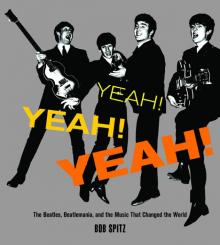
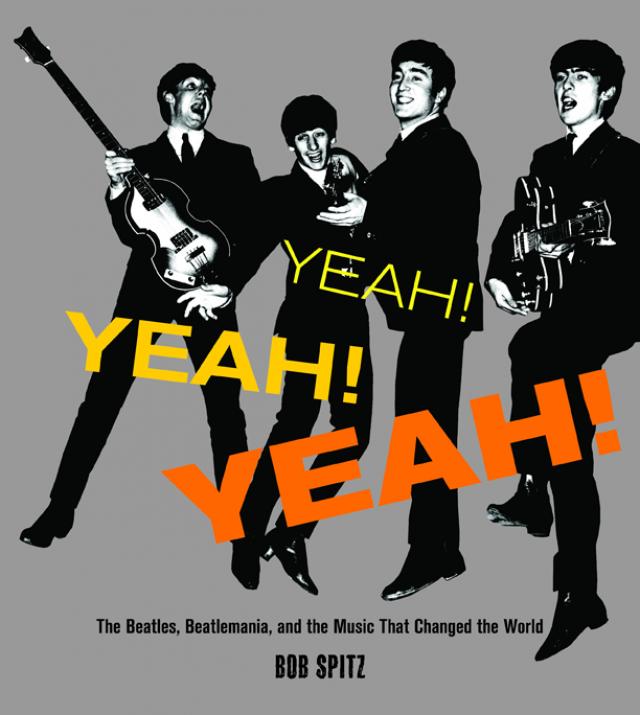
Yeah yeah yeah, p.9
Yeah! Yeah! Yeah!,
p.9


One can only imagine what George Martin felt when he listened to the playback. He was a serious musician, schooled in the formalities of symphony. “Please Please Me” really rocked. Martin knew it the moment he heard the tape. Grinning, he looked up over the console and exclaimed to the Beatles, “Gentlemen, you’ve just made your first number one record.”
• • • • •
Only six days after the release of the single, the Beatles appeared on a British TV show, Thank Your Lucky Stars, to plug “Please Please Me.” The audience was completely unprepared for what they saw. Gliding across the screen were four extraordinary-looking boys, grinning at one another from beneath mops of outlandishly long hair and behaving like cuddly windup toys. No one had ever seen hair that long—or that shape—before. And their suits broke all the rules; they were smart and relaxed but also buttoned to the neck.
The Beatles, posing in the backyard of one of their houses, 1964. © TERRY O’NEILL/REX FEATURES
Once viewers got past the image, the music knocked them out cold. Hearing “Please Please Me” had the same effect as being thrown into an icy shower: the bracing rock ’n roll song chilled to the bone. The tone of it was powerful, unrelenting. “Please pleeease me, wo-yeah, like I please…,” the Beatles sang, vibrating with uncommon energy.
A bomb had gone off. British rock ’n roll had arrived. “To those of us in England who lived for the next great American single,” said journalist Ray Connolly, “it seemed like the Beatles were the promise we’d been waiting for all our lives.” Up until that time, British rock ’n roll was basically American music copied—badly— by the British. Now the UK had an innovator of its own. “Please Please Me” hit the right groove, it was authentic, and it was entirely British.
Unlike “Love Me Do,” which had to scrounge for airplay, “Please Please Me” dominated the BBC with the kind of all-out air-play that indicated a smash hit. The critics raved. And sales were strong, stronger than anything the record company had expected. Even in Liverpool, where the Beatles were already wildly popular, the impact was fantastic. Every time the band came into NEMS to see Brian, where he maintained an office, security measures had to be taken for their safety. Kids started coming around the shop, hoping to get a glimpse of the Beatles, blocking the doors so the ordinary customers couldn’t get in. At one point, there were so many fans hanging around that Brian had to send the boys out the second-floor fire escape, onto the roof, where a ladder lowered them to safety.
Now everywhere the Beatles went there was an uproar. On a short tour through Britain with five other, bigger acts, the Beatles were last on the bill. But as the tour progressed, audiences began calling for the Beatles before the first act was finished. Singer Kenny Lynch, who introduced them, only had to put the microphone to his lips and say, “And now…” before he was drowned out by screams as the Beatles bounded onto the stage. “I think the Beatles shook those crowds up, even scared them a little,” Lynch recalled. “They were so different, so tight, so confident, really playing their hearts out. It was like no experience those kids ever had before. Every girl thought they were singing straight to her; every boy saw himself standing in their place.”
In fact, a group of young girls had already formed a fan club, which had come into full flower around the English provinces. It was like an exclusive sorority that teenagers— mostly girls—joined for five shillings dues, which entitled them to a chatty mimeographed newsletter and intimate information about “the lads”: the color of their eyes and hair, their height, their ideal girl, car, and food (in that order), and also their upcoming appearances. At first, this was a small, passionate group, perhaps thirty or forty in number. But by mid-1963, the mail poured in in bulging sacks, demanding any speck of information about the fabulous Beatles.
“It all changed from that show,” Paul recalled. “We took a break a day or two later, before the next leg of the tour, but when we went back out on the road, you could tell the whole balance had shifted, because all anyone wanted to hear was the Beatles.”
“Please Please Me” shot to number five on the charts. Its success required the band to put out an entire album—ten songs, including “There’s a Place” and “P.S. I Love You,” all of which had to be recorded in a grueling daylong session. It didn’t help matters that John was sick. He had developed a cold during the tour that was festering in his chest by the time the Beatles arrived in London, and his voice was shot. Still, the band managed to run through nine songs by dinnertime, most in only four or five takes. “They just put their heads down and played,” recalled Brian.
One of the songs, entitled “17,” was a breathless, all-out rocker that Paul and John had written one night on the way home from a gig. Its opening line—“She was just seventeen,and she’d never been a beauty queen”—had been bothering the boys for months. Something about it just didn’t work. One afternoon in Liverpool, sitting on Paul’s living-room floor, they came up with the solution: dropping the second part of the line in favor of “You know what I mean.” That line—“She was just seventeen, you know what I mean”—eventually became the cornerstone of the album, certainly the heart of one of their most famous songs, which they retitled “I Saw Her Standing There.” Nothing the Beatles had done so far packed more excitement into a number. From the opening bar, the song takes off, with all the spark and spirit of a rave-up. For two minutes and fifty-five seconds, the Beatles find the groove and don’t let go.
Before each recording session, John and Paul would preview their songs for producer George Martin. © TERRY O’NEILL/REX FEATURES
At the end of the day, the Beatles were exhausted. Even so, they were still one song short. Wouldn’t it be perfect, George Martin suggested, if they wrapped the whole project up that night? Despite their fatigue, the Beatles were willing, and they sorted through songs, looking for a killer finale. The engineer recalled that “someone suggested they do ‘Twist and Shout,’” a staple of Beatles shows throughout the past year, but it required a tremendous vocal performance. It was John’s song to sing. Was he up to it? No one, including John, was sure. He’d been straining his voice all day, draining it like a car running on fumes. There was enough left, he insisted, though admittedly his throat felt “like sandpaper” when he swallowed.
Everyone knew they’d have to get it on the first take, without a missed note or a recording glitch. There would be nothing left of John’s voice after that.
The band returned to the studio and tuned up. It was cold in the room, and the air seemed thick and stale. John tore open a wax carton and gargled noisily with milk. He’d played most of the day in a rumpled suit, but sometime after dinner the jacket was removed and two fingers yanked down the tie. Now, without a word, he stripped off his shirt. He draped it over a bench, then walked to the microphone and nodded to the others: good to go.
It was obvious from the very first notes that John was straining for control. “Shake it up, bay-be-eee…” was more of a shriek than singing. There was nothing left of his voice; it was bone-dry. Between clamped jaws, contorting his face, he croaked, “Twist and shout.” He had been struggling all day to hit notes, but this was different; this hurt. And it was painful to listen to. But the band rocked harder, building excitement with their energy, until the last tortured line, when Paul shouted, “Hey!”
John was wasted, near collapse, but the others already knew what he was about to find out: that “Twist and Shout” was a masterpiece—imperfect but still masterful, raw and explosive. In the control booth, there was jubilation as George Martin and his crew knew they had “got it in one” take.
The Beatles had their first album, but there was still no time to rest. For the next ten days, from February 12 to 22, 1963, they hopscotched around England, playing one-nighters on a crazy zigzag route. It was a brutal grind, and they grumbled—grumbled mightily. But after the grumbling came the work. Exhausted though the Beatles may have been, they never passed up an opportunity to promote themselves. Drive all night to a gig, shake hands with a record seller, sign autographs at a record shop, play a dance, a talent show, they did everything—everything—necessary to get their name around, to win fans, to succeed. There was a feeling shared among the band that if they kept at it, the dream would come true.
Beatles fans screaming outside the Palladium as they await the arrival of their idols, October 1963. © MIRRORPIX
The record deal was rewarding, and it had kept them going for quite a long time. But it was nothing compared with the news Brian delivered the following week, while the Beatles played a club near their home. “Please Please Me” had not only hit the charts, it eventually shot to number one in England.
• • • • •
For the Beatles, everything changed with their leap to the top of the charts. Once their record hit number one, their popularity extended far beyond the Cavern walls and far beyond the Mersey banks, establishing them as something of a national phenomenon. When they rejoined the five-act tour, everywhere the Beatles played, earsplitting screams broke out at the mere mention of their name. The minute the lights went down, the crowd went crazy. And after each act finished its set, the theaters shook with kids hollering, “We want the Beatles! We want the Beatles!”
By the end of 1963, the Beatles and their manager had grown weary of dragging themselves back and forth between Liverpool and London, sometimes two or three times a week. Besides, none of the boys had a place of his own. One might say they still lived with their parents, but even that was inexact. Interaction with families and friends was becoming awkward. Besides, all of the Beatles except George had steady girlfriends, with whom they were spending steady time. And with the constant invasion of fans, as Ringo noted, “it was impossible to go home.” Even John, whose wife, Cynthia, and son, Julian, born on April 8, 1963, remained Merseyside, lived more or less out of a suitcase.
Paul and Jane Asher in 1965, during the early days of their courtship. © MIRRORPIX
As a remedy, Brian rented the Beatles an un-furnished apartment in London, to use as a base when they were in the city on business or playing nearby. The little flat was frightfully sparse—no furniture to speak of, just three bedrooms with nothing more than single beds and lamps. A tortured stereo in one corner played a never-ending selection of loud music. But if there was a bleakness about it, Ringo and George, at least, didn’t seem to mind. As George recalled, “It was such a buzz because we’d been brought up in little houses in Liverpool, and now to have a posh apartment in Mayfair, and with a bathroom each, it was great.”
A crash pad was all right for George and Ringo, but John, for one, had a family to think about. Eventually he moved with Cynthia and Julian into a tiny fifth-floor apartment nearby. Paul, too, decided to split from the group’s place. He’d become involved with a scarlet-haired teenage actress named Jane Asher, who was a familiar face on British TV and on the stage. More and more, after a hectic day conducting Beatles business, Paul would make a beeline for her family’s town house. Throughout the fall of 1963, Paul and Jane spun madly from the West End to Covent Garden to the National Theater to various clubs, to anywhere there was something of cultural interest going on. Plays, exhibitions, concerts, parties, one after another—there was never a dull moment.
Friends described Jane Asher as “your typical girl next door.” She was all of seventeen when Paul first met her and already a fixture in the London acting community. She was slim-waisted, small, and striking, with delicate features and a pale, creamy complexion. After an adolescence of auditions and finishing school, Jane developed enormous poise accentuated by a lithe theatricality. Like Paul, Jane had the aura. “She was smart and sexy,” said one of Brian Epstein’s assistants, “one of the most charming young women I ever met.”
Paul immediately fell in love with her, as well as with her family. In November, Jane suggested that he move permanently into the Ashers’ magnificent town house; if he liked, the attic room was available, along with honorary membership in the family. The magna-nimity of it must have shocked Paul, who had been living out of a suitcase—or in a filthy van—for so long that it was hard for him to remember the last time he had his own room. To say nothing of a girlfriend who was living only one floor below. It was not an invitation that required much deliberation. “For a young guy who likes his home comforts,” he noted, it was a dream come true.
But it was only part of the dream. With all the hoopla, Brian Epstein suggested the Beatles take their show to America. The Beatles had always regarded the States as the promised land—home of their early singing idols Chuck Berry, Buddy Holly, Little Richard, the Everly Brothers, and, of course, Elvis Presley—but their records weren’t being released there. Capitol Records, which had the rights to Parlophone for America, frankly refused to put out British pop records. According to Capitol’s top executives, the Beatles were “nothing,” and they turned the group down cold. A New York lawyer sent copies of “Love Me Do” and “Please Please Me” to all of the other major American record labels and came up empty-handed. Only a tiny independent Chicago label called Vee-Jay heard the magic and agreed to put the two singles out in a few months’ time.
Meanwhile, the Beatles launched their next single in England, “From Me to You,” which came crashing onto the charts at the number six position and sold 200,000 copies in the first week alone. A British writer observed, “By now the Beatle legend was beginning to grow. It was becoming clear they were something rather special.” That was putting it mildly. All of London, it seemed, had their name on its lips: the Beatles!
Unfazed by the attention, the band plowed through appearances on television and in theaters, promoting “From Me to You” without pause. And everywhere they went, fans greeted them with screams that lasted right through their act.
Following the taping of a TV show, the Beatles were invited to hear a new rhythm and blues band that was playing in a club just outside of London. The Beatles had been hearing a buzz about the band for some time, and when they got to the club, it turned out to be a tumultuous scene. The place was mobbed with a wild and woolly bunch of fans who shouted and screamed and danced on tables. The Beatles heard right away what a “great sound” the band was making. The two guitar players—Keith Richards and Brian Jones—“just had presence,” according to Ringo, who summed up their appeal with one word: “Wow!” Mick Jagger, the band’s vocalist, seemed more than stylish. And everyone loved the band’s name: the Rolling Stones.
Later that night, as the two bands talked until dawn, none of the musicians could have dreamed of the incredible fame that awaited them or the cultural upheaval brewing in Britain. But there were already signs of a musical revolution. Besides the Beatles and eventually the Stones, inroads were being made by groups like the Yardbirds (with a guitar player named Eric Clapton), the Pretty Things (whose singer was Rod Stewart), and many others. But it was the Beatles, everyone agreed, who set the British music scene on fire. The fan mail was the best evidence of what lay ahead. Complete strangers wrote to thank the Beatles for their music and to pledge undying loyalty to the band. Thousands of letters poured in every week—bundles, cartons, sacks of mail, including autograph requests, love letters, stuffed animals, and pictures. And their fan club had grown to forty thousand members in England alone.
Lead singer and founding member of the Rolling Stones, Mick Jagger, with Keith Richards and Bill Wyman, 1960s. © MIRRORPIX
To satisfy their fans, George Martin begged the Beatles for another hit record. A song they’d begun writing after a gig seemed as if it might fit the bill. Paul had sketched out a lyric that showed promise. The way Paul saw it, he’d sing, “She loves you,” and the band would respond, “Yeah…yeah…yeah.” John liked it, though he thought the answering business was a “crummy idea.” They set to work, whipping out their guitars, and in a few hours’ time had the bones of a song in place. George Martin listened to a rundown of it in the studio and thought it was “brilliant…one of the most vital songs the Beatles had written so far.”
What the Beatles built into the song provided a perfect, lasting image for them: the yeah-yeah-yeahs and the falsetto ooooos (when performing this, they shook their heads in unison, setting off rapturous shrieks from the fans) became enduring symbols. Nothing identifies them more vividly.
Unlike the band’s previous records, “She Loves You” touched off a nationwide reaction the press immediately called “Beatles fever.” Before the record was even released, Parlophone had orders for a staggering 235,000 copies. No act in memory had spurred such demand. “We were like kings of the jungle then,” John remembered.
Unfortunately, that wasn’t the case in America. No one in the States knew who the Beatles were. Vee-Jay had released their first two singles, but even by Paul’s account, they were “a flop.” American disc jockeys ignored them completely. Brian Epstein, their manager, went to New York in an attempt to get things started, but not a glimmer of interest in the Beatles surfaced anywhere he went.
All that, however, was about to change. On Sunday, October 13, 1963, the Beatles were scheduled to appear on a British television show called Sunday Night at the London Palladium. Practically every TV set in the country was tuned to it each Sunday night as the top English and visiting American performers took part in the prestigious variety show. In Ringo’s estimation, “There was nothing bigger in the world than making it to the Palladium.”
Fans had begun gathering outside the theater just after the Beatles’ arrival for a rehearsal. By late afternoon, the situation outside the stage door intensified. There were a hundred or so kids hanging out there—more than the Beatles could safely deal with. Later, as the band left the theater and headed to their car, hordes of fans converged from everywhere and it all happened at once. An incredible roar went up, not merely any roar but an earsplitting blast of excitement, mixed with surprise and awe. Pandemonium broke out on the sidewalk. Pushing and shoving started as the Beatles ran through grabby hands, diving for cover into the car. In ten minutes, every newspaper had been alerted to the story.