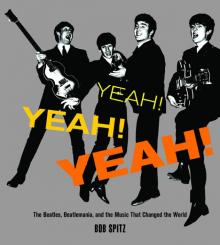
Yeah yeah yeah, p.5
Yeah! Yeah! Yeah!,
p.5


Cynthia and John, 1964. © MIRRORPIX
It was almost by accident that Cynthia came to John’s attention. They were in a lettering class together, but, as Cynthia recalled, “For John…[lettering] was impossible.” In order to distract from his inability, he became the class cutup, the clown. Still, this bad boy who disrupted everything he came into contact with lit a fire in her, and they struck up a “vague friendship.”
Later that December, a few days before the end of term, Cynthia and a group of friends decided to celebrate the upcoming holiday by going to a hangout between classes. After lunch, everyone drifted back to school, where an impromptu party was already in progress. A record player had been set up in one of the rooms. When John pushed his way through a tangle of couples and asked her to dance, she fell rapturously into his arms.
She came away from that room, Cynthia said, “madly in love.” For the next few weeks, John and Cynthia were just about inseparable. Their attraction may have shocked their fellow students, who considered the two of them “like chalk and cheese,” but it was mostly regarded with enthusiasm and relief. John became less of a cutup and easier to be around. “It calmed him down,” recalled a friend, “letting us live and learn in peace.”
But there was still music and the band that needed resolving, and until that score was settled, there would be no peace in John Lennon’s young life.
• • • • •
By the end of 1958, without much happening with John and Paul, George’s desire to play was so strong that he took up with three other friends who had a rock ’n roll band. They had arranged to play at the opening of a new club called the Casbah, which was in the basement of a large, handsome house owned by a family named Best. One of George’s bandmates knew Pete Best from school. It had been Pete who convinced his mother, Mona, to invite kids to dance in their basement and to put in special lights and a sound system. More than three hundred teenagers had already purchased club membership cards, so the opening promised to be a very special event.
A week before the Casbah opened, however, the band fell apart. George was on his way to the Bests’ house to give them the bad news when a friend asked him if there was any way to salvage the job. He said he had two friends—John and Paul—and went off on a bus to fetch them.
Pete Best on drums, 1962. © K&K STUDIOS/REDFERNS
For the moment, the Quarry Men were back in business. The Casbah was a runaway success. The new club was dazzling, hot, loud, young, private, and rocking— pulsing with just the right atmosphere. And the Quarry Men brought the house down. Even without a drummer, the kids loved them. Mona Best was so delighted that she guaranteed the band the princely sum of £3 a night to play there every Saturday. The Quarry Men were the featured attraction, and because of them the Casbah membership spiraled into the thousands. The club became so popular and crowded that after a while, you could barely hear the band. Eventually, however, an argument over money cost the Quarry Men their job, and a new band took over, featuring Pete Best, who had recently taken up the drums.
• • • • •
Throughout the next school year, in 1959– 60, things became very hectic for John, Paul, and George. John grew bored with his college studies; impatient as ever, he hated learning about art as opposed to actually painting and drawing. Besides, he was pre-occupied with rock ’n roll, so there was little to hold his attention in the classroom. George was also having trouble concentrating and eventually quit school. “At that stage, he didn’t have any idea what he wanted to do with his life,” recalled his friend Arthur Kelly. Everyone seemed to have a suggestion, but George was content to take a job at one of Liverpool’s department stores until something better came along. Only Paul stuck it out in school, but even he was growing restless, and it showed in his dwindling grades.
Stuart Sutcliffe and George, who became good friends, sharing a quiet and thoughtful musical interlude, 1960. © PETER BRUCHMANN/REDFERNS
Only rarely were the boys able to play somewhere meaningful as a band. There were very few gigs for a group without a drummer. Instead they entered several competitions, where they performed in a lineup with eight or ten other acts all hoping to be noticed by local promoters. Determined to break cleanly with the past, the Quarry Men changed their name to, of all things, Johnny and the Moondogs, which had the right touch of playful humor.
In the meantime, they continued to practice and play together, rehearsing at the flat of John’s friend Stuart Sutcliffe. Stuart, a slight, gentle young man, was one of the most respected painters at the art college, brimming with talent and a promising future. In fact, he had just won first prize in a prestigious competition sponsored by the local art museum and had been awarded a considerable sum for the honor. John, who was always thinking of his band, knew exactly how his friend should spend it. “Now that you’ve got all this money, Stu,” he said, “you can buy a bass and join our group.”
It took only a long moment for Stuart to mull over the offer before responding to John. He thought it was a wonderful idea, even though he didn’t know how to play a bass guitar or if he could carry a tune. It didn’t matter. To Stuart, playing the bass was simply another form of art. “And anyway,” he explained to a friend, “the band is going to be the greatest. I want to be part of it.”
After Stuart joined the band, a more proper name seemed in order. One night in February 1960, while sitting around the flat, John and Stuart brainstormed to come up with something better than Johnny and the Moondogs. Both boys loved Buddy Holly and the Crickets, whose songs were an inspiration. John remembered “just thinking about what a good name the Crickets would be for an English group, when the idea of beetles came into my head.” It was John’s idea to change the spelling “to make it look like beat music, just as a joke,” although when they printed it on a card to show the other boys, it became Beatals.
Paul and George heard about the new name the next day, and they immediately liked it. The Beatals. It had the right sound to it, they thought, amusing and cheeky. Yes, the Beatals—it would do nicely, everyone agreed.
But even with a name like the Beatals, the band was not able to attract any work. There was still the problem of the drums. And while Stuart looked swell with an electric bass slung across his body, there was the matter of actually playing it that needed to be worked out. Stuart’s thumb plucked at the chunky strings, but he was able to produce little more than a steady heartbeat, a monotonous thunk-thunk-thunk. And it left his hands—those delicate instruments that produced such gorgeous paintings—in terrible shape.
The four boys, the Beatals, would rehearse for hours in the basement of a tiny Liverpool coffeehouse, the Jacaranda, where other art students were inclined to drop in and listen to them play. The coffeehouse’s owner, Allan Williams, took an immediate interest in the band. He even encouraged the more professional local bands to include the Beatals in their get-togethers. One popular singer, Brian Casser—whom everyone called Cass—convinced them to change their name to the Silver Beetles. And a few days later he found them a drummer named Tommy Moore. Tommy was twice their age and had a day job operating a forklift, but he played in dance bands and could put the beat in the right place.
Now that they had a drummer, Stuart stayed after Allan Williams about giving the Silver Beetles a break. They were desperate to get going, to play in front of an audience. It didn’t take long for Williams to get the band some action. A British rock star named Billy Fury was preparing a tour, and he agreed to take a Liverpool group as his backup band. Four of the city’s best groups were invited to audition—as well as the Silver Beetles. The boys were beside themselves with joy, but it was clear to most people that they didn’t stand a chance against the other, more professional bands. “We didn’t even know them,” said a musician who played with the flashy Seniors, “and I don’t think anybody else knew them either.”
The day of the audition—May 10, 1960—everyone crowded into a tiny club where Billy Fury sat stone-faced, listening to the competition. Cass’s band, the Cassanovas, played first and did horribly. The Seniors, who followed them, sounded shrieky and shrill. Gerry and the Pacemakers sounded great, but they lacked a certain spark. And Cliff Roberts and the Rockers couldn’t compete in any category. The Silver Beetles, who played last, had nothing to lose. The boys launched into a brilliant set that left the others in the dust. “They blew everyone away,” recalled a musician who was there.
Billy Fury immediately cued his manager that the Silver Beetles were a natural fit. The manager wasn’t so sure, but he agreed to take the boys as Fury’s backing group—only without the bass player, Stuart. John stepped forward and turned him down cold. As far as the Silver Beetles were concerned, he explained, it was an all-or-nothing proposition. Either all of them went on tour or he could choose another band. In the end, it was decided that no Liverpool band would back Billy Fury. But another pop star, Johnny Gentle, who was about to begin a tour of Scotland, needed a backup band, and that job was offered instead to the boys.
The Silver Beetles were ecstatic. Johnny Gentle was an up-and-coming recording star, and this was a legitimate tour. They would finally have work as a real band.
Hastily, arrangements were made. Tommy Moore and George took time off from their jobs, Paul sweet-talked his father into a vacation before his upcoming exams, and Stuart and John simply cut classes. All the pieces fell neatly into place. Suddenly, everything seemed possible. They were actually going on the road—a road from which they would never look back.
Chapter 4
THEIR BIG BREAK
If the Silver Beetles had any illusions that life on the road was a glamorous one, they ended with the tour of Scotland.
For two weeks that summer in 1960, the boys crisscrossed hundreds of lonely miles through some of the most rugged, grim, and barren countryside on the northeast coast. There were none of the modern conveniences that cushioned travel between cities like Liverpool and London. The rickety train, lurching on the tracks, was insufferably hot and depressing, the stale air bone-dry and hard to breathe. It seemed to take forever to get to Scotland, as they snaked past the stagnant little provincial towns that dotted the river banks.
Johnny Gentle was waiting for them when they arrived. Though not yet quite a star, he had a decent following of fans who knew his two hit records and were waiting to see him perform. The Silver Beetles had only a half hour to rehearse with him and hammer out an agreeable set of songs before they were due to go on stage. They needed enough material for two one-hour shows, which meant they would have to work out most of it on the spot, in front of an audience.
They went right to work, playing at “border dances,” which were social gatherings in little halls that held up to three hundred teenagers who could shuttle between upstairs rooms featuring rock ’n roll shows and downstairs auditoriums where traditional bands played the Scottish reel. Inside those dinky, dilapidated halls, the Silver Beetles pulled out all the stops. They pummeled those Scottish kids with forty minutes of the most exciting music that never let up for a beat. One after another, the songs built to a furious, undisciplined pitch, rumbling and wailing like a train through a tunnel. The kids at each show were undone by the music, practically throwing themselves around the floor.
“I used to watch [the Beatles] work the crowd as though they’d been doing it all their lives,” Johnny Gentle remembered, “and without any effort other than their amazing talent. I’d never seen anything like it. [John and Paul] were so tapped into what each other was doing and could sense their partner’s next move. They just read each other like a book.” Johnny Gentle put on a good performance, and the fans loved him, but the Silver Beetles rose mightily to steal the whole show.
George Harrison, Stuart Sutcliffe, and John Lennon, photographed by Astrid Kirchherr, 1960. © K&K ULF KRUGER OHG/REDFERNS
The boys were naturals. Still, it was difficult work. They played until very late each night in front of notoriously rough crowds that often started fights during the shows. It was impossible to get to sleep before dawn. And there was very little money to be made. Three days into the tour, in a town called Fraserburgh, the last scrap of land on the gusty northeast coast of Scotland, the Silver Beetles’ pockets were empty. They had to borrow money from Johnny Gentle so they could eat.
When they got back to Liverpool, the boys were tired and broke. But word had filtered back that they’d been brilliant on stage, so Allan Williams was able to book them for a string of dances that ran through the summer. The gigs helped to establish them locally, and they were paid an awesome £10 a night, more than they’d ever made before. The bad news was that the dances were in the worst holes this side of the equator—very rough ballrooms where punch-ups interrupted each song, with flying crates and beer bottles and glasses. The Silver Beetles learned how to play in any situation.
When it seemed they were about to hit the big time, Tommy Moore quit the band. The boys were devastated, though they tried to keep up appearances. Unable to play the rest of the summer dances without a drummer, they bumped around the city, singing in dingy pubs. But they were miserable, embarrassed, and depressed—an indication of how badly their dreams had stalled.
Just when everything seemed hopeless, just when it seemed they would have to disband and take up ordinary part-time jobs, Allan Williams threw them another life preserver. Williams had booked Derry and the Seniors, a popular Liverpool band, into a club in Hamburg, Germany, where British and American servicemen were stationed and where the demand for live music far exceeded the supply. The Seniors proved such a success that the promoter begged Williams to send him another Liverpool band to play in a second club he owned. Allan offered the gig to Rory Storm and the Hurricanes, whose drummer was a bearded character named Ringo Starr, but they were determined to finish an engagement in Wales. Instead, he flirted with the idea of sending the Silver Beetles. Reluctantly. “They were really in no condition to perform,” recalled their friend Bill Harry, “but they courted Allan, and Stuart came on strong.”
Once again, fate intervened. With nowhere to play, John, Paul, Stuart, and George just hung out in local coffee shops and dance clubs, scouting out the competition. One of their stops was at the Casbah, where, at the time, the Blackjacks were playing. Sitting behind the drums was Pete Best. As far as the Silver Beetles could tell, he was pretty good—“a real pounding rock ’n roll drummer,” according to a fellow musician—and gave off “a powerful effect.” He owned an impressive new drum kit, and it also didn’t hurt that he looked good. Pete was a pale, stiff boy with a dusty mop of hair, eyelids all but shuttered, and an affecting languid smile, and girls were drawn to him in a visceral way. The Silver Beetles were keenly interested. With a drummer like Pete, they’d surely convince Allan Williams to give them the Hamburg gig.
The only thing left to do was to poach Pete from the Blackjacks, which turned out to be child’s play. Paul called him later that night, dangling a job opportunity that would pay him a whopping £15 a week. Pete didn’t hesitate to accept. “I’d always liked them very much,” he allowed of the Beatles. Besides, he dreaded going to a teachers college in the fall. “I decided [instead] to persevere with the music.”
The Fifth Beatle
Throughout the Beatles’ existence, several people claimed that they were “the Fifth Beatle.” Murray the K, the New York disc jockey who greeted the boys when they fi rst arrived in America and coined the phrase, was the fi rst to stake his claim. But before Murray, there were other, more worthy candidates:
Stuart Sutcliffe: The Beatles’ fi rst bass player helped name the band and was the fi rst to comb his bangs over his forehead.
Pete Best: The Beatles’ original drummer gave them their powerful “atomic” sound and carried the beat throughout their apprenticeship in Hamburg.
Neil Aspinall: Their trusty roadie was with them from the beginning and remained with the band until they broke up in 1970. Today, he continues to serve as the president of Apple Music.
George Martin: Their distinguished producer mentored the Beatles through the recording process and deserves credit for allowing them to experiment with sound and establish their identity.
Brian Epstein: Their manager believed in them when others only laughed at the prospect of the Beatles’ becoming “bigger than Elvis.”
In the meantime, the other boys set about untangling personal commitments. John learned that he would not be welcomed back at the art college, where he was failing most of his courses. If Aunt Mimi found out, he’d never hear the end of it. Anyway, there was nothing she could do to keep John from going to Germany. He was nineteen, of legal age, and well outside his aunt’s grasp. Paul had another term left at the Liverpool Institute and a father for whom education was the one sure route to social betterment. “I didn’t want to go back to school, or college,” Paul later explained. Yet he knew that Jim would not tolerate idleness. So Paul invited Allan Williams to the house to help plead his case. Allan laid it on thick, assuring Jim that there would be no problems, that he would look after the boys. And Paul probably implied that after Hamburg, he would continue his studies. Before the evening was over, Jim had given his consent.
One of the Beatles’ awkward Hamburg stage arrangements, with Paul stationed at the piano while Stuart anchored the bass. © K&K STUDIOS/REDFERNS
Allan also spoke to Stuart Sutcliffe’s parents. George had already dropped out of school and was free to do as he pleased. So the deal was sealed. Very quickly thereafter, the gears began to crank. Birth certificates were produced, along with passports and visas. Bags and equipment were packed and labeled for transit. It all came together with remarkable speed. On August 16, 1960, the Beatles (they finally changed the spelling of the name)—John, Paul, George, Stuart, and Pete—left for Hamburg.