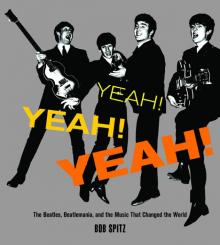
Yeah yeah yeah, p.12
Yeah! Yeah! Yeah!,
p.12


They also wrote “No Reply” and “I Feel Fine,” both of which would appear on the Beatles’ next album. While they were recording “I Feel Fine,” a happy accident occurred. They had finished a decent take of the song and were about to listen to the playback. “We were just about to walk away,” Paul remembered, “when John leaned his guitar against the amp.” The closeness of the guitar and amp produced an electrical spike that sent distortion echoing through the studio. For the Beatles, discovering feedback was like hitting the lottery. No one had ever considered using a sound effect like that before. “Can we have that on the record?” Paul asked George Martin. No problem. They re-created the accident, and each time seemed to get more control over the sound.
In a year, the Beatles would almost single-handedly reinvent the way music was recorded, but for now they were happy to revel in their discovery. It was a completely new and exciting experience. In the fall of 1965, they put it all together. Like everything else they’d done, their unique sound was the result of exploring the past and using early pop music influences to go their own way. As John described it, “We finally took over the studio.”
Chapter 8
THE BARDS OF POP
The whole of London now moved to the beat of the swinging Beatles soundtrack. Almost everyone credited them with the new and enchanting spirit that now seemed to be seeping into all aspects of city life. There was a revolution in the arts that could be seen on the walls of London’s galleries. Similarly, rock ’n roll had taken over the airwaves, with bands like the Animals, the Kinks, the Yardbirds, Herman’s Hermits, the Dave Clark Five, the Who, and of course the Rolling Stones. Fashion had been transformed by designers whose boutiques turned a seedy lane in Soho called Carnaby Street into a high-style mall. As one shopper recalled, “There were so many different things you could wear—red corduroy trousers, green corduroy trousers, flowery shirts, polka dots everywhere. Before that, all we had were gray and brown.”
It went without saying that the Beatles rejuvenated, if not reinvented, the local scene. Their music spoke directly to young people and eloquently expressed teenage feelings. Their round-necked jackets and high-heeled boots dominated fashion. And they appeared daring thanks to the cut of their hair. According to a famous British journalist, “The Beatles changed everything.”
But the Beatles weren’t interested in social upheaval. They wanted to make records, not waves. And despite the success of A Hard Day’s Night, they had no great desire to become movie stars. Their second film, Help!, made in 1965, was more work than fun. They’d begun experimenting with pot, which didn’t help matters. The Beatles were so stoned, so distracted filming the movie that they couldn’t remember their lines. As a result, it seemed to take forever to complete their scenes.
Their adventure with marijuana began when they were in New York and met Bob Dylan, whom all of the Beatles idolized. Dylan was a pop god, as far as the Beatles were concerned. Paul had discovered him first, buying The Freewheelin’ Bob Dylan album before they left for a tour of Paris at the beginning of the year. That record hit the turntable the moment the Beatles settled into their hotel suite. “And for the rest of our three weeks in Paris, we didn’t stop playing it,” John recalled. Considering he was only a twenty-year-old folk singer, the way Dylan wrote and sang—the strong intelligence, the unusual phrasing—did a major number on the Beatles. “Vocally and poetically, Dylan was a huge influence,” according to Paul.
Bob Dylan, 1964. © MIRRORPIX
When Dylan caught up with the Beatles in New York, they were ready for anything. Dylan was eccentric and intense but cool, very cool, in a way that only another pop act could appreciate. Even so, when he suggested they smoke marijuana, the Beatles were stunned—and a bit stupefied.
They were also uncomfortable, having never smoked pot before. But the boys found its effect spectacular—“We were just legless, aching from laughter,” George told a friend—and extremely liberating. Or so they thought. For the moment, it seemed like fun, but it would ultimately cause problems as, hopelessly stoned, they tried to look and act straight with friends and family.
It didn’t seem to hurt, however, when it came to their music. Help! needed a soundtrack album, so John and Paul got down to business, doing what they did best— writing songs. They worked furiously, high on pot and adrenaline, jotting ideas on pages that they ripped from spiral-bound tablets when they grew dissatisfied. Almost every line of every verse of every song was reworked several times. They spit words out quickly, sometimes talking over each other, testing rhymes and inflections in the process. Things occasionally got lost in the flow, but that had always been the way they worked best. “We made a game of it,” Paul recalled. “John and I wrote songs within two or three hours—our ‘time allotted.’ It hardly ever took much longer than that.” Or else they lost interest and moved on.
Almost immediately, they cranked out a treasure trove of new and unique songs. “Ticket to Ride,” which was released as a single in advance of the movie, sounded like nothing a rock ’n roll band had ever produced. “We sat down and worked on that song for a full three-hour songwriting session,” Paul recalled, “and at the end of it we had all the words, we had the harmonies, and we had all the little bits.” Aside from “Help!” and “Ticket to Ride,” the other gems were “You’re Going to Lose That Girl,” “It’s Only Love,” “You’ve Got to Hide Your Love Away,” and “I Need You.”
Two weeks before filming started, Ringo took a day off in London and married his girlfriend, Maureen Cox, making him the second of the Beatles to tie the knot. “He’s the marrying kind,” John explained after the news hit the papers, “a sort of family man,” which was true enough. Only a few months earlier, Ringo had told a reporter, “I want to get married someday and I don’t plan to wait too long about it.”
Both George and Paul also had steady girlfriends; George continued to date model Pattie Boyd, whom he had met on the set of A Hard Day’s Night, and Paul was still dating Jane Asher, the up-and-coming actress who had already appeared in a popular TV series and was performing regularly in the theater.
The Beatles spent the first half of 1965 ping-ponging between the movie studio and the recording studio. Aside from a brief vacation abroad, all their spare time was filled with radio and TV appearances to plug their latest album. It seemed as if their lives were bogged down in work, without much freedom. Then, in early May, Brian Epstein showed up on the movie set and assembled the Beatles in a dressing room. He acted “rather secretively,” according to Paul, who sensed that something extraordinary was about to happen. “I’ve got some news for you,” Brian announced with great theatricality. “The prime minister and the queen have awarded you an MBE.”
None of the boys had any idea what he was talking about. An MBE might have been a sports car, for all they knew. (George later joked that it stood for “Mr. Brian Epstein.”) As mostly working-class lads from Liverpool, they had little knowledge of the titles given to upper-class Britons. What they discovered was that under a charter signed in 1917, the king and his successors were empowered to recognize distinguished service to the Crown through honorary awards. The highest rank was Knight or Dame, the lowest was Member of the Most Excellent Order of the British Empire, or MBE. Usually it was awarded for acts of heroism in war. Giving it to pop stars was unprecedented. The Beatles were astonished.
The Beatles displaying their MBE medals at a press conference in 1965. John later returned his medal. © PETER MITCHELL/CAMERA PRESS (G/S) LONDON
They thought they were unworthy of the honor. So, too, did many of the war heroes who had already been awarded an MBE. One man decorated for bravery fired off an angry letter to Buckingham Palace, saying, “I am so disgusted with the Beatles being given this award that I am considering sending mine back.” Another complained that giving the award to the Beatles made “its meaning seem…worthless.” Discussing it among themselves, the Beatles decided not to accept the award, but Brian convinced them otherwise.
Brian Epstein and George Martin at Abbey Road studio. © MIRRORPIX
In the midst of all the MBE ruckus, the Beatles continued to record, laying down the tracks for some of their most famous songs: “I’ve Just Seen a Face,” “It’s Only Love,” and “I’m Down.” During one long session, Paul was eager to try something new. He dragged a stool to the middle of the studio and, with the lights dimmed, played guitar to a ballad he had just written, which would become the most recorded song of all time.
“Yesterday” had been rattling around Paul’s head for nearly two years, since he “woke up one morning with the tune,” tumbled out of bed, and even before washing his face ran through it at the upright piano in his room. Had it come to him in a dream, as he initially suspected? Was it something he’d heard that he refused to let go of ? Paul hadn’t the foggiest. The chords just kept coming, one after another, falling neatly into place. The melody sounded familiar, like one of the old standards his father used to pound out on the piano after dinner, and though the overall impression it left was “very nice” indeed, Paul convinced himself that the tune was something he’d stolen. Still, the melody haunted him. “It was fairly mystical,” he explained. He couldn’t let go of it.
Friends assured him that the tune was original—all his. A songwriting acquaintance insisted he was “onto something important.” Even so, Paul remained unconvinced. He felt it was something he’d heard before. But everywhere he turned, the trail went cold. No one recognized it; it didn’t even resemble another song.
“Michelle…Ma Belle”
One day in 1965, John reminded Paul about “that French thing” he used to play at parties in Liverpool. Paul knew exactly what he was talking about: a precious, “rather French-sounding” instrumental he’d spun using a fi ngerpicking technique. “Well, that’s a good tune. You should do something with it.”
Coincidentally, Paul had been tinkering with a lyric built around the name Michelle and thought it might match up with the melody. To give it the musical lilt the name seemed to suggest, he decided to weave in a few French phrases as an accent. “Michelle…ma belle.” It so happened he was spending the weekend with his old Liverpool schoolmate Ivan Vaughan, whose wife taught French at a primary school. At Paul’s urging, she helped fi ll in the rest of the French expressions. By the time Paul played it for John, the song was pretty much fl eshed out but still lacked a chorus. “I had been listening to [the old song] ‘I Put a Spell on You,’” John recalled. “There was a line in it that went: ‘I love you, I love you, I love you.” Changing the emphasis to love, he “added a little bluesy edge” to the song, and they’d fi nished another one.
One night, while he was playing the melody on a friend’s piano, her mother swept through the room, wondering if “anyone wanted some scrambled eggs.” Without missing a beat, Paul improvised a lyric for his new tune: “Scrambled eggs…oh my, baby, how I love your legs…” The words fit perfectly. Too perfectly, in fact, because for more than a year he was unable to shake those awful lines.
“Scrambled Eggs,” as he now called the song, became Paul’s burden. Every day, every week, for a year and a half—without fail—he tinkered with it, trying to come up with good words. Rhyme schemes were tested and discarded in search of a word or two that would give the song its identity. Usually, Paul could rattle off lyrics in his sleep, but it was no use—the right phrase, the one that would unlock the song, eluded him. He and John had put songs aside before and come back to them, but this one was different. Paul knew the melody was exquisite. Frustrated, he ran it by John, who thought the song was “lovely” but had nothing to offer.
In May 1965, Paul left for a two-week vacation to Portugal with Jane, ready to abandon the song forever. But the minute his plane touched down, the words began to flow. During the five-hour drive from the airport to the beach, Paul ran through “Scrambled Eggs,” picking it apart. The stumbling blocks began to give way. “I remember mulling over the tune,” he said, “and suddenly getting these little one-word openings to the verse.” Da-dada…yesterday…suddenly…fun-il-ly…mer-il-ly…No sooner did he have that foundation than the rhymes began to connect and blend. “‘Yesterday’—that’s good,” he decided. “‘All my troubles seemed so far away.’”
The song was exactly right by the time he returned to London. “What about having a string arrangement?” George Martin asked Paul when they were ready to record it. Paul cringed, worried that it might sound too syrupy. That wasn’t at all his style, but he agreed to at least try a string quartet.
They spent an afternoon mapping it out, devising cello and violin lines to complement the melody. Actually, arranging it wasn’t that tough. “Yesterday” lent itself beautifully to the silky sound of strings, and the two men—Paul humming parts, with George Martin writing down the notes—created the gorgeous accompaniment that underscores the record. The entire session took less than three hours to complete. Forty years later, the song is still the most played record of all time.
• • • • •
The Beatles had undergone quite a change since they first appeared on the pop scene. Outwardly, they remained the same lovable mop tops, their smiles as familiar and flashy as the grille on a Jaguar, their extreme hairdos as symbolic as the queen’s crown. Privately, however, they were changing. Their use of drugs had become more frequent. The generation gap was widening, and with it came a heavier feeling that they could no longer play the charming but cheeky lads.
Part of it was because of the maturing music scene. One night in May, the Beatles crept into a darkened box at the Albert Hall in London to catch Bob Dylan’s performance, and they left speechless, in awe. He seemed so intense, so emotionally out there, expressing himself so eloquently. How did he manage to do that—to write and sing so beautifully and from such a remarkable place?
John and George found part of the answer quite by accident one night at a dinner party organized by a British dentist. A strange group of guests was assembled, and the two Beatles, with Cynthia and Pattie, were uneasy from the moment they walked through the door. Nothing out of the ordinary occurred until after dinner, when they prepared to leave. The host pulled John aside and talked to him seriously in a corner of the room.
George celebrates his twenty-first birthday with a fat stogie, piles of mail, and a comely fan. © MIRRORPIX
“We’ve had LSD,” John revealed to George in a bone-dry voice. The drug, a powerful and dangerous substance that caused mind-altering hallucinations, had been slipped into their coffee. “I didn’t really know what it was,” George remembered, “and we didn’t know we were taking it.” So little was known about LSD, in fact, that it wasn’t even illegal at the time. It meant nothing to George, but John was furious. He had not come to dinner to have drugs put into his coffee.
John and Paul reading the Daily Mirror. © MIRRORPIX
Mumbling good-byes, they grabbed Cynthia and Pattie and sped off toward a nightclub in London. For a few minutes everything was fine. “Suddenly I felt the most incredible feeling come over me,” George remembered. John felt it, too. They saw streaks of blazing light behind their eyelids. The tone of their bodies felt different. It was scary. They quickly left the nightclub and went out onto the street. Pattie was feeling agitated and out of control. Later, she threatened to break a store window until George dragged her away. “We didn’t know what was going on and thought we were going crackers,” John explained. “It was insane going around London on it.”
The bizarre hallucinations continued until dawn. Objects took on a weird fun-house distortion. At one point, they imagined flames shooting up into an elevator in which they were riding. Said John, “We were all screaming, ‘aaaaaaagh,’ all hot and hysterical.”
But if the LSD was scary and dangerous, it also allowed the Beatles to look inside themselves. The drug, they decided later, possessed an undeniable power—a spiritual power—that made a lightbulb go on in their heads and gave them a kind of enlightenment. But in July 1965, after their first unwitting trip, John and George were too shook up by the experience to experiment with LSD. “There was too much to sort out,” George said, too much of an emotional upheaval.
In fact, they were exhausted—exhausted from all the exposure. The Beatles were everywhere at once—in magazines and newspapers, on television, in the movies, on the radio. “You couldn’t walk down the street without having us staring at you,” John said. Everyone wanted a piece of the Beatles: promoters, celebrities, dignitaries, even the queen. Early in July, after looking over their schedule, Brian announced to the press that contrary to the group’s usual practice, the Beatles would not be doing any TV or radio appearances to promote their new record. They were going to take a breather— just not yet. It would come after another American tour.
• • • • •
No sooner had the Beatles touched down in New York than the shift in the scene was evident. Music was everywhere; it seemed to have taken over the streets. They not only heard the new groove on the radio but could see it in the styles as well as the manner in which the kids carried themselves. The airwaves were awash in records by pop groups like the Byrds, Sonny and Cher, the Turtles, the Dixie Cups, and of course Bob Dylan.
Sonny and Cher. © MIRRORPIX
The Byrds (from left to right): Roger McGuinn, Kevin Kelley, Gram Parsons, and Chris Hillman. © MIRRORPIX
Gone was the innocence that had accompanied the previous two tours. There was no official greeting at the airport, no prearranged waving to the fans; despite a heavy turnout at Kennedy Airport, the boys remained completely out of sight throughout the arrival process. Even at the usual press conference, the Beatles showed none of their trademark wit. And at the hotel, the Beatles remained locked in their suite practically the entire time they were in New York.