The scrolls of sin, p.2
The Scrolls of Sin,
p.2
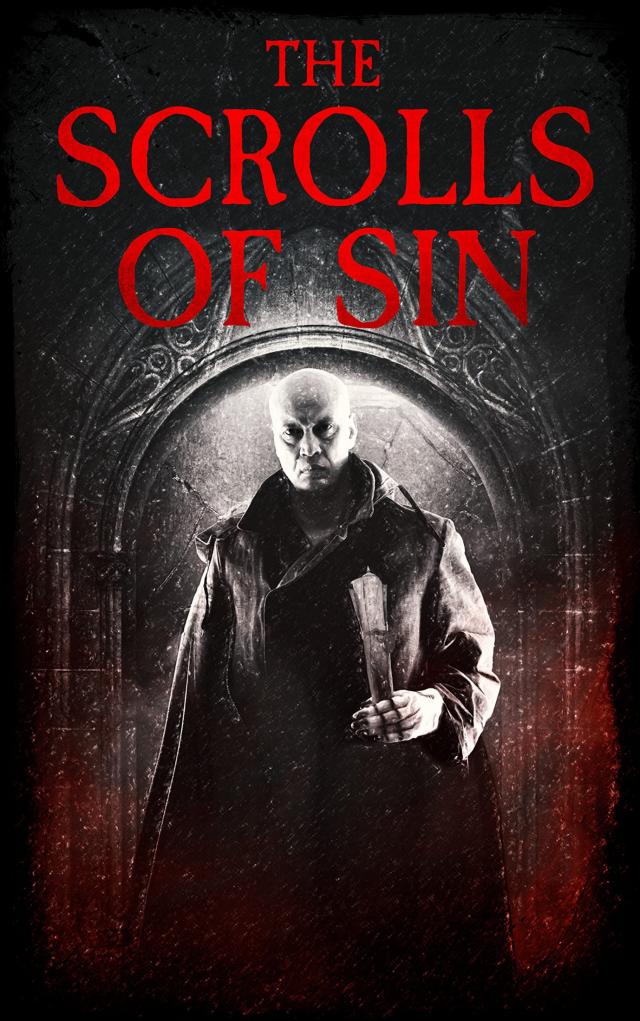


With the coffin planks sealed, Edimor was ready—ready to weave the great spell, the spell long white faces at the long table had said only the elders had the faculties to muster. The torches burned from their designated sconces. From their middle, sitting up in the coffin, Edimor cast his good arm skyward. Edomax stood near; holding a torch in one hand and a thick scroll in the other. Through the torchlight Edimor fixed his eyes on the wan outline of Umbort, sprawled and twisted on the stone floor.
Edimor began the rites. Edomax held steady the scroll, unspooling it as the long incantation required. As if guided by the hands of a demon, Edimor’s head whipped down, then cocked up to gaze at the ceilinged blackness with eyes glossing a full and loathsome white.
Out of the supine, oiled body Edimor flew. What were flickering flames burned with the violence of stars. Shadow itself congealed, becoming a tube, one which Edimor still trafficked.
Detached from all corpus, his mind—he was free. Free to relive instant visions he could not shake nor change.
Unhinged cruelty had always been his flaw. Now there was nowhere to hide. Nodding meek yesses to those positioned above one moment, harboring every grudge, then stamping up or down stairs to lash out on a convenient slave or his slow demented brother the next. Most Ordrids were cruel, but few had failed to master their contempt with the same abysmal floundering as he.
If that weren’t enough, another imp hounded him—and not the good kind—those perched on the mantles all over the keep. It was established the twins were homely, yes. A type of dreadful beauty flowed abundantly from most Ordrid loins, but Edimor and Edomax were afflicted with a mild woe that periodically sprouted from their bloodline like heads of laughable cabbage. Some never grew hair, a mark on aesthetics that usually bore no concern to the males who draped themselves in dark garments to call upon the moon. Edomax, for one, could care less, but a bald head on an insignificant frame had always driven the afflicted Edimor barreling mad. Sure, he laid with his father’s harem as regular as the rest, but none of the laced voluptuaries put him in the warmth of their eyes, as they so eagerly did for, of course, the black-maned Maecidion.
Alien black became shadow. Shadow became the walls and ceiling of the crypt once more. And Umbort Ouvarnia opened his eyes, seized by the throbbing in his wounded thigh, listening to Edomax Ordrid chortle and jig as he slowly rose from the cold, barren floor.
*
“Make sure that lid is nailed shut.” Never had the fair voice of an Ouvarnia commanded the catacombs.
“Yes, Eddie,” Edomax snickered, chasing him up the stairs. “Bevy, bevy, soon be mine.”
As they emerged triumphantly into the workroom, the sun was setting through the embrasures and the cauldron was cold. Umbort put back on his clothes.
“All I need now is his horse,” Umbort said. “Thank the gods we keep all their stallions.”
“Yes, yes, and then off you will be.”
Focused on his work like the wolf on its kill, drunk with the soul-shooter having worked, Umbort didn’t even realize until his rear end met the stairs that his ascent from the workroom had been halted.
“Out of my way,” he ordered, dusting himself off, eyeing a wandering batch of his family’s hulking conscripts. He had no reason to fear their swords. Part of the plan was Edomax’s escort. Demented or not, his brother could validate their brilliant scheme.
While the Ordrids worked in the supernatural and, equally useful, the superstitions and fears of men, the latter could also be their undoing. The House of Ouvarnia dealt in land, commerce, politics, allowing for the galvanization of even the lowest serf. In what privy scholars call the “Black Magic Summer,” the two Houses fought viciously between the waning nettielium and the first yellow of the maple.
Armored farmers and tradesmen lied to by the promise of land; they would lay the grand assault.
Dead Ordrids’ clothes were incinerated, their jewels crushed to dust. Regardless of its state, an Ordrid corpse would be nailed to a stake above well-tended flames. The remains would then be collected, brought back to Pelliul, and then added to wet waiting mortar; used, once solid, to strengthen their great home’s western wall. The wall that faced Nilghorde and the distant Ordrid keep. For years after, even skeptics were unable to shake the sight of the passing fungi that had burst hideously from the unsealed cracks.
Outnumbered, the senior Ordrids soon offered what Edimor would have called a sinister posture of peace.
Although peace resumed, and ever after the Houses skirted about the other, it was whispered, still whispered, that the Ouvarnias now cremate their own, guarding their remains day and night, fearing the vilest of retribution.
But all such war and all such peace Edimor would not know.
“He escaped!” Edomax cried to the conscripts. “He escaped from the room just below!”
Umbort swung around. “Max?”
“He is an Ouvarnia,” his brother sneered. “Sworn enemy of our glorious House. Owner of bevvies that belong to I.”
Umbort spit out every credential of Edimor Ordrid to deaf ears. Edomax clapped and gleamed and he licked his lips as the stairwell slung red. Edimor looked through enemy eyes, he screamed through a lacerated throat that was not his own. He cried out his own name through enemy lungs as the mailed barbarians, allies under the black banner, laughed and hacked him merrily to pieces.
The Leaf of the Palm
“To the palms!
For their leaf alone,
Of all the god’s tall,
Select who to walk,
Who better to crawl.
Coming a leader,
Corruptible dread,
Turn the skies a bruised blackness,
Turn the white sands to red.”
—Ullumon the Lathairboni’s Chant to the Wind
“I want to go home!”
Conabitt Lotgard’s nanny peeled away from her looking glass. The crone was old, draped in the regalia of his family’s immense staff. “But young master, you are home,” she sighed, as tired of the brat as he was her repulsive odor. The young boy crossed his arms, bettering his defiance, continuing to stare out at the night through the golden square of the carriage window. “Come now, we mustn’t always be so glum. Your sisters have taken quite a liking to the place.”
“I hate Suela.”
South of the mighty Orisulan peninsula, Suela, the land of black-skinned men, teemed with dust, danger, and the wide dripping forests this boy was not allowed to play in. That there were cats the size of hounds, moving castles called elephants, all would have enchanted normal boys, and Conabitt Lotgard, if anything, playing out his fantastic adventures with a fleeting attentiveness was very much a normal boy. Stiff rules of the colony, however, forbade any venturing out beyond their continuously refortified walls.
A great sea divided these lands, Orisula and Suela—and now, the young boy from the happiness he’d once clutched like bird eggs.
The grim old nanny was still squawking. “Your father arranged the day’s amusements in the hopes of, well, amusing you.”
“People dancing like monkeys and painted like clowns,” the boy snarled, “beating on drums. It’s boring. Boring, boring, boring.” The carriage rocked onto an uphill. The soldiers who accompanied them—six, Conabitt had counted earlier—all rode war horses. Their metal shoes clicked and clacked, confirming they’d reached the cobbled path hewn from the jungle that weaved back to the bright lanterns of the colonial gate.
Conabitt’s mood lightened as he listened to their muffled bellows. Out in the wild Suelan night the mailed and bearded men trotted, spear tips pointing towards the heavens, shields polished, free. He wondered what such men talked about on these nights, and if being assigned babysitting duties made such warriors resent the skinny boy, tucked away like one of his sisters’ diaries.
An old hand, thin like vellum, brushed back the golden hair seemingly determined to conceal his pout. This was not out of affection, as his mother’s rare caress would have been. The nanny’s insolent grooming was one of the many ways the crone asserted the young noblemen was in all ways ignoble. “We shall be home soon. We shall have to put you straight in the bath, you—”
“Shh.”
He’d been short with her lately. This he was aware, and he was not proud. But she could suck rocks.
He sat up and peered out the window. After a moment, she seemed to notice too; the soldiers had stopped talking. The carriage still moved, the horse shoes clinked and clanked as they had, but—no, there were voices, now.
Conabitt disobeyed another rule. Dark trees passed his head. Carriage lanterns caught in their bobbling the heavy back end of a mounted horse. Its rider, clad in the chainmail and sash of an Orisulan uniform, sat still and serious as a statue. Except the large man was looking this way and that, behind him, not seeing Conabitt’s sprouted head, then whispering to someone on the other side.
When the wood thunked, it splintered under Conabitt’s chin. His first thought was someone had thrown fruit, as his mates had back in the Morgeltine District. Then came the hoots, the yells. Then he saw the spear. He reached out and touched its tip, buried deep in the rosewood.
“Formation!”
He could not see the rest. The carriage shook, jostled by giants, or worse than, the men bursting out of the jungle hooting insanely. A face appeared, glistening demonic in the window, sending the boy scrambling into his nanny’s arms where they together screamed. Soldiers galloped and hacked and soon screamed, too. The carriage shook, then again, then shook and stopped. There was another awful scream then the doors creaked and swung open.
“Savages!” the woman cried, clutching an ornamental blade better for no more than opening a sealed letter. “Away with you!”
“Looki, looki,” one round, sweating head turned to the other and said. The Suelan bit down on a wet, bone-handled knife and then leapt inside. Outside the doors, to the rear of the carriage, tall heads had gathered in a row. They shined, bald under the light of the moon as this crawling demon, eyes glowing white, whiter than anything the boy had ever seen, steadily advanced.
Muscles like rope twitched, with every grunt, with every forward placement of an unhurried hand.
The Suelan grabbed onto an ankle. Desperate not to be dragged out and eaten, the nanny clung to a curtain, bringing it down as she plunged her letter opener into the man’s determined hand.
Moon rippled on a slimy back. He becomes an explosion of jolts, crawling back out into the hot night with his captive and his cohorts waiting.
The young boy could not move. Couldn’t breathe. Think. He stared at his nanny. A blur of arms and shoulders engulfed her.
“He?”
“He,” moaned the man smiling at: “da boy.”
The young boy, just shy of eleven, saw again the wet, bone-handled knife. He looked into those big white, unblinking eyes and felt as if he’d slip off of them, right off the edge of the world. He screamed, he was sure of it, a pitched girlish wail, breaking the ambushers into coarse rounds of laughter.
Far in the distance, the lanterns of his father’s colony burned along the walls and above the high, proud gate. Unseen by any sentry, far down on the red-cobbled path, the young boy is pulled out of the carriage and his ankles and wrists bound with vines.
The soldiers in his games died. The soldiers in the books read to him, they die. The sliced and clubbed soldiers being dropped beside him, they too now—face down in the dirt. His cry earned a prompt gagging.
What terror struck him no one can tell, for a child so full of wonder, without yet the jaded faculties of adulthood, only dimly contemplated the primal fear of soon not being. He was scared of the pain.
The dray horse that had once pulled the carriage had been especially targeted. What horses hadn’t been slain the black men now collected, handing the reins to one dressed in the spotted hides of a great cat.
Chainmail jingled as pockets were pilfered and belts cut free. The sounds of bare feet shuffling in and out of the carriage went on long enough that young Conabitt slowly began to think less and less about spears.
Arching his back and pinning his chest, he found that if he strained his neck he could lift his head and see. The poor old woman was being carried to someplace behind him. Her garments now torn and darkened, she no longer screamed. Terror renewed when she was flopped onto the litter beside him, staring at him in the full display of fresh death.
The Suelans continued their collecting. Of the six, not one Orisulan soldier had survived. The newest blood-flinging corpse revealed they’d taken a cruel Suelan with them. As the poles and vine of the litter squeaked under its burden, the ambushers, a crowd now showing close to ten, gathered around Conabitt.
He laid his chin hopelessly in the dirt and stared at someone’s gnarled, potato-like toe. One of them was talking in a deep, authoritative way. Someone else was responding, in the boos and ohs of their native tongue, in a tone that sounded like a question.
“Me!” was the response. The big toe and its accompanying foot vanished, replaced by others, some widening in their stance as the men argued.
Compliments of decades of occupation, many Suelans now spoke broken Orisulan. Daring to see who, Conabitt watched as the cat-hide man pointed to another the boy could not see. The cat-hide man continued: “No-ting change! I take boy. Make demand on da whites.”
With absolute delicacy, Conabitt rolled onto his side.
“Boy, I poke out you eyes, you lookit me.”
He tried to look away, but that was the worst thing one could ever tell a boy. Conabitt squirmed and wriggled and slammed his eyes, only to crack them open upon the foulest man in the lot. The ambushers now seemed split into parties, like his preferred board game where two pieces ruled smaller ones to a plethora of strategic dooms. One such piece was clearly the man in spotted hides. The other, the Suelan whom Conabitt was supposed to not be looking at, was bleeding from a fresh wound. His hair, twisted like vines, sprouted from the top of his head like a horse mane. “Hole hostage, yes,” this second man was saying. “Demands—no. For gold. Not else.”
There was grumbling. “Da boy be da white rulah’s seed,” the cat man pleaded. “Now our chance. Now!”
They were back in their voweled tongue, stomping and spitting. All debate ended when one out in the periphery revealed they’d found coins, turning the gathering into a grabbing frenzy.
The men were evil, and the men laughed. They laughed so as the trees themselves seemed to leer down at Conabitt. Working his wrists to mitigate the vines, Conabitt suddenly stopped. He thought he heard a chuckle, out from somewhere deep in the night, a laughter that was somehow…different. What manner of Suelan hid in the shadows may have enjoyed being born right out of a nightmare. When a second, fouler laugh rang out, every man turned and faced the black.
“We go now,” the cat man said, his voice bereft its confidence. The captured horses, whose reins were still in his hand, stomped and snorted uneasily.
The ring of Suelans was being encircled by snickers and giggles, hideous, sounding like no group of men the boy had heard. Horse-mane slapped the killing side of his club, moving squarely over the boy, planting one leg on each side. Bushes rustled as things shouldered through.
The next thing Conabitt heard was a collective cry. Every horse bolted onto the cobblestones. Hyenas were everywhere, running and snickering and tearing away flesh from their screaming hosts.
Stricken by a new, more ghastly fear, the pain of being eaten propelled Conabitt into squirms. Somehow he managed to get his hands out in front. Spears stuck into the sides of demoniac dogs, spears and knives dropped by Suelans before succumbing to the loud, bloody, ball-like maulings around him. Blades to cut the vines binding him were everywhere. But he could not move.
No farther away than the bedside candle he’d light after suffering a lucid nightmare, a dark, capable muzzle blew steam onto his mouth. Fangs were the only thing left in the world, yellow, so close and still. The hyena’s eyes: into them the boy stared, frozen, as a lifeless glimmer shifted.
The beast leapt, knocking Conabitt so hard he didn’t feel the dead Suelan’s knee that crashed into the back of his head. Right beyond the boy, Horse-mane wrestled with those same fangs, slaying the beast with a knife’s upward plunge.
“You,” Horse-mane looked at Conabitt, tossing aside the dying animal. “You not die by bite. You die by Suelan.” The knife was already over his head, smeared in blackness of the blood and moon. “You die!”
Conabitt flailed and cried, caught in the man’s free hand and hoisted to his knees. Two more hyenas sent the boy back down. What few stars he could see spun and swam. The moon blinked, an indifferent eye. Horse-mane was the last to die, taking one of his two killers with him.
The hyenas laughed. Some panted, wounded. A favorite game the boy and his mates used to put each other through had been the time-honored tradition of choking one another and then roaring with mirth as their victim stumblishly came to. He felt that sensation, those moments before blipping out of the world. But he was awake. He was still alive. And alive in the night, he could see a man—a shape, black, withered, and deep as though a bottomless crack in the earth had stood upright to leer at him, the voice, cooing the beasts who rubbed on him their muzzles, cool and coy as a snake’s slither.
The boy’s head fell and rested on a gnawed-on knee.
*
A grinning coconut hung over him. It looked shiny, happy even.
Hyenas made their noises somewhere nearby.
“Silence, you wooly devils,” the coconut demanded.
“Where am I?” Conabitt whispered.
The coconut pulled back, becoming the sweating face of an old man. “In my hut. I saved you from da rebels.”
Old eyes went over the boy’s bruised, scraped skin. Conabitt felt an impulse to touch his wounds, but doing so, he found them lathered and dressed. The old black man, by contrast, hadn’t so much as a cut or bump on the head.
Hyenas tromped and snickered outside the door.
“How you feeling?” the old man said.