The scrolls of sin, p.25
The Scrolls of Sin,
p.25
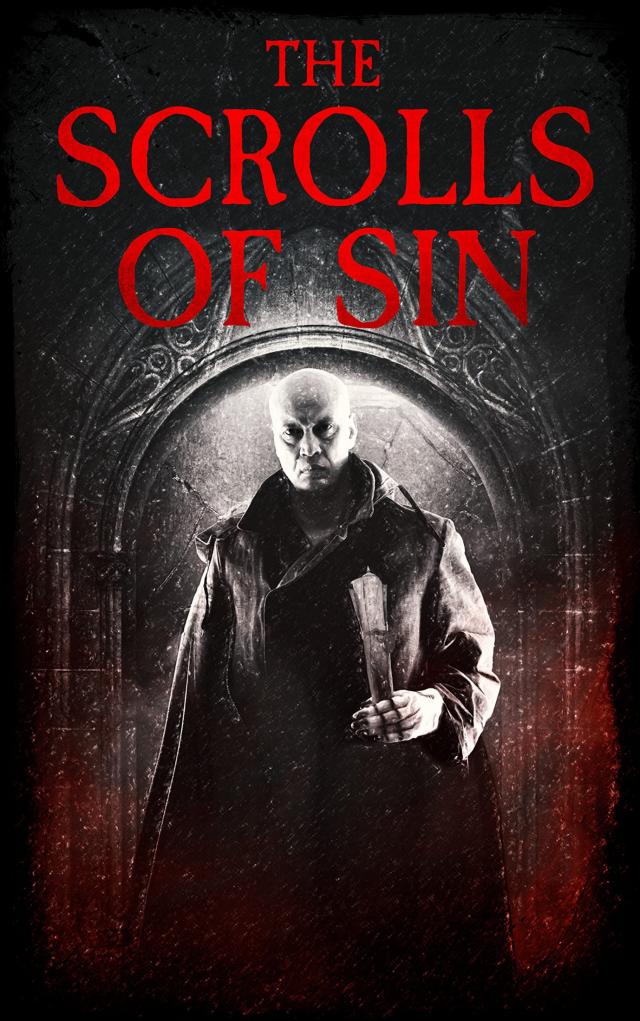


Some would suggest more Ordrid magic was at work, but the mob was just the poor, the slowest five among them sent to the Pauper Morgue.
Bosgaard and Bella
If I had to wear this sash and badge one more time, I would happily donate my corpse to the Wing of Trauma’s next suicide exhibit. The sky’s dreariness confirmed it was too early to crawl out of bed, let alone don the role of student-on-duty and wither away.
I slumped over my appointed desk and reminisced in the way of half-dreams. My brothers and I had just spent the better part of a month bagging each other’s deer and concubines all over the green hills. Now I was back, at the illustrious Institute of Human Sciences, where, without end, professors and one-day doctors took apart their cadavers.
When I lifted my head, I saw him standing in front of the faculty mausoleum. He meandered back and forth as if looking for a way in.
I poked my head out just far enough to say, “May I help you?”
“They turned it into a fortress” he said, as if we’d known one another for years. “Don’t suppose you have a key for all these locks?”
Those superfluous locks were, I guess one could say, impressive. With a new addition to the outer wall and a roof like a giant’s shield, the mausoleum was buckling under its own burden. But no bronze dome nor fresh layer of granite had ever brought around any admiring tourists. I decided to extend my neck out of the duty hut a little further and make introductions.
“I am Legriel Lotgard. I am, you know, a student here at the illustrious—”
“At the IHS,” he said. I’m sure I appeared most unlordly when he turned and looked at me. Gesturing at the mausoleum, he continued, “They aren’t worried about a rival institute, are they?”
Though he was of only average height, his persistent scowl and shoulders like stones you’d see lobbed from a catapult gave him the appearance of one of the rare pit fighters who survive to middle age. More pleasant were the flowers he held, though their leaves had been bleached by the sun, petals withered by the pattering of a week’s rain.
That he’d plucked the bouquet from someone’s grave added to the impression that I was engaging with a rogue.
“No, they’re afraid of ghouls,” I answered at last. He stared at me, but said nothing. “You, you have a loved one in the mausoleum?”
“Yes,” he said. “Bella.”
I must have overlooked her when I’d perused the names of professors who’d joined their medium by way of entombment. “She was a professor,” I said, exposing my skepticism, “for this institute?”
“Body snatcher.”
Like all first-year students, I was made aware of our school’s more nefarious histories. However, tales of warring medical factions under the light of the moon were something I regarded as a bit closer to myth. Even less convincing was his proclamation that a body snatcher had been placed in the IHS mausoleum, reserved only for the most revered contributors and reread faculty.
Emerging from the hut, the morning caressed me with the beginnings of rain. Standing under the plashing and patters, he stared at me as a man would if having no fancy for telling tall tales, or buying into them. He at least believed his words.
I had no idea which keys under my charge led to what locks, though we could kill the day trying.
I would later blame only curiosity, not inclement weather. Contrary to my nerves, I invited him to join me. “Out of the rain,” I said, “for a bite and, hell, a sip of the hard stuff. Let’s not get caught, though,” I added, attempting levity. “A drink on duty’ll land me in the Municipal Dungeon.”
He smiled, though I wished he hadn’t. He looked the way a madman may right before a euphoric killing. Thus convincing me I’d grown momentarily psychic, he said, “I was just released from there.”
I would love to have seen my face. A child suddenly aware they’re alone in the woods may have expressed less panic. I think I reached for the whistle about my neck. The institute provided one for all gate duties, but as I slipped and stumbled backward, I’d wished they’d given me a sword.
“Ghouls, you say?” the man echoed, patting the mausoleum’s granite.
“Glibbmor Ghouls,” I said, righting my spectacles and regaining my wits. I fell back on my father’s preferred tactic, one he’d made a political career of: lambasting a greater buffoon if ever feeling one yourself. “The ghouls are tunneling in these parts more and more these days, or so the department heads would have us believe.” I gave a good laugh. “All those years spent staring at bones and other maps of our cosmic indifference, yet when it comes to their own carcasses, they take a turn for the superstitious.”
“Glibbmor,” he said in a way I didn’t like. “If you’re inclined to…superstition, his clan is, or was, known for using the sewers. Hideous, that one. They called him Glibbmor the Infested.”
“What do they call you?”
“Bosgaard.”
My fear immediately returned—doubled. But, being the fool I am, I would have to endure it. Having accepted my offer, he followed me in.
#
All student posts were a bore, an entire day dishing out directions to the lost and fighting valiantly not to fall asleep over your homework. This post overlooking the never-used side gate was widely known as the dullest. A dorm colleague I’d convinced to come help me stave off the day’s appointments had gotten as far as the threshold, seen my company, then my face, then ran off in terror.
I began sipping on Bleeding Anna way too early. Soon, my fear began to wither, allowing me to bask: I was sitting next to a legend. There is something relieving about knowing a man can kill you but chooses not to. Bosgaard the Snatcher Slayer. He’d once been a snatcher himself, until, according to the most popular thread, he killed his whole team to greedily scamper off with the corpse of a holy man. He was caught on site, however, for the authorities had been tipped off by someone who matched him in treachery.
After devouring most of my breakfast, he asked, “Ever heard of Bileprine?”
Whatever myths may or may not have arisen, that the Bileprine Institute had once existed was a fact. A fact that now haunted our halls like a faint yet persistent ghost. The oldest of the academics, usually lost in a nostalgic trance and emboldened by strong drink, lisped and giggled at the expense of our institute’s one and only and long-gone rival. “I have.”
“Your schools proved the winner,” he stated, making it clear he had once worked for the opposing team.
As the rain outside intensified, I noticed he no longer eyed the keys on the wall. It seemed he was now preparing to tell me a story. He’d spent my entire lifetime in a prison—what was another hour?
The youngest son in a long line, I had been shunted to the bile-soaked destiny of medical doctor. But as the notorious snatcher slayer took a pull and his eyes glazed, I was to learn how much worse a plight a man could be given.
“Winner in what game?” I asked, prompting what was to come.
“One with many players.” That euphoric-killing look of his returning. “The institute here and the Bileprine, sure, but also all us snatchers who slinked and slithered and brained each other out in City Cemetery. Then there were all the damn ghouls.”
I was the captor of intrigue, but in the same way I’d been when I’d silently waited in the cadaver repository, hoping to see a finger twitch or a leg rise.
I said I’d regret not hearing his tale, though later my only regret would be that I’d met him. He grabbed my bottle, and then he began.
*
No rustic campgrounds for me (Bosgaard said), at least not for long. As a boy, I was drawn in by Nilghorde. The clamor and whirl of her markets, the handsome laughter of her lively women. I knew I desired city life by the time I neared the height of my father.
Like most members in the Chapwyn flock, he was as strict as he was devoutly poor. I never shared his views, though I played scroll-beating zealot the same way other, more fortunate boys mimicked their own fathers as tiny lawmen or carpenters.
The only Chapwyn topic I enjoyed were the scriptures dealing with the undead. Though such ghasts and fiends were referred to as literal, they were treated by the religious as mythic and cautionary metaphors. My father viewed my poring over such pages not with pride, but with sideways glances and an off-put worry.
His problems, however, became far more tangible when our choiring camp fell stricken by disease. When petitions to the city churches became pleas, we received a short but pompous letter detailing how the priests wanted eagerly to help, prayed for us night and day, but were unable to provide medicine, labor, or money. Many bright faces withered. Death took my sisters and my mother, yet my father remained ever faithful, always sure to remind me that forces of good tend to work in mysterious ways.
I don’t think I ever really believed him, and neither his rural maxims nor the city priest’s abandonment of our parish dampened my desire to walk on cobblestone streets. It was no use scaring me with grim tales of abduction or murder either, though he and eventually the remaining congregation tried. The city wore its allure the way its whores wore perfumes and pearls, a metaphor I would’ve never dared speak aloud. When I was supposed to be learning the seven sojourns of Ansul, I was instead dreaming of days touched by trumpets, nights nestled in throngs above fabled fighting pits.
Like all young men, I viewed the world unrealistically. Reckless, I did what youth has always prescribed: pitied those who fed me, scoffed at how they were able to, and thought no more about it because one day, unlike them, I’d be famous and rich.
When Chapwyn children turn sixteen, they’re given the option to renounce the religion. For most, it’s a notional event, having already sewn the frocks and vestments to be worn until the rot of sweat and grime have reclaimed them for the earth. But my case, painfully then, obviously now, was one quite different. My decision left me without food or family, but it also left me free.
I’d hoped to become a celebrated juggler, or if that didn’t pan out, perhaps pursue wider horizons and sign on for one of the Municipal One’s ships. In my newfound freedom, I was free to learn that I was no juggler, nor was I the stuff of a future admiral.
I’d traded poverty in the woods for its meaner urban cousin. Coming of age, the need for money greeted me like air greets the lungs of a man chained to the bottom of a river. Many years later, our cell’s most articulate inmate suggested that my widely-agreed-upon somberness was also an inherited trait. I’d always acknowledged just one. New to Nilghorde, starving and unskilled, I harnessed the one marketable attribute my father had given me: muscles under my rags like that of a shaved chimp.
I started working for Bileprine. By the looks you’ve given, I know you’re aware snatchers were responsible for robbing graves. Well, not all the graves that got plucked were done by humans hoping to profit, or humans at all. But the dead hauled from coffins and tombs and dropped on examination tables, that was us.
Bileprine was new, thus an underdog, thus requiring tactics that snatchers hired by your institute didn’t have to—or maybe didn’t want to—employ. Our group was especially pernicious, headed by a man barely distinguishable from a lower devil. Though I hadn’t participated, the Bileprine Boys also lured to their doom hungry drifters and hungrier orphans.
Having trouble one night out in Whisperer’s Plain, I nearly jumped out of my skin when a female voice said from above, “I hope Bileprine isn’t expecting her delivered whole.”
I was down in a hole, one I’d dug and now standing on the edge of the casket I’d opened. Without the convenience of lamplight, my work was guided by the moon and stars, or, when unavailable, my hands. Moon and hands was the case this night, and I’d been caught trying to wrench free the corpse from an unseen entanglement.
“Here, use my lantern,” the soft voice said: scouring me, the hole, the body, everything, in a blinding light. “And why no tarp?”
“Over the hole?” I grimaced.
“Well yes, silly. You could use lanterns or candles then, unless you see in the dark like a cat. That, however, is looking doubtful.”
“I can’t see anything now,” I said, uncovering my face to a world of blinking dots.
“Poor thing. Such a sad fate.”
I’d thought her words and the tone accompanying them were meant to jibe me, in the way inflicted and suffered by those typical of lurking about graveyards. Dark humor and hair cropped close to the head—this creature was most certainly a snatcher, yet most certainly not a boy. As I regained my vision, this slim silhouette sprawled on the grass to peer at my work, showing a fair face concerned over the corpse that I still held by the wrist.
Since her lantern was likely to get us both killed, it seemed wasteful not to take full advantage of it. The dead woman hadn’t been dead long. This I knew, not only for the absence of repulsive odors, but because I’d watched them bury her. What I hadn’t seen at dusk, I saw now.
“The neck glands are still swollen.” the living of the two women said. My observations concurred, though I knew not what it meant, other than it made my skin crawl. The neck on this one, those glands, they were like lodged pears just plucked from a tree sunned by Hell’s giving flames. “Did her family put any bouquets of Pavonia in her coffin? Or what about a wreath of onions around her feet?”
I looked. They had. Both. When I confirmed her prognosis, she did not elate as I’d thought she would. She only sulked.
“Just as I suspected.”
She shook my filthy hand and said her name was Bella. The corpse that had brought us together had died of a disease whose name I’ll spare you the annoyance and me the embarrassment of trying to remember—yes! That was it! Tullbifita.
Bella worked for your institute as a snatcher, but she wasn’t evil, she wasn’t even bent. Bella had worked at some rat-and-bandage infirmary in the southern sprawl of the Thunder Bustle. Full of compassion, she’d take the corpses of the unclaimed and the forgotten and bring them here. She did this to “better serve humanity” rather than see them “discarded like trash” in the Pauper Vault.
Though she refused to be called a specialist, she was. The contents of a vomit bucket, the size and demeanor of a particular tumor—that infirmary left her a reluctant expert in the signs of a cadaver’s final killer. It must have been to provide for a sick mother, or maybe to keep off the streets and out of the whorehouses a brood of baby sisters, but for whatever reason, she joined the IHS Body Snatcher’s Guild. We met on a night she’d been tasked out to find someone destroyed by Tull-bifita.
I gave her my body, though as I watched her supple backside strut off before disappearing behind an obelisk, I wished I could say that first part with an entirely different meaning. I felt the fool. A night’s digging with nothing to show for it. Worse, I’d given a valued corpse to a competitor. Worse yet, I would never see that competitor again.
She disappointed me by proving me right. Night after night, restless birds become articulate, the winds whipping past headstones seeming to call or to giggle. A week later perhaps, I’d perfected my foolishness by meandering near disease-riddled graves far too close to sunrise. Be it the Watchmen or the Ward who caught you, a trespasser with a severed foot in his pocket was met with far worse than irons.
My work was disrupted too. More than once, I’d toss my shovel and silently argue with no one why I hadn’t been bold enough to kiss her. Would she have let me? Even in the faces of the fairer dead, I saw the woman who’d winked at me before scampering off the right side of the world.
Having convinced myself at last that she wasn’t worth remembering, I’d just pried open a particularly rank coffin when she dropped down beside me. Three rags around my face had prevented decayed bowels from upending my stomach, but the sight of her bested me. Blaming the smell for why I’d puked, not fluttering nerves, would end up being only the first lie I’d concoct because of her.
Like rat colonies rivaling over the same heap, snatchers were prohibited from interacting. The Institute of Human Sciences was the worst. If any of the IHS Body Snatcher’s Guild were caught with Bileprine scum, it would result in immediate termination, a black mark on their underworld jacket, and, if the opportunity arose, the bone-mongers threatened to haul off to the nearest Ward station with a litany of allegations. True or untrue, on the head of a former hire, they were useful ways to rid themselves of a traitor.
But in that foulness, atop a coffin lid, she kissed me. I was good at it too, or so she said, prompting me to suffocate her with more.
This led to us meeting most nights. On the ones we weren’t able to work alone, we’d slip away from our colleagues, even if only long enough to hug and pet like insane children. To our great advantage, both institutes back then demanded more stiffs than snatchers could unearth. With us all spread thin as mist, solitary assignments were the norm.
We picked graves together, bestowing the other with generosities. I handed her stillborn triplets. She let me take a man whose skin still gleamed so heartily under the stars that we couldn’t help but entertain that a witch had buried her grown-obsolete plaything in radiant unlife. But for all the rings and brooches I furtively pocketed, she left the dead’s ornaments in place, even refolding their arms back to their family’s posture of choice after I’d slung them onto her cart.
After work, as the sun pinked the rim of the world, we’d skip off together. My hovel too often visited in those days by my fellow rogues, Bella and I would abscond to her quaint apartment instead, as pert with white lace and wholesome reds as I’d expect of a Lotgard Lady. No offense, of course. You understand.
One evening, the Bileprine Boys received word a member of the Ward had killed himself, so hulking he broke two branches on his garden tree before the third helped a noose send him to oblivion. The Bileprine slobbered their lust for this specimen. After an overdrawn ceremony, the Ward’s color guard marched off under snapping standards, leaving the grave for every snatcher with a pocket to fill.
I don’t remember much about that night itself, other than I had to work with my group and that the moon hung low and swollen. A strange thing about the Metropolitan Ward: for all their self-righteousness, they tend to bury their dead in the lowest bowls of a graveyard. This suicide being no exception, the tombstones surrounding our target served as concealers. We crept closer.