The scrolls of sin, p.20
The Scrolls of Sin,
p.20
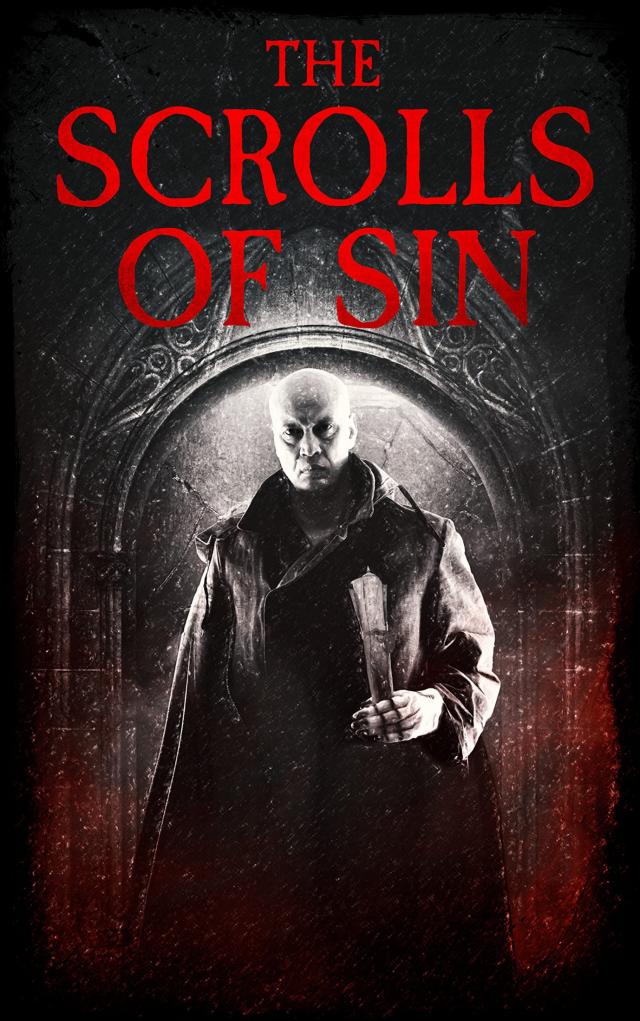


When I struck, Father flapped and batted at thin air. Above his eyes, blood escaped, violent and free. His hand gripped wildly for a weapon that wasn’t there.
After a long while, after all the twitching had stopped and I dared to breathe, I opened the window. Like the nameless falling into the Pauper Vault, I dropped him out and refastened its locks. Walking down the stairs, I kept hearing Somyellia: “My beast, look at what you have done.” Over and over, finally trailing off with that haunting laugh that could blot out life or breathe it in.
There was one more stop to make, and I needed to get the body prepared. The blanket, now wrapping Father, wasn’t the only thing I had packed away. Once my preferred cove was found, I parked the cart and unpacked my cleavers.
In almost complete darkness, I dismantled Father and collected his parts into jars that I’d already labeled.
The scraps were stuffed down a drainage culvert, a feast for the rats I could hear gathering. In less than an hour, I had all the valuables packaged and ready.
Deep into the tiny-eyed hours of night I arrived at one of the reception doors at the Institute of Human Sciences. The groomed gentlemen peering out the viewing port refused to open the door. Holding up a freshly plucked liver, however, turned them around. I had pocketed a few coins this way before, but withered organs and mummified limbs were no longer in demand. Here I had fresh materials. The cart emptied as my purse filled. I called it justified compensation.
By early morning I was back at the Pauper Morgue. After the follow-on tasks were finished, I sprawled out on the floor to finger through the enrollment application the query-eyed doorman had handed me upon request.
At some point I fell asleep. There I dreamed of many things. When I finally woke, all I could recall was a thunderous storm, met with the charge of some unnamable legion.
Soon after, I applied to the Institute. With a successful attempt at their elect entry exam, much to the chagrin of my bosses, I resigned from my position at the morgue.
I signed up for the monastic dormitories and made its space home as best I could. It was strange I was told that I couldn’t decorate the walls and shelves with my old tastes, considering where I was, and how it had always served as such esteemed motivation.
The scholarly swarm was quite younger than me, and during orientation I caught the ample look-aways from pubescent faces. Days at the Institute were long and tedious, overflowing with assignments and sapped inkwells far into the night.
Vast does not describe the vaults and exhibits that made the interior. Libraries towered up to ceilings so high their elaborate mosaics were but mere smudges of light and dark when viewed from the ground. There were the fabled viewing cages too. And, if you wanted to venture from the main arteries, you could easily lose yourself in the dungeon-like bleakness, where polished stairs became old wood and peculiar echoes.
The student body rivaled the Institute’s vastness so that even I could sometimes get lost in the fray. To my shock, some students were hesitant to handle the muck and piping of our being. That was no issue with my studies, and I enjoyed anatomy class over the more daunting core requirements that left my head a scrambled bowl of confusion.
Dreams are a strange thing. Standing too close to the street performer may often lead one to see the flaws in his act and the streaks in his makeup.
I was passing the courses, though some with great struggle. But I noticed that I never read poetry anymore. My collection of works sat dusty and unused in a corner above all my research papers, scribbled in haste to make punitive deadlines. My muscles ached from inaction, and collapsing into a chair became a ritual after classes. Slowly I began to see my peers as spiritless larvae rather than prestigious scholars.
After a semester, it was clear my life was not in the clean walls of the Institute, or among the kind that never had to fight for their plate. I dropped out shortly after marks were posted. I was tired of feeling sucked dry and hung up in some closet apart from the world. I left numb. Nothing that was shown to me could raise the hairs on my neck or streak wide a smile across my face any longer.
Except for one.
In route from my dorm to my composition class, I would cut through the exhibits. In the Wing of Trauma, displaying hundreds of examples of life’s hard edges, I walked past a familiar skull with a hole in its frontal plate.
I returned to the Pauper Morgue, where my return was met with great rejoice. They doubled my old salary, killed my replacement, and with a warm broth escorted me back to my old station, where, aside from a fresh batch of run-through workers who’d proved unsatisfactory to the House of Rogaire, laid many a fair corpse, nude and uninspected.
Such things, so beautiful yet so dead, went to their final resting places uncaressed. The post-mortem with Somyellia would remain unique. Call it loyalty, perhaps.
VIII
Snier’s Tale
My name is Tymothus Snier. At least that is the name scribbled on the paperwork at the orphanage where I spent my childhood. I never knew my parents and have honestly given it little thought. A whore and a priest, an actress and a soldier; it all makes little difference to my plight. Having always been on my own, unknowable parents did little but cloud the mind.
The books that I dusted and rearranged had to be worth something. They better—fair compensation for suffering the House of Rogaire, and, in what was a growing likelihood in some peculiar way, the House of Ordrid too. The sand in the hour glass was running low. I was about the fuck out of this place. Things were always weird in the Rogaire mansion, but had recently gotten the kind of weird that brings with it screaming and pain.
The books: all that remained was finding an interested and well-funded collector. Verdigris-stained spines could be wiped clean, and with a little buffering, the leather covers could be restored back to their pre-Years of Peace glory.
Although the library was vast, its lack of occupancy was as if its towering double doors were seen by my eyes alone. But the volumes were just the beginning. Treasures hid in unlit rooms and behind cobweb draperies. A stout ladder would able me to chisel out ornate tiles covering the dome ceilings, and just a few of the paintings neglected in the great hall would feed a frugal mouth for years. In a mansion this size, the possibility of finding jewels, heirlooms garnished in guarded drawers, and glorious hidden vaults was worthy of a most thorough reconnaissance.
I hadn’t always posed as a butler. I’d been a rent-boy. I’d waded foulness itself having briefly been a grave robber. But, I was always meant to be a burglar. There are essentially two challenges in my current profession. The first: acquisition of a worthwhile target. Worthwhile doesn’t always mean the score.
I—
—wait, let me go at this from a slightly different angle.
Everybody squawks on about Do-Gooder’s Row—its monstrous white inhabitants and what have you. If you are weary of hearing about them, I assure you your weariness pales in comparison to my own. But perhaps for different reasons. It seems I’m of the select few to take notice, but doers like Zaderyn the Poor Swimmer are in desperate short supply when it comes to finding heroes of the people in this vile city. While the Zaderyns populated the first few columns, the deeds and doers diminish as an admirer heads east, ending at the feet of heroes like the vigilante citizen who reported his overly masturbating neighbor to the nearest Chapwyn temple.
I reckon if you’re around a Rehleian long enough you’ll hear a peasant’s calendar based off when this statue was being carved a necklace or that statue began showing its gauntlets. But perhaps I am no different—a Rehleian after all, and even a Nilghordian, though I admit that last part with the utmost reluctance. So you will have to pardon my provincial ways. It really is the best way moving forward, and, besides, not all of us were born and bred in Pelliul.
With this in mind, during a stint in the Rat’s Nest, I shared straw with a couple of thieves. The Do-Gooder statues were all chiseled down to the knees; three-quarters built if you were fortunate enough to study mathematics. We were talking about target acquisition, and those two told me a tale that had with it an unorthodox but long-lasting moral.
At the time, I was rather preoccupied by my draconian arrest. How is it that the more laws made for the greater good, the greater the prisons swell? These two fops—their comical arguing and tragic story captured my interest.
Apparently they’d staked out what they thought was an appraisal loft. Under an assumption that the lavishly garbed old man was the owner, one night they made their entry. Much to their misfortune, the old man was guarded by a colossal dog. To add to their dilemma, the Metropolitan Ward was at the doorstep in a time unseen before by either crook. Naturally, once in the Ward’s custody they received a volley of new bumps and bruises. Worst yet, they broke into a loft that wasn’t meant to appraise coin and old silverware.
Any committed burglar would suffer a vicious dog to score a worthy prize, but as they took turns being mauled, they noticed no hanging scales or appraisal-loft displays of any kind. The poor fools—out-of-work botanists the moment our land cracked down on a growing list of herbs said to degrade the fiber of the working class—had broken into a bungalow of a Scepter, and the valuables they saw being carried in were gifts to congratulate him on his landslide victory over his mysteriously vanished competitor. In numerous portraits, their would-be victim loomed over them imperiously, or so they described when not choking one another.
Paying attention to the happenings of the city, getting in tune with Nilghorde’s heartbeat, led to future successes. Failing to do so led to gallows and grain ships. When I confirmed who the old man was, reality washed over them. That was the reason why the Ward had made it in record time—hell, for all we know, homing pigeons fly to their stations when men of monetary or political importance are in distress.
As I have said, the statues at Do-Gooder’s Row back in those days were three-quarters built, which meant the Conqueror’s macho quest, over somewhere closer to twenty. Once he’d declared peace in Rehleia, he was, and is, henceforth called The Municipal One.
The Municipal One brought about such wonderful things as new roads, new heroes, and a sea of graves as the goodhearted had a chicken in every pot. With all this came the new laws. Burglary soon came with a life sentence—said to serve as a deterrent, but around the Municipal Dungeon’s twelfth or fifteenth grant for another sub-level, the deterrent speeches ceased in the public square. The two who loped into one of the many homes owned by a man such as Scepter Macudden…well, they didn’t face a life sentence. They faced what was reserved for unrepentant blasphemers, murderers of the rich, and the rarity: a convicted necromancer.
I try to look for the good in all things. I was eventually released from prison, and in their story learned the valuable lesson of due diligence.
The second challenge of any burglary is dealing with the residents of the target itself. In the case of the Rogaire mansion, I had figured that out like the cleverest street performer. It had been years since I retired from duping spent clients or cleaning out their hotels. I found through careful study that homes were the most lucrative risk to take. The exhilarating joy of standing in an unoccupied dwelling surrounded by the fruits of your soon-to-be labor is mouthwatering. Besides, escalation is the sign of improvement.
I’d been staking out the Rogaire mansion for close to a year. I know you wonder: why wait so long? Why not just get the goods and scamper off? Many would follow your instincts, and there was a time I did as well. That jumpy impatience, however, only results in a minimal score—and, after all, it’s the score we all do it for. I shiver at the thought of the money I left in unsearched nooks, mattresses unslit, and rooms behind mirrors. I reckon if I had the patience then that I have now, I would be long retired. Maybe buy a flock of young Suelan boys and live out my days in Pelliul, attending reenactments and theater.
Regardless, I had just about reconnoitered that behemoth place, more a small castle than a mansion. Still, there were locked doors and inconsistencies under floor planks yet to be pried. I had solved almost every riddle, save for the location of a few keys and a peculiar noise I’d regularly hear coming from outside my bedroom window. Besides, despite the high number of reasons that would make any sane person wish to leave, I wasn’t leaving until I knew where the vault was, how to get in, and how to gallop off in un-pursued glee.
The denizens of that dreary house were as familiar with my face as they were the gargoyles that stare down from the cornice. It is impossible to repress a smile. Every day getting dressed in the mirror, fixing my bow tie and sash. I am not a big man, lean with shoulders that insist on a mild slouch. My hair, forever blond, now combed over a nagging bald spot. Yet despite such a modest frame and a face referred to as “birdish,” I possess the bluest eyes in all Mulgara. Vain? Well, Dear Heart, in two of my careers it was a sad dog that didn’t wag its own tail, or know when it could sleep next to the fireplace rather than in a gutter.
*
Dressed for duty, I tightened white gloves over learned hands and proceeded from my chambers.
*
“Tymothus, bring us the rabbit,” Morlia said, sighing into the hand propping up her chin. Her breath fogged a jewel on her brooch the size of a ripe plum. “The venison has a salty flair.”
“Yes, Mum.” I went back, past her lounging armored goons, through the steam, and fetched the rabbits from anticipating cooks. By now our calendars revolved around the Big Three: Maecidion having been dead a decade, the one day a year the Lady approved of dinner, and the completion of Do-Gooder’s Row. Yes, the dearest latter was only a widely rumored two weeks from being finished. I believe the final brilliance to extract from the marble were the bootless toes of some beggar who’d fallen into a puddle right before a Lotgard or Ouvarnian cart had to cake its polished wheels in Nilghordian street mud. As was the standard, the rabbits were in an array of poses, some caught in flight while others in cartoonish gestures of nobility.
For the life of me, I couldn’t understand why that family insisted on using trenchers. They had the money to fund the forging of a hundred golden dinner plates without a care. It must have been the late Rinlot’s doing, the former master of this ill place. He had been of the southern green hills. An Oxghordian. Those southern voices, with that hilarious booming accent, a continuous melodic blend of aristocracy and farmhand idiot. No matter how long ago a group relocated to the city, they maintained several imperishable southern traditions. He’d been a hunk of a man, the warden of the Municipal Dungeon. As large as a pit fighter, he embraced a regal masculinity in contrast to his rather simple mind.
The lady of the house, Morlia Rogaire—well, I can’t recall the maiden name of that redheaded, bejeweled harpy—her family came from the quarter on the shores of the Thunder Bustle and was probably forgotten by her own decree. How those two ever met and married was the grandest of juxtapositions.
He was the one who filled their hidden vaults—wherever those infernal things were. The formidable and overpaid position of Warden didn’t explain the wealth. I’ve seen crazier things in these lands. Although jewels jangled at the bottom of their pockets, they’d never been fully accepted by the Nilghorde elite. The few Ouvarnias who lived in Nilghorde barely acknowledged their existence, and the Lotgards had only invited them to one party.
She, on the other hand, was from the cannibal streets. She still wore her hair tied up for quick bathing and still wore her makeup with the gaudiness of an aging prostitute. A whore, that’s my best guess anyway, and it would fit all the better that she sensed an opportunity to capitalize on male dimwittedness.
Once draped in the excesses of wealth, you’d have thought Morlia was an empress from some far-off land. Her knack for barking orders and her eternal dissatisfaction with everything led to miserable dinners and crucified slaves. Rinlot had been a southern boy turned middle-aged man, still hazardously trusting and gregarious. Her eyes carried a keen maliciousness, and her intentions seemed to mimic my own. Yes, she had to have been a prostitute; her cunning business approach to the prize of emerald-covered templets and ruby brooches was, in my best mood, admirable.
With Rinlot now dead, the mansion had only three residents. One was Morlia. Another was her and Rinlot’s only child, that damned boy Rinmor, or as Morlia insisted for some blasted reason, “Morden.” As spoiled as the meat that miraculously always found only the plate of the Lady; his incessant pranks were only dwarfed by his odd behavior. When not trying to trip me with string, I found him staring for hours at the moon.
Last and least, through some intertwining of two family tree’s most low-hanging and moss-ridden branches, a cousin of Rinlot’s crawled onto their steps years before I took employment and, to my humor, never left.
Werlyle Rogaire-Qell was a humble sight, even for a Qell. I recall from boarding school dreary parchments about their House. Nearly a century had passed since the feud between the House of Qell and the House of Ouvarnia. The regal horse masters massacred the House of Qell, sending them scampering to every corner and down every hole in Rehleia. Most now huffed swamp air with the Rehtons down in Amden. A prolific drunk, only his high forehead resembled anything of his much fairer cousin, on the whole short and stubby and prone to a downward gaze. If he was indicative of the rest, I can at best give them credit for even mustering the gall to challenge anyone in armed conflict.
Werlyle’s presence was like an indomitable itch under Morlia’s girdle. Since Rinlot was no more, showering Werlyle with insults, often in front of company, had no response other than a few curses and spittle. Half in a bottle of Bleeding Anna most nights, his retorts while head down on the dining room table were their own lessons in hilarity. It took every fiber of my being to avoid dropping the tray of exotic slugs when he went into a slurred sonnet. Cobwebs on the chandelier was all the symbolism he required. That and twiddling his nubby finger at her, yelling “loins,” and flicking his tongue at the guests who nearly fainted.