The case of the one eyed.., p.1
The Case of the One-Eyed Witness,
p.1
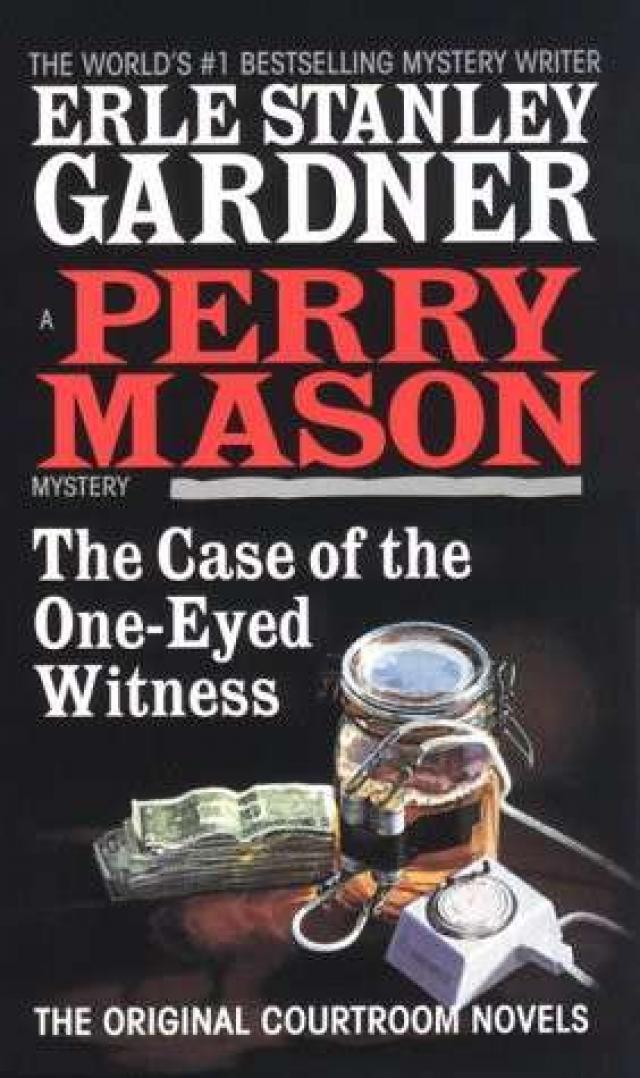


The Case of the
One-Eyed Witness
by
Erle Stanley Gardner
Copyright © 1950 by Erle Stanley Gardner.
Renewed 1978 by Jean Bethel Gardner
Electronic Book: Copyright © 2012 by The Erle Stanley Gardner Literary Trust
All rights reserved.
Contents
Copyright
Foreword
Chapter 1
Chapter 2
Chapter 3
Chapter 4
Chapter 5
Chapter 6
Chapter 7
Chapter 8
Chapter 9
Chapter 10
Chapter 11
Chapter 12
Chapter 13
Chapter 14
Chapter 15
Chapter 16
Chapter 17
Chapter 18
Chapter 19
Chapter 20
Chapter 21
Chapter 22
Chapter 23
Chapter 24
About the Author
Foreword
Twice each year eight or ten of the outstanding experts in the field of scientific crime detection gather at the Harvard Medical School. There, under the auspices of Captain Frances G. Lee, one of the most remarkable characters in the history of crime detection, these experts instruct a handpicked class. The instruction fills a work-crammed week. It covers everything pertaining to murder, from detection to an actual post-mortem.
There are no more than two dozen pupils. To be enrolled in such a class one must have an okay from the governor of his state, a clearance from the head of the state police, or a special dispensation from Captain Frances G. Lee herself.
In previous forewords to three of my books I have mentioned some of the leading figures connected with these seminars: Captain Frances G. Lee of the New Hampshire State Police; Dr. LeMoyne Snyder, a doctor of medicine as well as a lawyer, who specializes in the field of legal medicine; Dr. Alan R. Moritz of the Western Reserve University in Cleveland, one of the country’s leading pathologists as well as one of its cleverest detectives.
In the foreword to this book I want to introduce the reader to Dr. Robert P. Brittain, a Scotsman who is both a barrister and a doctor of medicine. He is a young man of great brilliance who is at present lecturer in Forensic Medicine, in the department of Forensic Medicine at Leeds University in Leeds, England.
Dr. Brittain is quiet and unassuming, a man of small, wiry physique. Intellectually he’s a giant.
At his first lecture to a group of the broad-shouldered men who had been carefully selected from the cream of the state police, I felt that Dr. Brittain’s youthful appearance, his slight build, would make it difficult for him to hold the interest and attention of his audience. I was never more mistaken.
Earnestness, sincerity and knowledge command respect everywhere. Dr. Brittain aroused the interest of his audience with his first few sentences. He held the men fascinated and there was an underlying attitude of deep respect in their attention.
Midway in his lecture, in illustrating a point on identification, Dr. Brittain asked the members of the group to estimate his height and weight. These men who were carefully trained to give a mere glance and tell the color of a man’s eyes, his height, weight, age and complexion, made some very wild guesses about Dr. Brittain. They all estimated him as being heavier than he was and taller than he was.
And at this point I take respectful issue with Dr. Brittain. It wasn’t that these trained officers were lacking in powers of observation, it was simply that they became confused in trying to reconcile the man’s intellectual stature with his physical appearance.
I know because I was in the room, and while I didn’t guess out loud, I’d have been as far off as any of the others if I’d made my estimate.
Later on I was to see Dr. Brittain in his home in Glasgow, to consult with him on a difficult case Dr. LeMoyne Snyder and I were trying to solve. I was then to learn something of his charm, his social grace, his marvelous sense of humor, the poetic side of his nature. But at the time I first saw him I sat spellbound through a technical lecture, my interest so aroused that I can even now repeat almost verbatim parts of that lecture.
I think the true measure of an instructor is whether he can be interesting as well as exact. Knowledge is apt to be ponderous, boring and a bit stuffy. We remember only what interests and impresses us. If, therefore, instructors can make their lectures so interesting they cause pupils to sit forward on the chair edges, there is no need for later “cramming.”
And, lest the reader may think I am giving too much emphasis to Captain Lee’s program, it is well to remember that the upgrading of our police officers is one of the most important problems in the present-day administration of justice.
Of late, I have been privileged to work with a committee which donates its services for the purpose of freeing innocent men who have been wrongfully convicted of murder. In this manner, I have been brought to a realization that every time an innocent man is convicted it is not only a great tragedy, but the party who is really guilty continues at liberty as a menace to society. This has brought home to me the importance of having crime detection keep pace with the achievements of science in other fields.
We have some remarkably competent investigative officers and we are rapidly getting more. The police officer who has pride in his profession and confidence in his knowledge can tackle his job with the quiet courtesy born of competence. The ignorant officer all too frequently masks his ignorance with brutality and may well send innocent men to prison.
Captain Frances G. Lee is a pioneer in the field of more efficient investigative work, and she carefully selects her instructors at these semi-annual seminars on Homicide Investigation. The sessions run through long hours for six consecutive event-packed days, but one seldom sees a student yawn. Such men as Dr. Richard Ford of Harvard, Dr. Milton Helpern of New York, Dr. Russell S. Fisher, now Chief Medical Examiner of Baltimore, Dr. LeMoyne Snyder of Lansing, and Dr. Joseph T. Walker of Harvard and laboratory consultant for the Massachusetts State Police, make those seminars never-to-be-forgotten events.
So I make a bow to these men who can make learning so much fun, and I dedicate this book to one of the truly great intellects in the field of legal medicine and of scientific crime detection,
DR. ROBERT P. BRITTAIN.
Erle Stanley Gardner
Chapter 1
The night sky was sodden with low-hanging clouds. Cold drizzle coated the sidewalks with moisture, gave a halo to the street lights, and caused the tires of passing automobiles to hiss over wet pavement.
Most of the buildings in the neighborhood shopping center were dark, but on the corner the drugstore was a blaze of light Halfway down the block on the same side an all-night café radiated a glow of hospitality. Across the street the motion picture theater had switched out most of the lights in the foyer. The second show was drawing to a close and within five minutes the doors would open to disgorge the audience after the last run of the feature picture.
Over in the drugstore, the prescription clerk in a white smock was making entries in a book. The long soda counter was vacant, but a tired-looking girl was arranging glasses, preparing for the sudden rush of trade which would follow the closing of the motion picture theater. Within seven minutes every stool would be occupied and people would be three deep at the counter. At that time, the cashier would move over to help out, and the prescription clerk would lend a hand.
In the meantime there was a complete lull as the store waited for that last spurt of business which would swell the day’s receipts.
The woman who came hurrying down Vance Avenue and turned into Kramer Boulevard paused to glance apprehensively over her shoulder before making the turn, then she rounded the corner. The light from the window of the drugstore splashed her features, showing lines of determination about the mouth, fear in the eyes.
She opened the door and walked in.
The cashier, an open book held flat on the desk by the side of the cash register, kept on with her reading. The girl at the soda fountain looked up inquiringly. The prescription clerk put down his pen and started to move forward.
Then it was apparent the woman’s interest was in the two telephone booths at the back of the store.
Afterwards, in trying to recall her appearance, they all agreed she was somewhere in her early thirties, with a good figure which even the lines of the dark coat with the fur collar couldn’t hide. The cashier noticed that she was carrying a brown alligator-skin purse.
They might have remembered more if it hadn’t been that at that moment the swinging doors of the movie theater opened and a stream of people poured out to congest the sidewalks.
The cashier sighed and closed her book. The prescription clerk pushed an advertising display of vitamin pills to the front of the counter, moved a carton of razor blades slightly forward. The girl at the soda fountain wiped her hands on a towel, and started mixing four chocolate malted milks in the electric mixer. She knew she would have orders for those within the next ninety seconds.
The woman disappeared into one of the phone booths, opened her handbag and took out a coin purse.
A frown of annoyance crossed her features. She searched vainly for a nickel, then almost ran to the cashier’s desk.
“Can you give me some nickels? Please hurry. Please!”
The cashier would ha
ve noticed her then if it hadn’t been that the doors of the drugstore were pushed open by a crowd of teen-age students, noisily centered in their own little world, exchanging loud banter, intent upon banana splits, butterscotch sundaes, whipped cream, marshmallow, chocolate syrup, and chopped nuts.
The cashier handed the woman five nickels, sized up the crowd pouring in the door and moved over to the soda fountain to give a hand. It would be another ten minutes before the avalanche would hit the cashier’s desk.
The woman vanished into the phone booth. No one remembered her after that.
She placed a slip of paper on the shelf by the telephone, stacked the five nickels on top of the paper, picked off the top nickel, dropped it in the coin slot and dialed a number.
The hand which held the receiver to her ear was quivering slightly. Her eyes kept watch through the glass window of the booth, carefully checking the faces of this sudden influx of late customers.
The woman listened anxiously while she heard the sound of ringing coming over the telephone, then the receiver was lifted at the other end of the line, the strains of dance music from an orchestra mingled with the synthetic sweetness of a voice which had been carefully trained in sugary accents, “Yes. Hello.”
“Quick, please. Get this right I want to speak with Perry Mason, the lawyer. Get him to the phone and …”
“Perry Mason? I’m afraid …”
“Get Pierre, the headwaiter, on the phone. Mr. Mason is with a young woman at a table …”
“But Pierre is very busy. There will be a wait. If you are in a hurry …”
“Go to Pierre. Ask him to point out Mr. Mason to you. Tell Mr. Mason to come to the phone at once. It’s important. At once. Do you understand?”
“All right. Hold the line.”
There followed some two minutes of waiting. The woman impatiently glanced at her diamond-studded wrist watch, frowned at the telephone, said at length, half to herself, half to the mouthpiece of the telephone, “Hurry, hurry. Oh, please hurry!”
It seemed an age before the lawyer’s slightly annoyed voice came over the wire. “Hello. Yes. This is Mr. Mason.”
Her words came out with the staccato force of a sudden burst of machine-gun fire.
“This is important,” she said. “You must get it and you must get it straight the first time. I won’t have an opportunity to …”
“Who is this speaking?” the lawyer interrupted.
“I’m the one who sent you the package,” she said. “Please listen to what I have to say. Do you have a pencil?”
“Yes.”
“Please write down this name and address.”
“But why …”
“Please, Mr. Mason. I will explain. Seconds are precious. Will you please write this name and address?”
“Go ahead.”
“Medford D. Carlin, 6920 West Lorendo. Have you got that, Mr. Mason?”
Mason said, “Just a minute. That’s Carlin, C-a-r-l-i-n?”
“That’s right,” she said. “The initials are the same as the abbreviation of a physician and surgeon, M.D. The address is 6920 West Lorendo.”
“Yes, I have it.”
“Did you receive the money all right?”
“What money?”
“Oh, Mr. Mason, you must have received it! That package I told you about. Don’t tell me you didn’t get it. Oh, I …”
Her voice trailed away into a silence of utter despair.
“Will you,” Mason asked impatiently, “kindly give me your name and quit beating around the bush? How was I supposed to receive any money and who is this talking, please?”
“I can’t tell you my name. It wouldn’t mean anything. But the money, five hundred and seventy dollars, was in the envelope I … Oh, Mr. Mason, please go to see Mr. Carlin, show him the clipping which is in the package with the money and …”
“But I tell you I haven’t received any package.”
“Then you will. It’s coming. Tell Mr. Carlin that under the circumstances he’s going to have to get another partner. Mr. Mason, I can’t begin to tell you how important this is. It’s a matter of life and death. Don’t lose a minute when … Oh! Oh! OH!”
Her voice froze in her throat as the dark, apprehensive eyes, which had been watching the front door of the drag-store, spotted a tall man in his early thirties. He was just entering the door.
He walked with the long, easy stride of a person who has never known anything except good health, and stood, with a slightly quizzical expression in his eyes, surveying the faces of those who occupied every available stool at the lunch counter.
The woman’s reaction was instantaneous. The receiver dropped from her hand to dangle at the end of the cord, knocking a few times against the side of the telephone booth, then swinging gently.
She glided out of the booth, inched along behind a display rack, then stood with her back turned to the soda fountain, apparently completely engrossed in a study of the magazines which were grouped in long lines of display.
She managed a start of surprise as the man’s fingers closed on her elbow. Her head jerked back. Indignation on her face suddenly melted into a seductive smile. “Oh,” she said, “you!”
“I wondered if you were here.”
“I—you’re finished?”
“Yes. It didn’t take as long as I thought it would.”
“Oh, I hope I haven’t kept you waiting. I wanted a tube of toothpaste and while I was here I got started looking at the magazines. It’s only been just a second or two and I …”
He placed an athletic arm, hard with muscle, around her waist, swung her over toward the lotions counter. “Come on. Let’s get that toothpaste and get out of here.”
Chapter 2
Perry Mason, holding the receiver of the telephone in his left hand, held his right index finger pressed against his ear to shut out the sound of music which came from the nightclub orchestra.
Della Street, Mason’s efficient secretary, seated at the table which Mason had vacated, caught his eye and correctly interpreted the quick, nodding gesture of his head. “What is it?” she asked, moving rapidly to his side.
“Something funny about this,” Mason said. “Get on one of the other phones, see if that telephone supervisor friend of yours is on duty and if they can trace this call, will you? Tell them to rush it. It’s a woman. She sounds terrified.”
Della Street whipped out a notebook, leaned toward the celluloid circle on the front of the telephone on which Mason was talking, and noted the number. Then she rushed to a phone in the women’s powder room.
Mason was still holding the receiver when she returned.
“It’s a pay station, Chief, at a drugstore on the corner of Vance Avenue and Kramer Boulevard. Apparently the receiver has been left off the hook.”
Mason slipped the receiver back into place.
“What was it?” Della Street asked.
Mason returned the notebook to his pocket. “Someone wants me to contact an M. D. Carlin immediately. Address is 6920 West Lorendo. Look him up in the book, will you, Della?”
Della Street’s swift fingers turned the pages of the telephone book. “Yes, here he is. M. D. Carlin, 6920 West Lorendo. Telephone is Riverview 3–2322.”
“Make a note of the number,” Mason said.
“Do you want to ring him?”
“Not yet It’s late. I want to know more about this before I take any action. But it’s something mighty important to that woman. I wish you could have heard her voice over the telephone, Della.”
“Upset?”
“More than upset. She was in a blue funk.”
“What did she want you to do?”
“To tell this Carlin that he was going to have to get another partner.”
“She has been working with him on some scheme?”
“I don’t know. She gave me that message and said that a package of money was on its way to me. Ordinarily I’d toss an offer of anonymous employment to one side, but I can’t get over the note of terror in that woman’s voice. When she left that telephone she’d worked herself up to a pitch where she was frightened to death. You could hear the bang when the receiver dropped and then hear it thumping from time to time against the wall as it swung back and forth. I thought perhaps she had fainted.”
“So what do we do now?” Della Street asked.