The case of the golddigg.., p.1
The Case of the Golddigger's Purse (Perry Mason Series Book 26),
p.1
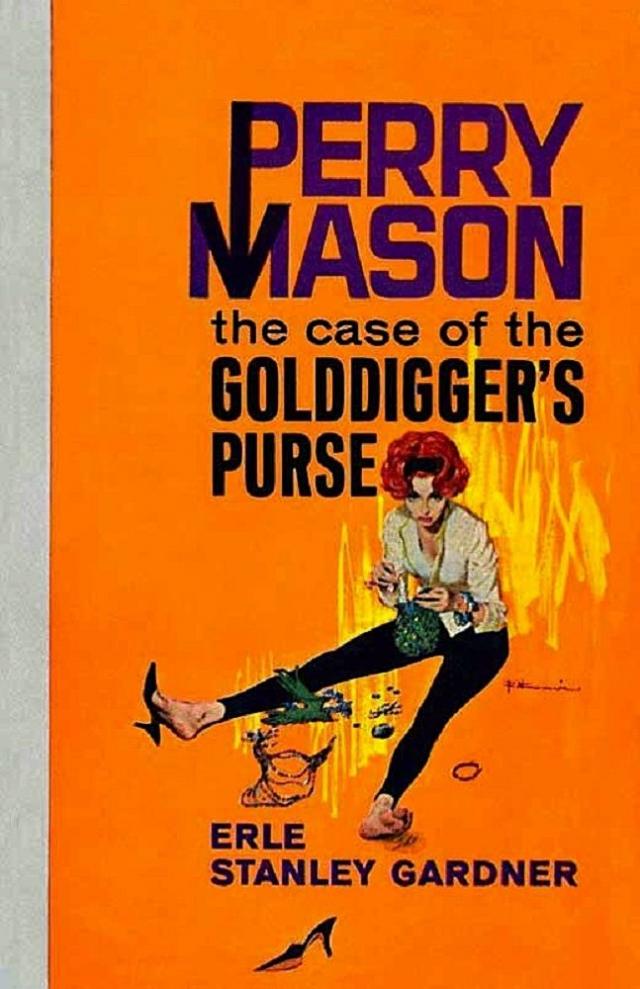


Table of Contents
Cover Page
Copyright Page
Cast of Characters
CONTENTS
Chapter 1
Chapter 2
Chapter 3
Chapter 4
Chapter 5
Chapter 6
Chapter 7
Chapter 8
Chapter 9
Chapter 10
Chapter 11
Chapter 12
Chapter 13
Chapter 14
Chapter 15
Chapter 16
Chapter 17
Chapter 18
Chapter 19
Chapter 20
About the Author
THE CASE OF THE
GOLDDIGGER’S PURSE
ERLE STANLEY GARDNER
Copyright © 1945 by Erle Stanley Gardner. Renewed 1972 by Jean Bethel Gardner.
Electronic Book: Copyright © 2013 by The Erle Stanley Gardner Trust
Published by Della Street Press. All rights reserved. No part of this book may be used or reproduced in any manner whatsoever without the written permission of the copyright holder.
Cast of Characters
Perry Mason—The lawyer whose duties know no boundaries
Harrington Faulkner—A businessman with a hobby (collecting rare fish) but no conscience
Paul Drake—Private detective and aide-de-camp to Perry Mason
Della Street—Perry Mason’s secretary
Sally Madison—A rock-hard golddigger
Elmer Carson—Harrington Faulkner’s business partner
Genevieve Faulkner—The slender, attractive first wife of Harrington Faulkner
Tom Gridley—Sally Madison’s Prince Charming
David Rawlins—Who runs a pet shop
Jane Faulkner—Harrington Faulkner’s second wife
James L. Staunton—Distinguished-looking insurance broker
Sergeant Dorset—Of the Homicide Squad who has no use for subtleties—or for Perry Mason
Adele Fairbanks—A friend of Jane Faulkner
Lt. Tragg—Chief of Homicide, who has great respect for Perry Mason’s ability
Wilfred Dixon—A good poker player
Judge Summerville—Presiding judge at preliminary hearing
Ray Medford—Prosecuting attorney
CONTENTS
Cast of Characters
Chapter 1
Chapter 2
Chapter 3
Chapter 4
Chapter 5
Chapter 6
Chapter 7
Chapter 8
Chapter 9
Chapter 10
Chapter 11
Chapter 12
Chapter 13
Chapter 14
Chapter 15
Chapter 16
Chapter 17
Chapter 18
Chapter 19
Chapter 20
About the Author
Chapter 1
Perry Mason, seated at the restaurant table, looked up at the tense, nervous face of the man who had deserted his spectacular companion to accost him.
“You said you wanted to consult me about a goldfish?” Mason repeated blankly. His smile was almost incredulous.
“Yes.”
Mason shook his head. “I’m afraid you’d find my fees were a little too high . . .”
“I don’t care how high your fees are. I can afford to pay any amount within reason, and I will.”
Mason’s tone contained quiet finality. “I’m sorry, but I’ve just finished with a rather exacting case. I have neither the time nor the inclination to bother with goldfish. I . . .”
A tall, dignified gentleman gravely approached the table, said to the man who was regarding Mason with an expression of puzzled futility, “Harrington Faulkner?”
“Yes,” the man said with the close-clipped finality of one accustomed to authority. “I’m engaged now, however, as you can see. I . . .”
The newcomer’s hand made a quick motion to his breast pocket. There was a brief flash of paper as he pushed a folded oblong into Faulkner’s hand.
“Copy of summons, and complaint, case of Carson versus Faulkner. Defamation of character, a hundred thousand dollars. Here’s the original summons—directing your attention to the signature of the clerk and the seal of the court. No need to get sore about it. It’s all in the line of work. If I didn’t serve it somebody else would. See your lawyer. You have ten days to answer. If the other fellow isn’t entitled to anything he can’t get it. If he is, it’s your hard luck. I’m just the man who serves the papers. No good getting mad. Thank you. Good night.”
The words rattled along with such staccato rapidity that they sounded like a sudden, unexpected burst of hail on a metal roof.
The process server turned with quick, self-effacing grace, and merged himself into a group of diners who were just leaving the restaurant.
Faulkner, acting like a man who is in the middle of a bad dream and is being swept helplessly along by the events of his nightmare, pushed the papers down into a side pocket, turned without a word, walked back to his table and rejoined his companion.
Mason watched him thoughtfully.
The waiter hovered over the table. Mason smiled reassuringly at Della Street, his secretary, then turned to Paul Drake, the private detective who had entered a few minutes before.
“Joining us, Paul?”
“A big coffee and a slab of mince pie is all I want,” Drake said.
Mason gave the waiter their orders. “What do you make of the girl?” he asked Della Street as the waiter withdrew.
“You mean the one with Faulkner?”
“Yes.”
Della Street laughed. “If he keeps playing around with her he’ll have another summons served on him.”
Drake leaned forward so that he could look past the corner of the booth. “I’ll take a look at that myself,” he announced, and then after a moment said, “Oh, oh. That’s a dish!”
Mason’s eyes thoughtfully studied the pair. “Incongruous enough,” he said.
“Notice the getup,” Drake went on. “The skin-fitting dress, the long, long eyelashes, the burgundy fingernails. Looking in those eyes, he’s already forgotten about the summons in his side pocket. Bet he doesn’t read it until . . . Looks as though he’s coming back, Perry.”
Abruptly the man pushed back his chair, arose with no word to his companion, marched determinedly back to Mason’s table. “Mr. Mason,” he said, speaking with the crisp, deliberate articulation of a man determined to make his point, “it has just occurred to me that you may have received an entirely erroneous impression of the nature of the case about which I was trying to consult you. I think perhaps when I mentioned that it concerned a goldfish, you naturally considered the case one of minor importance. It isn’t. The goldfish in question is a very fine specimen of the Veiltail Moor Telescope. The case also concerns a crooked partner, a secret formula for controlling gill disease, and a golddigger.”
Mason regarded the anxious face of the man who was standing beside the table and tried not to grin. “A goldfish and a golddigger,” he said. “After all, perhaps we’d better hear about it. Suppose you draw up a chair and tell me about it.”
The man’s face showed sudden satisfaction. “Then you’ll take my case and . . .”
“I mean I’m willing to listen and that’s all,” Mason said. “This is Della Street, my secretary, and Paul Drake, head of the Drake Detective Agency, who quite frequently assists me in gathering facts. Won’t you invite your companion to come over and join us, and we may as well . . . ”
“Oh, she’s all right. Let her sit there.”
“She won’t mind?” Mason asked.
Faulkner shook his head.
“Who is she?” Mason asked.
Without changing his tone in the least, Faulkner said, “She’s the golddigger.”
Drake said warningly, “You leave that baby alone at that table and you won’t find her alone when you get back.”
Faulkner said fervently, “I’d give a thousand dollars to the man who would take her off my hands.”
Drake said laughingly, “Done for five hundred. It’s cheap at half the price.”
Faulkner regarded him with unhumorous appraisal, drew up a chair. The young woman he had left sitting at the table merely glanced over at him, then opened her purse, held up a mirror and started checking her make-up with the careful appraisal of a good merchant inspecting his stock-in-trade.
Chapter 2
Mason said to Faulkner, “You haven’t even read the papers that process server handed you.”
Faulkner made a gesture of dismissal. “I don’t have to. It’s just part of a campaign to annoy me.”
“What’s he suing for?”
“A hundred thousand dollars, the man who served the papers said.”
Mason said, “You’re not interested enough to read them?”
“I’m not interested in anything Elmer Carson does to annoy me.”
“Tell me about the goldfish,” Mason said.
Faulkner said, “The Veiltail Moor Telescope is a prized goldfish. The uninitiated would hardly consider him a goldfish. He isn’t gold. He’s black.”
“All over?” Mason asked.
“Even the eyes.”
“What’s a Telescope f
ish?” Drake asked.
“A species of goldfish that has been developed by breeding. They’re called Telescopes because the eyes protrude from the sockets, sometimes as much as a quarter of an inch.”
“Isn’t that rather—unprepossessing?” Della Street asked.
“It might be to the uninitiated. Some people have called the Veiltail Moor Telescope the Fish of Death. Pure superstition. Just the way people react to the black color.”
“I don’t think I’d like them,” Della Street said.
“Some people don’t,” Faulkner agreed, as though the subject held no particular interest. “Waiter, will you please bring my order over to this table?”
“Yes, sir. And the lady’s order?”
“Serve it to her over there.”
Mason said, “ After all, Faulkner, I’m not certain I like that method of handling the situation. Regardless of what the girl is, you’re dining with her, and . . .”
“That’s all right. She won’t mind. She isn’t the least bit interested in what I’m going to talk about.”
“What is she interested in?” Mason asked.
“Cash.”
“What’s her name?”
“Sally Madison.”
“And she is putting the bite on you?” Mason asked.
“I’ll say she is.”
“Yet you take her out to dinner?”
“Oh, certainly.”
“And walk away and leave her?” Della Street asked.
“ I want to discuss business. She wouldn’t be interested. She understands the situation thoroughly. There’s no need of any concern about her.”
Drake glanced at Perry Mason. The waiter brought him his mince pie and coffee, shrimp cocktails to Della Street and Mason and consommé to Harrington Faulkner.
Over at the table Faulkner had vacated, Sally Madison completed her make-up, sat with a carefully cultivated expression of demure rectitude frozen on her face. She seemed to have no further interest in Harrington Faulkner or the party he had joined.
“You don’t seem to have any hard feelings,” Mason said.
“Oh, I don’t,” Faulkner hastily disclaimed. “She’s a very nice young woman—as golddiggers go.”
Mason said, “ If you’re not going to read that complaint and summons, suppose you let me glance through it.”
Faulkner passed it across the table.
Mason unfolded the papers, glanced through them, said, “ It seems that this Elmer Carson says that you’ve repeatedly accused him of tampering with your goldfish; that the accusation is false and has been made with malice; that Carson wants ten thousand dollars as actual damages and ninety thousand dollars by way of punitive damages.”
Faulkner seemed to have only a detached interest in the claims made against him by Elmer Carson. “You can’t believe a word he says,” he explained.
“Just who is he?”
“He was my partner.”
“In the goldfish business?”
“Good heavens, no. The goldfish is just my own hobby. We have a real-estate business. It’s incorporated. We each own one third of the stock and the balance is held by Genevieve Faulkner.”
“Your wife?”
Faulkner cleared his throat, said with some embarrassment, “My former wife. I was divorced five years ago.”
“And you and Carson aren’t getting along?”
“No. For some reason there’s been a sudden change in him. I’ve made Carson an ultimatum. He can submit a buy-or-sell offer. He’s jockeying around to get the best price available. Those are minor matters, Mr. Mason. I can handle them. I want to see you about protecting my fish.”
“Not about the slander suit?”
“No, no. That’s all right. I have ten days on that. Lots can happen in ten days.”
“Not about the golddigger?”
“No. She’s all right. I’m not worried about her.”
“Just about the goldfish?”
“That’s right. Only, you understand, Mr. Mason, the partner and the golddigger enter into it.”
“Why the concern about the goldfish?”
“Mr. Mason, I’ve raised this particular strain of Veiltail Moor Telescopes and I’m proud of them. You have no idea of the thought and labor that have gone into developing this particular fish, and now they’re threatened with extinction by gill disease, and that disease has been deliberately introduced into my aquarium by Elmer Carson.”
“He says in his complaint,” Mason said, “ that you accuse him of deliberately trying to kill your fish, and it’s for that he’s asking damages.”
“Well, he did it all right.”
“Can you,” Mason asked, “prove it?”
“Probably not,” Faulkner admitted glumly.
“In that event,” Mason told him, “ you might be stuck for a large sum by way of damages.”
“I suppose so,” Faulkner admitted readily enough, as though the matter held no immediate interest for him.
“You don’t seem particularly worried about it,” Mason said.
“ There’s no use crossing bridges like that before you come to them,” Faulkner said. “ I’m in enough trouble already. Perhaps, however, I haven’t made my position entirely clear. The things Carson does to annoy me don’t mean a thing to me. I am interested right now in saving my fish. Carson knows they are dying. In fact, it is because of him that they are dying. He knows that I want to remove them for treatment. So he has filed a suit, claiming the fish are the property of the corporation and not my individual property. That is, he claims the fish are affixed to the partnership real property and that I have threatened to and will, unless restrained, tear out the tank and remove the fish and tank from the premises. Because this constitutes a severance of the real property, he has flim-flammed a judge into giving him a temporary restraining order. . . . And hang it, Mason, he’s right. The confounded tank is affixed to the property . . . I want you to beat that restraining order. I want to establish title to the fish and the tank as my own individual property. I want that restraining order smashed and smashed hard and quick, and I think you’re the man to do it.”
Mason glanced across to the girl at the table Faulkner had left. She seemed to be taking no interest in the conversation. A look of synthetic, motionless innocence was frozen on her face as painting is glazed on a china cup.
“You’re married?” Mason asked Faulkner. “ I mean you’ve remarried since your divorce?”
“Oh, yes.”
“When did you start playing around with Sally Madison?”
Faulkner’s face showed a brief flicker of surprise. “Playing around with Sally Madison?” he repeated almost incredulously. “Good heavens, I’m not playing around with her.”
“I thought you said she was a golddigger.”
“She is.”
“ And that she was putting the bite on you?”
“Indeed she is.”
Mason said, “ I’m afraid you’re not clarifying the situation very much,” and then, reaching a sudden decision, added, “ if you people will excuse me, and there’s no objection on the part of Mr. Faulkner, I think I’ll go talk to the golddigger and get her ideas on the case.”
Waiting only for Della Street’s nod and not so much as glancing at Faulkner, Mason left the table and crossed over to where Sally Madison was seated.
“Good evening,” he said. “My name is Mason. I’m a lawyer.”
Long lashes swept upward, dark eyes regarded the lawyer with the unabashed frankness of a speculator looking over a piece of property. “ Yes, I know. You’re Perry Mason, the lawyer.”
“May I sit down?”
“Please do.”
Mason drew up a chair.
“I think,” he said, “ I’m going to like this case.”
“I hope you do. Mr. Faulkner needs a good lawyer.”
“But,” Mason pointed out, “ if I agreed to represent Mr. Faulkner, it might conflict with your interest.”
“Yes, I suppose so.”
“It might, therefore, cut down the amount of money you’d receive.”
“Oh, I think not,” she said with all the assurance of a person who occupies an impregnable position.
Mason glanced quizzically at her. “How much,” he asked, “ do you want out of Mr. Faulkner?”
“Today it’s five thousand dollars.”
Mason smiled. “Why the accent on today? What was it yesterday?”
“Four thousand.”
“And the day before?”
“Three.”