The case of the golddigg.., p.11
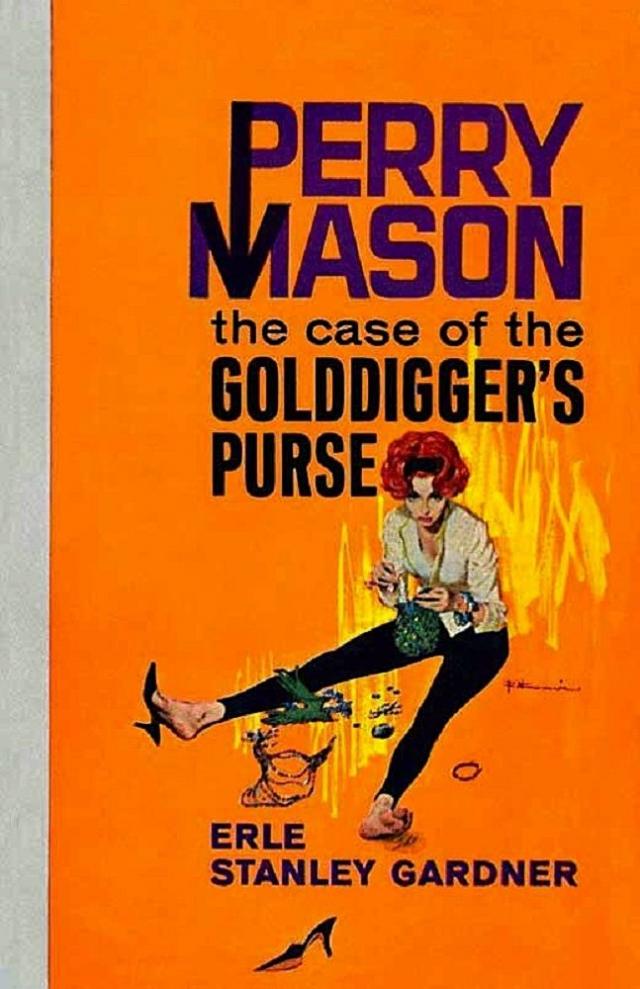
The Case of the Golddigger's Purse (Perry Mason Series Book 26),
p.11


Chapter 10
Mason and Della Street sat in a little all-night restaurant where the coffee was good. The ham was thin but had an excellent flavor and the eggs were cooked to golden perfection.
“Do you think we’re in the clear?” Della Street asked.
“I think so,” Mason said.
“You mean she’ll get rid of the gun?”
Mason nodded.
“What makes you think she’s going to do that?”
Mason said, “She was so anxious to get away. She certainly had something in mind. It doesn’t take more than six guesses, you know.”
“Didn’t she have an opportunity to get rid of the gun last night?”
“Perhaps not,” Mason said. “Remember that Sergeant Dorset took her out to see James Staunton. Did she tell you anything about the result of that interview?”
“Yes. Staunton insisted that Faulkner had brought him the fish. What’s more, he brought out a written statement to prove it.”
“The deuce he did!”
“That’s what she said.”
“A statement signed by Faulkner?”
“Yes.”
“What was done with the statement?”
“Sergeant Dorset took it. He gave Staunton a receipt for it.”
Mason said, “Staunton didn’t tell me about having any written statement from Faulkner. What was in it?”
“Something to the effect that Faulkner had turned over these two particular fish to Staunton. That he wanted Staunton to care for them and secure treatment for them; that he absolved Staunton of all responsibility in case anything should happen to the fish, either death from natural causes or theft or sabotage.”
“It was Faulkner’s signature?”
“Staunton insisted that it was, and apparently there was nothing about it to arouse Sergeant Dorset’s suspicions. He took the statement at its face value. Of course, I’m going by what Sally told me.”
Mason said, “Now why do you suppose Staunton didn’t produce that statement when I questioned him?”
“Probably because he felt your questioning wasn’t official.”
“I suppose so. But I thought I had him pretty well frightened.”
“But if Faulkner himself took those fish out of the tank, what was the reason for the soup ladle and the four-foot extension on the handle?” Della Street asked.
Mason said, “ I’ve already pointed that out to Sergeant Dorset. The ladle couldn’t have been used to take the fish out of the tank.”
“Why not?”
“In the first place,” Mason said, “the surface of the water in the tank was about seven and a half feet from the floor, and I don’t think the ceiling of the room was over nine and a half feet high. It’s one of those low-ceilinged bungalow rooms. Now take a four-foot handle on a soup ladle, try to bring it out of the tank, and you’ve got two feet of handle that remain in the tank after the top of the handle is against the ceiling.”
“But you can tilt the ladle, can’t you? That is, you can take it out on an angle.”
“Exactly,” Mason said, “and when you do that, you lose your fish.”
Della Street nodded, then frowned. She gave the problem thoughtful consideration.
“What’s more,” Mason went on, “I don’t think you could lift a fish out of a tank with a soup ladle. I don’t think the fish would stay in one position long enough to let you get him out. I think it would take something bigger than a soup ladle. Of course, I’m making allowances for the fact that these fish weren’t as active as they might have been. But even so, I doubt if it could be done.”
“Then what was the ladle used for? Was it just a blind?”
Mason said, “ It could have been a blind. It could have been something else.”
“Such as what?” Della asked.
“It could have been a device to get something out of the tank other than fish.”
“What do you mean?”
Mason said, “Someone took a shot at Faulkner last week. At any rate he claims they did. The bullet missed him and embedded itself in the upholstery of the car. Of course, that bullet was valuable evidence. Police have worked out the science of ballistical detection now so that they can tell a great deal about the weapon which fired any particular bullet. And they can examine a bullet under a microscope and tell absolutely whether or not it was fired from any given gun.”
“And what does all this have to do with the goldfish tank?” Della Street asked.
Mason grinned. “It goes back to something Elmer Carson told me. He was in the office when Faulkner came in carrying the bullet with him.”
“The one he’d dug out of the car?”
“That’s right. He’d recovered the bullet from where it had embedded itself in the upholstery, and he’d notified the police, although he didn’t tell anyone in the real-estate office about it.”
“And what happened?”
“The police came there and then Faulkner couldn’t find the bullet.”
“Oh, oh,” Della said.
“Now Carson points out that he never left his seat at his office desk, and the stenographer there, a Miss Stanley, apparently corroborated his statement. However, police searched him, also his desk.”
“So then what?”
“So then later on, along in the evening, when Miss Stanley was cleaning up her desk, she found a bullet under some paper on her desk.”
“You mean it wasn’t the same bullet?”
“I don’t know,” Mason said. “I don’t think anyone else knows. It was simply a bullet. Everyone acted on the assumption that it was the same bullet Faulkner had brought in earlier in the day and had then misplaced. But as nearly as I can tell, there were no identifying marks on the bullet, so that it could not definitely be said to be the same one.”
“I don’t see just what you’re getting at,” Della Street said.
Mason said, “Faulkner thought that he had placed the bullet on the top of his desk when he came in. Then he’d gone over to dictate some correspondence, standing by Miss Stanley’s desk.”
“He must have been a pretty cool customer,” Della Street said. “If someone shot at me, I don’t think I’d dig out the bullet and then start dictating correspondence.”
Mason said, “As I gather it, Miss Stanley noticed that his hand was shaking a little, but, aside from that, there were no other evidences of emotion.”
Della Street looked at her employer as though trying to peer behind his eyes and penetrate his thoughts. “Personally I would have said that Faulkner was excitable. If someone had actually shot at him I’d think he would have been as nervous as a kitchen cockroach when a light is suddenly turned on.”
“He was rather a complex character,” Mason said. “Remember that night when the process server served the papers on him in Carson’s suit for defamation of character?”
“Yes, I remember the occasion quite distinctly.”
“Remember that he didn’t get the least bit nervous. Didn’t even read the papers, but pushed them down in his side pocket and kept his attention concentrated on the business of the moment—which was to get me to protect his precious goldfish by beating the temporary restraining order preventing him from moving the goldfish tank?”
Della Street nodded. “That’s right. He took the service of those papers right in his stride. They seemed to constitute only a minor irritation.”
“Despite the fact that the suit was for a hundred thousand dollars,” Mason pointed out.
“You’re getting at something, Chief. What is it?”
Mason said, “I’m simply sitting here sipping coffee and putting two-and-two together, trying to find out if perhaps someone may not have actually taken a shot at Faulkner while he was riding along in his automobile.”
Della Street said, “But Faulkner hardly impressed me as a man who would have forgotten where he placed that bullet after he’d dug it out. That doesn’t seem to be in keeping with his character.”
“It wasn’t,” Mason conceded readily enough.
“Chief, what are you getting at?”
Mason said, “Let’s consider another possibility, Della. A person seated at an adjoining desk, as Carson was, could have reached over to Faulkner’s desk, picked up the bullet Faulkner had left on the desk and hidden it where it would never have been discovered.”
“You mean without leaving his desk?”
“Yes.”
“But I thought you said they searched Carson and searched his desk.”
“They did.”
“I don’t see . . . oh! Now I get it! You mean he could have tossed it into the goldfish tank?”
“Exactly,” Mason said. “The goldfish tank was right back of Carson’s desk; was wide enough at the top so he could have tossed the bullet over his shoulder and been almost certain of having it light inside the tank, and then it would drop down to the bottom and be a relatively inconspicuous object among the pebbles and gravel at the bottom of the tank.”
Della Street’s eyes were sparkling with interest now. “Then when Faulkner thought attempts were being made to steal his goldfish . . . you mean it was actually someone trying to get the bullet back out of the tank?”
“Exactly,” Mason said, “and the soup ladle would have been an excellent instrument to have dredged down to the bottom of the tank, scooped up the bullet and eased it back out again. If someone had been reaching for the goldfish it wouldn’t have been necessary to have tied a four-foot extension to the handle of the soup ladle. The goldfish would have been swimming around in the water, and by waiting for a favorable opportunity, they could have been fished out with a container that had a handle not over two feet in length.”
“Then Carson must have been the one who shot at him and . . .”
“Not so fast,” Mason said. “Carson had been in his office all that morning. Remember, Miss Stanley will give him an alibi. Or so Carson says, and he would hardly dare to falsify that, because he must know the circumstances incident to that first shooting are now to receive a lot of police attention.”
“Then for some reason Carson was trying to confuse the issues.”
“Trying to protect the person who had fired the shot, or the person who he thought had fired the shot.”
“You mean they may not have been the same?”
“It’s a possibility.”
“Would that account for the sudden animosity which developed between Carson and Faulkner?”
“The animosity had been there for some time. The thing that flared suddenly into existence was Carson’s open hostility.”
“And what did that have to do with it?”
Mason grinned and said, “Put yourself in Carson’s position. He’d tossed a bullet into a fish tank. He’d evidently acted on the spur of the moment, looking for the best possible place of concealment. It was a simple matter to toss the bullet in, but it was a difficult matter to get the bullet out. Particularly when you remember that Faulkner was living in the other side of the duplex house and that he was suspicious of Carson and would have promptly rushed over to see what Carson was doing if Carson came to the office outside of office hours.”
Della Street nodded.
“You can’t reach down to the bottom of a four-foot fish tank,” Mason said, “and pull out a lead bullet without making some rather elaborate preparations. And it was at this time that Carson suddenly realized Faulkner was concerned about the health of the goldfish and was planning to remove the entire tank to some place where the fish could be given treatment.”
“But wouldn’t Carson have been in a position to profit by that? Wouldn’t he have stood more chance of getting the bullet if the tank had been moved?”
“Probably not. And you must also remember that he was running the risk of having the bullet discovered as soon as the tank was moved. Of course, once that bullet was discovered, it wouldn’t take very much of a detective to piece together what must have happened, and Carson would find himself in quite a spot.”
“I’d say he was in a spot anyway,” Della Street said.
“He was,” Mason told her. “And so it became necessary for him to take steps to prevent the goldfish tank from being removed from the office. That was the reason for his sudden flare-up of hostility and the filing of his initial action against Faulkner, the action which resulted in a temporary restraining order preventing Faulkner from removing the fish tank. Of course, Carson might have been left without a leg to stand on when he finally got into court, but that didn’t bother him. He knew that by filing the action against Faulkner he could at least delay things until he had a chance to get that bullet out of the tank.”
“That certainly sounds logical,” Della Street admitted, “and would account for some of the things Carson did.”
“And,” Mason went on, “in order to make the filing of that injunction suit seem logical, Carson had to play the part all the way along the line. Otherwise, his sudden concern over the goldfish tank would have been so conspicuous that it might have aroused suspicion.”
“So that accounts for his action for defamation of character?”
“Exactly.”
“But what about the earlier attempts to steal the goldfish?”
“There weren’t any. Carson had probably managed to get access to the fish tank for some rather limited period. At that time, he probably tried various methods of extracting the bullet and found that he was up against a tougher problem than he had anticipated. The size of the tank, the weight of the tank, and its position, made it something of a job to get that bullet out of the tank.”
“And I suppose that the forty-five bullet which was subsequently found on Miss Stanley’s desk was simply another bullet that had been deliberately planted.”
“So it would seem,” Mason said. “You will note that Miss Stanley vouched for the fact that Carson had not left the office before the police arrived, and that he had been seated at his desk during all of the time which had elapsed between Faulkner’s entrance and the arrival of the police, but it’s logical to assume that between the arrival of the police and the discovery of the bullet, Carson must have gone out—perhaps several times. He certainly must have gone out for lunch. He could easily have picked up another bullet then.”
Della Street showed her excitement. “Chief, you’ve got it all figured out. It must have happened in exactly that way. And if it did, then Carson must have been the one who killed Faulkner and . . .”
“Take it easy, Della,” Mason cautioned. “Remember that all I have at present is a beautiful theory, a logical theory, but nevertheless, only a theory. And remember that we’re in a jam.”
“How do you mean?”
“Sally Madison had a gun in her purse. Let’s hope she’s smart enough to either hide that gun where it won’t be discovered, or to wipe all the fingerprints off of it, or to do both. In the event she doesn’t, and if it should prove to be the murder gun, the police will find fingerprints on it and sooner or later they’re pretty apt to discover they’re your fingerprints. Then we’re up against a serious charge. It will be a simple matter for the police to prove that we took Sally Madison out of circulation during a crucial period in the investigation. And if we try to plead innocence, or pretend that we didn’t know she had the murder weapon in her purse, we will be confronted with your fingerprints on the gun. So, taken by and large, we’re up against it if Sally Madison is caught before she gets rid of that gun.”
“Chief, couldn’t you have telephoned the police as soon as we’d found out that she had a gun in her purse?”
“We could have,” Mason said, “and in the light of subsequent events, we undoubtedly should have. However, the police would have been skeptical, and at the time, it seemed like a better bet to wipe your fingerprints off the gun, wash our hands of Sally Madison, and step out of the case. The peculiar combination of circumstances which made that night clerk enter the room and decide to stay there couldn’t very well have been foreseen.”
“So what do we do now?” Della Street asked.
Mason said, “We keep our fingers crossed and . . .”
Abruptly, Mason lowered his coffee cup to the saucer. “Damn!” he said.
“What is it, Chief?”
“Don’t look startled and don’t act guilty,” Mason warned. “Leave the talking to me. Lieutenant Tragg has just entered the restaurant and is headed this way, and if you think Tragg isn’t the last person in the world I want to talk to just now, you’ve got another think coming.”
Della Street’s face changed color. “Chief, you keep out of it. Let me take the rap. After all, I’m the one whose fingerprints are on the gun. They can’t prove that you knew anything . . .”
Mason abruptly raised his head to look over Della Street’s shoulder and said, with every semblance of surprise, “Well, well, well! Our old friend, Lieutenant Tragg! What brings you out here so early in the morning?’’
Tragg placed his hat on a vacant chair, drew up another one and calmly seated himself. “What brings you here?”
“Hunger,” Mason said, smiling.
“Is this your regular breakfast place?” Tragg asked.
“I think we’ll adopt it,” Mason told him. “The menu isn’t large, but it’s attractive. You’ll find the coffee excellent, and the eggs are well cooked. I don’t know about you, Lieutenant, but I particularly detest eggs that are fried in a pan so hot that a crust forms on the bottom of the eggs. Now, you take the fried eggs here, and they’re thoroughly delicious.”
“Exactly,” Tragg said, and to the man behind the counter called out, “Ham and eggs, and a big cup of coffee now, and another cup of coffee when you serve the eggs.”
Tragg shifted his position slightly, smiled at Mason and said, “And now, Counselor, since you’ve exhausted the subject of fried eggs, suppose we talk about murders.”
“Oh, but I haven’t exhausted the subject of eggs,” Mason protested. “A great deal depends on cooking them at just the right temperature. Now, the yolk of a fried egg should be thoroughly warm all the way through, not cooked almost solid at the bottom but runny on top. Nor should . . .”