

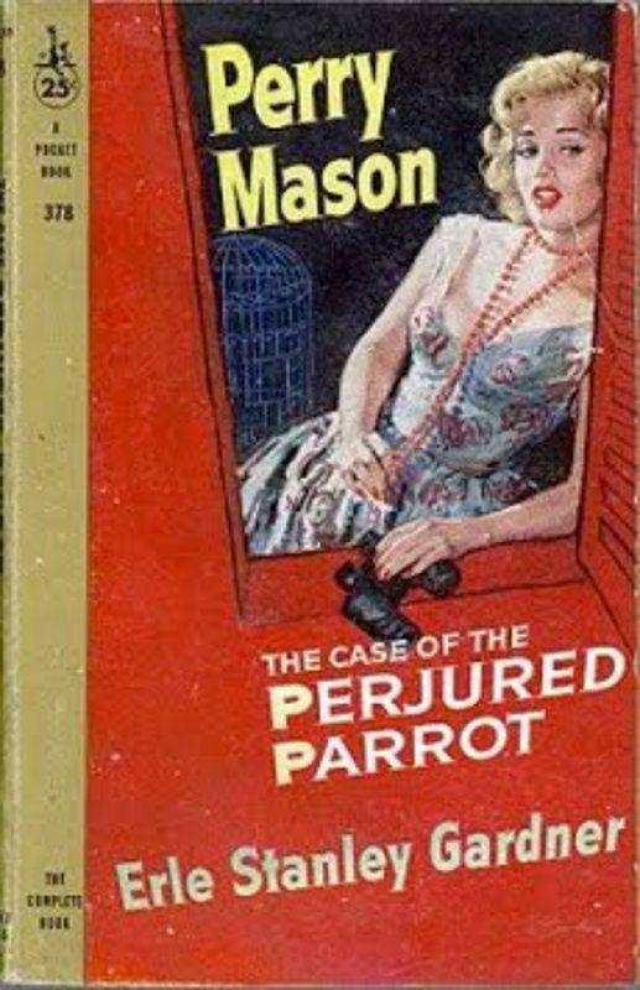
The case of the perjured.., p.10
The Case of the Perjured Parrot,
p.10


“Make certain we’re not being followed,” Mason said, sliding around in the seat so he could look through the back window.
“I’ve been checking pretty carefully on that,” Drake told him.
“Well, make a figure eight, just for the sake of being absolutely certain,” Mason said.
When Drake had completed the maneuver, Mason nodded his satisfaction. “Okay, Paul, drive right to the bungalow.”
“That’s rather a snoopy neighbor,” Drake observed thoughtfully. “We’d better switch out the lights a block or so before we get to the house … How about parking a few doors away, Perry?”
“No,” Mason said, “I want to make it fast. You can drive around the block once, and I’ll size up the situation, then switch off your lights, and swing in to the curb as near the screen porch as you can make it … I hope this damned parrot doesn’t squawk when I start moving him.”
“I thought parrots slept at night,” Drake said.
“They do,” Mason told him. “But when they’re being dragged around the country in automobiles, they get nervous—and I don’t know how much of a squawk Casanova will make when I steal him.”
Drake said, “Now listen, Perry, let’s be reasonable about this thing. If anything goes wrong, don’t get pigheaded and keep trying to make the switch. I’ll be all ready to make a getaway. For God’s sake, drop that parrot and make a run for it.”
“I don’t think anything will go wrong,” Mason told him, “—not unless the house is being watched, and we should be able to find that out by swinging around the block.”
“Well, we’ll know in a minute,” Drake said, turning the wheel sharply to the left. “We’re within two blocks of the place now.”
He ran two blocks and swung once more to the left. Mason sized up the bungalow as they glided past. “The house is dark,” he said. “There are lights in the house next door, and lights across the street. The screen porch looks easy.”
Drake said, “Maybe you think it won’t be a relief to me when this is over, Perry.”
He circled the block, swung in to the curb, with lights out and motor off.
Mason glided out of the car, the cage and the parrot in his hand, and vanished into the shadows. He found it a simple matter to cut the screen, snap back the catch on the screen door and effect an entrance to the porch. The parrot he had brought with him was restive, moving about on the perch in the cage, but Casanova, apparently drugged with sleep, barely stirred when Mason gently lowered the cage from its hook, and substituted the cage he had brought with him.
A few moments later, Mason had deposited Casanova in the back of the automobile. “Okay, Paul,” he said.
Drake needed no signal. He lurched the car into motion, just as the door of the adjoining house opened and the ample figure of Mrs. Winters stood framed in the doorway.
As Paul Drake skidded around the corner, with the lights out, the parrot in the back of the car mumbled sleepily, “My God, you’ve shot me.”
CHAPTER EIGHT
MASON unlocked the door of his private office, and then suddenly stood motionless, staring in surprise at Della Street.
“You!” he exclaimed.
“None other,” she told him, blinking back tears. “I guess you’ll have to get a new secretary, Chief.”
“What’s the matter, Della?” he asked, coming toward her solicitously.
She started to cry then, and he slid his arm around her shoulders, patting her reassuringly. “What happened?” he asked.
“That t-t-t-two-timing little d-d-d-devil,” she said.
“Who?” Mason asked.
“That librarian, Helen Monteith.”
“What about her, Della?”
“She slipped one over on me.”
“Come on over here; sit down and tell me about it,” Mason said.
“Oh, Chief, I’m so d-d-darned sorry I let you down!”
“How do you figure you let me down, Della? Perhaps you didn’t let me down as much as you think.”
“Yes, I did too. You told me to keep her where no one could find her, and …”
“What happened?” Mason asked. “Did they find her, or did she take a run-out powder?”
“She took a p-p-p-powder.”
“All right, how did it happen?”
Della Street dabbed at her eyes with a lace-bordered handkerchief. “Gosh, Chief, I hate to be a b-b-bawl-baby,” she said. “… Believe it or not, this is the first tear I’ve shed…. I could have wrung her neck with my bare hands…. She started in and told me a story that tore my heart inside out.”
“What was the story?” Mason asked, his face without expression.
“It was the story of her romance,” Della said. “She told it…. Oh, Chief, you’d have to be a woman to understand…. It was all about her life. She’d been romantically inclined when she was young. There’d been a high school, puppy-love affair, which had been pretty serious with her…. But it hadn’t been so serious with the boy … that is, it had at the time, Chief. I don’t know if you can get the sketch, I can’t tell it to you the way she told it to me.
“This boy was just an awfully nice boy. She made me see him just the way she saw him—a nice, clean, decent chap, with something of the mystic, or spiritual, in him … something that a woman really wants in every man she loves, and this was a real love affair.
“Then the boy went away to get a job, so he could make enough money to marry her, and she was all thrilled with pride. And then, after a few months, he came back, and …”
“… And he was in love with someone else?” Mason asked as she hesitated.
“No, it wasn’t that,” Della said. “He was still in love with her, but he’d become sort of smart-alecky. He looked on her as something of a conquest. He wasn’t in such a hurry to get married, and he’d been running around with a crowd of boys that thought it wasn’t smart to have ideals. They had a sophisticated attitude, and … well, I’ll never forget the way she described it. She said the acid of their pseudo-realism had eaten the gold off his character and left just the base metal beneath.”
“So then what happened?” Mason asked.
“Then she naturally became bitter—toward men and toward love. At a time when most girls were seeing the world through rose-tinted spectacles, she was embittered and disillusioned. She didn’t care too much for dances, and parties, and things, and gradually became more and more interested in books. She said she formed her friendships among books; that books didn’t tease you along until they’d won your friendship, and then suddenly reverse themselves and slap you in the face.
“Along about that time, she acquired the reputation of being narrow-minded and strait-laced, and a poor sport. It started in with a few fellows whose vanity was insulted because she wouldn’t drink bathtub gin, and neck. They advertised her as an awful pill, and gradually that reputation stuck to her. Remember, Chief, she was in a small town. It’s pretty hard for people to really see each other in a small town. They only see the reputation which has been built up by a lot of word-of-mouth advertising.”
“Was that the way she described it?” Mason asked.
Della Street nodded.
“All right, go ahead. Then what happened?”
“Then, when she’d just about given up any idea of romance, along came Fremont Sabin. He was kindly and gentle, he wasn’t greedy. He had a philosophy of life which saw the beautiful side of everything. In other words, Chief, as nearly as I can explain it, there was Something of the idealism in this man that she had worshiped in this boy with whom she’d been in love. But, whereas the boy had the ideals of youth, and they weren’t strongly enough entrenched in him to withstand the cynicism and cheap worldly wisdom of his associates, this man had battled his way through every disillusionment life had to offer, and won his idealism as an achievement, as an ultimate goal. His ideals stood for something—they were carefully thought out. They’d stood the test of time.”
“I guess,” Mason said thoughtfully, “Fremont C. Sabin was really a wonderful character.”
“Apparently he was, Chief. Of course, he played an awful trick on her, but …”
“I’m not so certain he did,” Mason said. “We can look at the thing from Sabin’s viewpoint, and see just what he was trying to do. When you get the whole picture in its proper perspective, and in the light of some new evidence we’ve uncovered, it’s quite consistent with his character.”
“Can you tell me about this new evidence, Chief?”
“No, you tell me about Helen Monteith first.”
“Well, this man started coming to the library. She knew him only as Wallman, a man who was out of work, a man who had no particular trade, and no particular cause to feel friendly toward the world; yet he did. He was interested in books on philosophy and social reform, and he was particularly interested in his fellowmen. He’d sit in the library, sometimes at night, apparently reading a book, but in reality studying the men who were seated around him. And then, whenever he had an opportunity, he’d get acquainted, in an unostentatious manner, and listen. He was always listening.
“Naturally, Helen Monteith, as a librarian, watched him and became interested in him. He started talking to her. Apparently, he had quite a knack of drawing people out, and he got her to tell him a great deal about herself before she realized how much she actually was telling him. And then she fell in love. Because the man was older than she, and because she hadn’t been anticipating anything of the sort, romance sneaked up on her and caught her unaware. She was madly in love with him before she even realized she was in love. And then when she found out that he loved her … Well, Chief, as she told me about it, she said it felt as though her soul was singing all the time.”
“She must have something of a gift for expression,” Mason said, his eyes narrowing slightly.
“No, Chief, it wasn’t an act she was putting on. She was absolutely sincere. She loves to talk about it, because it was such a beautiful thing with her. Despite the shock of the tragedy, and all the disillusionment which has come with finding out he was married, she’s still happy and philosophical about it all. She feels that she finally found happiness in her life. The happiness didn’t last, but she doesn’t seem to feel bitter about that, but, instead, is grateful for the measure of happiness she did have. Of course, when she read the morning paper about the murder, about how Sabin would go around using an assumed name, studying people, browsing in libraries … Well, of course, that made her suspicious. Then she saw the photograph of this mountain cabin and recognized it. But she fought against her fears, trying to convince herself against her better judgment…. And then the afternoon paper carried the picture of Sabin, and her worst fears were confirmed.”
“Then you don’t think she killed him?” Mason asked.
“Absolutely not,” she said. “She couldn’t … Well …”
“Why the doubt?” Mason asked, as her voice trailed off into silence.
“Well,” Della said, “there is this side to her character. If she had thought that he had been going to do something to hurt her … If she had thought that his ideals were going to … well, not exactly his ideals, either, Chief, but if she had thought that there was something about him which was counterfeit, I think she’d have killed him, in order to keep from discovering it, if you know what I mean.”
“I think I do,” Mason told her. “Go on, what happened?”
“Well, I took her to a little hotel. I went to some precautions to make certain we couldn’t be traced by the police. I gathered that was what you wanted. I got some baggage out of my apartment, and we registered as two sisters from Topeka, Kansas. I asked the clerk a lot of questions that tourists would ordinarily ask, and I think I completely sold him on the idea.
“We had a corner room, in the back, with twin beds and a bath, and quietly, in such a manner that she wouldn’t notice what I was doing, I locked the door from the inside and put the key in my purse.
“Well, we sat down and talked, and she told me all about her romance, and about everything which had happened. I guess we talked for three or four hours. I know it was long after midnight when we went to bed; and I guess it was about five o’clock this morning when she woke me up, shaking me and telling me she couldn’t get the door open. She was fully dressed, and seemed very much upset.
“I asked her why she wanted to get the door open, and she said she had to go back to San Molinas, that she simply had to. There was something she’d forgotten.
“I told her she couldn’t go back. She said she must, and we had quite an argument. Finally, she said she was going to telephone the hotel and have someone come up to open the door. Then I got hard with her.”
“What did you tell her?” Mason asked.
“I told her that you were sacrificing a great deal to help her, and that she was giving you a double-cross; that she was in danger, and that the police would catch her and charge her with murder; that her romance would be written up by every sob sister in the tabloid newspaper game; that she’d be dragged through courts, and the pitiless white light of searching and unfavorable publicity would beat upon her…. I told her everything I could think of. I talked like a lawyer working on a jury.”
“What happened?”
“She still wanted to go,” Della Street said; “so then I told her that the minute she walked out of that door, you were finished with her, you wouldn’t protect her in any way; that she was going to have to obey your orders, and stay there, until I could get in touch with you. She wanted to know when I could get in touch with you, and I told her I didn’t know, not until after you got to the office at around nine-thirty; that I could get Paul Drake to give you a message. She wanted me to call your apartment directly, and I told her absolutely nothing doing, because I was afraid the police would be plugged in on your line, and because I thought you didn’t want to know where she was, or have anything to do with her disappearance.
“Well, she thought that over for a while and decided it was reasonable. She said that was all right, she’d wait until nine-thirty, but made me promise, solemnly, that I’d try and get in touch with you then. She undressed and went back to bed, and said she was sorry she’d made such a scene. It took me about half an hour to get composed enough to drop off to sleep again…. And I woke up, and she was gone…. She’d deliberately planned that business about giving in just so she could double-cross me.”
“She’d taken the key out of your purse?” Mason asked.
“Of course not,” Della Street said. “I had that purse tucked under my pillow slip. She couldn’t have possibly got that key without waking me up. She went down the fire escape. The window was open.”
“You don’t know what time she went?” Mason asked.
“No.”
“What time did you wake up?”
“Not until after eight o’clock,” she said. “I was pretty tired, and I figured we wouldn’t have anything to do except be waiting, so I sort of set my mental alarm clock for around eight o’clock. I woke up and lay there for a while, thinking she was over on the other bed, and being grateful that she’d calmed down. I slipped out quietly from between the covers, so as not to awaken her, and started to tiptoe to the bathroom, and then looked over my shoulder, and saw that her bed looked rather strange. I went over for another look. She’d pulled the old stunt of wadding up some blankets and a pillow, and putting them under the covers, to make it look as though someone was asleep in the bed…. Well, Chief, that’s all there is to it.”
Mason held her close to him. “Don’t worry, Della,” he said. “You certainly did all anyone could have done…. Where did she go, do you know?”
“I think she was headed back for San Molinas.”
“If she goes there,” Mason said, “she’ll put her neck in a noose.”
“Well, I think she’s done it. She’s probably there by this time.”
“What did you do,” Mason asked, “when you found she was gone?”
“I telephoned Paul Drake’s office right away and told them to get in touch with you. I tried to locate you myself, but couldn’t find you anywhere.”
“I went uptown for breakfast, and then stopped in at a barber shop,” Mason told her.
“Well,” she said, “I think Paul Drake’s on the job. I finally got him personally, and explained to him what had happened, and told him to have his men in San Molinas try and pick her up and keep her out of sight.”
“What did Drake say?” Mason asked.
“Drake,” she said with a wan smile, “didn’t seem overly enthusiastic. I guess I caught him before he’d had his morning coffee. He seemed to think that he’d be dragged up before the Grand Jury in San Molinas if he tried anything like that.”
“Did you sell him on the idea?” Mason asked.
“I sold him,” she said grimly, “but I had to get pretty tough with him, in order to do it. He …” She broke off, as Drake’s code knock sounded on the door, and said, “There he is now.”
Mason nodded to her, and she crossed the office toward the door, then turned and said, “My eyes are a sight; let him in, will you, and let me go splash some cold water on my face?”
Mason nodded. As she glided through the door into the law library, Mason opened the corridor door. “Hi, Paul,” he said.
Drake’s shoulders were slumped forward, his manner lugubrious. “H’lo, Perry,” he said, walking across to the big leather chair, and sliding into it sideways in his favorite position.
“What’s new?” Mason asked.
“Plenty,” Drake said.
“Good, bad, or indifferent?” Mason asked.
“It depends on what you consider indifferent,” Drake said, mustering a slow grin. “To begin with, Perry, your certified copy of the divorce decree is an absolute forgery, and that was a damned clever stroke of genius, good enough for a cool one hundred thousand bucks.”
“You’re certain?” Mason asked.
“Absolutely certain. Mrs. Sabin probably had some Reno lawyer helping her, but we’ll never find out who it was, of course, because it’s a slick scheme of obtaining money under false pretenses. They had the regular printed blanks all in proper form, the signature of the clerk, and the deputy, and quite apparently they managed to get a genuine imprint of the court seal. That could have been done, the clerk admits, by sneaking around behind the counter sometime when he was occupied, but they don’t let every Tom, Dick and Harry go behind the counter; so, evidently, it was pretty carefully worked out in advance.”















