

The case of the perjured.., p.5
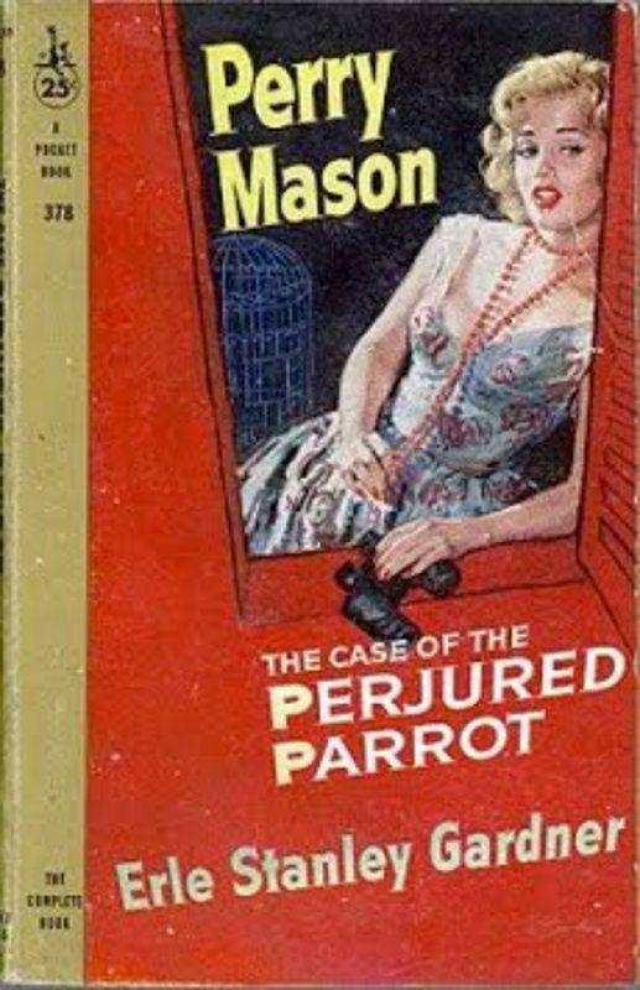
The Case of the Perjured Parrot,
p.5


“Friday, the second of September.”
“At what time?”
“Around two or three o’clock in the afternoon, I think it was.”
“Tell me about the man who bought it.”
“Well, he wore spectacles and had sort of tired eyes. His clothes didn’t look any too good, and he looked … sort of discouraged … no, not discouraged either. Ever since I talked with Mr. Drake about him, I’ve been trying to think more clearly so I can describe him. He didn’t look unhappy…. In fact, he seemed to be a man who knew what he was doing and was living his own life in his own way and getting some happiness out of it. He certainly didn’t seem to have much money. His suit was shiny, and his elbows were worn almost through, but I will say this for him—he was clean.”
“How old?” Mason asked.
“Around fifty-seven or fifty-eight, somewhere around in there.”
“Clean-shaven?”
“Yes, he had wide cheekbones and pretty straight lips. He was about as tall as you are, but he didn’t weigh quite as much.”
“What was his complexion? Pale or ruddy?” Mason asked.
“He looked like some sort of a rancher,” the man said. “He’d been out of doors quite a bit, I think.”
“Did he seem nervous or excited?”
“No, he didn’t seem as though he’d ever get excited over anything, just calm and quiet. Said he wanted to buy a parrot, and he gave me a description of the sort of bird he wanted to buy.”
“What do you mean when you say ‘description’?” Mason asked.
“Oh, he told me the breed and size and age.”
“Did you have any other birds beside this?”
“No, this was the only one I had that would fit the description.”
“Did he hear the bird talk?”
“No, he didn’t. That’s a funny thing. He just seemed to want a parrot of a certain appearance. He didn’t seem to care much about anything else. He took a look at the bird, asked me the price, and said he’d take it.”
“Did he buy a cage at the same time?”
“Yes, of course. He took the parrot with him.”
“And he was driving a car?”
“That’s the thing I can’t remember,” Gibbs said, frowning. “I can’t remember whether I took the cage out to the car or whether he did. I have an impression that he was driving a car, but I didn’t pay too much attention to it. If he did have a car, it was just the ordinary sort of a car you’d associate with a man of that type, nothing to attract attention or to impress itself on my memory.”
“Did he talk like an educated man?” Mason asked.
“Well, there was something quiet about the way he talked, and he had a peculiar way of looking at you while he was talking … looking right straight through you without seeming to be trying to do it. Some people just stare at you, and some seem to try to look holes through you, but this fellow just had a quiet way of …”
“Wait a minute,” Mason interrupted. “Would you know the man if you saw his picture?”
“Yes, I think I would. I know I’d recognize him if I saw him, and I think I’d recognize the picture if it was a good picture.”
Mason said, “Just a minute.”
He walked out to where Della Street was sitting in the car. He pulled out his penknife and said, “Going to have to cut your paper to pieces, Della.”
“Making dolls?” she asked.
“Making mysteries,” he told her, and ran his knife around the border of the newspaper photograph of Fremont C. Sabin. He took it back into the pet store, unfolded the photograph, and said, “Is this, by any chance, the man who bought the parrot?”
Gibbs became excited. “That’s the fellow,” he said, “that’s the man all right. That’s a good picture of him; those high cheekbones and that strong, firm mouth.”
Mason folded the newspaper photograph and pushed it down in his pocket. He and Drake exchanged significant glances.
“Who was it?” Gibbs asked. “Has his picture been in the paper recently?”
“Just a man who liked parrots,” Mason said casually. “Let’s wait until after a while to talk about him. Now, I want to get some information. Have there been any new parrots sold around here that you know of, recently?”
“I gave everything I had to Mr. Drake,” Gibbs said. “But when Mr. Drake was asking me about parrot food this afternoon, and whether I’d had any inquiries from any new people about how to take care of parrots, I couldn’t think of any at the time; but after Mr. Drake had left, I happened to remember Helen Monteith.”
“And who’s Helen Monteith?” Mason asked.
“She’s the librarian over at the city library, and a mighty nice girl. Seems to me I read about her being engaged to be married a short time ago. She came in a week or so ago to buy some parrot food and asked me questions about taking care of parrots.”
“How long ago?”
“Oh, a week or so…. Let me see, yes, it’s been a little more than a week, maybe ten days.”
“Did she tell you that she’d bought a parrot?”
“No, she didn’t; just asked some questions about parrots.”
“Did you ask her why she wanted to know?”
“I may have. I can’t remember now. The whole thing is kind of fuzzy in my memory. You know how it is; a man doesn’t think very much about all of those little transactions. Thinking back on it now, I can remember that at the time I wondered whether she’d been in the city and bought a parrot in there…. Come to think of it, I guess I didn’t ask her any questions at all, just gave her what she wanted.”
“Do you have her address?”
“I can find it in the phone book,” Gibbs said.
“Don’t bother,” Mason said, “we’ll look it up. You’d better shut up shop and go home…. She’s listed in the telephone book, is she?”
“I think so. If she isn’t, it’s a cinch she’s listed in the city directory. Here, let me look her up.”
Gibbs ran the pages of a thick, blue book through his long, listless fingers, then said, “Here it is, 219 East Wilmington Street. You go out Main Street ten blocks and come to a wide street. That’s Washington. The next street on the other side is Wilmington. Turn to the right and go for two blocks, and you’ll be right near the place.”
Mason said, “Thanks. I wonder if we can compensate you in any way for your trouble….”
“Not at all,” Gibbs said. “I’m glad to do it.”
“Well, we certainly appreciate it.”
“You don’t know whether we’d find Miss Monteith at the library now, or whether she’d be at her residence, do you?” Drake asked.
Before the man could answer, Mason said, “I don’t think that angle is particularly important, Paul. After all, it’s just a matter of someone asking a casual question. Good Lord, if we’re going to try to run down everyone who orders parrot food, we’ll be working on this thing for a year.” He turned to Gibbs with a smile and said, “It looked as though we were on the track of something, but the way it’s turning out now, I guess it doesn’t amount to much.”
He took Paul Drake’s arm and led him to the door. When they were out on the sidewalk, Drake said, “What was the idea, Perry? He might have given us a little more information.”
“Not much more,” Mason said, “and I don’t want to let him think we consider this as being too important. Later on he’s going to read his afternoon newspaper. Then, if he thinks we struck a hot trail, he’ll tell the police, and …”
“That’s right,” Drake interrupted. “I’d overlooked that.”
“What luck?” Della Street asked.
“Plenty,” Mason said, “but whether it’s good, bad, or indifferent is more than we know yet. Swing over to Main Street and run out until after you’ve passed Washington, then turn to the right on the next block. We’ll tell you where to stop.”
She touched two fingers of her right hand to the abbreviated rim of her tilted hat. “Aye, aye, sir,” she said, and started the car.
“We don’t want to try the library first?” Drake asked. “It’s probably nearer.”
“No,” Mason said. “A woman wouldn’t keep a parrot in a library. She’d keep it in her home.”
“Do you think she’s keeping a parrot?”
“I wouldn’t be surprised. I’ll tell you more about it within the next ten or fifteen minutes.”
Della Street swung the car skillfully through the late afternoon traffic. Drake, with his head pushed outside the car, reading street signs, said, “That’s Washington, Della, the next is the one we want.”
“There’s no sign on this corner,” Della said as she slowed the car.
“I think it’s the corner we want,” Mason told her. “Go ahead and make the turn anyway…. Good Lord, I don’t know why it is that a city will go to all sorts of trouble and expense to attract tourists and strangers with advertising, and then act on the assumption that only the natives, who know every street in the city, are going to be looking for residences. It wouldn’t cost much to put up a sign big enough to read on every street intersection of any importance…. This is it, Della, pull in to the curb.”
The house was a small California bungalow which dated back to an era of older and cheaper buildings. The outside consisted of redwood boards with strips of batten nailed across the cracks. Back of the house was a small garage, the doors of which stood open, disclosing an interior which was evidently used as a wood-shed and storehouse.
As Mason got out of the car, a parrot squawked in a high, shrill voice. “Hello, hello. Come in and sit down.”
Mason grinned at Drake. “Well,” he said, “I guess we’ve found a parrot.”
“There he is,” Della Street said, “in a cage on the screen porch.”
“Do we go to the front door and interview Helen Monteith?” Drake asked
“No,” Mason said, “We go to the back door and interview the parrot.”
He walked directly across the strip of dry grass which had evidently been a lawn at one time, until lack of care and the long Southern California dry spell had forced it to give up the struggle for existence. The parrot, in a bell-shaped cage on the screen porch, executed a peculiar double shuffle on the round perch of the cage. His feet fairly streaked back and forth in excitement as he squawked, “Come in and sit down. Come in and sit down. Hello, hello. Come in and sit down.”
Mason said, “Hello, Polly,” and went up close to the screen.
“Hello, Polly,” the bird replied.
Mason pointed at the parrot. “Oh, oh,” he said.
“What?” Drake asked.
“Look at the right foot. One of the toes is gone,” Mason said.
The parrot, as though mocking him, burst into high, shrill laughter; then, evidently in high good humor, preened his glossy, green feathers, smoothing them carefully between the upper hooked beak and the surface of the black-coated tongue. Abruptly, the bird turned its wicked glittering eyes on Perry Mason. It ruffled its feathers as though showing great excitement and suddenly squawked, “Put down that gun, Helen! Don’t shoot! Squawk. Squawk. My God, you’ve shot me!”
The parrot paused and cocked its head on one side as though seeking by a survey of the three startled faces lined up in front of the screen to estimate the sensation its words had produced.
“Good Lord,” Drake said. “Do you suppose …”
He broke off as a woman’s voice said, “Good evening. What was it you wanted, please?”
They turned to see a matronly woman with broad, capable shoulders staring curiously at them.
“I’m looking for a Miss Monteith,” Mason said. “Does she live here?”
The woman inquired, with just a trace of reproof in her voice, “Have you been to the front door?”
“No, we haven’t,” Mason admitted. “We parked the car out here at the curb and saw the garage was empty…. Then I became attracted by the parrot. I’m interested in parrots.”
“May I ask your name?”
“Mason,” the lawyer told her, “Mr. Mason, and may I inquire yours?”
“I’m Mrs. Winters. I’m Helen Monteith’s next-door neighbor, only her name isn’t Monteith any more.”
“It isn’t?”
“No. She was married almost two weeks ago … a man by the name of Wallman, George Wallman, a bookkeeper.”
“Do you,” Mason asked, “happen to know how long she’s had the parrot?”
“I believe the parrot was a present from her husband. She’s had it for almost two weeks. Did you have some business with Mrs. Wallman?”
“Just wanted to see her and ask her a few questions,” Mason said with his most disarming manner, and as Mrs. Winters looked at the other two as though expecting an introduction, Mason detached himself from the group and took her to one side where he could lower his voice in confidence. Della Street, interpreting his tactics, touched Paul Drake with her elbow, and they walked back to the automobile, got in and sat down.
Mason asked, “How long has Mrs. Wallman been gone, Mrs. Winters?”
“About half or three quarters of an hour, I guess.”
“You don’t know where she went or when she expects to be back, do you?”
“No, I don’t. She came home in an awful hurry and ran across the lawn to the house. I don’t think she was in the house over two or three minutes, then she came tearing out and got her car out of the garage.”
“Didn’t she drive up in her own car?” Mason asked.
“No, she doesn’t usually take her car to work with her. It’s only eight or ten blocks and, when it’s nice, she walks to work.”
“How did she come home?” Mason asked her.
“In a taxi. I don’t know what she intends to do about the parrot. She didn’t say a word to me about giving him food or water. I guess there’s plenty in the cage to last him over night, but I don’t know how long she intends to be gone…. I must close those garage doors for her. She never leaves them open when she takes the car out, but today she didn’t stop for anything, just backed the car out of the garage, and went a-kiting down the street.”
“Probably had a date in the city for a theater or something,” Mason said. “Perhaps she was meeting her husband…. I take it her husband wasn’t with her.”
“No. I believe he’s out somewhere looking for work—he comes and goes. She spent the weekend with him somewhere I know, because I had to keep the parrot for her.”
“Her husband’s out of work?” Mason asked.
“Yes.”
“Quite a few people are these days,” Mason told her, “but I suppose a young man who has plenty of vitality and stick-to-itiveness can …”
“But he isn’t young,” Mrs. Winters interrupted, with the air of one who could be led to say more if properly encouraged.
“Why, I gathered she was a young woman,” Mason said. “Of course, I haven’t met her personally, but …”
“Well, it depends on what you call young. She’s in the early thirties. The man she married must be twenty years older than she is. I guess he’s steady enough and nice enough and all that, but what in the world a young woman wants to go and tie herself up for, with a man old enough to be her father … There, I mustn’t go gossiping. I suppose it’s none of my business. After all, she married him, I didn’t. I made up my mind when she introduced him to me that I wasn’t going to say a word to her about his age. I figure it’s just none of my business, and I’m a great body to mind my own business…. May I ask what you want to see Mrs. Wallman about?”
Mason said, “I wanted to see Mrs. Wallman, but I also wanted to see her husband. You don’t know where I could reach him, do you?”
Her eyes glittered with suspicion. “I thought,” she said, “you didn’t know she was married.”
“I didn’t,” Mason admitted, “when I came here, but now that I’ve found it out, I’m quite anxious to see her husband. I … I might have a job for him.”
“There’s a lot of younger men out of jobs these days,” Mrs. Winters said. “I don’t know what Helen was thinking of, taking on a man like that to support, because that’s just what it’s going to amount to. I guess he’s a nice, quiet, respectable man and all that, but after all he’s out of work, and if you ask me, his clothes show it. I would think Helen’d get him a new suit of clothes. She lives simple enough and they do say as how she has quite a little put by for a rainy day.”
Mason’s eyes narrowed in thoughtful speculation. Abruptly he fished in his vest pocket with his thumb and forefinger and took out the folded newspaper picture of Fremont C. Sabin. “Is there any chance,” he asked, showing Mrs. Winters the picture, “that this photograph is of her husband?”
Mrs. Winters carefully adjusted her glasses, took the newsprint picture from Mason, and held it up so that the western light fell full upon it.
In the automobile, Paul Drake and Della Street watched breathlessly.
An expression of surprise came over Mrs. Winters’ face. “Land sakes, yes,” she said. “That’s the man, just as natural as life. I’d know him anywhere. Good Lord, what’s George Wallman done to get his picture in the newspapers?”
Mason retrieved the picture. “Look here, Mrs. Winters,” he said, “it’s vitally important that I find Mrs. Wallman at once and …”
“Oh, you want to see Mrs. Wallman now. Is that it?”
“Either Mr. or Mrs.,” Mason said. “Since she was the last one you’ve seen, perhaps you could tell me where I’d be able to find her.”
“I’m sure I don’t know. She might have gone to visit her sister. Her sister’s a school teacher in Edenglade.”
“Is her sister married?” Mason asked.
“No, she’s never been married.”
“Then her name is Monteith?”
“Yes, Sarah Monteith. She’s a couple of years older than Helen, but she looks about fifteen years older. She’s painfully correct in her ways. She takes life too seriously and …”
“You don’t know of any other relatives?” Mason asked.
“No.”
“And no other place where she would have gone?”
“No.”
Mason terminated the interview by raising his hat with elaborate politeness. “Well, Mrs. Winters,” he said, “I certainly thank you for your co-operation. I’m sorry that I bothered you. After all, I guess I’ll have to plan on seeing Mrs. Wallman some other time.”















