The case of the perjured.., p.14
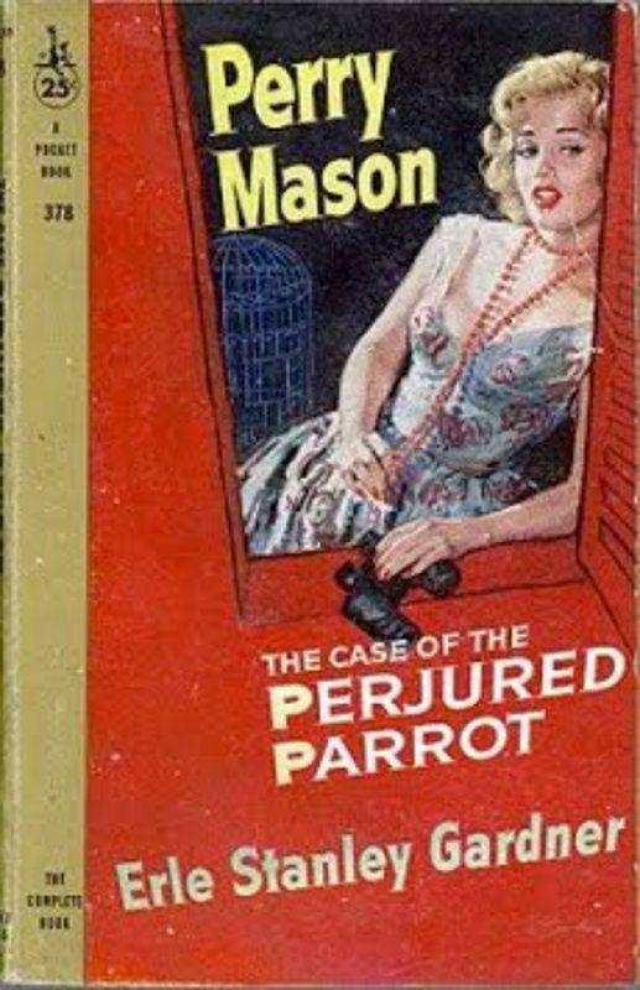
The Case of the Perjured Parrot,
p.14


“I’m sorry,” Mason told him, “it was my fault. I’m assuming the responsibility.”
The sheriff swung his weight slowly back and forth in the creaking chair. “What conclusions are you drawing?” he asked of Mason.
Mason said, “I don’t think I’m ready to draw any conclusions yet. I’d like to wait until after the inquest.”
“Think you could draw some then?”
“I think I could,” Mason told him, “if I were permitted to question the witnesses.”
“That’s sort of up to the coroner, ain’t it?” the sheriff asked.
“Yes,” Mason said, “but it occurs to me the coroner might do what you suggested would be in the best interests of justice.”
“I suppose he’d have to ask the district attorney about what he should do,” the sheriff remarked musingly.
“In that event,” Mason said, “we’re sunk. That’s why I said I didn’t want to form any opinion from the evidence. Once a man forms an opinion, he starts interpreting facts in the light of that belief. He ceases to be an impartial judge of facts. That’s what’s happened to Raymond Sprague. He’s come to the conclusion that I’m opposed to justice; that my tactics must necessarily be opposed to justice; that, therefore, he can best serve the ends of justice by blocking me at every turn. He’s also come to the conclusion that Helen Monteith is guilty of murder; therefore, he interprets all the facts in the light of that belief.”
“Ain’t that being a little harsh on Sprague?” the sheriff asked.
“I don’t think so,” Mason replied. “After all he’s only human.”
The sheriff munched on his tobacco, then slowly nodded and said, “One of the things I’ve got against this state is the way they measure the efficiency of a district attorney. The state keeps records of the criminal trials in the different counties. They gauge the efficiency of the district attorneys by the percentage of convictions they secure in cases tried. Now that ain’t right. If I was keeping a district attorney’s record, I’d give him more points for finding out somebody was innocent, and not prosecuting that person, than I would for getting a conviction just because he’d gone into court.”
Paul Drake started to say something, but Mason warned him to silence with a gesture.
“Of course,” Sheriff Barnes went on, “Raymond Sprague has his record to consider. Sprague is a good boy, he wants to get some advancement politically. He knows that when he comes up for office, no matter what he runs for, people are going to look at his record as district attorney.
“Now, I’m different. I’m sheriff, and that’s all I want to be—just sheriff. I know that I have a lot of power to use, and I want to use it fair and square to everyone. I don’t want to have anyone convicted that ain’t guilty.”
“Under those circumstances,” Mason said, “don’t you think it would be more fair, all around, to have the guilt or innocence determined at the coroner’s inquest tonight? Then, perhaps, it wouldn’t be necessary to take the matter before a jury. If Helen Monteith isn’t innocent, the prosecution has everything to gain by having me put all my facts before the coroner’s jury. If she is innocent, then the prosecution has everything to gain by not being put in the position of going into court on a big case, and having the jury return a verdict of not guilty.”
“Of course,” the sheriff said, “if we was going to do that down at the coroner’s inquest, we couldn’t have a lot of objections and things; we’d have to scoot right along and hit the high spots. You couldn’t make a lot of objections to questions and all that sort of stuff.”
“I wouldn’t,” Mason promised.
“Well,” the sheriff said, “I’ll see what I can do.”
“I’d prefer,” Mason told him, “that you didn’t try to do anything with Sprague. In other words, I don’t want to tip my hand to Sprague. I’m putting my cards on the table with you.”
“Nope,” the sheriff said, “I’m co-operating with the district attorney; the district attorney has to know everything about it. Maybe he’ll be willing to give you a break. Maybe he won’t. I’m telling you, fair and square, if he agrees to let you talk it’ll be because he’ll want to give you lots of rope and watch you hang yourself.”
“That suits me,” Mason said. “All I want is the rope.”
“You’d have to be kinda tactful,” the sheriff said. “Sprague wouldn’t like it if it appeared you was bringing out all the evidence.”
“I can appreciate that,” Mason said. “I’d try to let it appear I was co-operating with the district attorney; whether I can really co-operate or not, depends upon how Sprague looks at it.”
Sheriff Barnes looked out the window. The afternoon sunlight etched the lines of his bronzed countenance, showed the silver strands in his hair. He held his lips pursed for ten thoughtful seconds before seeking the relief of a cuspidor.
“Well,” he said, “we’ll see what we can do. As I understand it, all you want is to see that all the evidence gets before that coroner’s jury.”
“That’s all,” Mason said, “and I’d like to do it in such a way the coroner’s jury would feel I was trying to assist the coroner. As I’ve mentioned before, when people get fixed beliefs, they interpret everything in the light of those beliefs. Take politics, for instance. We can look back at past events, and the deadly significance of those events seems so plain that we don’t see how people could possibly have overlooked them. Yet millions of voters, at the time, saw those facts and warped their significance so that they supported erroneous political beliefs.
“The same is true of the things which are happening at present. A few years from now we’ll look back in wonder that people failed to see the deadly significance of signs on the political horizon. Twenty years from now even the most stupid high school student can appreciate the importance of those signs and the results which must inevitably have followed. But right now we have some twenty-five million who think another. And both sides believe they’re correctly interpreting the facts.”
The sheriff came to an upright position, while the chair gave forth one long, last, protesting squeak, which made Della Street wince. “Well,” he said, “I’ll let you know in an hour or so. I’ll have to talk with the coroner and the district attorney. Personally, Mason, I’m for you. I ain’t running the prosecution, but I am running the department of criminal investigation. There’s been a murder committed in my county. I’m going to do everything I can to find out who committed that murder. I think you’re prejudiced because you think Helen Monteith is innocent, whereas I think she’s guilty. Naturally, you’re trying to protect your client. On the other hand, you’ve had a lot more experience with big murder cases than I have. I ain’t going to let you lead me around by the nose, but I am going to take any help you have to offer, and be mighty darned glad to get it.
“And now you want to see Helen Monteith?”
Mason nodded.
“All right,” the sheriff said, “you’ll have to come over to the jail, and only you can see her. You’ll have to leave the others behind.”
Mason entered the cement-floored office of the jail as Sheriff Barnes swung back the heavy iron door. The atmosphere was permeated with the sickly sweet odor of jail disinfectant, with the psychic emanations from scores of dispirited derelicts. It exerted a strangely depressing influence upon one who had not become immune to it.
“She’s in the detention ward,” the sheriff said, “and the detention ward’s over on that side. The matron’s the jailer’s wife. I’ll have to get her and bring her down. You can go in that room and wait.”
Mason entered the little office and waited some five minutes before the jailer’s wife escorted Helen Monteith into the room.
“Well,” she said, as she dropped into a chair, “what do you want?”
“I want to help you, if I can,” Mason told her.
“I’m afraid you can’t. I seem to have put my foot in it all the way along the line.”
The matron said, “I’ll stand just outside the door here, and …”
“Go ahead and close the door,” the sheriff told her. “Let them talk in private.”
When the door had swung shut Mason said, “Tell me about it.”
Helen Monteith seemed fatigued to the point of spiritual and mental exhaustion. “Oh, what’s the use,” she said. “… I guess I was just too happy, that’s all … The bottom dropped out of everything. By the time this is over, my job will be gone. The only man I ever really loved is dead. They’re accusing me of murdering him, and … and …” She blinked back tears and said, “No, I’m not going to cry. It’s all right. When a woman reaches my age, crying is just a sign of self-sympathy, and I don’t intend to give in to myself.”
“Why did you leave Della Street?” Mason asked.
“Because,” she said, in that same dispirited tone of voice, “I wanted to go back and burn the letters I’d received from … from my husband,” she said, with a trace of defiance in her voice.
Mason said, “He may really have been your legal husband, after all. There’s some doubt as to the validity of his marriage to Helen Watkins. If you’ll help, we may be able to do something.”
“There’s nothing you can do,” she said wearily. “They have the cards all stacked against me. I didn’t tell you the worst thing against me.”
“What?” Mason asked.
“I went up to that mountain cabin Tuesday, the sixth.”
“Why?” Mason asked.
“Just sentiment,” she said. “No one will believe me, no one would ever understand. I suppose you’d have to be in love to get my viewpoint anyway, and probably it has to be a love which comes after you’ve had one complete and utter disillusionment. Anyway, I went up there just because I’d been so happy there. I just wanted to go up and bask in the smell of the woods, in the sunshine and the aura of peace and tranquillity which surrounds the place. The chipmunks were so friendly, the bluejays so impudently inquisitive … I wanted to live over in my mind the happiness I’d had.”
“Why didn’t you tell that to the officers?”
“I just didn’t want to be made to appear ridiculous. It’s the same thing you have to contend with in love letters. They seem sacred and tender when you read them, but when they are read in court, they sound simply ghastly.”
“Someone saw you up there?”
“Yes, I was arrested for speeding. That is, the traffic officer says I was speeding. Personally, I think he just wanted to round out his day’s quota of arrests. It was a steep curve, and he claimed there was a limit of fifteen miles, and I was going twenty-five … Anyway, he took the number of my car, and gave me a traffic ticket to sign, and I signed it. They found out about that, and that puts me on the spot.”
“And how about the gun?” Mason asked.
“My husband asked me to get that gun for him.”
“Did he say why?”
“No. He rang me up at the library and asked me if there wasn’t a gun in the collection which would shoot. I told him I didn’t know, but I supposed so. He said he’d seen a derringer in there, which he thought was in pretty good shape, and thought we could get shells for it. He asked me to get the gun and get some shells for it. He said he only wanted it for a few days, and then I could put it back.”
“Didn’t that request seem rather unreasonable?” Mason asked.
“Of course not. I was in love,” she said simply, as one might talk of a happy home life before it had been completely destroyed by some catastrophe.
“So you went back home in order to burn up the letters?”
“Yes.”
“Wasn’t it to hide the shells?”
“No.”
“But you did try to hide the shells?”
“After I got there, I decided it would be a good plan to get rid of them.”
“And the parrot?” Mason asked. “Did you kill the parrot?”
“Good heavens, no! Why should I want to kill the parrot?”
“You probably noticed,” Mason said, “that the parrot kept repeating, ‘Put down that gun, Helen … don’t shoot … My God, you’ve shot me.’ ”
“Well, you can’t blame that on me,” she said. “My husband purchased that parrot at a pet store on Friday the second. I’m not responsible for anything a parrot says. What’s more, that parrot never was anywhere near that cabin.”
Sudden tears flooded her eyes. “I can’t believe, I simply can’t believe that he ever intended to do anything which wasn’t for my complete happiness. Oh, God, why did he have to die. He was so gentle and kind and considerate and had such a wonderful character.”
Mason crossed over to her and placed his hand on her shoulder. “Take it easy,” he said, “save your nerves as much as you can. You’re going through an ordeal tonight before the coroner’s jury.”
“What do you want me to do?” she asked, choking back sobs. “T-t-tell them I refuse to answer questions? I understand that’s what the b-b-best lawyers tell c-c-clients who are accused of m-m-murder.”
Mason said, “On the contrary, you’re going to go on that witness stand and answer all their questions. No matter how they hurl accusations at you, or how they try to browbeat you, you’re going to keep your head and simply tell the truth. It’s going to be an ordeal, but you’re going to emerge with flying colors.”
“That isn’t the attitude you adopted last night,” she said. “Then you were trying to keep me away from the police.”
“Not the police,” Mason said. “I was trying to keep you away from a parrot killer.”
“What do you mean?”
“I thought,” Mason said, “that it was well within the bounds of possibility that someone would try to kill the parrot at your house. If you were there and heard the intruder … Well, whoever killed that parrot had already committed one murder. One more or less wouldn’t have made a great deal of difference.”
“But how did you know someone was going to try and kill the parrot?”
“It was just a hunch,” Mason said. “… Think you can go through with it tonight?”
“I’ll try,” she promised.
“All right,” Mason told her. “Let’s cheer up; let’s get this feeling of hopelessness completely licked.”
“I’ll try to stick out my chin and take it,” she told him. “Just a few days ago I thought I was the happiest woman in the world. Now, if I dared to let myself start sympathizing with myself, I’d feel I was the most miserable. It’s quite a comedown.”
“I know it is,” Mason sympathized.
“I’ve lost the man I loved, and I’m accused of murder on top of that.”
“That accusation isn’t going to last very long,” Mason said.
She managed to smile, tilted her chin up a bit. “All right, let’s go.”
CHAPTER TWELVE
ANDY TEMPLET, the coroner, having acquired some reputation as a practical philosopher, refused to be stampeded by the flattering preparations which the press had made for reporting the inquest. He stood calmly and at ease while press photographers snapped pictures of his kindly, twinkling eyes and the whimsical smile about his mouth. Having called the inquest to order and selected his jury, he made a brief speech in which there was no attempt at grandiose eloquence.
“Now, folks,” he said, “we’ve got to determine the cause of death in this case. In other words, we’ve got to find out how this man died. And if somebody killed him, and we know who that someone was, we can say so. If we don’t know, we hadn’t better try to fix the responsibility. We aren’t here to try anyone for anything. We’re just trying to determine how Fremont C. Sabin met his death, up in his mountain cabin.
“Now, the coroner has charge of inquests. Most of the time he lets the district attorney ask questions, when the district attorney wants to, but that doesn’t mean the district attorney runs the inquest. It simply means the district attorney is here to help us, and, in a case of this kind, he’s here to try and uncover facts which will help him convict the murderer. The sheriff is also an interested party, and the sheriff has a lawyer here, Mr. Perry Mason. Mr. Mason is representing the heirs—that is, one of the heirs. Mr. Mason wants to find out how the murder was committed. Mr. Mason is also representing Helen Monteith.
“I want everybody to understand that we ain’t going to have any monkeyshines, and we ain’t going to have any oratory, or long-winded objections. We’re going to move right along with this thing, and if I get my order of proof all cockeyed, that’s my responsibility. I don’t want anybody to point out anything except facts. I don’t want anybody to try and get the witnesses rattled.
“Now, I’m going to start out asking questions. When I get done I’ll let the district attorney ask questions, and I’ll let Perry Mason ask questions, and the jurors can ask questions. But let’s get down to brass tacks and keep moving. Do you all understand?”
“I understand,” Perry Mason said.
The district attorney said, “Of course, the coroner’s idea of what is a technicality may differ from mine, in which event …”
“… In which event,” the coroner interrupted, “what I think is going to be what counts. I’m just a plain, common, ordinary citizen. I’ve tried to get a coroner’s jury of plain, common, ordinary citizens. The object back of this proof is to give the coroner’s jury a chance to figure what happened. We haven’t got a jury of lawyers. We’ve got a jury of citizens. I think I know what they want…. Anyway, I know what I want.”
Andy Templet stilled the titter which ran over the courtroom and said, “I think we’d better have the neighbor who discovered the body, first.”
Fred Waner came forward and was sworn. He gave his name, address, and occupation.
The coroner said, “You found the body, didn’t you, Mr. Waner?”
“Yes.”
“Where?”
“In his mountain cabin, up in Grizzly Flats.”
“He owned a cabin up there?”