

The case of the perjured.., p.18
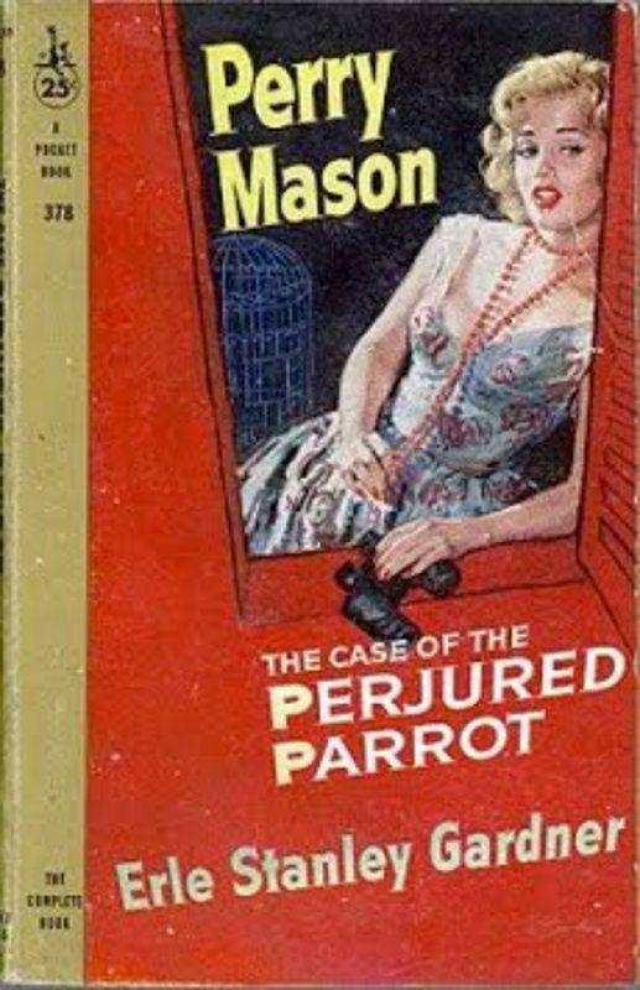
The Case of the Perjured Parrot,
p.18


“This much we do know: Sabin became alarmed. He switched parrots and got Miss Monteith to get a gun for him. Despite those precautions, he was murdered. The murderer naturally assumed that the parrot in the cage was Casanova, and took excellent steps to see that it didn’t die before Sabin’s body was discovered.
“Sabin, in the meantime, thought that he was getting a divorce—that is, he thought his wife was getting one. He thought that he would soon be free to follow up the bigamous marriage ceremony in Mexico with a perfectly legal marriage ceremony elsewhere.
“Waid, lying in wait in the cabin, in which he had ensconced himself so that he could overhear all the telephone conversations which took place over Sabin’s telephone, was waiting for the proper moment to strike.”
“Why was he so anxious to hear the telephone conversations?” the sheriff inquired.
“Because the success of his entire plan depended upon leaving in an airplane with Steve Watkins, at such a time that it would apparently give him an alibi. The only excuse they had to do this was the appointment Sabin had made to pay over a hundred thousand dollars to his wife in New York. He knew that Sabin was in constant telephone communication with his wife in Reno. Therefore, he had to be certain that nothing went wrong.
“While he was listening on the telephone, he heard Sabin put in a call for Bolding, the examiner of questioned documents, realized suddenly that if Sabin sent Bolding the specimens of handwriting of all the persons with whom he’d had business dealings, those handwriting specimens would include some of his own; that the handwriting expert would break down the endorsements on the back of those forged checks, and brand him as a forger. He realized, suddenly, that whatever he was to do had to be done swiftly. I think he had intended to wait until eight o’clock before committing the murder. He had his string of fish already caught, the evidence all ready to plant. Then, that telephone call came through. He knew that he had to get to Sabin before those documents went into the mail, so he jumped up and ran out of the cabin without even pausing to pick up the cigarette he had laid down on the table when he heard the telephone call come through.”
“Why didn’t you tip us off so we could grab Waid?” the sheriff grumbled.
Mason said, “Because the evidence would be materially strengthened by having Waid become panic-stricken, and make a sudden disappearance. Flight, in itself, is an evidence of guilt. You can see that Waid was panic-stricken. As soon as he realized he had murdered the wrong parrot, he knew how deadly the evidence of the parrot would be, because it would prove conclusively that the parrot didn’t learn his speech by hearing the excited last words of Fremont C. Sabin, but had been carefully coached to repeat those words by someone who had access to it; and Waid was the only one, outside of Fremont Sabin, and the son Charles, who had access to the parrot. You will note that Steve Watkins didn’t live in the house, and Mrs. Sabin had been away for six weeks.
“Of all the persons who had a complete alibi, the parrot was the one who had the best. The parrot was not at the scene of the shooting. That was attested to by Mrs. Winters. Therefore, the parrot couldn’t have learned his speech from hearing Sabin say those words. I felt it was quite possible that Sabin’s murderer might be in the room last night when I disclosed the switch in parrots. Charles Sabin had known of it for some time. The information came as news to Mrs. Sabin, Steve and Waid—I saw to that…. So Waid decided the only thing for him to do was to kill the parrot. He didn’t know that other persons had heard the parrot’s comments. You see, that’s the trouble with teaching a parrot something to say: you never can tell how often he’ll say it, or when he’ll say it.
“But Waid had all the breaks in one way. He hadn’t intended to pin the crime on Helen Monteith. It’s probable that he knew nothing of Helen Monteith. He had intended to pin the crime on Helen Watkins Sabin. Imagine his consternation when he found that Helen Watkins Sabin had an alibi; that she had been in court in Reno when the murder was supposed to have been committed. Then, he suddenly realized there was an excellent opportunity to pin the crime on Helen Monteith, but he had to get that parrot out of the way. And then his confidence suddenly returned when he learned that the decree of divorce had been forged, and that Mrs. Sabin didn’t have an alibi after all.
“Once having placed the time of the murder accurately, and disregarding the evidence of the string of fish to which Sergeant Holcomb attached such great importance, it became obvious that Sabin was not alive at ten o’clock on the evening of Monday, the fifth. Therefore, Waid’s statement that he had talked with Sabin over the telephone must have been false.”
Helen Monteith said, “Well, I hope they hang him! He killed one of the best men who ever lived. You’ve no idea how unselfish and considerate Mr. Sabin was. He thought of everything, no detail was too small to escape him. Nothing which would go for my comfort was overlooked.”
“I can readily appreciate that,” Mason said soberly. “Everything that he did … Wait a minute …”
He stopped abruptly.
“What’s the matter?” the sheriff asked.
Mason said excitedly, “That will! He really executed that after he’d married you. Yet he didn’t make any provision in it for you. He provided for everyone else.”
“Yes,” she said.
“Why didn’t he provide for you?” Mason asked.
“I don’t know. He would have had some good reason. I didn’t want money, anyway. I wanted him.”
Mason said, “That’s the angle to this case I can’t understand. Fremont Sabin made his will at the time he was negotiating that property settlement with his wife.”
“What’s wrong with that?” Sheriff Barnes asked.
Mason said, “It just doesn’t fit into the picture. He makes provision for every one of the objects of his affection, but he doesn’t make any provision whatever for Helen Monteith.”
“That was because he didn’t have any reason to,” the sheriff said. “He’d married her in Mexico, and he was going to marry her again, later on. We know now that the reason for all this was that he was waiting for Helen Watkins Sabin to get her divorce. Naturally, he didn’t expect to die in the meantime.”
Mason said, “No, that doesn’t cover it. The businessman doesn’t make his will because he expects to die, but to take effect when he does die. He covers every possible eventuality. Notice that the will specifically provided for the payment of money to Helen Watkins Sabin in the event he died before the divorce decree had been granted and the money paid. In other words, she, having made a good faith attempt to carry out the agreement, was to be protected, regardless of what might happen to Sabin. That shows his essential fairness. Yet, he made no provision for Helen Monteith.”
Helen Monteith said, “I didn’t want him to. I’m not dependent on him for anything. I’m making my own living. I …”
Suddenly Mason got to his feet and started pacing the floor. Once or twice he made little gestures with his fingers as though checking off points against some mental inventory he was taking. Abruptly he turned to Della Street. “Della,” he said, “go get the car. Fill it up with oil and gas, and bring it down to the front door. We’re going to take a ride.”
He turned to Sheriff Barnes and said, “Sheriff, I’d consider it as a personal favor if you’d expedite all the formalities as much as possible. Cut all the red tape you can. I want to get Helen Monteith out of here at once.”
The sheriff studied him from beneath leveled eyebrows. “You think she’s in some danger here?” he asked.
Mason didn’t answer the question. He turned to Helen Monteith. “Do you suppose,” he said, “you could help me check one phase of your alibi?”
“What do you mean, Mr. Mason?”
Mason said, “I want you to do something which is going to be a nerve strain. I hate to inflict it upon you, but it’s necessary. There’s one point we want to establish, immediately.”
“What?” she asked.
“I think I know the real reason for that original substitution of parrots,” Mason said. “I remarked a while ago that we’d probably never know just what caused Sabin to make that switch. Now I think we can get the real reason. If what I suspect is true, there’s an angle to this case so vitally important that … Do you think you could stand a drive to Santa Delbarra? Do you think you could point out to me the exact room in the hotel where you last saw your husband?”
“I could,” she said, “but I don’t understand why.”
Mason shifted his eyes to meet the steady inquiry in those of Sheriff Barnes. “We’ve been talking quite a bit about becoming hypnotized by circumstantial evidence. After a person once gets a fixed belief, he interprets everything which happens in the light of that belief. It’s a dangerous habit to get into, and I’m afraid I haven’t been entirely innocent, myself. I’ve been so busy pointing out the trap to others that I’ve walked into one myself without noticing what I was doing.”
Sheriff Barnes said, “I don’t know what you’re after, Mason, but we’ll rush things through. I have the matron coming over with all the personal property taken from Miss Monteith…. Here she is now. Check this property and pay particular attention to the contents of your purse, Miss Monteith. Then, sign this receipt on the back of this manila envelope.”
Helen Monteith had just finished signing the receipt when Della Street entered the room and nodded to Mason. “All ready, Chief,” she said.
Mason shook hands with the sheriff. “I may give you a ring later on, Sheriff,” he said. “In the meantime, thanks a lot.”
He took Helen Monteith’s arm, and, with Della Street on the other side, piloted her out into the fresh air of the warm night.
Twice while they were riding up the long stretch of moonlit road to Santa Delbarra, Helen Monteith tried to find out from Perry Mason what he expected to find at the end of their journey. In both instances Mason avoided the inquiry.
Finally, in response to a direct question, Mason said frankly, “I don’t know. I do know that on one side of this case there’s an inconsistency, a place where the loose threads fail to tie up. I want to investigate that and make certain. I’m going to need you to help me. I realize it’s a strain on you, but I see no way of avoiding it.”
Thereafter he drove in silence until the highway swung up over a hill to dip down into the outskirts of Santa Delbarra.
“Now,” Mason said to Helen Monteith, “if you’ll tell me how to get to the hotel where you stayed …”
“It’s not particularly inviting,” she said. “It’s inexpensive and …”
“I understand all that,” Mason told her. “Just tell me how to get there.”
“Straight down this street until I tell you to turn,” she said.
Mason piloted the car down an avenue lined with palm trees silhouetted against the moonlit sky, until Helen Monteith said, “Here’s the place. Turn to the right.”
He swung the car to the right.
“Go two blocks, and the hotel is on the left-hand corner,” she said.
Mason found the hotel, slid the car to a stop, and asked Helen Monteith, “Do you remember the room number?”
“It was room 29,” she said.
Mason nodded to Della Street. “I want to go up to that room, Della,” he said. “Go to the room clerk, ask him if the room is occupied. If it is, find out who’s in it.”
As Della Street vanished through the door to the lobby, Mason locked his car, and took Helen Monteith’s arm. They entered the hotel. “An elevator?” Mason asked.
“No,” she said. “You walk up.”
Della Street turned away from the desk and walked toward Mason. Her eyes were wide with startled astonishment. “Chief,” she said, “I …”
“Let’s wait,” Mason warned her.
They climbed the creaky stairs to the third floor, walked down the long corridor, its thin carpet barely muffling the echoing sound of their footfalls.
“This is the door,” Helen Monteith said.
“I know,” Mason told her. “The room’s rented … isn’t it, Della?”
She nodded wordless assent, and Mason needed only to study the tense lines of her face to know all that she could have told him.
Mason knocked on the door.
Someone on the inside stirred to life. Steps sounded coming toward the door.
Mason turned to Helen Monteith. “I think,” he said, “you’re going to have to prepare yourself for a shock. I didn’t want to tell you before, because I was afraid I might be wrong, but …”
The door opened. A tall man, standing very erect on the threshold, looked at them with keen gray eyes which had the unflinching steadiness of one who is accustomed to look, unafraid, on the vicissitudes of life.
Helen Monteith gave a startled scream, jumped back to collide with Mason who was standing just behind her. Mason put his arm around her waist and said, “Steady.”
“George,” she said, in a voice which was almost a whisper. “George!”
She reached forward then with a tentative hand to touch him, as though he had been vague and unreal and might vanish like a soap bubble into thin air at her touch.
“Why, Helen, sweetheart,” he said. “Good Lord, what’s the matter, you look as though you were seeing a ghost … why, dearest …”
She was in his arms, sobbing incoherently, while the older man held her tightly against him, comforting her with soothing words in her ears, tender hands patting her shoulders. “It’s all right, my dearest,” he said. “I wrote you a letter this afternoon. I’ve found just the location I want.”
CHAPTER FOURTEEN
GEORGE WALLMAN sat in the creaking rocking chair in the hotel bedroom. Seated on the floor by his side, her cheeks glistening with tears of happiness, Helen Monteith clasped her arms around his knees. Perry Mason was seated astride a straight-backed, cane-bottomed chair, his elbows resting on the back; Della Street was perched on the foot of the bed.
George Wallman said in a slow drawl, “Yes, I changed my name after Fremont made such a pile of money. People were always getting us mixed up because I looked like him, and word got around that I had a brother who was a multimillionaire. I didn’t like it. You see we aren’t twins, but, as we got older, there was a striking family resemblance. People were always getting us mixed up.
“Wallman was my mother’s maiden name. Fremont’s son was named Charles Wallman Sabin, and my middle name was George, so I took the name of George Wallman.
“For quite a while Fremont thought I was crazy, and then, after he’d visited me back in Kansas, we had an opportunity for a real good talk. I guess then was when Fremont first commenced to see the light. Anyway, he suddenly realized that it was foolish to set up money as the goal of achievement in life. He’d had all he wanted years ago. If he’d lived to be a thousand he could still have eaten three meals a day.
“Well,” Wallman went on, after a moment, “I guess I was a little bit foolish the other way, too, because I never paid enough attention to putting aside something that would carry me through a rainy day…. Anyway, after Fremont had that first visit with me, we became rather close, and when I came out here to the West, Fremont used to come and see me once in a while. Sometimes we’d go live together in a trailer; sometimes we’d stay up in his cabin. Fremont told me that he was keeping the association secret from his business associates, however, because they’d think perhaps he was a little bit cracked, if they found out about me and my philosophy of life.
“Well, that suited me all right. And then, shortly after I was married, Fremont came down to San Molinas to talk with me.”
“He knew about your marriage?” Mason interrupted.
“Of course. He gave me the keys to the cabin and told me to go up there for my honeymoon. He said I could use it whenever I wanted to.”
“I see,” Mason said, “pardon the interruption. Go ahead.”
“Well, Fremont showed up with this parrot. He’d been up to the house and picked him up, and the parrot kept saying, ‘Drop that gun, Helen … don’t shoot…. My God, you’ve shot me.’ Well, that didn’t sound good to me. I’m something of an expert on parrots. I gave Casanova to Fremont and I knew Casanova wouldn’t say anything unless someone had been to some trouble to repeat it many times in his presence—parrots vary, you know, and I knew Casanova. So I suggested to Fremont that he was in danger. Fremont didn’t feel that way about it, but after a while I convinced him. I wanted to study the parrot, trying to get a clue to the person who had been teaching him. So I got Fremont to buy another parrot and …”
“Then it was Fremont who bought the parrot?” Mason asked.
“Sure, that was Fremont.”
“Go ahead,” Mason said.
“Well, Fremont bought the parrot, so that no one would suspect I was studying Casanova, and I wanted a gun to give him, so I got Helen to get me a gun and some shells, and I gave that to Fremont. Then, he went on up to the cabin, and I came here to Santa Delbarra to look things over and find out about getting a place for a grocery store. I didn’t read the papers, because I never bother with ’em. I read some of the monthly magazines, and quite a few biographies, and scientific books, and spend a good deal of time around the libraries.”
“Well,” Mason said, “I’m afraid you’re going to have to readjust your philosophies of life. Under your brother’s will, you’ve inherited quite a chunk of money.”
George Wallman meditated for a while, then looked down at his wife. He patted her shoulder comfortingly, and said, “How about it, Babe, should we take enough of it to open up a little grocery store, or shall we tell ’em we don’t want any?”
She laughed happily. When she tried to speak, there was a catch in her throat. “You do whatever you want to, dearest,” she said. “Money doesn’t buy happiness.”
Mason got up, nodded to Della Street.
“You going?” Wallman asked.















