

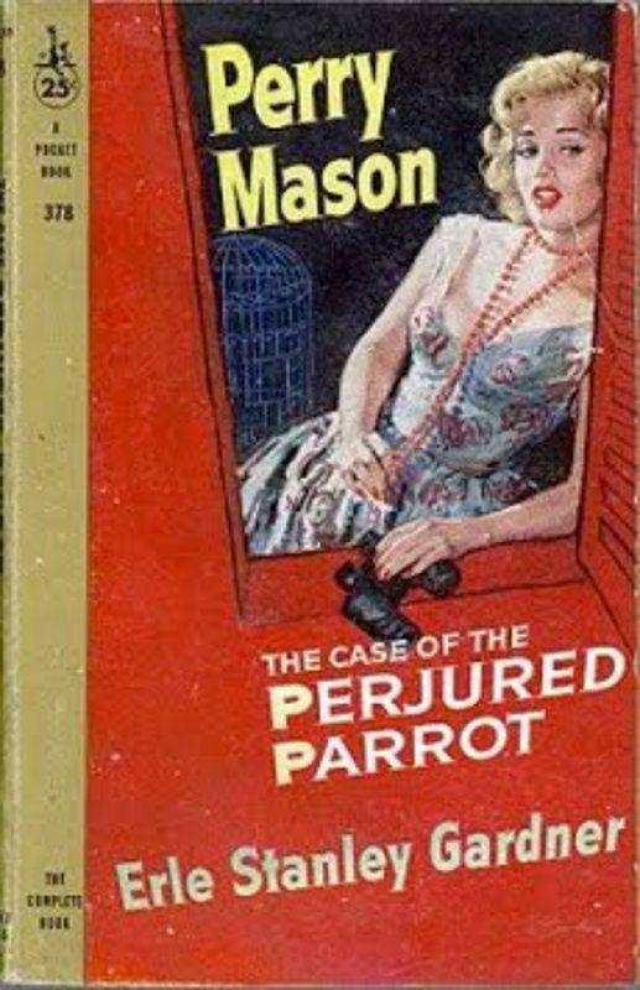
The case of the perjured.., p.11
The Case of the Perjured Parrot,
p.11


“Then there wasn’t any case of Sabin vs. Sabin ever filed?”
“No.”
“That,” Mason said, “was clever. If it hadn’t been for this murder, no one would ever have detected that forgery. A certified copy of a decree of divorce is accepted at face value everywhere. Unless there’s some question of the pleadings, no one ever thinks of going back to look at the court records. What a sweet job that was. A cool hundred thousand, and still his legal wife! Of course, there’s the forgery angle and obtaining money under false pretenses; but if it hadn’t been for this murder, no one would ever have tumbled to it.”
“Even as it is, she’s doing pretty well for herself,” Drake said. “She’s the legal widow, and, as such, entitled to step in and take charge.”
“All right,” Mason said, “we’ll skip that for a while. What’s this about Helen Monteith?”
Drake made a wry grimace and said, “I wish you’d wash your own dirty linen, Perry.”
“Why?” Mason asked.
“It’s bad enough to hold your coat while you cut the legal corners,” Drake said, “but when I find myself suddenly wished into the position of wearing your coat, it doesn’t go over so big.”
Mason grinned, offered a desk humidor to the detective, and helped himself to a cigarette. “Go on,” he said, lighting up, “give me the works.”
“Della called the agency about quarter past eight this morning, and was in an awful lather,” Drake said. “She wanted to get in touch with me, and wanted to get in touch with you, and wanted operatives to watch for Helen Monteith in San Molinas. My agency got in touch with me, and I telephoned Della at the number she’d left. She was registered under the name of Edith Fontayne. She told me all about Helen Monteith taking a run-out powder, and how you wanted her kept away from the police, and for me to beat it down to San Molinas and pick her up, and keep her hidden out.
“I told her to get in touch with you.
“She said she didn’t know where you were. I told her I’d try and find you, and that was every damn thing I would do. My gosh, here I was remonstrating with you last night about the chances you were taking in holding a fugitive from justice away from the sheriff and the district attorney, and then all of a sudden Della proposes that I stick my neck out on the same proposition. It was so hot that even you had to play it so you didn’t know where she was….”
“What did you finally do?” Mason interrupted.
“Do?” Drake groaned. “What the devil could I do? I did exactly what she wanted. My God, Perry, I’ve always been friendly with Della, and it’s been sort of a give-and-take, informal relationship. I always felt she was my friend, but when I told her I had to draw the line some place, she became a regular little hellcat over the wire. She told me that if I wanted your business, I was to take care of it the way you wanted; that I should know damn well you wouldn’t leave me out on the end of a limb, and that you’d never made a foolish move yet; that you wanted Helen Monteith kept away from the police, and …”
“Never mind what she told you,” Mason said, grinning, “what did you do?”
“Took my medicine like a little man, got my operatives in San Molinas on the telephone, and told them to get out to Helen Monteith’s house; to grab her as soon as she showed up, and rush her back to the city; to kidnap her, if they had to, or do anything else that was necessary. My operatives started arguing with me, and I had to read the riot act to them, and told them I’d take the responsibility.”
“Well,” Mason said, “where’s Helen Monteith now?”
“In jail,” Drake said gloomily.
“How come?”
“My operatives didn’t get the message in time. She’d got out to the house about half an hour before they did. Evidently, the police had left word with Mrs. Winters to let them know as soon as Helen Monteith showed up. The sheriff and the district attorney went out there on the run. They nabbed Helen. She’d been killing parrots, burning papers, and trying to find some place to hide a box of forty-one caliber cartridges…. You can figure where that puts her.”
“How about the parrot-killing?” Mason asked with interest.
“She went home and killed the parrot,” Drake said. “Snickasneed its head off with a butcher knife—made a nice clean job of it, too.”
“As soon as she got home?” Mason asked.
“I reckon so. The sheriff didn’t tumble to it for a little while. They caught her red-handed with the forty-one caliber shells and stuff she’d been burning in the fireplace. The sheriff went to quite a bit of trouble trying to get something out of the ashes, but about all he could tell was she’d been burning paper. They hustled her out to jail and telephoned in for a technical man from the homicide squad here, to see what could be done about reconstructing the papers…. Sergeant Holcomb has been working hand and glove with ’em, you know.”
“I know,” Mason said. “What did she say about the forty-one caliber shells? Does she admit buying them?”
“I don’t know,” Drake said. “They hustled her off to jail, and that’s all anyone knows.”
“When did they find out about the parrot?”
“Not so very long ago,” Drake said. “Sergeant Holcomb’s men apparently discovered that when they went through the house….”
“Wait a minute,” Mason interpolated. “Couldn’t the parrot have been killed after Helen Monteith was arrested?”
“Not a chance,” Drake said; “they put the place under guard right after they’d pinched her. That was so no one could get in and remove any evidence. I think your friend, Helen Watkins Sabin, may have been back of that move. I understand they’re going through the house with a magnifying glass, looking for additional evidence. They found out about the parrot, and my man telephoned in a report about fifteen minutes ago…. Perry, why the devil do you suppose she killed that parrot?”
“The murder of a parrot,” Mason said, with his eyes twinkling, “is somewhat similar to the murder of a human being; that is, a person must look for a motive. Having found a motive, there must then be opportunity, and …”
“Nix on it, nix on it,” Drake interrupted. “Cut the comedy, Perry. You know damn well why she killed that parrot. Now, I want to know why.”
“What makes you think I know?” Mason asked.
“Phooey!” Drake exclaimed, “don’t take me for such a simp. She wanted the parrot out of the way, and you wanted the parrot preserved as evidence of something or other. You knew she was going to kill that parrot if she had a chance, so you had Della keep Helen Monteith out of the way long enough for us to go down and substitute parrots. I suppose it was because of the cracks the parrot’s making about ‘Drop that gun, Helen’ and ‘My God, you’ve shot me,’ but I still don’t see why she didn’t kill the parrot before, instead of waiting until she had to climb down a fire escape to do the parrot-butchering…. I admit that I thought last night you were trying to keep Helen Monteith concealed from the authorities, and I thought so this morning when Della Street rang up. I didn’t realize until just now that what you were really trying to do was to keep her away from that parrot.”
“Well,” Mason said, “now that the parrot’s dead, we might as well …”
“But the parrot isn’t dead,” Drake interrupted. “You have the parrot. I suppose that the parrot is a witness to something or other—probably the murder—but damned if I see how he could have been. Tell me, Perry, could a parrot be used as a witness in a court of justice?”
“I don’t know,” Mason said. “It’s an interesting point, Paul. I’m afraid the oath couldn’t be administered to a parrot. In other words, he might commit perjury.”
Drake glanced sidelong at Mason and said, “Go ahead and joke all you want to, brother. I suppose if you don’t want to tell me, there’s nothing I can do to make you.”
“What else do you know?” Mason asked, abruptly changing the subject.
“Oh, a few things,” Drake said. “I’ve had a bunch of men working all night. I’ve been trying to find out as much as I could about that wiretapping up there at the cabin. You know, it occurred to me, Perry, that I might find out something about the calls which had been listened in on, by getting a copy of the telephone bill. You see, that cabin line is on a local exchange, but Sabin wouldn’t have been interested in maintaining a telephone to call any of his neighbors. All of his contacts were in the city, and, of course, they’d have to be handled as long distance calls.”
“A good idea,” Mason said. “You deserve credit for that, Paul.”
“Credit, hell,” Drake said lugubriously. “I deserve cash for it. When you get the bill, it’s going to floor you, Perry. I’ve got men working on overlapping nine-hour shifts, and I’ve got ’em scattered all over the country.”
“That’s fine,” Mason said. “How did you get the telephone bill, Paul?”
“One of the men took a chance,” Drake said, “went down to the telephone office, said he was a ‘detective,’ and, because of the murder, wanted service discontinued on the telephone, and wanted to pay the bill. The girl in the local telephone office fell for it, and handed him the bill. He insisted on checking all the long distance charges.”
“What did you find?” Mason asked.
“A few calls to his residence, here in the city,” Drake said. “Those were evidently calls where he’d talked with his secretary. Several of them had been station-to-station calls, and quite a few of them had been for Richard Waid personally. But the interesting things, Perry, are the person-to-person Reno calls.”
“The Reno calls?” Mason asked.
“Yes. Apparently he was in almost daily telephone communication with his wife in Reno.”
“What about?” Mason asked.
“You’ve got me on that,” Drake said. “Probably trying to make certain that the divorce was going through according to schedule, and that she’d be in New York with a certified copy of the decree.”
Della Street, her face freshly powdered, eyes showing but little trace of tears, bustled busily into the office, and appeared surprised to see Paul Drake. “Hi, Paul,” she said.
“Don’t you ‘Hi, Paul’ me, you baggage,” Drake grumbled. “Of all the high-pressure stuff I ever had handed me …”
She came over to where he was sitting on the chair, and put her hand on his arm. “Don’t be such an old grouch-face,” she laughed.
“Grouch-face nothing,” he told her. “You put it up to me cold-turkey that I either had to go in for kidnapping or lose Mason’s business.”
“Well, Paul,” she said, “I was trying to do what the Chief wanted—that is, what I thought he’d want under the circumstances.”
Drake said to Mason, “You’re bad enough. This girl is twice that bad.”
Mason grinned at Della. “Don’t talk with him this morning, Della, he’s suffering from an ingrowing disposition.”
“Did he get Helen Monteith?” she asked.
“No, the officers did,” Mason told her.
“Oh!” she exclaimed in startled dismay.
“It’s all right, Della,” Mason said. “Ring up Sabin’s residence, get Richard Waid or Charles Sabin, whichever one is available; say that I’d like to see both of them at the office at their earliest convenience.”
He turned back to Paul Drake. “Have your men found out anything about where those forty-one caliber shells were bought, Paul?”
“Not where they were bought,” Drake said, “but by this time the police sure have found out who bought ’em.”
Mason dismissed it with a gesture. “Concentrate for a while on the Reno end of things, Paul. Find out as much as you can about what Mrs. Sabin did in Reno, and get me copies of the long distance telephone bill.”
“Okay,” Drake said, sliding from the chair, “and remember this, Perry Mason, the next time you duck out because things are getting too hot for you to handle, I’m going to duck out too. Being a stooge is all right, but being pushed up into the front-line trenches just when the machine guns start rattling, is a gray horse of another color.”
CHAPTER NINE
IT WAS shortly after eleven when Charles W. Sabin and Richard Waid reached Mason’s office. Mason wasted but little time in preliminaries. “I have some news,” he said, “which may be of interest to you. As I told you last night, I had located Casanova. He was in the possession of a Helen Monteith, whom Fremont C. Sabin apparently married under the name of George Wallman. The parrot in her house was killed sometime either last night or early this morning. The theory of the police is that Helen Monteith killed him. The parrot had been saying repeatedly, ‘Put down that gun, Helen … don’t shoot…. My God, you’ve shot me.’
“Now then,” Mason went on, glancing from one to the other, “does that mean anything to you?”
“It must mean the parrot was present at the time my father was murdered,” Sabin said. “Then Helen must have … but which Helen?”
“But another parrot was found in the cabin,” Mason pointed out.
“Perhaps the murderer switched parrots,” Waid ventured.
Charles Sabin said, “Before we discuss that, I have something of prime importance to take up with you.”
“Go ahead,” Mason told him, “we’ll let the parrot wait.”
“I’ve found a will,” Sabin announced.
“Where?”
“You remember it was disclosed that C. William Desmond acted as attorney for my father in connection with certain matters pertaining to the divorce settlement. That was news to me; I hadn’t heard of it. It wasn’t until Waid told me that I knew anything about it.
“However, it seems that my father didn’t care to have Cutter, Grayson & Bright represent him in connection with the divorce matter.”
“And he had Desmond draw up a will at the same time he made the property settlement agreement?” Mason asked.
“Yes.”
“What was the will?” Mason wanted to know.
Charles Sabin took a leather-backed notebook from his pocket, and said, “I have made a copy of so much of the provisions as relate to the distribution of his property. It reads as follows:
“ ‘Because I have this day entered into an agreement with my wife, Helen Watkins Sabin, by which it is agreed and understood that she is to receive the sum of one hundred thousand dollars in cash from me, by way of a complete property settlement, and which said sum is to be paid on the completion of divorce proceedings, and the delivery of a certified copy of a final decree of divorce, I direct that, in the event I should die before said sum of one hundred thousand dollars is paid to my said wife, Helen Watkins Sabin, that then, and in such event, my said wife is to receive, from such estate as I may leave, the sum of one hundred thousand dollars in cash. In the event, however, said sum of cash has so been paid to the said Helen Watkins Sabin prior to the time of my death, I then intentionally make no other provision for her in this, my will, because the said sum of one hundred thousand dollars is ample to provide for her, and adequately compensate her for any claims she may have on my bounty, or to my estate.
“ ‘All of the rest, residue, and remainder of my estate, real, personal, or mixed, I give, devise, and bequeath, share and share alike, to my beloved son, Charles W. Sabin, who has, for years, maintained a commendable patience toward the vagaries of an eccentric man, who has ceased to regard the dollar as the ultimate goal of human endeavor, and to my beloved brother, Arthur George Sabin, who will probably not care to be made the object of my bounty.’ ”
Sabin glanced up from the notebook. “Suppose Dad died before the divorce was granted, does that,” he asked, “have any effect on his will?”
“No,” Mason said. “The way the will is drawn, Helen Watkins Sabin is completely washed up. Tell me about this brother.”
“I don’t know very much about Uncle Arthur,” Charles Sabin said. “I have never seen him, but I understand, generally, he’s something of an eccentric. I know that after Dad became wealthy, he offered Uncle Arthur an opportunity to come into the business, and Uncle Arthur indignantly refused it. After that, Dad visited him and became very much impressed with Uncle Arthur’s philosophy of life. I think that something of my father’s detachment from active business was due to the influence of Uncle Arthur, and I think that’s what he means in his will…. Of course, you understand, Mr. Mason, that I want to make some independent provision for my father’s widow?”
“You mean Helen Watkins Sabin?” Mason asked in surprise.
“No, I mean Helen Monteith, or Helen Wallman, or whatever her legal name is. Somehow, I regard her as being my father’s widow, and much more entitled to recognition, as such, than the fortune hunter who hypnotized Dad into matrimony. Incidentally, Mr. Mason, Wallman is a family name. My own middle name is Wallman. That’s probably why my father used it.”
“Well,” Mason said, “as it happens, Helen Monteith, as we may as well call her, is in custody in San Molinas. The authorities intend to charge her with the murder of your father.”
Sabin said, “That’s one of the things I want to talk with you about, Mr. Mason. I want to ask you, fairly and frankly, if you think she murdered my father.”
Mason said, “I’m virtually certain that she didn’t murder him, but there’s some circumstantial evidence which she’s going to have a hard time explaining away—in fact, she may never be able to do it, unless we uncover the real murderer.”
“What evidence, for instance?” Sabin asked.
“In the first place,” Mason said, “she has motivation. She’d been tricked into a bigamous marriage. Men have been killed for less than that. She had opportunity; and what’s more, she had the weapon.















