

The case of the perjured.., p.16
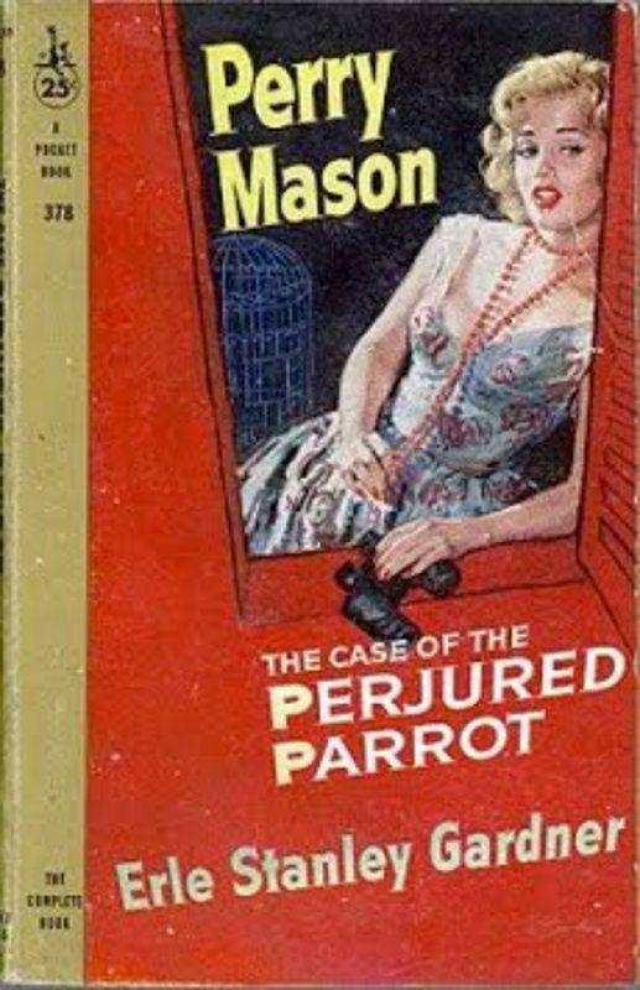
The Case of the Perjured Parrot,
p.16


“I didn’t make a speech about it,” the district attorney said.
“Well,” the coroner observed, “we’re going to have no more speeches made by either side. The coroner is inclined to feel that it’s asking pretty much of any young woman to have a gruesome spectacle like this suddenly thrust in front of her.”
“It was done,” Mason said, “purely as a grandstand, purely for the purpose of capitalizing on Miss Monteith’s overwrought condition.”
“I had no such intention,” the district attorney said.
“What did you have in mind?” the coroner asked.
“I merely wanted to identify the parrot as being the one which had been given to her by her husband on Friday, September second.”
“He can do that,” Mason said, “without throwing all this bloodstained paraphernalia in her lap.”
“I don’t need any suggestions from you,” Sprague said.
The sheriff stepped forward. “If the coroner wants to make any rulings,” he said drily, “I’m here to enforce them.”
“The coroner is going to make a ruling,” Andy Templet announced. “The coroner is going to rule that there’ll be no more personalities exchanged between counsel. The coroner’s also going to rule that there’ll be no more sudden and dramatic production of bloodstained garments, bird cages, or dead birds.”
“But I only wanted to identify the parrot,” the district attorney insisted.
“I heard you the first time,” the coroner told him, “and I hope you heard the coroner. Now, let’s proceed with the inquest.”
“That’s all,” the diistrict attorney said.
“May I ask a question?” Mason inquired.
The coroner nodded assent.
Mason stepped forward and said in a low, kindly voice, “I don’t wish to subject your nerves to any undue strain, Miss Monteith, but I’m going to ask you to try and bring yourself to look at this parrot. I’m going to ask you to study it carefully, and I’m going to ask you whether this is the parrot which your husband brought home to you.”
Helen Monteith made an effort at self-control. She turned and looked down at the lifeless parrot in the cage, then quickly averted her head. “I c-c-can’t,” she said, in a quavering voice, “but the parrot my husband brought home had one claw missing. I think it was from his right foot. My husband said he’d caught the foot in a rat trap, and …”
“This parrot has no claws missing,” Mason said.
“Then it isn’t the same parrot.”
“Just a moment,” Mason said; “I’m going to ask you to make another identification.”
He nodded a signal to Paul Drake, who, in turn, passed the word to an operative who was waiting in the corridor. The operative came through the door carrying a caged parrot.
Amid a silence so tense that the steps of the detective could be heard as he walked down the carpeted aisle, the caged parrot suddenly broke into shrill laughter.
Helen Monteith’s lips quivered. Apparently she was restraining herself from hysteria by a supreme effort.
Mason took the caged parrot from the operative. “Hush, Polly,” he said.
The parrot twisted its head first to one side, then the other, leered about him at the courtroom with twinkling, wicked little eyes; then, as Mason set the cage on the table, the bird hooked its beak on the cross-wires of the cage, and completely circled it, walking over the top, head downward, to return to the perch as though proud of the accomplishment.
“Nice Polly,” Mason said.
The parrot shuffled its feet on the perch.
Helen Monteith turned to regard the parrot. “Why,” she said, “that’s Casanova…. The sheriff told me he’d been killed.”
The parrot, tucking its head slightly to one side, said in a low, throaty voice, “Come in and sit down, won’t you? Come in and sit down, take that chair … Squawk … Squawk … Put down that gun, Helen … don’t shoot … Squawk … Squawk … My God, you’ve shot me.”
The spectators stared wide-eyed at the drama of the parrot apparently accusing the witness.
“That’s Casanova!” Helen Monteith exclaimed.
The district attorney said dramatically, “I want the words of this parrot in the record. The parrot is accusing the witness. I want the record to show it.”
Mason regarded the district attorney with a half smile twisting his lips. “Do I understand,” he inquired, “that you’re adopting this parrot as your witness?”
“The parrot has made a statement. I want it in the record,” the district attorney insisted.
“But the parrot hasn’t been sworn as a witness,” Mason observed.
The district attorney appealed to the coroner. “The parrot has made a statement. It was a plainly audible statement.”
“I would like to know,” Mason said, “whether the district attorney is making the parrot his witness.”
“I’m not talking about witnesses,” Sprague countered. “I’m talking about parrots. This parrot made a statement. I want it in the record.”
“If the parrot is to be a witness,” Mason said, “I should have some right of cross-examination.”
“Well,” the coroner ruled, “a parrot can’t be a witness, but the parrot did say something. What those words were can be put in the record for what they’re worth. I think the coroner’s jury understands the situation thoroughly. I never did believe in putting things in a record and then striking them out. When jurors hear things, they’ve heard them, and that’s that. Now, go on with the inquest.”
“I think that’s all the questions I have,” Mason said.
“That’s all,” Sprague said, “except … wait a minute…. Miss Monteith, if this parrot is Casanova, then where did the parrot come from that was killed?”
“I don’t know,” she said.
“It was in your house.”
“I can’t help that.”
“You must have had something to do with it.”
“I didn’t.”
“But you’re certain this is Casanova?”
“Yes. I can identify him by that claw that’s missing, and by what he said about dropping the gun.”
“Oh, you’ve heard that before, have you?”
“Yes. My husband commented on it when he brought the bird home with him.”
The district attorney said, “Miss Monteith, I’m not satisfied that your violent emotional reaction when this dead parrot was brought before you is purely the result of a nervous condition. Now, I’m going to insist that you look closely at this parrot and …”
Mason got to his feet and said, “You don’t need to look at that parrot, Miss Monteith.”
Sprague flushed and said, “I insist that she does.”
“And I insist that she doesn’t,” Mason said. “Miss Monteith is not going to answer any more questions. She’s been a witness. She’s under a great emotional strain. I think the jury will understand my position as her attorney in announcing that she has now completed her testimony. She has given the district attorney and the coroner an opportunity to ask her all reasonable questions. I am not going to have the examination unduly prolonged.”
“He can’t do that,” Sprague said to the coroner.
“I’ve already done it,” Mason told him.
The coroner said, “I don’t know whether he can or not, but I know that this young woman is nervous. I don’t think you’re making proper allowance for that condition, Sprague. Under ordinary circumstances, a widow is given condolences and sympathy. She’s particularly spared from any nerve shock. This witness certainly has been subjected to a series of trying experiences during the last twenty-four hours. As far as the coroner is concerned, she’s going to be excused. We’re trying to complete this inquest at one sitting. I’m getting facts, that’s all. And I want to keep moving. You’ll have plenty of opportunity to ask her questions before the Grand Jury, and on the witness stand … I’m going to ask Mrs. Helen Watkins Sabin to come forward as a witness.”
“She ain’t here,” the sheriff said.
“Where is she?”
“I don’t know, I haven’t been able to serve a subpoena on her.”
“How about Steven Watkins?”
“The same with him.”
“Is Waid here, the secretary?”
“Yes. He’s been subpoenaed and is here.”
“Well, let’s hear from Sergeant Holcomb,” the coroner said. “Sergeant Holcomb, come forward and be sworn, please.”
Sergeant Holcomb took the witness stand. The coroner said, “Now, you’re a sergeant on the homicide squad of the Metropolitan Police, aren’t you, Sergeant, and you know all about the investigation of murder cases, and the scientific method of apprehending criminals?”
“That’s right,” Sergeant Holcomb admitted.
“Now you got this box with the creel of fish in it, that Sheriff Barnes sent in?”
“Yes, that was received at the technical laboratory of the police department. We had previously received a telephone call from Sheriff Barnes about it.”
“What did you find out about the fish?” the coroner asked.
“We made some tests,” Sergeant Holcomb said. “I didn’t make the tests myself, but I was present when they were made, and know what the experts found.”
“What did they find?”
“They found that there had been a limit of fish in the creel; that the fish were, of course, badly decomposed, but, as nearly as could be ascertained, the fish had been cleaned and wrapped in willow leaves. They had not been washed after being wrapped in willow leaves.”
“And you went up to the cabin with Sheriff Barnes the next day?”
“That’s right. Sheriff Barnes wanted me to see the cabin, and we were to meet Richard Waid there. He was coming on from New York by plane, and we wanted to meet him in a place where our first conversation wouldn’t be interrupted by newspaper reporters.”
“All right, go on,” the coroner said.
“Well,” Holcomb observed, “we went to the cabin. We met Mr. Mason on the road up to the cabin. Richard Waid came while we were there at the cabin.”
“What did you find at the cabin, in the line of physical conditions?” the coroner asked.
“Just about the same as has been described.”
“At this time,” the coroner said, “I think the jury had better take a look at all of these photographs, because I’m going to ask Sergeant Holcomb some questions about them.”
The coroner waited while the photographs were passed around to the jurors, then turned back to Sergeant Holcomb.
“Sergeant Holcomb,” he said, “I want to give the members of this jury the benefit of your experience. I want you to tell them what the various things in that cabin indicate.”
The coroner glanced down at Perry Mason and said, “I suppose you may object that this is a conclusion of the witness, but it seems to me this man has had a lot of experience, and I don’t know why he shouldn’t …”
“Not at all,” Mason said. “I think it’s a very wise question. I think it’s a perfectly proper way of getting at the ultimate facts of the case.”
Sergeant Holcomb shifted himself to an easier position in the witness chair, gazed impressively at the jury, and said, “Helen Monteith killed Fremont C. Sabin. There are dozens of things which would be sufficient to establish an absolutely ironclad case against her, before any jury. First, she had motive. Sabin had married her under an assumed name; he had placed her in the position of being a bigamous wife. He had lied to her, tricked her, and deceived her. When she found out that the man she had married was Fremont C. Sabin, and that Sabin had a wife very much alive at the moment, she shot him. She probably didn’t intend to shoot him when she went to the cabin. Our experience has been that, in emotional murders of this nature, a woman frequently takes a gun for the purpose of threatening a man, for the purpose of frightening him, or for the purpose of making him believe that she isn’t to be trifled with; then, having pointed the gun at him, it’s a simple matter to pull the trigger, an almost unconscious reflex, a momentary surrender to emotion. The effects, of course, are disastrous.
“Second, Helen Monteith had the murder weapon in her possession. Her statement that she gave it to her husband is, of course, absurd on the face of it. The crime could not have been suicide. The man didn’t move from the time he fell to the floor. The gun was found some distance away, and was wiped clean of fingerprints.
“Third, she admits having been present at the cabin at the exact moment Sabin was murdered. She, therefore, combines motive, means and opportunity.”
“How do you fix that exact moment of the murder?” the coroner asked.
“It’s a matter of making correct deductions from circumstantial evidence,” Sergeant Holcomb said.
“Just a minute,” Mason interrupted. “Wouldn’t it be better to let the sergeant tell the jury the various factors which control the time element in this case, and let the jurors judge for themselves?”
“I don’t know,” the coroner admitted. “I’m trying to expedite matters as much as possible.”
Sergeant Holcomb said, “It would be absolutely foolish to resort to any such procedure. The interpretation of circumstantial evidence is something which calls for a highly specialized training. There are some things from which even the layman can make logical deductions, but on a complicated matter it requires years of experience. I have had that experience, and I am properly qualified to interpret the evidence for the jury. Therefore, I say that Fremont C. Sabin met his death sometime between ten o’clock in the morning and around noon, on Tuesday, the sixth day of September.”
“Now, just explain to the jury how you interpret the evidence so as to fix the time,” the coroner said.
“First, we go back to known facts, and reason from them,” Sergeant Holcomb said. “We know that Fremont C. Sabin intended to go to his cabin on Monday, the fifth, in order to take advantage of the opening of fishing season on the sixth. We know that he actually did go there; we know that he was alive at ten o’clock in the evening of the fifth, because he talked with his secretary on the telephone. We know that he went to bed, that he wound the alarm clock and set the alarm. We know that the alarm went off at five-thirty. We know that he arose, went out, and caught a limit of fish. It is problematical how long it would take him to catch a limit, but, in discussing fishing conditions with other anglers on the creek, it would seem that with the utmost good fortune he could not possibly have caught a limit before nine-thirty o’clock. He returned to the cabin, then, at between ten and eleven in the morning. He had already had a breakfast, two eggs, probably scrambled, some bacon and some coffee. He was once more hungry. He opened a can of beans, warmed those up and ate them. He did this before he even bothered to put his fish in the icebox. He left his fish in the creel, intending to put them in the icebox as soon as he had washed them. But he was hungry enough to want to finish with his lunch before he put the fish away. In the ordinary course of things, he would have put those fish away immediately after he had eaten, probably before he had even washed his dishes. He didn’t do that.”
“Why don’t you place the time as being later than noon?” the coroner asked.
“Those are the little things,” Sergeant Holcomb said, with very evident pride, “which a trained investigator notices, and which others don’t. Now, the body was clothed in a light sweater and slacks. From the observations which I made on the temperature in that cabin, I found that it varies quite sharply. The shade is such that the sun doesn’t get on the roof good until after eleven o’clock. Thereafter it heats up very rapidly until about four o’clock, when once more shade strikes the roof, and it cools off quite rapidly thereafter, becoming cold at night.
“Now, there was a fire laid in the fireplace. That fire hadn’t been lit, which shows that it wasn’t late enough in the evening for it to have become cold. From noon until around four in the afternoon, it would have been too hot for a person to have been comfortable in a sweater. The records show that the fifth, sixth and seventh were three very warm days—that is, it was warm during the daytime. Up there at that elevation it cooled off quite rapidly at night. It was necessary to have a fire in the evening, in order to keep from being uncomfortably cool. That cabin, you understand, is just a mountain cabin, rather light in construction, and not insulated against conditions of temperature, as a house in the city would be.”
“I see,” the coroner remarked approvingly. “Then you feel that Mr. Sabin must have returned and had his second breakfast—or lunch—before the sun got on the roof?”
“That’s right.”
“I think that covers the situation very comprehensively,” the coroner said.
“May I ask a question or two?” Mason inquired.
“Certainly.”
“How do you know,” Mason asked, “that Mr. Sabin didn’t meet his death, say, for instance, on Wednesday, the seventh, instead of on the sixth?”
“Partially, from the condition of the body,” Sergeant Holcomb said. “The body had been there at least six days. Probably, seven. In the heat and closeness of the room, decomposition had been quite rapid. Moreover, there’s another reason. The decedent had had a breakfast of bacon and eggs. Mr. Sabin was an enthusiastic fisherman. He went up to the cabin for the purpose of being there on the opening morning of fishing season. It is inconceivable that he would have gone fishing on that first morning and not caught at least some fish. If he had caught them, there would have been evidences that he’d eaten them for breakfast the next morning instead of bacon and eggs. There were no remains of fish anywhere in the garbage pail, nor in the garbage pit in the back of the house, to which the contents of the garbage pail were transferred each day.”
And Sergeant Holcomb smiled at the jury, as much as to say, “That shows how easy it is to avoid a lawyer’s trap.”















