

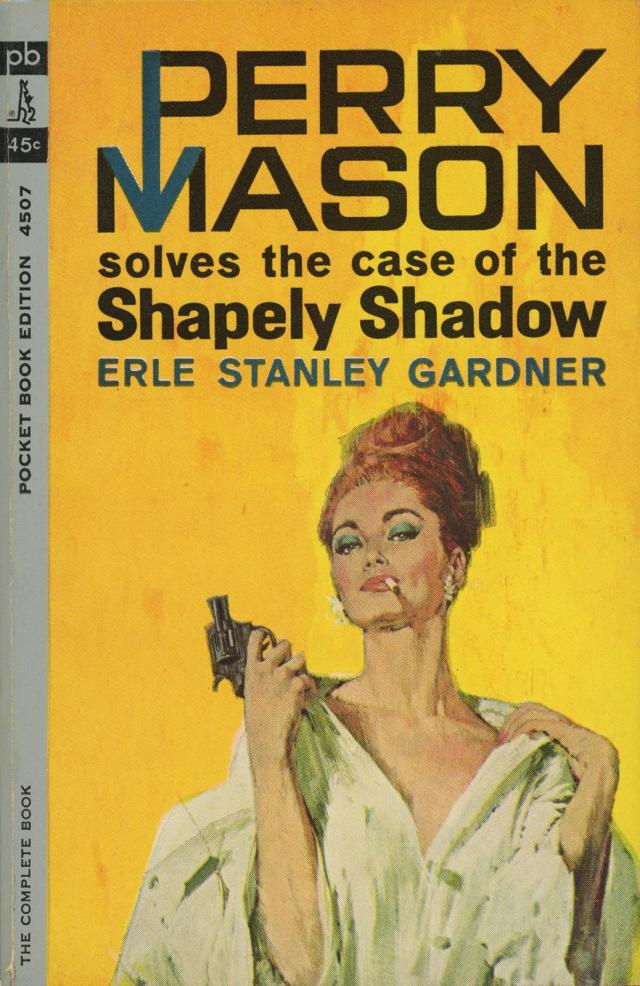
The case of the shapely.., p.10
The Case of the Shapely Shadow,
p.10


“And how far was the highway from the structure?”
“There is a surfaced highway within a hundred and fifty feet of the structure. This is not a main highway but it is, nevertheless, a surfaced highway. By that I mean it is surfaced so that it did not soften in the rain and as a result there are no tracks on it, that is, identifiable tracks. It is, however, possible to see the tracks made by the one automobile which came through the soft spot in front of the structure. Those tracks turned downhill on the surfaced highway and left muddied imprints for a distance of perhaps twenty-five feet. The imprints were quite plain at the time the car entered upon the paved highway and then faded out until it became impossible to identify them.”
“Thank you,” Mason said, “that’s all.”
Ruskin called an expert on moulage who testified to photographing the tracks, to making moulages, which he introduced and which showed, in turn, the tracks of all four tires.
“Were these tracks sufficiently distinct so that you could identify the makes of tires that were on the automobile?” Ruskin asked.
“I could, yes, sir. Three of the tires were identical in make. The other one was a different tire. The other one had a small defect in the tread.”
“What tire was that?”
“The tire on the right front wheel.”
“It was a sufficient defect so that it could be identified in the tracks in the soft soil?”
“Oh, yes.”
“Now then,” Ruskin went on, “have you examined a car registered in the name of the defendant, Janice Wainwright, with license number GVB 393?”
“I have.”
“Have you made molds of the tires on that car?”
“I have.”
“Do you have them with you?”
“I do.”
The witness introduced the moulages with appropriate designations, and they were introduced in evidence.
Ruskin said, “Will you please take the moulage casts of the tracks which you found at the scene of the crime and the molds which you made of the tires, and see if they fit?”
The witness said, “I have here moulages of the tracks left at the scene of the crime. These moulages were made in transparent plastic. It is possible to take these moulages and put them over the molds of the tires in order to show the manner in which the tires would fit into the tracks.”
“Will you do this, please, for the benefit of the Court and the jury?”
The witness demonstrated each moulage in turn.
“We would like to have all of this material introduced in evidence,”
Ruskin said, “as People’s Exhibits J-i, J-2, J-3, J-4 and so on, putting a number on each exhibit and having all of the moulages under People’s Exhibit J.”
“No objection,” Mason said.
“Cross-examine,” Ruskin said.
“I take it,” Mason said to the witness, “that in making all of these casts and moulages and models you used the greatest care to see that there was no error in measurement?”
“That is true,” the witness said.
“When the tires were on the ground, there was a pressure of several hundred pounds on each wheel?” Mason asked.
“That is correct.”
“And when you made the models of the tires, this pressure was removed from the tires?”
“Well … yes.”
“Then even if the defendant’s tires did make those tracks, the models of the tires should not fit into the moulage of the tracks because of the absence of this pressure.”
“I tried to compensate for that.”
“How did you compensate for it?”
“I partially deflated the tires and put sufficient pressure on them to duplicate the flattening out that would have taken place if the weight of the car had been on the tires.”
“What standard did you use? How did you determine what number of pounds pressure?”
“I used my judgment.”
“In other words,” Mason said, “you deflated the tires and then you put just sufficient pressure on the tire in the process of duplicating it so that the treads would be sure to fit into these tracks.”
“That is not fair,” the witness said, “nor is it an accurate statement of what I did.”
“But you did take this factor into consideration?” Mason asked.
“Yes.”
“And used your judgment as to how much this factor should influence the resulting models and moulages?”
“In a way, yes.”
“Thank you,” Mason said. “That’s all.”
“Just a moment,” Ruskin said, “I have a question on redirect. Is there anything in the deflation of these tires, or the method which you used, which would alter in any way the tread of the tires?”
“Nothing.”
“That’s all,” Ruskin said.
“I have a question on recross-examination. I will ask the witness if the things he did, did not change the dimensions of the tire.”
“The things I did may have changed the dimensions, but the tread wasn’t altered.”
“You did change the dimensions of the tire.”
“All right, if you want to put it that way,” the witness said irritably. “I changed the dimensions of the tire.”
“Thank you,” Mason said. “I was quite certain you had.”
The jurors exchanged glances indicating a certain amount of perplexity.
Ruskin called the cashier of the bank where Morley Theilman had his account. The banker testified, somewhat reluctantly, that over a period of some three weeks Morley Theilman had been withdrawing money in the form of cash; money which had invariably been withdrawn in the form of twenty-dollar bills; that the withdrawals had amounted to something over a hundred and eighty-seven thousand dollars during the three weeks’ time. That on Tuesday, the third, the decedent had drawn out five thousand dollars in cash in the form of twenty-dollar bills.
“Cross-examine,” Ruskin said.
“No questions,” Mason announced.
“I will call Cole B. Troy as a witness,” Ruskin said.
Troy identified himself as having been interested in several business ventures with the decedent, Morley Theilman, and as having been in conference with Theilman on the evening of Tuesday, the third; he testified that the conference had taken place in Bakersfield; that Theilman phoned his wife about eight saying he would be home around eleven or eleven-thirty, then had left his office about nine o’clock stating that he was driving back to his home in Los Angeles and wanted to be home by eleven.
“And what did you do after Mr. Theilman left the office?” Ruskin asked.
“I paced the floor idly for a couple of turns and wound up standing at the window looking down on the street.”
“Now, I will show you this diagram of the street which shows the location of your office and ask you if that diagram is a correct presentation of the street intersection and the location of your office?”
“It is.”
“Now then, while you were standing at the window, what did you see?”
“I saw Morley Theilman cross to the curb, stand a moment, then walk diagonally across the street.”
“I’m going to put this diagram on the blackboard,” Ruskin said, “and ask if you can mark on there with an X the approximate spot where you first saw Mr. Theilman.”
“Well, it was about here,” the witness said, making a mark.
“Now make another mark X at the point where you saw him hesitate on the curb.”
The witness made a mark.
“Now can you make a line indicating the direction which Mr. Theilman took in crossing the street on a diagonal?”
The witness made the line on the sketch.
“And then what? Just what did Mr. Theilman do? Make a line to indicate his motions after he crossed the street.”
“Well,” Troy said, “he crossed the other sidewalk on a diagonal to the corner, then walked around the corner. After that I was unable to see him because of the building on the opposite corner.”
“You continued to stand at the window?”
“I did.”
“And what did you see after that, if anything?”
“Within a matter of seconds after Theilman had started across the street,” Troy said, “I saw the shadow of a woman.”
“You first saw the woman’s shadow?”
“Yes.”
“That was before you saw the woman herself?”
“Yes.”
“Did you notice anything about that shadow, anything that was peculiar?”
“It was a very shapely shadow; that is, the shadow itself intrigued me because it appeared to be cast by a young woman who was … well, shapely.”
“But you could only see her shadow at that time?”
“That’s right.”
“And where was that shadow?”
“It was cast by a street light at the corner. The woman was out of my sight but from looking down overhead I could see the shadow.”
“Will you indicate on the diagram about where this shadow was?”
The witness indicated.
“Now, did you ever see this woman?”
“Yes, I did.”
“When?”
“Well, when Mr. Theilman was … oh, approximately halfway across the street.”
“And what happened then?”
“The woman moved out of the shadows and stood almost directly beneath my window.”
“You couldn’t see her clearly at that point?”
“No, just her head and shoulders.”
“Then what?”
“Then, as Mr. Theilman crossed the street, she moved along behind him.”
“How far behind?”
“I would say … oh, about twenty feet.”
“And you could see her more clearly at that time?”
“Certainly. As she moved off the sidewalk I got a very good view of her back.”
“Can you describe her?”
“She was, I would say, a young woman; that is, probably under thirty. She was well formed and she wore … well, it was some kind of a rather tight-fitting skirt or dress. I can’t remember exactly how she was dressed except I noticed she was—well, she lived up to what I had expected from looking at her shadow.”
“And you continued to watch her?”
“Yes.”
“For how long?”
“Until she was out of sight.”
“And where did she go?”
“She followed the exact course taken by Mr. Theilman.”
“You may inquire,” Ruskin said, turning to Perry Mason.
“Theilman phoned his wife about eight?” Mason asked.
“Yes.”
“Did he use your office phone?”
“No. We were leaving a restaurant. He used a phone booth.”
“Did you hear the conversation?”
“No.”
“How do you know he phoned his wife?”
“He said he was going to phone her and went to the phone booth.”
“Let’s go back to this shapely shadow,” Mason said. “You were at your office window?”
“Yes.”
“You watched Theilman after he came in sight?” Mason asked.
“Yes, sir.”
“Then you saw the shadow of this young woman?”
“Yes, sir.”
“And you say that after she became visible, that is, after she had moved out into your line of vision, you continued to watch her until she vanished around the corner?”
“Yes, sir.”
“And she was about how far behind Mr. Theilman?”
“I would say twenty feet.”
“Now, let’s approximate the distance on this diagram. How wide is this street, do you know?”
“I think it is sixty feet.”
“And the sidewalks are about how wide?”
“Oh, perhaps ten feet.”
“So that would be a distance of eighty feet across the street.”
“Yes.”
“That is in a straight line, however. On a diagonal the distance would be greater.”
“Yes.”
“How much greater?”
“Oh, perhaps … perhaps a hundred and twenty feet.”
“Now,” Mason said, “you have testified that you watched Mr. Theilman cross the street and lost sight of him when he went around the corner where the building obstructed your view.”
“That’s right.”
“But you have also testified that you were watching this young woman from the time you first saw her, and evidently you saw her when Theilman had covered only some twenty feet of the distance. Now, which were you watching, the young woman or Theilman?”
“I was watching them both.”
“On whom were your eyes focused, Theilman or the woman?”
“On … well, I guess sort of in between them.”
“Then you weren’t watching the woman?”
“I was watching her but my eyes weren’t focused on her.”
“And you weren’t watching Theilman?”
“I was watching him but my eyes weren’t focused on him.”
“In other words, while a good-looking woman with a seductive figure was crossing the street, you didn’t look at her but kept your eyes focused at a point approximately ten feet ahead of her?”
“Well … No, I guess that’s not right. I … I was looking back and forth at both of them.”
“Can you describe this woman’s walk?”
“It was very graceful, very sinuous, very … well, hippy.”
“And you took your eyes off that seductive walk, off that graceful glide, off those swaying hips in order to watch Theilman, who was some twenty feet ahead of her?”
“Well, no,” Troy admitted. “When you come right down to it and put it that way, Mr. Mason, I don’t think I did. I kept my eyes on the girl.”
“Then you were mistaken in saying that you were watching Theilman?”
“Yes. I saw him generally but I was watching the girl. My eyes were on her.”
“Then you were completely mistaken in stating that your eyes were focused at a point midway between the young woman and Theilman?”
“I hadn’t given it any thought when I answered that question, Mr. Mason.”
“In other words, you answered a question while you were under oath without thinking?”
“Well, I guess I did.”
“And so gave a wrong answer?”
“Yes, sir, I did. I must have.”
“Thank you,” Mason said, with exaggerated politeness. “I was quite satisfied you had. Were there any other questions you were asked which you answered without thinking?”
“No.”
“You’re thinking now?”
“Yes.”
“That is all,” Mason said.
“I will call Mrs. Morley L. Theilman to the stand,” Ruskin said.
The second Mrs. Theilman, attired in black, her eyes demurely downcast, moved slowly forward, held up her right hand and was sworn and took her place on the witness stand.
Ruskin’s voice as he questioned the witness held that note of synthetic sympathy which is the stock-in-trade of some prosecutors examining bereaved widows.
“Mrs. Theilman,” Ruskin said, “we have to perform the disagreeable duty of identifying the decedent. You are the widow of Morley L. Theilman and you were, I believe, called upon to identify his body after it had been found in the place referred to generally as the Palmdale subdivision?”
“That is right,” she said.
“You saw the body?”
“I did.”
“Can you identify it?”
“Yes, it was the body of my husband, Morley L. Theilman.”
“Now then,” Ruskin went on, “directing your attention to Tuesday, the third—that would be the day before the body was found—can you tell us about the time you last saw your husband, where he was and what he did?”
Slowly and in a low voice, the witness described how Theilman had returned from his office, stated that he wanted to go to Bakersfield; that he asked for a fresh suit of clothes; that while he was in the bathroom shaving she had gone through the pockets of the discarded suit, had found the threatening letter and the envelope in which it came, and had read the printed demand for money, then had put the letter and envelope in the pocket of the fresh suit that her husband was going to wear.
“And was this the suit that he was wearing at the time of his death?” Ruskin asked.
“It was,” she said.
“You may cross-examine,” Ruskin said.
Mason rose, walked a few paces toward the witness stand and stood facing the slender woman with the downcast eyes.
“Mrs. Theilman,” he said, “where did you first meet your husband?”
“In Las Vegas, Nevada,” she answered in a low voice.
“What were you doing at the time?”
“Objected to,” Ruskin said, “as incompetent, irrelevant and immaterial, not proper cross-examination. It makes no difference what she was doing. It makes no difference when she met the decedent or how she met him.”
“I think I will overrule the objection,” Judge Seymour said. “In a case of this sort I certainly intend to give the defendant every latitude in the field of cross-examination. Counsel undoubtedly has some point in mind or he wouldn’t have gone into this. You may answer the question.”
“I was working in a rather varied capacity.”
“Describe the varied capacities,” Mason said.
Her voice grew a little stronger. Her eyes raised long enough to flash a glance of gathering animosity at Mason. “I guess the best way to describe it is to say that I was a show girl.”
“You showed yourself in bathing suits, did you not?”
“At times, yes.”
“You were a hostess?”
“Yes.”
“A shill?”
“I don’t know what you mean by a shill.”
“You put on daringly cut evening gowns that were tight and clinging and circulated around the gambling tables?”
“All evening gowns that are any good are tight and clinging,” she said.
“And yours was tight and clinging?”
“Yes.”
“And you circulated around the gaming tables?”
“Yes.”
“And made yourself easy to pick up?”
“I wasn’t picked up.”















