

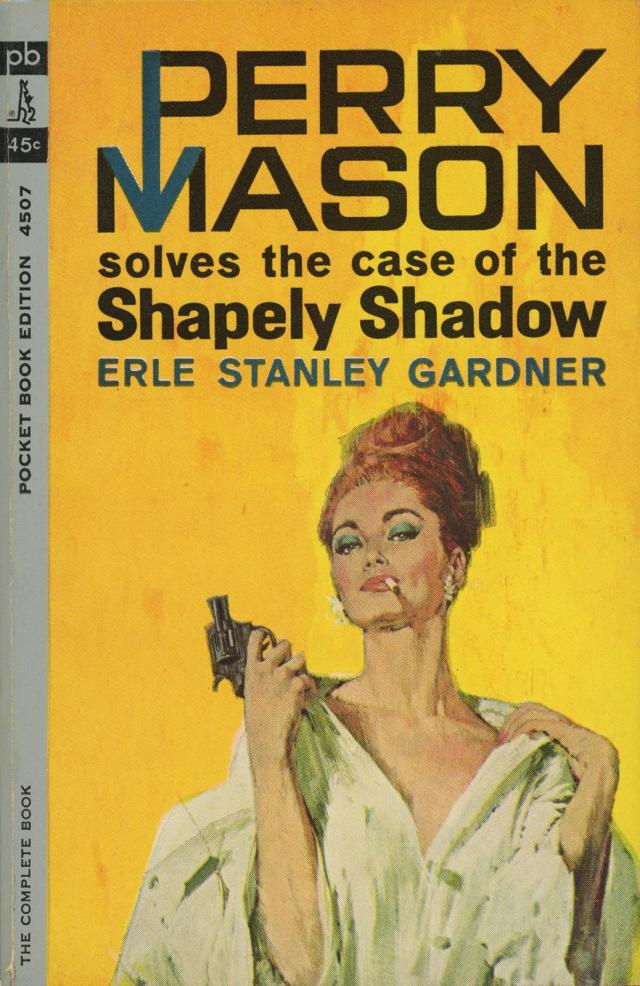
The case of the shapely.., p.9
The Case of the Shapely Shadow,
p.9


“After I came to my senses, I decided that I would compete. There isn’t any such thing as a woman being outmoded or outmodeled if she makes up her mind that she isn’t going to be outmoded or outmodeled.
“By that I don’t mean that you can turn back the hands of the clock, but you certainly can use the weapons nature gave you, and you can sharpen those weapons enormously. Any man in your own age bracket will take notice—even some of the younger ones.”
“So you started sharpening weapons?” Mason asked.
“After it was too late, I started sharpening my weapons and then, when Morley wanted to deal with me on a business matter, I made up my mind that I’d let him look over the arsenal.”
“He approached you?” Mason asked.
“A lawyer approached me.”
“In his behalf?”
“He didn’t say so in so many words, but I knew he was representing Morley, although he said his client was someone else.”
“When was this?”
“The latter part of last week. He said that he wanted to get proxies on my stock or wanted to buy the stock. Then he came again early this afternoon.”
“And what did you tell him?”
“I told him the stock wasn’t for sale and that as far as proxies were concerned it made a great deal of difference who wanted the proxies.”
“So then he told you that your former husband wanted them?”
“No, at least not in so many words. He said time was short and that his client had to keep in the background. So I told him that he could give me a hundred dollars to show his good faith and to cover expenses, and that I’d take the train tonight to Las Vegas and his client could meet me there and we’d discuss matters.”
“Then what happened?”
“He gave me the money for expenses and I came up here. I was hoping Morley would be alone.”
“Had other people been trying to get your stock?”
“Plenty of them. During the last three weeks there had been several telephone calls from people who said they were brokers.”
“These were offers for the purchase of the stock?”
“Offers for proxies,” she said. “They didn’t want the stock as much as they wanted the voting power.”
“And in this financial transaction with your husband, did you have any figure in mind?”
She said, “There was only one figure that I ever wanted him to be interested in—mine.”
Peremptory knuckles sounded on the door. Mason got up and opened it.
A police officer said, “You know, Mr. Mason, you could wear out your welcome in Las Vegas mighty fast.”
“This woman is a witness,” Mason said. “She’s been at Police Headquarters and made her statement. You’re finished with her now.”
“That’s what you think,” the officer told him. “You’re the one who’s finished with her. We have orders to see that you are escorted to the airport, Mr. Mason.”
“And if I don’t go?” Mason asked.
“Oh, you don’t need to go,” the officer said, “but you’d want to be careful—very, very careful that you didn’t violate any of the laws or any city ordinances while you’re here, Mr. Mason. We wouldn’t want to have anything happen to you and we’d be certain to keep a close eye on you. If you violated any ordinance—and we have lots of them—you’d be seriously inconvenienced.”
“That’s okay,” Mason told him. “As a matter of fact, we had finished. We were just leaving anyway.”
“That’s fine,” the officer said. “We’ll drive you folks down to the airport. You don’t need your cab.”
Chapter Eleven
Paul Drake, his skin oily with fatigue, a stubble showing along the angle of his jaw, was still at work in his office when Mason and Della Street came in at three-thirty in the morning.
“What do you know, Paul?” Mason asked.
“Not too much,” Drake said. “The body was found up at a subdivision in the mountains back of Palmdale. It’s a place Theilman had purchased after a subdivider went broke on it. There’s one of those real estate office buildings on it—a sharp-roofed little office affair. The body was found in there, face down on the floor.”
“How was he killed?”
“Gun shot, right through the heart. Thirty-eight caliber.”
“Any weapon found?”
“No weapon.”
“Clues?”
“I wouldn’t know all of them,” Drake said, “but there are plenty. There was a thundershower up there during the night and so it’s possible to put certain things together. Two cars had been driven in there before the thundershower, Theilman’s Cadillac and Janice Wain-Wright’s Ford. The thundershower dampened the ground. There was just one set of tracks going through the damp ground. Those were the tracks of Janice Wainwright’s automobile when she left the place.
“So you can figure what happened. Theilman intended to drive home and reach there about eleven o’clock. When he left Troy’s office in Bakersfield, Janice Wainwright, all dolled up like a million dollars, followed him to where he had the car parked. After he had telephoned his wife—”
“Now, wait a minute,” Mason interrupted. “I’m a suspicious guy. Do we know that he telephoned his wife?”
“Sure we do. He went to a phone booth and used his telephone credit card. He put through a person-to-person call to his wife. They have a record of it there on the call sheet.”
“He called his wife and talked to her?”
“That’s right, at least the call was completed.”
“Scratch one form,” Mason said.
“What do you mean, scratch one form?”
“Troy saw a shapely shadow,” Mason said. “Anyone who has seen the second Mrs. Theilman is impressed by her shape. I was hoping that she had perhaps followed her husband to Bakersfield and was following him back.”
“In that case somebody must have accepted the telephone call in her name,” Drake said.
“All right, go on. What else, Paul?”
“Well, there’s nothing to it, Perry. You can put the whole thing together. That thundershower traps your client. There was a bed up in that little real estate house and evidently it wasn’t the first time Theilman had stayed up there, and probably wasn’t the first time your client stayed up there. Theilman told his wife only that he was going over to Bakersfield to have a business conference with Cole Troy. Actually he shaved in the middle of the afternoon and put on a fresh suit of clothes. Now you tell me: Does a man about to take a hundred-mile drive to meet another man on a business conference do those things? Not on your life. He had a date with Janice Wainwright. They quarreled. She killed him and skipped out with the dough. That thunder-shower and the tracks of her car have trapped her.”
“All right,” Mason said resignedly. “What is the D.A.’s office doing, Paul? Going to have a preliminary?”
“No one knows yet,” Drake said, “but I don’t think so because they’re issuing subpoenas to appear before the grand jury and—”
There was a short, sharp ring on Drake’s telephone. Drake picked it up, said, “Yes,” then before he had time to say anything else the door opened and Lt. Tragg stood smiling in the doorway.
“Well, gentlemen,” Tragg said, “we all seem to be working late.”
Mason grinned. “This isn’t late, Tragg, it’s early. We’re starting a new day.”
“That’s fine,” Tragg said. “Start it right, then. I have a little present for you and Della Street, Perry.”
“What is it?” Mason asked.
Tragg handed out two folded papers. “Subpoenas duces tecum to appear before the grand jury,” he said, “in its investigation of the murder of Morley L. Theilman.”
“You can’t make an attorney a witness against his client,” Mason said, “and that same protection applies to the secretary.”
“I know, I know,” Tragg said. “We don’t want your testimony, Mason, we just want the things that are in your possession—the tape recording and the disc showing the numbers on the twenty-dollar bills that were in the suitcase your client took to your office.”
Mason’s face was without expression. “You assume, then, that such articles are in existence?”
“I know they’re in existence,” Tragg said.
“It will be a pleasure to co-operate with you in any way as far as factual evidence is concerned, Lieutenant.”
“I was sure it would be,” Tragg said ironically. “Please be very careful not to let any of the evidence get destroyed, Mr. Mason, and be sure to bring it with you when you appear before the grand jury.
“Well, I know you folks are tired. You’ve certainly had a hard day and quite a night. I don’t want to interfere with your sleep so I’ll be leaving.”
Tragg smiled, bowed and left the office.
“Well, there you are,” Drake said.
“That,” Mason announced, “means that Janice Wainwright has talked. She’s told the police everything she knows, including her story of the visit to my office and the fact that we took down the numbers of those twenty-dollar bills. The police couldn’t have learned about that any other way.”
Drake studied Mason thoughtfully. “You seemed awfully damned willing to give Tragg that evidence. Aren’t you going to try to hold it out?”
“No. Why should we hold it out? We’ll go before the grand jury and give them anything we have.”
“Say,” Drake said suddenly, “your client didn’t pay you any fees or anything in twenty-dollar bills, did she, Perry?”
Mason looked at him in surprise. “What makes you think that?” he asked.
“I was just wondering,” Drake said.
Mason said suavely, “If you’ll read the subpoena duces tecum quite carefully, Paul, you’ll find that while we’re ordered to produce any records which we made in the office of the numbers of those bills, there’s nothing said about producing any money which might have been given to me by my client.”
Drake said, “Now look, Perry, don’t try to cut any corners on this thing. These boys mean business this time, and they’re not fooling around with any preliminary hearing. They’re going to get the testimony in front of a grand jury, get an indictment, and take your client into court in front of a jury.”
“Fine,” Mason said. “I’m always willing to take my chances in front of a jury. Well, we’ll be shoving off, Paul.”
Mason and Della Street left the office. Mason gave Della Street some bills. “Take these down and put them in the safe before you go home, will you, Della?”
“What is this?” Della Street asked.
“I believe we received two hundred and fifty dollars from our client,” Mason said.
“Is this the same two hundred and fifty dollars?” she asked.
“I wouldn’t know,” Mason said. “I’ve mixed the money all up with my own money, I’m afraid, and I know I’ve spent some money, including the cash tip we gave the pilot of the plane. After all, there isn’t any restraining order telling me not to spend money, and so far there’s been no subpoena to produce money we’ve received from our client.”
Chapter Twelve
Judge Lloyd L. Seymour nodded to the deputy district attorney. “Does the prosecution wish to make an opening statement?” he said.
Manlove P. Ruskin, one of Hamilton Burger’s best trial deputies, arose, bowed to the court and advanced to the jury.
“May it please the Court, and you ladies and gentlemen of the jury,” he said, “the prosecution in this case intends to prove that the defendant, Janice Wainwright, knew that her employer, the decedent, Morley L. Theilman, was collecting large sums of money in cash. This money was in the form of twenty-dollar bills.
“We can only speculate as to the use Mr. Theilman intended to make of those twenty-dollar bills, but we will furnish sufficient evidence to show that he did have those twenty-dollar bills and he intended to make some use of them.
“We propose to show that the defendant had a suitcase containing some twenty-five or thirty pounds of twenty-dollar bills, an amount estimated at perhaps as much as two hundred thousand dollars; that she made a dupe of her present counsel, Perry Mason, making him think he was helping her in protecting the interests of her employer, whereas, as a matter of fact, she deliberately intended to kill her employer and steal the money.
“We propose to show that she lured her employer to an abandoned realty subdivision in the mountains back of Palmdale and there killed him; that she then went to Las Vegas, Nevada, claiming that she was acting under instructions of her employer, knowing that her employer was dead and could never contradict anything she chose to say.
“However, we propose to show that the well-laid scheme of the defendant had several weak points, several holes which will become readily apparent as the evidence develops.
“We propose to show that Cole B. Troy, an associate of Morley Theilman, saw a young woman meeting the description of the defendant shadowing Morley Theilman when he left Bakersfield on the night before his death.
“We propose to show that when Mr. Theilman left the office of Cole B. Troy he had no intention other than that of driving directly to his home to the north of this city. That he was shadowed by the defendant who accosted him and inveigled him into going to the mountain subdivision to spend the night with her.
“We propose to show indisputably, by circumstantial evidence, that the defendant in this case appropriated to her own use monies which had been withdrawn by the decedent from his bank in the form of cash. We propose to show that the motive for the murder was the theft of a large sum of money, perhaps as much as two hundred thousand dollars in cash.
“We will prove to you, by circumstantial evidence which cannot be refuted, that the parties drove to this rendezvous in the mountains back of Palmdale, that there was a thunderstorm in the early hours of the morning, and that this thunderstorm so moistened the soil in front of the cabin where the body was found that it would have been impossible for any automobile to have driven up to that cabin, or driven away from it, without leaving tracks in the soft mud; that the only tracks which were left driving away from the scene of the shooting were those made by the defendant’s car.
“On the strength of that evidence we shall ask for a verdict of first-degree murder.”
Ruskin again bowed to the court, returned to the counsel table and sat down.
“Does the defense have any opening statement?” Judge Seymour asked.
“The defense does,” Mason said.
He arose and faced the jury. “Ladies and gentlemen,” he said, “I ask you to bear in mind the fact that all of this evidence which has been indicated by the prosecutor is circumstantial evidence. We expect to show that these circumstances are all fully capable of being explained by a reasonable hypothesis other than that of guilt.”
“If the Court please,” Ruskin said, “this is not the time or the place to argue the case. If the defense counsel wishes to state what he expects to prove, we have no objection. If he wishes to argue the case, he should wait until the proper time.”
“Very well, Your Honor,” Mason said gravely, and turning to the jury, said, “We expect to prove that the defendant is innocent.” Then he walked back to his place at the counsel table, seating himself.
A ripple of merriment sounded in the courtroom, and some of the jurors were seen to smile.
Judge Seymour said, “The prosecution will proceed with its case.”
Ruskin called a licensed surveyor who introduced road maps showing the location of the subdivision, a sketch map of the place where the body was found, showing the interior of the building, the position of the body, and the relationship of the building to the surrounding terrain.
He then called a photographer who introduced in evidence pictures that had been taken showing the body, the terrain, and the interior and the exterior of the building.
“Call Mr. Marcus,” Ruskin said.
Marcus proved to be a meteorologist who stated that on the early morning of Wednesday, the fourth, there was a thundershower in the mountains back of Palm-dale; that this shower, while of brief duration, was somewhat violent and that it was accompanied by a precipitation which could only be estimated but which in his opinion was amply sufficient to account for the softness of the ground in front of the little structure which had been used as an office in the real estate subdivision.
Photographs were introduced showing the muddy section in question and showing the tracks of an automobile crossing this muddy section.
“Cross-examine,” Ruskin said to Perry Mason.
Mason seemed quite affable as he rose and bowed to the witness. “Do you know what time the thundershower occurred?” he asked.
“It was approximately five o’clock in the morning.”
“What do you mean by approximately?”
“Well, I’ll put it this way. It was between four-thirty and five-thirty a.m. In view of the fact that the thunderstorm was exceedingly localized in its sweep over the locale, it is impossible to pin the time down any closer than that. But I can say definitely it was between four-thirty and five-thirty.”
“That was on the morning of Wednesday, the fourth?”
“That is correct.”
“How much did it rain at this particular locality?”
“From an inspection of the ground I would say that it must have rained approximately twenty-five hundredths of an inch, perhaps a little more. But there is a slope in front of the structure in question, and water collected in there to a greater extent than would otherwise have been the case. The ground was quite soft, soft enough to have shown tracks—particularly the tracks of automobiles.”
“Did you notice any tracks of automobiles?”
“I did. There was one car, a Cadillac, on the far side of the soft ground. It was parked in front of the structure. It had left no tracks. There were tracks made by an automobile leading from the structure to the highway.”















