

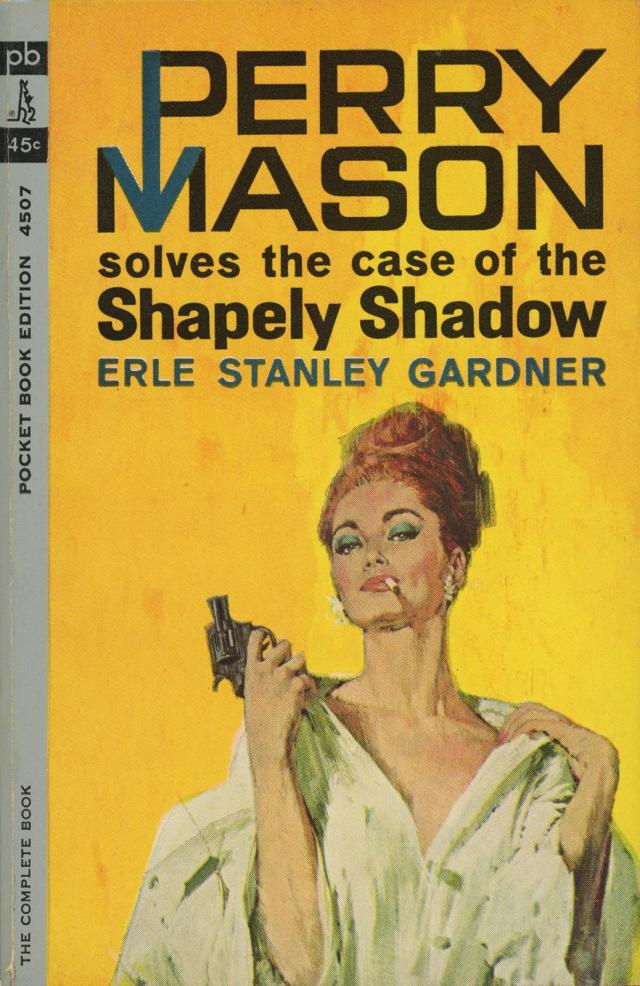
The case of the shapely.., p.13
The Case of the Shapely Shadow,
p.13


“In the parking lot at the office.”
“Then you got frightened and went to your apartment—at least when you telephoned you said you were at your apartment.”
“Yes.”
“And then what?”
“Then Mr. Theilman telephoned me.”
“And told you to do what?”
“To take some money from the petty cash drawer in the safe, to take the first available evening plane for Las Vegas and meet his first wife when she arrived there on the train. Carlotta doesn’t like to fly.”
“And then what did you do?”
“I got the money from the petty cash in the office safe.”
“How much?”
“He told me to take two hundred and fifty dollars.”
“How much was in there?”
“He tries to keep five hundred dollars there.”
“And you took two hundred and fifty dollars for your expenses on the trip?”
“Yes. I was simply following his instructions.”
“But you also gave me two hundred and fifty dollars as a fee when I saw you in Las Vegas.”
She hesitated a moment, then said, “That also was in accordance with instructions. He told me to give you two hundred and fifty dollars.”
“In cash?”
“He said to give you two hundred and fifty dollars.”
“So you went to the safe where Mr. Theilman keeps five hundred dollars for emergencies. You took two hundred and fifty dollars for your own use as expenses and you took two hundred and fifty dollars to pay me. That’s a total of five hundred dollars. Was there any money left in the cash drawer?”
“No.”
“You took it all?”
“Yes.”
“As the prosecution will point out,” Mason said, “immediately after Mr. Theilman’s death you went to the safe and looted the emergency cash drawer of every cent that was in it.”
She was close to tears. “I did only what he told me to do.”
“And what did you do after that—immediately after you emptied the cash drawer?”
“I went to the beauty shop.”
“And were there how long?”
“About five hours.”
“Did you drive to the beauty shop?”
“It’s in the neighborhood of my apartment.”
“Where was your car?”
“Parked on a side street around from the apartment house.”
“When did you actually see your car after you went to the beauty shop?”
“You mean on the fourth?”
“Yes.”
“Not until about five-thirty when I got in it and drove to the airport.”
Mason said, “You’ve got to get on the witness stand and tell that story and when you tell it, you’re hooked … Now look here, Janice, if you were having an affair with Mr. Theilman, I want you to tell me about it and tell me about it now. If you went out there to meet him at that subdivision … “
“Mr. Mason, I tell you, I didn’t. And I know that Mr. Theilman wasn’t there at the time he phoned me. There isn’t a telephone in that office. It was taken out. The nearest telephone is some two miles down the road.”
“Is there any chance, any chance whatever,” Mason asked, “that you could have been deceived by someone who was impersonating Mr. Theilman, someone who told you—”
“Not a chance in the world,” she interrupted. “I know Mr. Theilman’s voice. As a secretary I’m trained to listen to voices on the telephone.”
Mason shook his head. “Janice,” he said, “it’s an impossible combination of circumstances, and the minute you get on the stand and try to make that story stand up they’ll tear you to pieces.”
“It’s the truth.”
“Well,” Mason said, “if that’s your story, that’s your story, but I have a feeling that you’re still holding out on me. I have a feeling that you’re still trying to deceive me and—well, if you are, it’s going to be your funeral, and when I say it’s going to be your funeral I mean it literally.”
She started to cry. “You don’t trust me.”
Mason looked at her thoughtfully and said, “You puzzle me, Janice, but I’m going to present your case to this jury for everything that’s in it.”
“I wish you’d have more confidence in me,” she said.
“I wish I did too, but the physical evidence contradicts your story. You must have gone out there to that subdivision. You must have been there before that thunderstorm started, and you must have driven away after the thunderstorm.”
“I didn’t! I didn’t! I didn’t!” she said.
Mason shrugged his shoulders. “All right, Janice, it’s up to you. But I can’t put you on the stand and let you tell that story. It would be better for you never to take the stand, simply to sit tight and adopt the position that the prosecution has to prove you guilty beyond all reasonable doubt and that they haven’t done it.”
“Please, can’t I do that?” she asked eagerly. “Can’t I keep from going on that witness stand?”
“You’re afraid of the witness stand, aren’t you?”
“Yes. I don’t want them to ask me about—how I felt toward Mr. Theilman—what happened before his marriage. You said I didn’t have to.”
“You don’t have to,” Mason said. “The law gives you that right to remain silent, to force the prosecution to prove you guilty beyond all reasonable doubt without any necessity on your part to prove yourself innocent. But I’m going to tell you something as a matter of practical psychology, Janice. If they make out a case and you don’t go on the witness stand, you’re going to be convicted of first-degree murder.
“Because you’re young and attractive, and because of your loyalty to your employer in the years of association, they’ll probably give you the benefit of the doubt when it comes to fixing the penalty. They’ll give you life imprisonment instead of the gas chamber, but they’ll convict you of first-degree murder.”
“I can’t help it,” she sobbed.
“Dammit!” Mason said. “I’m afraid I can’t either,” and motioned to the officer that the interview was over.
Chapter Thirteen
Back in his office, Mason moodily paced the floor. Della Street, accustomed to the lawyer’s moods, sat at her secretarial desk and watched him with anxious eyes.
“What will happen if you don’t put her on the stand?”
“Nine chances out of ten she’ll be convicted,” Mason said. “If I put her on the stand, the way things look now, I think it’s a moral certainty she’ll be convicted.
“Apparently, Della, she was in love with Theilman and prior to Theilman’s second marriage they had some week ends together. Janice is trying to cover up the extent of her feeling for Theilman and undoubtedly would like to keep the evidence of those week ends out of the picture. The prosecution’s cross-examination of Janice about those week ends could tear the girl to pieces and wave the remnants in front of the jury—and if they should find she had any of the money that was in that suitcase, even one lone twenty-dollar bill, she’ll be finished.”
“Well, naturally,” Della Street said.
Mason went on, “There’s just too darned much evidence of blackmail here. There was no need to send Theilman two letters. There was no need to send one to his house and one to his office. And if Theilman was going to tell his secretary not to open any letters from A. B. Vidal, then why would he toss the Vidal letter and envelope in the wastebasket where she would be almost certain to notice them?
“And consider the blackmail letter. It simply told Theilman to get the money. It didn’t tell him to get a suitcase and put it in locker FO82.
“Those instructions must have been given over the telephone. If a blackmailer was going to phone his victim, why first send him a letter?
“Janice now indicates this whole blackmail idea may have been an elaborate cover-up so Theilman could get a large sum of cash and put across a business deal.
“The trouble with that is Theilman is dead. He can’t speak for himself. So when Janice starts speaking for him, everyone is going to listen to what she says with downright suspicion. When she tries to make Theilman’s words give her a defense, the jury won’t believe her … And someone got away with a couple of hundred thousand dollars—all in twenties—ready for spending.”
Della Street shook her head. “It doesn’t make sense.”
“Well, we’ve got to make it make sense before we’re through with it,” Mason said. “I’ve got to stand up in front of that jury and have a theory of the case that will make sense. What’s more, it’s got to be such a water-proof, airtight theory that this deputy district attorney can’t rip it apart.
“The way it looks now, there wasn’t any blackmailer. Theilman was working some sort of a razzle-dazzle to make it seem he was being blackmailed, but I can’t prove it.
“The minute Janice Wainwright gets on the stand and tells her story as we know that story, she’s sunk, Della … And if they ever find so much as one twenty-dollar bill from that blackmail money in her possession, she’s going to the gas chamber.”
“You keep saying that, Chief. Do you think she could have?”
“I’m afraid she could have,” Mason said. “You see, she took five hundred dollars out of the cash drawer. Now, let’s suppose this whole thing was an elaborate build-up by Theilman in order to get some money out of the bank and get it in the form of cash so that it would appear he was being blackmailed. He’s very apt to have filled up the five hundred dollars in that petty cash drawer with some of the bills that had been in that suitcase. Hang it, Della, there just isn’t any logical explanation for some of the things in this case, yet I’ve got to have a logical explanation when I stand up in front of that jury.”
“And you’re sure you can’t put Janice on the stand?”
“Not as long as she’s concealing something. I don’t think she realizes the terrific ordeal she would face in a cross-examination by a hostile attorney.
“That’s one of the reasons I treated the second Mrs. Theilman as I did. I wanted Janice to realize that an attorney with a sneering, cynical cross-examination can rip a woman to pieces on the witness stand.”
“Well,” Della Street said indignantly, “Mrs. Theilman had it coming. Here’s a girl that has been around and knows the ropes, who married Theilman because she saw a chance to get her hands on a soft touch. She stole him, Chief—just deliberately stole him from his wife.
“And now she has the audacity to get on the witness stand as the crushed, bereaved little widow. Why, butter wouldn’t melt in her mouth. Her voice was so low and her manner was so demure and her eyes were so downcast! Why, you know just as well as I do that she’s sitting back and thinking in her own mind just what she’s going to do with all the money she’s inherited from her dead husband.
“She was a shill in a gambling house—a come-on, as she expressed it.
She went over to the table in order to encourage Theilman to do more gambling. He liked what he saw, and she took a physical inventory. She decided that she could move in and … well, that’s it. She just moved in.”
Mason nodded. “How did my cross-examination seem, Della?”
“Believe me,” Della Street said, “to a person sitting back in the courtroom you certainly ripped the mask off that woman. She was making a wonderful impression on the jurors, sitting there so demure and so sweet and so brave. Then you started making her mad, and finally her true character came out. She looked at you as though she could kill you with her bare hands. I’ll bet right now she’s home sticking pins in your image.”
Mason permitted himself a grin. “She probably doesn’t feel passionately fond of me … Hang it, Della, I feel that I have that jury interested. I think that they would like to go along with my theory of the case—only I haven’t got any theory of the case. I don’t dare to get one until the prosecution has put on all its evidence.”
Paul Drake’s code knock sounded on the door. Mason opened the door and let the detective in.
“Hi, Perry,” Drake said, and to Della Street, “How are you tonight, Beautiful?”
“We’re still in the saddle,” Mason said, “but we’ve been jolted a few times. I’m afraid … well, I don’t like to think of what’s ahead.”
“I hate to bring you bad news,” Drake said, “but I have a tip for you.”
“What is it?”
“They have a bombshell—a veritable bombshell, that they’re going to drop in your lap at the exact moment they rest the case.
“They feel that you’re planning to get along without putting Janice on the stand; that you’re going to trust to your oratory and to your logic to build up some kind of a theory of the case that will cause some of the jurors to have a reasonable doubt.
“Now they’ve got something that’s going to force you to put Janice on the stand, and when she gets on the stand they’re going to rip her wide open.”
“What is it?” Mason asked.
“I don’t know. It’s some bit of evidence they’re holding, and they’re going to throw it at you in the closing minutes and then rest their case. Hamilton Burger, the district attorney, is going to be in court personally when that happens.
“I can also tell you something else. They’re going to jockey around for position so they don’t throw this bomb at you until they have you trapped. They won’t let you jockey the case into a recess or adjournment. They’re going to hit you either in the middle of the morning or in the middle of an afternoon session. Then they’re going to rest their case and it will be up to you to start putting on your case while you’re still groggy from this knockout punch.”
“Is there any chance you can find out what this evidence is?” Mason asked.
Drake shook his head. “They’ve got it guarded as though it were the greatest military secret in the world. There isn’t a chance, Perry, not a chance.”
“But you do know they have this evidence?”
“I got a straight tip,” Drake said. “One of the newsmen is very close to Hamilton Burger. Burger would have a fit if he thought the man had tipped me off.”
“What happened?”
“Burger told him to be in court and to be ready for a most sensational development. He was told that the development would come only a few minutes before the prosecution closed its case; that you would be left out on the end of a limb and they would be standing there with a saw and Hamilton Burger was going to take great delight in sawing off the limb. They wouldn’t tell this newsman any more, so he got mad and came to me to see if I had any idea what this sensational development was going to be. I pretended I had some sort of an idea and as he tried to find out what I knew, I began to get an idea of what he knew.
“I told him that Burger thought he’d saw off the limb you were on, but you’d fool the prosecution at the last minute.”
Mason frowned, resumed pacing the floor.
Drake glanced at Della Street’s apprehensive eyes, then turned back to the lawyer. “Perry,” he said, “I have a hunch. It’s just a hunch, but I have it.”
“Shoot,” Mason said.
“Are you sure, are you absolutely sure that Janice Wainwright didn’t put those blackmail notes together herself?”
Mason turned to Drake. “No,” he said, “I’m not absolutely certain and I wish I could be. I’m not certain of anything in this case. I have a most peculiar feeling that I’m walking a tightrope across a chasm and that somebody has a knife that can cut that rope at any time.”
“That ties in with the confidential tip this reporter got,” Drake said.
“How about forgetting it and getting some eats, Perry?”
Mason shook his head.
Della Street said, “This is one of his nights, Paul. He’s going to keep pacing back and forth, wearing out the carpet and drinking coffee.”
“How about you, Beautiful?” Drake asked. “Come on out and have a bite.”
Della Street shook her head. “Thanks, Paul. It’s my place to stay here with Perry.”
“You can’t help him worry,” Drake said.
“No,” she smiled, “but I can help pour the coffee.”
Mason might not have heard them. His eyes level-lidded with thought, he was pacing slowly and methodically back and forth across the office.
Chapter Fourteen
Thirty seconds before nine-thirty a.m. and after the courtroom was filled with restless, whispering spectators; after counsel were at their places at the table; after the jurors had all been seated and in that moment of tense expectation when they waited for Judge Seymour to take the bench, Hamilton Burger, the district attorney, came striding through the side door of the courtroom and seated himself at the prosecutor’s table.
The arrival of the district attorney caused a veritable buzz of comment and it was in the middle of this buzz that the bailiff pounded his gavel and said, “Everybody stand up, please.”
Judge Seymour entered the courtroom, nodded to the jurors and the spectators, said, “Be seated, please. The case of the People versus Janice Wainwright. The defendant is in court, the jurors are all present. Proceed with your case, Mr. Prosecutor.”
“I will call Lieutenant Sophia of the Las Vegas police force,” Ruskin said. The officer came forward, was sworn and was asked by Ruskin whether or not the defendant had made any statement when she had been arrested in Las Vegas, Nevada.
“She did.”
“Was that statement voluntary?”
“It was.”
“Were there any threats?”
“No.”
“Were any inducements held out?”
“There were no inducements and no promises. No threats were made. She was advised of her rights. In fact, she had previously been advised by her attorney not to make any statement—to say nothing.”
“But she did make a statement?”
“She made a statement to Lieutenant Tragg and to me.”
“And there were no inducements of any sort held out?”















