

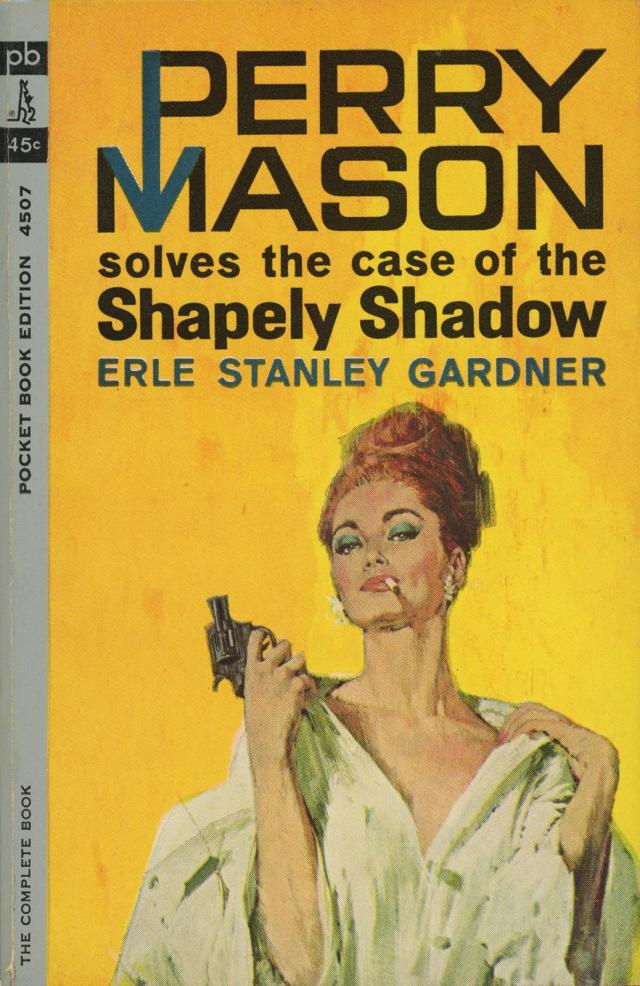
The case of the shapely.., p.16
The Case of the Shapely Shadow,
p.16


“There’s no need to delay matters while counsel takes up more time reading the number of that bill into the record,” Hamilton Burger said.
“There’s only one twenty-dollar bill introduced in evidence and we don’t need all this red tape and rigmarole which will simply result in further delay.”
“The Court is inclined to agree with the prosecution,” judge Seymour said. “What about the twenty-dollar bill, Mr. Mason?”
“I want to examine Mrs. Carlotta Theilman and ask her if, after my secretary and I were driven to the airport by the police, after she got the taxi driver to take her to the casino, she didn’t pay off the taxi driver with a twenty-dollar bill.”
“What if she did?” Hamilton Burger said. “That doesn’t mean anything.”
“It means a great deal,” Mason said. “It means that this twenty-dollar bill is now established to have been one of the twenty-dollar bills that was in the suitcase at the time it was placed in the locker FO82 at the Union Depot.
“If the defendant had that twenty-dollar bill in her possession, the prosecution is going to claim that it means she was doing the blackmailing, that she was the one who fabricated the letters, that she was the one who secured delivery of that suitcase; that when Mr. Theilman found out about what had happened, she had no alternative except to murder him. “That twenty-dollar bill therefore becomes a very damning bit of evidence in the case. It is a most important piece of evidence.
“Now, if I can show in any way that the witness Dudley Roberts, the taxi driver, secured or could have secured that twenty-dollar bill from Mrs. Carlotta Theilman, then the entire case of the prosecution is greatly weakened; in fact, it may collapse.”
Judge Seymour frowned thoughtfully, visibly impressed by the argument.
“Oh, Your Honor,” Hamilton Burger said, “this is the same old story, the same old grandstand. Now, if the Court please, even if there is anything to counsel’s wild theory that Mrs. Carlotta Theilman did give the taxi driver a twenty-dollar bill, it still doesn’t mean anything. Mrs. Carlotta Theilman had no access to that suitcase. She had no opportunity to get one of those twenty-dollar bills. She hadn’t even seen the decedent. She hadn’t been in touch with him. She had only been in touch with the decedent’s secretary, the defendant in this case.
“If, however, she did pay him with a twenty-dollar bill and counsel wishes to establish that fact, it is part of an affirmative showing which counsel should make on defense and as a part of his case. We have no objection whatever to his calling Mrs. Carlotta Theilman as his own witness. He can call her right now if he wants to, as his first witness.”
Judge Seymour said, “I think that is correct, Mr. Mason. I think that’s probably the best way of looking at it.”
“May I be heard in response to that statement, Your Honor?” Mason asked.
“Certainly.”
Mason said, “The district attorney well realizes that there are certain aspects of this case which give the defendant certain technical advantages and of which he would like to deprive the defendant. If it should appear as a part of the prosecution’s case that the cab-driver was paid with a twenty-dollar bill by Mrs. Carlotta Theilman, then it no longer is conclusive proof that the defendant had in her possession any of those twenty-dollar bills which were in that suitcase. And since the case of the prosecution is founded so greatly upon circumstantial evidence, I would then have an opportunity to move the Court to advise the jury to bring in a verdict of acquittal.
“The Court is fully familiar with the rule of law that if the circumstantial evidence can be explained by any other reasonable hypothesis than that of guilt, the courts are obligated to accept such interpretation.”
Judge Seymour thought for a moment, suddenly said, “Very well. This court is a temple of justice. It is not bound by strict red tape or arbitrary rules of procedure. Those rules of procedure, on the other hand, are designed primarily and solely to bring about the administration of justice. I am going to permit the defense to recall Mrs. Carlotta Theilman. You will take the stand, Mrs. Theilman.”
Judge Seymour turned to Perry Mason and said, “And, Mr. Mason, I think I will limit your questions to the one point which you have brought up.”
“Very well, Your Honor,” Mason said.
Hamilton Burger in exasperation looked at the courtroom clock.
A deputy located Mrs. Carlotta Theilman and she returned to the stand.
“You have already been sworn and are still under oath,” Judge Seymour said. “Now, Mr. Mason, you may ask that question.”
Mason said, “Mrs. Theilman, you will recall the evening of the fourth in the city of Las Vegas when we were having a conference in a motel. That conference was interrupted by the police who escorted Della Street and me to the airport, leaving you there in the motel. Now, I believe that it is in evidence that you took a taxi-cab to the Double Take Casino after we had departed.”
“That is right,” she said. “I took the cab that was waiting there.”
“When you arrived at the casino, do you remember how you paid the cabdriver; that is, what money you gave him?”
“Why, yes,” she said. “I remember I gave him a fifty-cent tip and the bill was, I think—”
“What I am trying to get at,” Mason interrupted, “is how you paid him. Did you have the exact amount of cash with you or did you pay him with a larger bill?”
“No,” she said, “I paid him with a five-dollar bill. I remember I had—Now, wait a minute. I didn’t either. I got the five-dollar bills from the taxi driver. I remember I had three five-dollar bills when I entered the Casino. I was playing the twenty-five-cent machine and I turned in two of the five-dollar bills for quarters. I … I received three five-dollar bills and some silver from the cabdriver in change.”
“Then,” Mason said, “you must have given him a twenty-dollar bill.”
“That’s right. I remember now that I did. I had a twenty-dollar bill and gave it to him.”
“Did you only have one twenty-dollar bill in your purse?” Mason asked.
“No, I had several. I think I had, oh, perhaps ten or twelve twenty-dollar bills. I gave him a twenty-dollar bill.”
Mason bowed to the Court. “Thank you, Your Honor,” he said. “That is all.”
Hamilton Burger and his deputy engaged in a whispered conference.
“Do you have any questions on redirect, Mr. Prosecutor?” Judge Seymour asked.
Hamilton Burger, plainly exasperated, got to his feet. “Where did you get this twenty-dollar bill that you gave the taxi driver, Mrs. Theilman?”
“Why, I had it in my purse.”
“And where did you get it when you put it in your purse?”
“I got it from my bank in Los Angeles.”
“Exactly,” Hamilton Burger said, “you couldn’t by any conceivable possibility have received that twenty-dollar bill from your former husband, could you?”
Mason was on his feet before she could answer the question. “Just a moment, Your Honor,” he said. “That question is argumentative; it calls for a conclusion of the witness; it is leading and suggestive. If the prosecution is going to present its case on circumstantial evidence, the circumstances have to speak for themselves. This witness cannot testify to a conclusion.”
“But this is redirect, Your Honor,” Hamilton Burger said.
“That doesn’t make any difference,” Judge Seymour said. “You can direct the attention of the witness to a certain specific subject on redirect examination but you can’t lead the witness and you certainly can’t put the words in her mouth. The objection is sustained.”
Hamilton Burger made no attempt to conceal his anger. “When had you last seen your ex-husband prior to the time you came to Las Vegas on the fourth, Mrs. Theilman?”
“It had been over two years.”
“When had you last seen his secretary?”
“It had been about the same length of time.”
Hamilton Burger said angrily, “All right, I’ll let the facts speak for themselves,” and sat down.
“Now just a moment, Mrs. Theilman,” Mason said, “I have another question on recross-examination.”
“Now, if the Court please,” Hamilton Burger objected, “this is just what I warned the Court was going to happen. Perry Mason recalled this witness, assuring the Court he only wanted to ask one more question on cross-examination about that twenty-dollar bill. Now he’s trying to prolong this and drag it out with arguments and further questions and general fishing expeditions until the hour for the noon adjournment.”
“I think the prosecution is right, Mr. Mason,” Judge Seymour said.
“This witness was recalled only for the purpose of one question.”
“That is quite correct, Your Honor, and that is all I wanted to ask. But the prosecution has taken over and has brought in a lot of new matter. Now I want to ask a question relating to the questions which were brought up on redirect examination by the district attorney.”
“You certainly have that right,” Judge Seymour said. “If your questions relate only to that phase of the interrogation, you can ask them.”
Mason approached the witness. “You say that you hadn’t seen your former husband for a period of about two years?”
“Objected to as already asked and answered,” Hamilton Burger said.
“If he keeps this up we’ll be here all day.”
Judge Seymour frowned at the district attorney and said, “The witness could have answered that question in half the time it has taken for your objection. I take it this question is preliminary only, Mr. Mason?”
“Yes, Your Honor.”
“Objection overruled. Answer the question,” Judge Seymour snapped.
“That is right,” the witness said.
“Now then,” Mason said, “have you, or did you, within a period of twenty-four hours before the time of your arrival in Las Vegas have any dealings of any sort with A. B. Vidal?”
“Objected to as not proper cross-examination,” Hamilton Burger shouted.
“Overruled,” Judge Seymour said.
The witness hesitated for a moment, then said, “Since I am under oath I will have to state that I had a telephone conversation with a man who said his name was A. B. Vidal.”
“When did you have this conversation?”
“At eight-thirty p.m. on the evening of the third. That was Tuesday.”
“What did this man want?”
“The same thing the others wanted. He wanted to negotiate with me for my stock.”
“He said his name was Vidal?”
“That’s right. A. B. Vidal.”
“Did he say where he was?”
“It was a long-distance call from Bakersfield.”
“Did you recognize the voice?”
“Not the voice of A. B. Vidal, but I could hear over the phone someone giving instructions in a low voice and I am satisfied that voice was the voice of my husband. It was an exceptionally good connection and, as it happens, I have keen ears.”
“What was the conversation?” Mason asked.
“I told the person with whom I was talking that if his principal wished to talk with me, I would meet him in Las Vegas, Nevada; that I would take the Union Pacific Domeliner, The City of Los Angeles, on the evening of Wednesday, the fourth. I told this person that I would negotiate, not with any agent, but only with the principal. I said that I knew who the principal was and that if they wanted me to be there and negotiate, they could send me a hundred dollars to cover expenses in the form of cash, and if that money was forthcoming I would meet with the principal in Las Vegas.”
“Then what?” Mason asked.
“With that,” she said, “I hung up the telephone without waiting for any further comment.”
“Did you get the money?”
“I did. The next afternoon the money was brought to my house. It was in an envelope marked ‘Expenses to Las Vegas.’ It contained five twenty-dollar bills.”
“Thank you,” Mason said. “That’s all.”
Hamilton Burger was on his feet, confronting the witness. “You put this money in your purse?”
“Yes.”
“And took it to Las Vegas with you?”
“Some of it. I bought a ticket with some of the money.”
“You never told me this dummy gave the name of Vidal,” Hamilton Burger accused.
“You never asked me,” the witness said. “I told you a lot of people were trying to get my stock and that I had reason to believe some of them were acting as dummies for my husband. I didn’t go into details because you didn’t ask me.”
Mason smiled at the jury.
Hamilton Burger and Ruskin had a quick, whispered conference.
Then abruptly Burger said, “That’s all.”
“That’s all,” Mason said. “I have no further questions.”
Judge Seymour looked at the clock. “Well, gentlemen, we only have fifteen minutes before noon. Does the defense wish to start with its case?”
“We’re quite ready,” Mason said.
“Well, now just a minute,” Hamilton Burger said, and again had a whispered conference with Ruskin. Then he said, “Very well, go ahead.
We’ll put on the rest of our evidence by way of rebuttal.”
“Very well,” Judge Seymour said. “Proceed, Mr. Mason.”
Mason smiled at the judge and said, “We have no evidence on the part of the defense, Your Honor. The defense rests. Let’s proceed with the argument.”
“What!” Hamilton Burger shouted.
“The defense rests,” Mason said. “Let us proceed with the argument.”
“Very well, Mr. District Attorney, you may open the argument,” Judge Seymour said.
“We don’t want to argue it at this time, Your Honor,” Hamilton Burger said. “This move by the defense has taken us completely by surprise.” He looked at the clock. “It lacks only a few minutes of the noon hour of adjournment and … I would suggest that we adjourn until two o’clock. We may wish to move to reopen the case.”
Mason said, “This is the same district attorney who was so concerned about the delay, about stalling the case along and wanting to save the taxpayers’ money. I’m quite ready to go ahead right now. Why not start the arguments?”
Judge Seymour smiled, said, “Well, I think in view of the manner in which this case has been expedited a difference of ten minutes isn’t going to affect the schedule of court or the tax rate in this county. Court will take a recess until two o’clock. The defendant is remanded to custody, the jurors are warned to remember the admonition of the Court not to discuss the matter among yourselves, permit it to be discussed in your presence, or to form or express any opinion. Court will recess until two o’clock.”
Hamilton Burger glared angrily at Mason, got up and pushed his way through the crowd out of the courtroom.
Ruskin paused for a moment, looked at Mason with a half-smile, and left.
“What happened?” Janice Wainwright asked.
“I’m gambling,” Mason said. “I’m gambling with your life and with your liberty, but it’s the only thing to do. I didn’t have time to confer with you and I didn’t want to confer with you. If I had engaged in a whispered conversation as though we had any doubt about the matter, it would have been fatal. The jurors would have seen that conference and would have felt that I had some doubt. The only thing for me to do was to act as though I had every assurance in the world that this jury was going to acquit you, and leave the matter in their hands.”
“I think you did just right,” she said. “That means that I don’t have to get on the stand, doesn’t it?”
“It means you don’t have to get on the stand,” Mason said.
“Thank heavens for that.”
Mason smiled and said, “Chin up, Janice.”
The officer who came forward to take Janice into custody had a reassuring smile. Mason, Della Street and Paul Drake moved over to one corner of the courtroom, waiting until the spectators had left.
“That was a daring gamble,” Paul Drake said.
“Every once in a while an attorney has to make them,” Mason said.
“You have to rely on your own judgment.”
“Those tire tracks still crucify you,” Drake said.
Mason merely grinned, said, “Hamilton Burger’s bombshell turned out to be something of a dud, Paul.”
“The man’s going to have a stroke if you keep on deviling him,” Della Street said.
“You haven’t seen anything yet,” Mason told them. “Wait until court reconvenes. I have a plan. If it works, Burger will be chewing nails.”
Chapter Fifteen
When court reconvened at two o’clock, Hamilton Burger said, “If the Court please, at this time the prosecution would like to reopen its case.”
Judge Seymour shook his head. “I think not, Mr. Prosecutor,” he said. “The prosecution had that opportunity and elected not to take it. You stated that you would reserve the evidence which you had for rebuttal. Now that the defense has rested there can be no rebuttal. The Court sees no reason for permitting a prosecutor to gamble on what is going to take place and then, in the event he loses, to reshuffle the cards so there will be a new deal. The evidence in the case is closed. Are you ready to proceed with the argument?”
“Under those circumstances,” Hamilton Burger said, “we ask that the Court recess until tomorrow morning in order to give us an opportunity to prepare for argument and we can then put in a full day in argument to the jurors.”
Judge Seymour glanced at Perry Mason. “Does the defense have any objection?”
“The defense wants to proceed,” Mason said. “The district attorney is an officer of the people and paid by the taxpayers. He has expressed himself as being very much concerned at the cost to the taxpayers of undue delay in these matters so we’re quite willing to give the taxpayers a break by proceeding right now.”















