

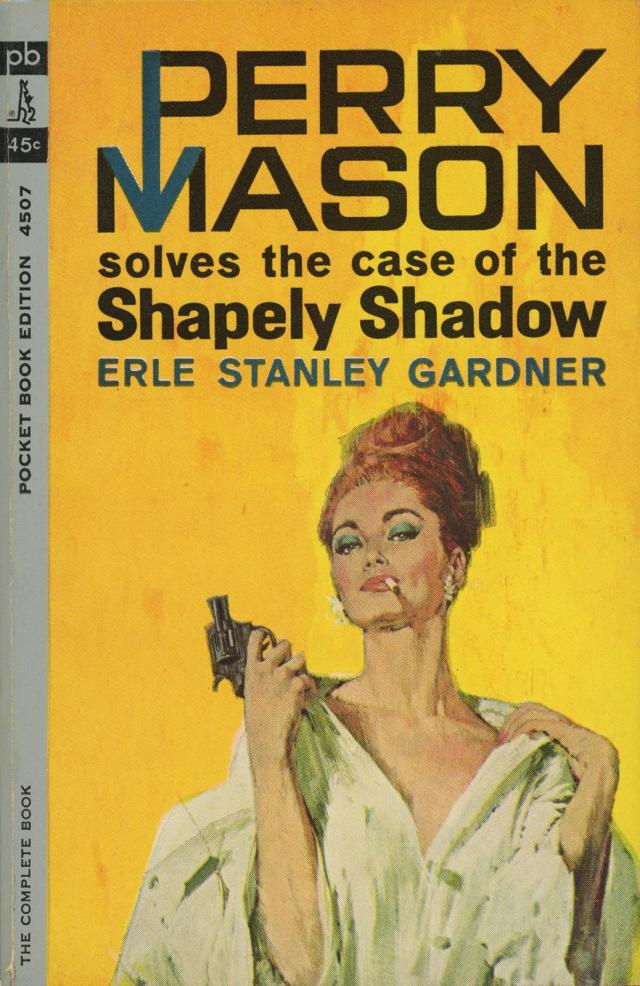
The case of the shapely.., p.15
The Case of the Shapely Shadow,
p.15


“Well, did she give you a twenty-dollar bill and you gave her change?” Ruskin asked.
“I don’t think so.”
“Are you positive?”
“Yes, I’m positive she didn’t.”
“That’s all,” Ruskin said.
“Will you swear she didn’t?” Mason asked, smiling.
“All right,” the witness shouted, “I’ll swear she didn’t.”
“A few moments before you said you wouldn’t swear she didn’t,” Mason said. “Now what has changed your mind? Is it the fact that the prosecutor quite obviously wants you to so swear?”
“I object to that,” Ruskin shouted. “That is not proper cross-examination and it isn’t a question of what I want him to swear to.”
“It goes to his bias,” Judge Seymour said. “I think the situation here is obvious, however. Answer the question, Mr. Roberts. The objection is overruled.”
“I’m willing to swear that she didn’t because I know she didn’t. I’m positive of it now. The more I think of it, the more positive I become,” Roberts said.
Ruskin grinned at Mason.
“You’d been thinking of it ever since the fourth of the month, hadn’t you?” Mason asked.
“Off and on.”
“And you weren’t willing to swear that she didn’t give you a twenty-dollar bill a few minutes ago.”
“Well, I’m swearing to it now,” the witness said.
“Because I’ve made you angry?” Mason asked.
“I’m swearing to it.”
“That’s all,” Mason said.
“No further questions,” Ruskin observed.
“Call Louise Pickens,” Ruskin said.
Louise Pickens was a very attractive, curvaceous young woman bubbling good nature and friendliness. The minute she walked forward and held up her hand, took the oath, seated herself and smiled at the jurors, the jurors relaxed their positions and started smiling.
“What’s your occupation?” Ruskin asked.
“I’m a policewoman.”
“Now, I am going to ask you if you are familiar with the words of the message which was testified to as having been on the paper found by Mrs. Theilman in her husband’s pocket.”
“Yes.”
“And did you make any experiments in duplicating that message?”
“I did.”
“What were those experiments?”
“I purchased a Los Angeles Times and a Los Angeles Examiner under date of Tuesday, the third, and found that it was possible to reconstruct that message from words in the headlines of the two papers.”
“And you did so construct such a message?”
“I did.”
“Do you have it with you?”
“I do.”
“May we see it, please?”
“Now, just a moment,” Mason said, “I object to this on the ground that it is incompetent, irrelevant and immaterial. The fact that the message could have been so constructed is certainly not binding on this defendant.”
“I propose to connect it up,” Ruskin said.
“I think I’ll permit it, Mr. Mason,” Judge Seymour said, “particularly on the strength of counsel’s assurance that it will be connected up. I think it’s within the province of the prosecution’s case to prove how the message could have been constructed. Of course, the jurors will understand that that doesn’t necessarily mean the message was constructed in that way. The objection is overruled.”
Louise Pickens produced the message.
“I move this be received in evidence as People’s Exhibit, appropriate number.”
“I think it is M-i,” the clerk said.
“Very well, it will be received as People’s Exhibit M-i.”
“Subject to the defendant’s objection, if the Court please,” Mason said.
“Subject to the defendant’s objection, which is overruled. It will go in evidence,” Judge Seymour ruled.
“You may inquire,” Ruskin said.
“No questions,” Mason said.
Ruskin looked at the clock, then leaned forward, whispered to Hamilton Burger, the district attorney, for a moment, then said to the Court, “May we have the indulgence of the Court for a moment, please?”
Judge Seymour nodded.
Ruskin and Hamilton Burger engaged in a lengthy whispered conference, from time to time looking at the clock.
At length Burger arose. “If the Court please,” he said, “we have about finished with our case but there is a certain matter of policy which we would like to discuss. Would it be possible for us to ask the Court to adjourn until two o’clock?”
Judge Seymour shook his head. “It is not yet eleven, gentlemen,” he said. “We have a backlog of cases. The courts are all starting half an hour earlier in order to try and get caught up and I don’t feel that I can delay this case. I suggest that you put on some other witness and then you can discuss your strategy during the noon hour.”
Again Burger and Ruskin engaged in a hurried whispered conference.
Then Burger said, “Call Wilbur Kenney.”
As Wilbur Kenney came forward and held up his right hand to be sworn, Janice Wainwright whispered to Perry Mason, “Why, he’s the man who has the newsstand at the corner by the office.”
“What’s your occupation?” Burger asked.
“I’m a newsdealer, if you want to put it that way. I peddle papers and a few magazines. I have a corner newsstand.”
“Are you acquainted with the defendant?”
“Oh, yes. I’ve known her for years.”
“Referring to the morning of the third, that would be Tuesday, did you see the defendant?”
“I did.”
“What did she do, if anything?”
“She bought a copy of the Times and the Examiner.”
“And then what?”
“Then she went into the dime store across the street.”
“Then what?”
“Then she went up to her office building and entered the office building.”
“Did you see her again that morning?”
“Yes.”
“When?”
“About half an hour later.”
“What did she do?”
“Came down and bought another copy of the Times and another copy of the Examiner.”
There was a startled gasp from spectators in the courtroom as the significance of the testimony began to sink in.
“Now, this was on Tuesday, the third, at about what time?”
“Right around eight-forty-five in the morning. She came to work at eight-thirty and spoke to me as she passed. Then she came down and bought these papers, went across to the dime store, then went up in the office building and came down in about half an hour and bought two more papers.”
“Did she make any statement to you in connection with the second purchase?”
“She said there was some stuff in the papers she’d been cutting out.”
“Thank you,” Hamilton Burger said, and turned triumphantly to Perry Mason. “You may inquire.”
“No questions,” Mason said.
“Call Lucille Rankin,” Hamilton Burger said.
Lucille Rankin came forward and was sworn.
“Have you ever seen the defendant in this case before?” Hamilton Burger asked.
“Yes.”
“Where?”
“At the five-ten-fifteen-twenty-five-cent and dollar store where I work.”
“When did you see her?”
“On Tuesday, the third.”
“At what time?”
“At approximately eight-forty-five.”
“Did you have any business transactions with her?”
“Yes.”
“What were they?”
“I sold her a pair of scissors.”
“Was there any conversation?”
“Yes, she said she wanted a pair of small scissors that would cut pieces out of a newspaper.”
“Did you observe anything under her arm at the time she made this statement?”
“Yes. She had two newspapers folded under her left arm.”
“Cross-examine,” Hamilton Burger said.
“No questions,” Mason observed affably.
Hamilton Burger said triumphantly, “That concludes the prosecution’s case.”
Mason arose, looked at the clock. “If the Court please, it is rather unusual for a murder case to be handled in such an expeditious manner. The defense is taken somewhat by surprise. I would like to ask for an adjournment until two o’clock this afternoon so that I may confer with my client.”
Judge Seymour shook his head. “We’re trying to get the calendar caught up, Mr. Mason. I admit that it’s unusual for a case of this magnitude to be handled in this expeditious manner, but we still have a good hour. I will state, however, that it is time for us to take our usual morning recess and in place of the usual ten-minute recess I will make it a twenty-minute recess, and that will give you time to confer with your client.”
Judge Seymour turned to the jury. “The Court will take a recess for twenty minutes during which time you will again remember the admonition of the Court not to discuss the case, or permit it to be discussed in your presence, or to form or express any opinion.”
Judge Seymour arose and left the bench.
As the courtroom cleared of spectators, Mason turned to Janice Wainwright. “Well, Janice?” he asked in a whisper.
“Mr. Mason,” she said, “they’re making that look something terrible, but actually it was just an innocent errand that I ran for Mr. Theilman.”
“Go on,” Mason said, “keep talking.”
“Mr. Theilman asked me to run down and get him the morning papers, both of them, and said there was some stuff he wanted to cut out about a real estate development and asked me to get him some scissors. I had to go out and buy some because I’d broken the office pair a few days before.”
“Then what?” Mason asked.
“After I returned to the office, he asked me to go down and get two more papers.”
“What became of those papers?” Mason asked.
“I don’t know. He never put them in the wastebasket, I’m certain of that. But usually he didn’t throw papers in the wastebasket. He would keep old newspapers in the closet. He had a pile of them, and then the janitor would remove them after the pile got so big. We’d save them for wrapping and things of that sort, and sometimes Mr. Theilman would want to refer to a back issue of the paper in order to check some of the real estate ads. But after he’d cut things out of papers usually he put those papers in the wastebasket, only this time he didn’t.”
Mason said, “Janice, I’m going to have to put you on the stand. You must realize that the circumstantial evidence is very black against you. Now, you have an explanation of sorts for everything—’Theilman said this, Theilman told me to do that, Theilman told me to do the other, I was following Mr. Theilman’s instructions.’
“Now Mr. Theilman is dead. You can understand what the prosecution is going to do to you once you get on the witness stand. They’re going to insist that you have fabricated a story in which you have deliberately made all the explanations dependent upon what Theilman told you, and that the reason you have done that is because Theilman is dead and can’t contradict you.
“Under those circumstances everything depends on the impression you make on the jurors. You can’t afford to lose your temper, you can’t afford to get hysterical, you can’t afford to start crying. You’ve got to stand up there and take it on the chin.
“You understand that?”
“Yes.”
“Can you do it?”
“Mr. Mason, I … I’m afraid I can’t.”
“I’m afraid you can’t, either,” Mason said grimly. “All right, Janice. You have about fifteen minutes left to start thinking things over. Become composed. Get your story together. I’ve carried the ball up to this point. After court reconvenes you’ll have to carry the ball. Now you sit there and think things over.”
Mason walked away from her and over to where Paul Drake and Della Street were standing.
“Not so good, Perry,” Paul Drake said. “That last was a real bombshell.”
Mason said, “She says she was getting the papers for Mr. Theilman.”
“And very conveniently Mr. Theilman isn’t in a position to contradict her,” Paul Drake said dryly. “I think your client is a liar.”
Mason said, “If there’s one thing I’ve learned from practicing law, Paul, it’s that an attorney must be reasonably skeptical of the things his client tells him until he gets into court, and then he must accept every word his client says at face value. He must stand up in front of the jury and show that he believes what his client is saying.”
“I know,” Drake said sympathetically, “but that was quite a bombshell, Perry. That—”
“Well, let’s analyze it,” Perry said. “What does it mean?”
“It means,” Drake said, “that your client went downstairs, got some newspapers, came back and pasted a blackmail message on a sheet of paper. Then she decided she’d make a good job of it so she went down and got another set of newspapers and pasted a blackmail message which was sent to Theilman at his residence.”
“All right, why would she do that?” Mason asked.
“She wanted to be sure he got it.”
“Theilman was in his office. All she had to do was to put that message in with the mail and he was sure to get it, and what’s more she’d know that he had it.”
“Well, perhaps she wanted his wife to know about it,” Drake said.
“On the other hand,” Mason said, “suppose Theilman planned on disappearing and wanted to get as much ready cash as he could. He wanted to leave a blackmail message behind and wanted to be sure that people knew about it. He hoped that Janice Wainwright would look in the wastebasket and find the message there but he didn’t know whether she would be too ethical to dig out the pieces and read it, so he put another message in the inside pocket of his suit and then went home and changed his suit, knowing his wife’s habit of looking through the pockets.”
Drake said, “You’re client is a pretty good-looking babe, Perry. If she backs up that story with enough nylon, and you can make it sound convincing to the jury, you may get a hung jury out of it.”
Mason suddenly stiffened to attention.
Della Street, knowing his every mood, watching him, said, “What is it, Perry?”
Perry snapped his fingers. “Simple,” he said, “and I almost overlooked it.”
“What?”
“If the message was cut from those papers,” Mason said, “then it was either prepared by Theilman or by Janice Wainwright. In either event the message couldn’t have come through the mail, and if that is the case the letter from A. B. Vidal—that is, the addressed envelope—has to be a dummy.”
“But,” Della Street said, “Janice said that that envelope was in the mail … It had to be in that envelope.”
“But it couldn’t have been,” Mason said.
“I’m afraid,” Drake told him, “that that’s one of the things the prosecution is going to pick on. You can see what they’re doing, Perry. Hamilton Burger is here to have the honor of cross-examining your client, of ripping her story to pieces. Once she gets on that witness stand, Hamilton Burger is going to be the hero of the piece and he wouldn’t be in here in that capacity unless he had some card up his sleeve.”
Mason walked across the courtroom, stood looking out of the window regarding the traffic on the street far below with unseeing eyes.
The courtroom again filled with spectators. The bailiff entered. A buzzer summoned the jurors.
Throughout the courtroom was the air of tense expectation which comes before a crucial battle.
“Everybody stand up,” the bailiff said.
Judge Seymour came in from his chambers, walked over to the bench and seated himself. The bailiff’ tapped the gavel. Everyone sat down.
“The jurors are all present, the defendant is in court,” Judge Seymour said. “You may proceed with your case, Mr. Mason.”
“If the Court please,” Mason said, “a matter of some considerable importance has occurred to me during the recess. I would like to recall one of the prosecution’s witnesses for further cross-examination.”
“What witness?” Judge Seymour asked.
“Mrs. Carlotta Theilman.”
Judge Seymour glanced down at the prosecution table.
Hamilton Burger arose. “If the Court please,” he said with quiet dignity, “I believe this is the first time Your Honor has presided in a case where Mr. Mason was representing a defendant. I have been in dozens of those cases. This is all a part of a virtually stereotyped procedure. Counsel always waits until it suits his convenience and then asks to recall a witness for cross-examination, thereby giving undue emphasis to the questions that he asks and thereby frequently securing a much-needed delay.
“In the present case it is quite obvious that defense counsel wants the benefit of a delay in determining whether to put the defendant on the stand or not. I can sympathize with him in his problem, but we have our work to do, the Court has its work to do and the taxpayers are entitled to some consideration. I submit that the purpose of this request for cross-examination is simply to obtain further delay and attempt to stall the case until the hour of the noon adjournment so that counsel can delay his decision whether he wants to put the defendant on the stand or not.”
Judge Seymour said, “I feel that it is incumbent upon defense counsel to cross-examine the prosecution’s witnesses at one time and not piece-meal. Of course, the Court has it in its discretion to permit a witness to be recalled for further cross-examination even after the prosecution has rested, but the procedure would be irregular and I would be inclined to allow it only in most exceptional circumstances. And since those circumstances do not appear at the present time, I see no reason for granting the motion.”
“May I be heard, Your Honor?” Mason asked.
“Yes, certainly, Mr. Mason. I never wish to preclude argument on the part of counsel.”
“If the Court please,” Mason said, his voice vibrant with sincerity, “this is a case which depends upon circumstantial evidence. One of the items of circumstantial evidence which the prosecution will rely upon in presenting the case to the jury is the identity of this twenty-dollar bill, number … let me see that exhibit, please, Mr. Clerk.”















