

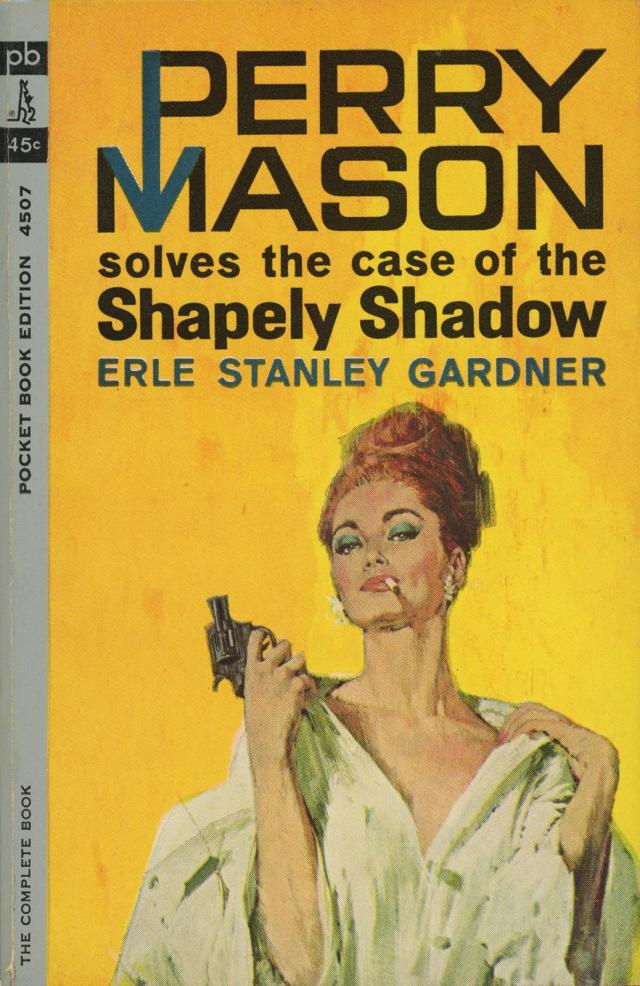
The case of the shapely.., p.4
The Case of the Shapely Shadow,
p.4


“Once more you have used that expression, ‘all you can tell me.’ “
“It seems to cover the situation,” Mason said.
“What do you know about Morley L. Theilman?”
“I never met the man in my life.”
Orland said, “His wife thinks he was being blackmailed. She thinks he had given this blackmailer quite a sum of money, that the blackmailer was using the name A. B. Vidal and that Vidal was using the mails. Apparently you thought so too.”
“Where’s Theilman now?” Mason asked.
“That,” Orland said, “is something we’re trying to establish. He doesn’t seem to be in his usual haunts, and when a man disappears at a time when he’s being blackmailed, we always like to get as much information as we can.”
“Do you folks have anything on this A. B. Vidal?” Mason asked. “Does he have a record? Do you know anything about him?”
Orland grinned and said, “I’m sure I can’t tell you, Mr. Mason.”
Mason smiled. “I can appreciate your position,” he said. “Is there anything else?”
“I’d like to know the things you say you can’t tell me,” Orland said.
“And,” Mason told him, “I would like to know the things you say you can’t tell me.”
Orland turned to Paul Drake. “Mason has done most of the talking here,” he said. “Now I’d like to hear from you. Remember, you have a license. You’re bound by business ethics and you can’t hold out information dealing with the commission of a crime. Now then, Mr. Drake, without any interruptions, please, tell us exactly what you know.”
Drake said easily, “What Perry has told you has taken a big load off my mind. Perry wanted me to pick up the trail of an A. B. Vidal at the post office when Vidal called for a letter. I naturally wanted to make it as painless as possible and so I got in touch with one of my friends who is a postal inspector, told him I had reason to believe Vidal might be using the mails in connection with the commission of a crime, and arranged to be notified when a letter came in for Vidal. I fixed things so I could put a stake-out on the job, and when Vidal picked up the letter I could have my men get a line on him.”
“And the locker at the Union Depot?” Orland asked.
“Mason said he wanted to find out something about the lockers at the Union Depot. He asked me if I could help him and I told him I thought I could, that I’d helped out a fellow down there who—”
“What’s his name?” Orland interrupted.
“Smith.”
“Smitty, eh?” Orland said. “Sure. I know him. What happened?”
Drake said, “I phoned Smitty and asked him to meet me. We got down there and Mr. Mason—”
“Now, just a minute. Who do you mean by ‘we’?”
“Perry Mason, his secretary, Della Street, and me.”
“You all went down there?”
“That’s right. We returned only a few minutes ago.”
“And what happened?”
“Smitty met us down there. Mason told him he wanted to take a look in locker FO82, and Smitty told him he’d inspect the locker but Mason couldn’t touch anything that was in it. Smitty opened the locker. There was nothing in it.”
“You’re still keeping men at the post office?” Orland asked.
“I am not. I withdrew the men and told the postal inspectors not to bother with Vidal as far as I was concerned.”
“You did that on your own, or in accordance with instructions from Perry Mason?”
Drake looked helplessly at Perry Mason.
“He was acting on my instructions,” Mason said.
“Okay,” Orland said, “that’s all I need to know—provided that’s all you know, Drake.”
“That,” Drake said, “is all I know.”
Orland turned to Mason.
“And that,” Mason said, “is all I can tell you.”
Orland left the office.
Mason turned to Drake. “All right, Paul,” he said, “you’re in the clear. You’ve told him everything you know.”
“Thanks a lot,” Drake said. “The fact that you came in here like that and did the job you did helped me out a lot.”
“All right,” Mason told him. “You’ve told him all you knew at the time. Now then, you’re going to learn some more. It’s all right for you to tell the police what you know when they ask you questions. You don’t have to run down the hall to tell them something you find out after the police have left.”
“Now, wait a minute, Perry,” Drake remonstrated, “I don’t want to know anything that—”
“Do you want a job or not?”
“I’m running an agency. I need all the jobs I can get.”
“All right,” Mason said, “you’ve got a job.”
“What is it?”
“Morley Theilman,” Mason said. “I want to know about him.”
“What about him?”
“I’d like to find where he is at the present time. Last night he was in Bakersfield. He was with Cole B. Troy, a business associate. He left Troy about nine o’clock. He never reached home. His wife called the police.
“Now I want to find Theilman. Put some men on the job and see what you can find out.”
“If the police are working on it, they’ll have run down all the leads,” Drake said.
“Exactly,” Mason told him, “but since the police aren’t confiding in us, I want to get all the information they have and more, if possible.”
“Okay,” Drake said. “I’ve got a good correspondent in Bakersfield. I can pick up the phone and get him on the job.”
“There’s the phone,” Mason said, “pick it up.”
As Drake reached for the phone, Mason left the office, pausing in Drake’s reception room to ask the switchboard operator to notify Della Street not to expect him back before noon.
Chapter Five
Perry Mason, consulting the address he had copied from the phone book, turned into Dillington Drive, a winding road which followed the contour of the hill and looked out over a lazy, haze-filled valley.
The lawyer drove slowly and stopped at number 631, a modern house of flat roof, glass sliding panels, and sloping lawn. His watch showed the time to be eleven-ten.
Mason climbed a gentle incline on broad cement steppingstones and pressed a button.
Chimes sounded in the interior of the house. A few moments later a door opened and a strikingly beautiful woman in her late twenties stood looking up at the lawyer with clear blue eyes.
“Mrs. Theilman?” Mason asked.
“Yes,” she said guardedly.
“I’m Perry Mason, an attorney,” the lawyer said. “I would like to talk with you—about your husband.”
“Come in,” she invited.
Mason entered a room which was mellow with subdued sunlight filtering through pearl-gray drapes. There was wall-to-wall oyster-shell-colored carpeting on the floor. The chairs were deep and comfortable.
The whole room, while tastefully decorated, gave the impression that it had been designed for living, rather than to conform to any particular style of interior decoration.
“Won’t you be seated, Mr. Mason?”
Mason thanked her, seated himself, and said, “Mrs. Theilman, I’m sorry that I can’t put all of my cards on the table at this time. I understand, however, that you are anxious to get information concerning your husband, and I am just as anxious as you are.
“I am representing an undisclosed client. I am satisfied that I am not representing any interests that are adverse to you. Otherwise I would not be here. As far as I know, there is no reason why you can’t talk frankly with me and, to the best of my knowledge at the present time, I think it would be to your interest to do so.”
“Did my husband consult you?” she asked.
Mason said, “Frankly, he did not, Mrs. Theilman, although I have the feeling that my interest in the matter may be connected with what is best for him.
“Now I’m going to tell you very frankly the reason I am here. You have reported to the police that your husband has disappeared. You have apparently reported to the police that you felt your husband was being blackmailed by an individual named A. B. Vidal. The police have questioned me because of an interest I had shown in Mr. Vidal sometime earlier. I gave the police all the information I was able to give them.”
“You’re not representing Mr. Vidal, are you?”
“No, I’ve never seen Vidal in my life as far as I know, and from all the information I have at the present time I consider his interests are adverse to those of your husband.”
“I think,” she said cautiously, “I’d want to know a little more about your connection with the case and just what your interest is, Mr. Mason.”
Mason said, “I can tell you this much. I had reason to believe A. B. Vidal might be trying to blackmail your husband. My secretary put the key to locker FO82 at the Union Depot in an envelope and mailed it to A. B. Vidal, General Delivery. That was shortly before noon yesterday.
“I hired a private detective agency to keep watch on the post office and when A. B. Vidal called for the envelope with the key in it I wanted him shadowed. I wanted to find out who he was; I wanted to get the license number of the car he was driving; I wanted to get his general appearance and find out where he went.”
Her face showed sudden interest. “Were you able to do this?”
“I was not,” Mason said, “for the simple reason that Vidal was too smart to be caught in that kind of a trap. The whole business of mailing the key to him at General Delivery was simply a decoy. He had evidently prepared a duplicate key to the locker and so was able to remove what was in the locker without calling for the envelope. He then deposited a quarter in the slot, removed the duplicate key and left the locker locked and empty.”
“You’ve told that to the police?”
“Yes.”
“If your secretary mailed the key to Mr. Vidal, then she must have been the one who opened the locker and put the package, or whatever it was, in the locker in the first place.”
“That doesn’t necessarily follow,” Mason said. “I wouldn’t want to deceive you and I wouldn’t want you to deceive yourself. All I can say is that my secretary did put the key in an envelope and mailed it to Vidal at General Delivery.”
“You aren’t my husband’s lawyer?”
“As far as I know,” Mason said, “I have never met your husband.”
“Then if you aren’t connected with Vidal and you aren’t connected with my husband, how did you get into the case?”
“I didn’t say that I wasn’t connected with your husband, Mrs. Theilman. Actually I am not retained by him directly, but I do feel that my client has your husband’s best interests at heart.”
“Can’t you explain more than that?”
Mason shook his head and said, “I’m sorry.”
Mrs. Theilman said, “The person using the name A. B. Vidal is, in my opinion, using that name as an alias.”
“You think he is a blackmailer?”
“I know it.”
“Can you tell me how you know it?”
Mrs. Theilman thought things over for a few moments.
“I can assure you,” Mason went on, “that if I had any interests which I felt were adverse to yours, or if my client did, I would not be here. If I wanted to get any information from you under those circumstances, I would have asked you to give me the name of an attorney who was representing you and with whom I could deal.
“At the present time I am here simply in the capacity of one who seeks information from a witness. I am trying only to get factual information.”
“All right,” she said, “I’ll give you factual information, Mr. Mason. I’ll give it to you in the same way that you have given the factual information to me. I will tell you what I have told the police. I will not put all my cards on the table until you are in a position to put all your cards on the table.”
“All right,” Mason said, “can you tell me what you told the police?”
“My husband came home from the office yesterday afternoon about two o’clock. He seemed very much concerned. He said that he had to go to Bakersfield. He wanted to change his clothes and asked me to get out another suit for him. I did, and he put on the fresh suit.
“As is my habit, I went through the pockets of the suit he had taken off, which I was going to send out to be cleaned and pressed. I wanted to make sure that he hadn’t forgotten anything.”
“This was after he’d put on the other suit?” Mason asked.
“Yes.”
“And he’d taken the things out of the pockets of the other suit himself?”
“Yes, he always does. I wasn’t transferring things from his pockets. I wasn’t even in the room while he was changing. I came in and picked up the discarded suit which he had tossed on a chair and simply went through the pockets to make sure he had left nothing. Quite frequently he leaves a knife or some keys or coins, or something of that sort. I guess all men do that. They have so many pockets and—well, when they’re in a hurry … “
“I understand,” Mason said, smiling. “I’ve been guilty quite a few times myself.”
“Well,” she said, “there was a letter in the inside breast pocket of the coat. When I took it out I couldn’t help but see what it was. It was a letter that had been composed of words cut from a newspaper, or newspapers, and pasted together so that it made a message.”
“Do you remember the message?” Mason asked.
“I can recite it verbatim,” she said. “It was, get money. instructions on telephone. failure will be fatal.”
“You didn’t make any copy?”
“No. I simply remembered it.”
“Go on,” Mason said.
“There was an envelope in the pocket,” she said. “It evidently was the envelope the letter had come in. It was just an ordinary stamped envelope with my husband’s name and address typewritten on it, and up in the upper left-hand corner the return address was A. B. Vidal, General Delivery.”
“So what did you do?” Mason asked.
She said, “My husband was in the bathroom, shaving with an electric razor. He had left his coat, that is, the coat of the fresh suit that he was going to wear, on a hanger. I took the letter and the envelope and slipped them into the inside breast pocket and quietly left the room.
“Since he had said nothing to me about this, I felt that it might be embarrassing if I asked him for an explanation and—Well, Mr. Mason, I’m one of those wives who doesn’t believe in asking for explanations or in embarrassing a husband. I feel that if my husband has anything he wants to tell me, he will tell me. If he doesn’t tell me, it is because he either doesn’t want to worry me or because he doesn’t want me to know.”
“This letter, however, caused you some concern?” Mason asked.
“The letter, plus the fact that for some time I have had a feeling my husband had something on his mind, something that was worrying him.”
“Do you know anything about your husband’s financial affairs?”
“Very little. We sign joint income tax returns, but I simply sign my name on the dotted line without even bothering to look at the amount of the tax.”
“You aren’t in the habit of discussing financial affairs with your husband?”
“My husband,” she said, “gives me a very generous allowance. That’s all I ask and all I want. I run the house from that, and from time to time my husband makes me presents of a new car or things of that sort. I buy my clothes from my allowance.”
“It is ample?” Mason asked.
“Quite ample,” she said, smiling.
Mason swept his eye up and down and said smilingly, “It seems to be very ample indeed, and spent with superb taste.”
“Thank you,” she said.
“And then your husband left for Bakersfield?” Mason asked.
“I assume that he did. He got in his car and drove away and he was in quite a hurry.”
“Now,” Mason said, “you’re to the north of Los Angeles. About how long does it take your husband to get from the house to his office?”
“Around half an hour. Of course he tries to avoid the congested traffic whenever possible. He is an early riser and he tries to get to the office before the daily morning traffic jam and he tries to get back early in the afternoon. When he can’t do it, he telephones and says that he won’t be home until late. He then waits until after six o’clock in the evening before he starts. He doesn’t like traffic jams.”
“I see,” Mason said. “Now, you saw this message that had been prepared by pasting together words that had been cut from the newspaper.”
“Yes.”
“They were pasted on a sheet of paper.”
“Yes.”
“Now,” Mason said, “I’m going to ask you to think carefully, Mrs. Theilman, because this answer may be important. Had those words been torn in any way?”
“What do you mean, torn?”
“Torn in two and then pasted together again?”
“No. They had been cut neatly with a pair of scissors.”
“No evidence of tearing?”
“None whatever.”
“The address on the envelope,” Mason said, “was it the address of your husband’s office or—”
“Frankly, I didn’t notice that. He gets quite a bit of mail here at the house.”
“I don’t suppose you noticed the envelope when it came in.”
“Heavens, no. I just glance through the mail that comes in and if it’s for my husband I put it on a little table to the right of the door. He picks it up when he comes in.”
“How much mail does he have come to the house?”
“Not too much but still quite a bit. Mostly it’s unimportant mail, circulars and things of that sort. Naturally his business mail comes to the office.”
“But this one came to the house?”
“It could have. I remembered only my husband’s name being on the envelope and the name of A. B. Vidal being in the upper left-hand corner.
I saw it for only a second or two.”
“Your husband doesn’t come home to lunch?”
“No. He eats lunch in town.”















