

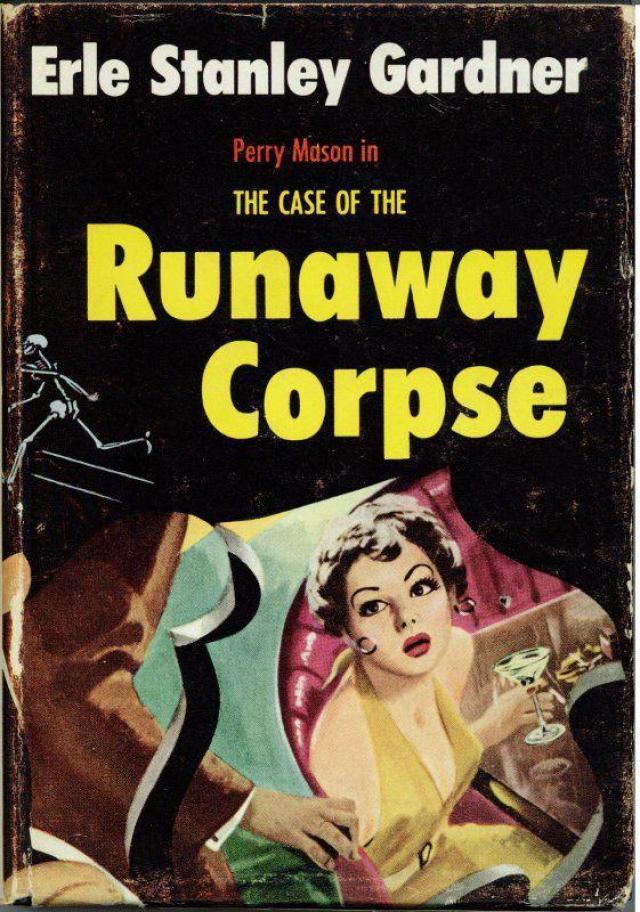
The case of the runaway.., p.13
The Case of the Runaway Corpse,
p.13


“Who told you that?”
“One of the people in here.”
“One of the officers?”
“No. An inmate.”
“A woman?”
“Yes.”
Mason said, “Stay away from her. Don’t talk with anybody. Don’t form any friendships. Sit tight. Leave things in my hands.”
“You’re going to continue to represent me?” she asked.
Mason nodded.
“I was afraid you’d .. - afraid you might back out.”
“I don’t back out.” Mason told her. “Even if you’re guilty you’re entitled to a fair trial. You’re entitled to all of your rights under the law. It’s my business to see that you get them.”
“Thank you.”
“Are you guilty?”
“No.”
“Of poisoning Hortense Paxton?”
“No.”
“Of poisoning your husband?”
“No.”
“You’ve got some things to explain,” Mason said wearily, drawing up a chair and sitting down across from her.
“I know.”
Mason watched her sharply, “Your friend, Sara Ansel turned against you.”
“She’s back in my comer now.”
“How do you know?”
“She telephoned.”
“Did they let you take a telephone message?”
“From her, yes.”
Mason said angrily, “They were monitoring the conversation. What did she say? Anything?”
“Only that she had doubted me and turned against me and had told the police everything she knew and a lot of things she didn’t know, and then she started thinking things over and had become thoroughly ashamed of herself.”
Mason said, “She had told police she watched you digging a hole and burying some poisons.”
Myrna Davenport’s eyes raised to Mason’s. For a moment there was a distinct flicker of panic in them.
“She told the police that?”
Mason nodded.
Myrna folded her hands on her lap, looked down at them, and said, “Well, of course, she had every reason to doubt me.”
“You packed your husband’s bags when he went on trips?”
“Oh yes.”
“He carried candy with him?”
“Yes, always.”
“You bought that candy?”
“Yes.”
“The candy in his bag was poisoned.”
“I know. They told me,”
“You didn’t poison it?”
“No.”
“Who did?”
“I don’t know.”
“You had been living in the house in Paradise?”
“Yes.”
“And after your uncle, William Delano, became ill, you went to live with him?”
“Yes.”
“And what did your husband do?”
“He stayed up in Paradise most of the time, but he would come and visit us.”
“Your husband didn’t like the idea of you moving down to Los Angeles?”
“No.”
“Why?”
“He said that I was letting myself in for a lot of drudgery and making a nursemaid out of myself, that when Uncle William died I’d never get a dime out of the estate.”
“What made him say that?”
“He thought it was all fixed for Hortense to get it all. Even after she died Ed didn’t want me there. He didn’t like Aunt Sara. For some reason Ed thought Aunt Sara would manage to get the bulk of the money some way.”
“If you get convicted of murdering Hortense Paxton, she may do it yet,” Mason said. “There’s a peculiar legal question involved.”
“I didn’t murder Hortie. I loved her.”
“Your husband never moved down to the house in Los Angeles, did he?”
“Not until after Uncle William died. After that he did. But of course, he kept a lot of things up there in Paradise. He turned that into his office. It was easier to run his mining deals from up there.”
“You packed his bags,” Mason said. “Do you remember packing them when he left for Paradise the last time?”
“Yes.”
“What did you pack?”
“Not many clothes because he kept most of his wardrobe in Paradise. I packed some shirts, socks, pajamas—“
“You remember the pajamas?”
“Yes.”
“What were they?”
“White, with red figures.”
“What sort of figures?”
“Something like a fleur-de-lis.”
“Have you seen the pajamas he was wearing when the body was found?”
“No.”
“They haven’t shown those to you?”
“No.”
“They haven’t asked you to look at the body?”
“No.”
“They probably will,” Mason said. “You’ll have to steel yourself for the shock.”
“Yes, I know.”
“Think you can do it?”
“Yes, of course.”
“Why do you say of course?”
“I’m not very emotional.”
“I’ll say you aren’t,” Mason said angrily. “You can’t seem to understand the predicament you’re in.”
“I understand it.”
“Now when you packed up your husband’s bag the last time he left, you put a box of candy in it?”
“Yes.”
“Where did you get that candy?”
“I bought it at a candy store. I bought two boxes. I put one box in and left the other box in the bureau drawer.”
“Did you open one of those boxes of candy?”
“No.”
“You’re certain?”
“Yes, of course.”
“You didn’t even tamper with the wrapping?”
“No. It was just the way it came from the candy store except for the outer paper. The box was wrapped in cellophane. I didn’t cut the cellophane at all.”
“Then you’re certain they can’t find any of your fingerprints on any of those candies?”
“Of course not.”
“Someone opened the box and filled the candies with poison—two different kinds of poisons.”
“So they tell me.”
“That wasn’t you?”
“No, of course not.”
“Handling chocolates is a tricky business. There are very apt to be latent fingerprints on those chocolates.”
“That’s fine. They won’t be mine.”
“I can depend on that?”
“Definitely. I promise—word of honor.”
“How many bags did your husband have when he left?”
“One suitcase.”
“What kind?”
“Just an ordinary big suitcase.”
“Now wait a minute,” Mason said. “He bought a bag somewhere before he got to Fresno.”
“I don’t know why he should have done that.”
“And he had two suitcases with him.”
“I don’t know where the other one came from. I mean why he had it with him. He kept the bulk of his things at Paradise. He only carried the things he needed for short stays when he left up there.”
“Did he leave any suitcases up at Paradise when you moved?”
“I don’t think so. We carried things down in suitcases and left them down in Los Angeles. The suitcases are down there.”
“‘How many of them?”
“Four or five.”
“You don’t know anything about the two suitcases your husband was carrying?”
“No.”
“You don’t know what became of them?”
“No.”
“Did you know that he was carrying samples of ore in suitcases?”
“No. I suppose he could have.”
“Did you know anyone he intended to see on this trip?”
“No. He told me he had a deal on for selling a mine. He was going to make a nice profit if it went through.”
“He didn’t tell you any more about it?”
“No.”
“He didn’t talk with you over the telephone from Paradise and give you any more information?”
“No.”
“You mean he didn’t call you at all from Paradise?”
“Once. That was Sunday. He said he was leaving, that he’d join me Monday night—yesterday.”
“That was the only time he called you?”
“Yes.”
“Over what period of time?”
“A week or ten days.”
“Why didn’t he call you more than that?”
“I don’t know. I think it was because of Aunt Sara.”
“What about her?”
“He thought that she used to listen in on the extension phone. He used to call oftener. Then he said someone was listening and after that he didn’t call much. When he did he was very short and curt. He didn’t like Aunt Sara.”
“And she didn’t like him?”
“No.”
“Do you know anything about your husband’s business affairs?”
“Very little.”
“He was going to meet someone and consummate a mining deal?”
“That’s what he said.”
“Where?”
“I gathered it was up here someplace—either Fresno or Modesto or someplace like that.”
“You don’t know anyone he intended to meet in San Bernardino?”
“No. He wasn’t going to San Bernardino.”
“How do you know?”
“He was coming straight home.”
“How do you know?”
“He said he was.”
“When?”
“When he telephoned.”
“The first time he telephoned?”
“There was only once.”
“You mean this last trip?”
“Yes.”
“Can you describe the suitcase that you packed for him? What it looked like?”
“It was a dark brown leather. It had been scuffed up. It had his initials in gold on it.”
Mason pushed back his chair.
“Where are you going?”
“Out and skirmish around,” Mason said. “I can find out more outside than I can in here talking to you. You aren’t telling me anything.”
“That’s because I don’t know anything.”
“Let’s hope you can make a jury believe that,” Mason told her.
Chapter 10
Mason caught a late train to Los Angeles and entered his office at 10:50 A.M. to find Della Street regarding a letter with puzzled scrutiny.
“Now what?” Mason asked.
“Gosh, Chief, I didn’t hear you come in. How was the trip?”
“Okay. The D.A. in Fresno seems to be a nice chap, but he’s going to give us quite a fight. What’s causing the expression on your face, Della?”
“Was there one?”
“There certainly was,” Mason said, walking over to take the letter from her hand. “What is it?”
“It’s from the detective in Bakersfield. I had just glanced through it.”
“What does he want?”
“Money.”
Mason took the letter and read:
Dear Mr. Mason:
I am writing this on my portable typewriter at San Bernardino. I have just learned by radio report that Edward Davenport of Paradise is dead, that his wife is accused of his murder and that you are representing her. I assume that you are also handling the affairs of the estate. I was doing work for Ed Davenport pursuant to his instructions when I learned of his death.
I am not in a position to wait for an estate to be probated before getting my money, and because Mr. Davenport indicated the job I was working on was of considerable importance to him it may be something you as attorney for the estate and for Mrs. Davenport should know about.
Since he is dead I can’t gain anything by being loyal to him and if the enclosed report is of value to you and his wife you might remember that I’m open to any employment in my profession in any way I can be of assistance.
I take it my prompt cooperation should entitle me to a prompt remittance from you and I hope the enclosed report will be of value to you.
I am enclosing herewith a bill for $225 covering salary and expense in connection with my employment by Mr. Davenport to cover unit thirteen of the Pacific Palisades Motor Court at San Bernardino.
For your information I had met Mr. Davenport in connection with another business matter which I transacted for him some two years ago in connection with a mining deal. I have not seen him since but presume he had filed my name to be used in connection with any similar matter of employment which he might have.
I shall be most happy to be of any further assistance.
Very truly yours,
Beckemeyer Detective Service.
By Jason L. Beckemeyer.
“Well,” Mason said, “we seem to clear up one phase of the mystery only to run onto another mystery. Why the devil did Davenport want to have a detective cover unit thirteen in that motel at San Bernardino?”
“Why did we?” Della Street asked.
“We did because of that telephone call, which, incidentally, must have been received some time after Davenport’s death. Let’s have a look at the detective’s report.”
She handed him the typewritten sheet.
Pursuant to instructions received over the telephone at approximately nine-fifteen on the evening of the eleventh from Edward Davenport who telephoned from Fresno, California, identified himself and arranged for the employment, I drove to San Bernardino on the evening of the twelfth to cover unit thirteen of the Pacific Palisades Motor Court.
I arrived at San Bernardino at approximately 1:00 A.M. on the morning of the thirteenth. The Pacific Palisades Motor Court had a sign announcing that there were no vacancies. I parked my automobile in such a position that I could watch the entrance to unit thirteen and kept watch until approximately ten-thirty in the morning, during which time I was on the job personally making absolutely certain that anyone who entered or left unit thirteen would be under surveillance.
At approximately ten-thirty on the morning of the thirteenth I noticed a maid enter the unit with a passkey, after first knocking. The maid had a portable unit containing bed linens, towels, etc., and had been previously engaged in making up units which had been vacated.
I immediately left my automobile, approached unit thirteen, and knocked on the door which had been left ajar. The maid answered the knock and I pushed my way into the unit and stated that I wanted to talk with the maid who had just made up unit ten. Inasmuch as I had seen the same maid emerge from unit ten I knew she was the one I wanted.
She seemed somewhat alarmed and wanted to know my business. I pretended that I was an officer without actually telling her I was, and asked her to describe the condition in which she had found unit ten, how many people had occupied it, whether there was anything that indicated that these people had been using drugs or were engaged in the drug traffic. The maid fell for this story and talked with me at some length. I was able during the conversation to size up unit thirteen. It had not been occupied during the night. By discreet inquiries I learned that the unit had been engaged by telephone the night before and that remittance had been transmitted by telegraph. The maid did not know the name of the person engaging the unit.
Cautioning the maid that under no circumstances was she to mention my visit to anyone—either her employer, her fellow employees or any occupant of the premises—I returned to my automobile and kept unit thirteen under surveillance until six o’clock that evening. I had not been instructed as to what I should do in case the unit was unoccupied, as Mr. Davenport seemed certain it would be occupied on the evening of the twelfth. My instructions were to see who called on the party early on the morning of the thirteenth, and to be on the safe side I decided to go on duty at 1:00 A.M. During this time I convinced myself that no one had checked into the unit. I had provided myself with sandwiches and thermos containers of coffee so that I did not interrupt my surveillance for eating. A conveniently located service station enabled me to keep an almost continuous watch on the unit, and during brief periods when it was out of my observation I assured myself each time that no one had entered the premises.
At about six o’clock on the evening of the thirteenth, while listening to a radio newscast, I learned that Ed Davenport had died the day before, that his widow was being held on suspicion of murder, and that Mr. Perry Mason was her lawyer.
Under the circumstances and since the unit was unoccupied, I determined to try another angle. I went to the telegraph office and insisted that a telegram which I had sent to the Pacific Palisades Motor Court, sending money to reserve a unit, had not been delivered. The person in charge looked up the records, asked me if I was Mr. Stanton and I assured her that I was. The employee then brought a duplicate copy, showing me that a telegraphic remittance sent by Frank L. Stanton of Fresno had been duly delivered. I apologized and left.
If I can be of further service I will hold myself in readiness. I am quite certain that the unit thirteen was unoccupied during the night of the twelfth and thirteenth. Information elicited from the maid was to the effect that if anyone had occupied the cabin during the first part of the evening of the twelfth, or, in fact, at any time after four o’clock in the afternoon, the necessary service work with towels, bedding, etc., would have waited until the maids came on duty at eight-thirty the next morning.
Beckemeyer Detective Service.
By Jason L. Beckemeyer.
“Well.” Della Street said, “that checks in with Paul Drake’s information.”
Mason nodded, said, “Now why the devil would Ed Davenport have been so anxious to find out who occupied that unit, and why did he wire funds to reserve the cabin and then hire a detective to see who occupied the place?”
“It must have been someone that he wanted to trap in some way,” Della Street said. “Or someone whose loyalty he suspected.”
“But who?”
“Looks like another job for Paul Drake.”
“It sure does.”
“Mr. Beckemeyer seems anxious to cooperate,” she said.
“Most anxious,” Mason agreed.
“And in a hurry for his money.”
“He sounds hungry. Tell you what you do, Della, send him a check. That will put him under obligations to our side.”















