

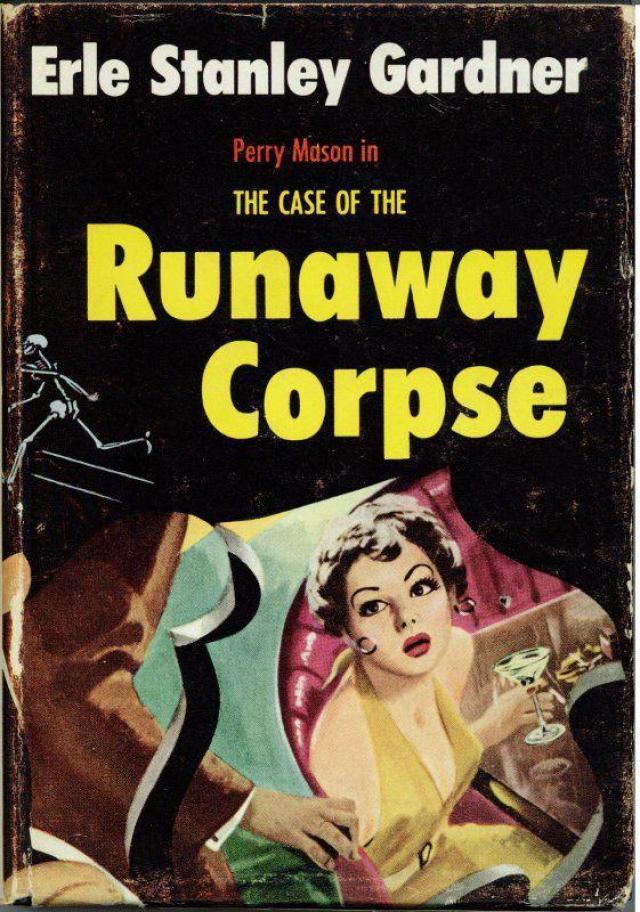
The case of the runaway.., p.7
The Case of the Runaway Corpse,
p.7


“It couldn’t be,” Della Street said. “Do you want to talk with Mrs. Ansel now?”
“Bring her in,” Mason said. “Why didn’t you get some sleep, Della?”
“Because I wanted to be on the job so you could get some rest. I can catch forty winks after lunch. If you get mixed up in this thing you’re really going to be busy. And there are several longdistance calls. Among them a call from the district attorney of Butte County.”
“I wonder what he wants,” Mason said, and then smiled.
“Yes,” Della Street remained demurely, “I wonder.”
“Well, let’s take things one at a time,” Mason said. “I’m in conference at the moment. I can’t be disturbed by any calls. I’ll be available in thirty minutes. Now let’s see what Mrs. Ansel has to say.”
Della Street nodded, picked up the phone and said to Gertie at the switchboard, “Mr. Mason is in now, Gertie. Tell Mrs. Ansel he’ll see her at once. I’m coming out to escort her in.”
Della Street left the office and returned with Sara Ansel, who had ceased all pretext of keeping herself well groomed. Her face was haggard and tired. There were swollen pouches under her eyes. Such make-up as she was wearing had been hastily applied and it was quite apparent she had had no sleep.
“Mr. Mason,” she said, crossing the office toward him and literally grabbing his hand, “you must do something. We’ve got to extricate ourselves from this thing. It’s terrible.”
“Sit down,” Mason said. “Calm yourself. Tell me just what happened.”
“Everything’s happened.”
“Well,” Mason said, “tell me about it.”
“I can never forgive myself. I can never forgive myself for being such a fool. I let that little minx pull the wool right over my eyes and … and then I got you into it. I thought I knew something about human nature, and in the relatively short time I had known her that woman became almost like a daughter to me. She seemed so helpless, so imposed upon, so frightfully inadequate to cope with the situation. And now to think of what has happened.”
“Go on,” Mason said. “Tell me about it. You may not have too much time, you know.”
“Why that woman is a regular Lucrezia Borgia. She’s a minx, a poisoner, a murderess.”
“Please give me the facts,” Mason said, seating himself and studying Sara Ansel.
“Well,” she said, “to begin with the coroner exhumed the body of Hortense Paxton. He found she’d been poisoned. Myrna Davenport did it.”
“When did you learn all this?”
“Well, it all started when we got home. There was a notice of a telegram under the door. Myrna called the telegraph office and it seems some friend of hers had sent a telegram that said to call immediately, no matter what hour of the day or night.”
“Go on,” Mason said.
“So Myrna called and this friend told her that the coroner had exhumed the body and was taking the stomach and organs for an analysis.”
“And then what?”
She said, “Believe me, Mr. Mason, I have never been so completely shocked in my life. Myrna stood there just as demure and quiet as anything, and then said, ‘Aunt Sara, before I sleep I want to do a little work in the garden.”
Mason raised his eyebrows.
“She’s a great little gardener,” Sara Ansel explained. “That was her only recreation. But—well, wait until you hear what that woman was doing.”
“I’m waiting,” Mason reminded her.
“I was just completely all in,” Mrs. Ansel went on. “I’m not young enough and resilient enough to go tearing around on these trips, taking all this excitement and experiencing all of these night plane rides. I was about ready to fall on my face, but I decided to take a hot shower and then get into bed. I went up to my room, showered, and—well, I’d better explain that that room is on the second story and it looks down on the yard in back of the patio, and what do you think I saw Myrna Davenport doing?”
“What was she doing?” Mason asked impatiently.
“Calmly proceeding to dig a hole, a very deep hole. She wasn’t gardening at all. She had a spade and she was digging a hole.”
“Go on,” Mason said.
“And right while I was watching her she took some packages, little paper packages, and dumped them in the hole and then proceeded to cover the packages with dirt. After she’d filled the hole with dirt she took sod that she had cut out and carefully patted the sod back into place, making a good smooth job of it.”
“And then?” Mason asked.
“Well, all that time I was standing at the window watching her. I’m not nosy, Mr. Mason, but I do have a normal, healthy, human curiosity.”
“So what did you do?”
“So I marched right downstairs and caught that demure little hypocrite before she’d had a chance to get rid of the spade.”
“What happened?”
“I asked her what she’d been doing and she said that when she got nervous she always liked to be out with her flowers, that she’d been spading up around some of the plants, loosening the soil and getting them so they could enjoy a new day, and now she was thoroughly relaxed and she could go in, go to sleep and sleep for twelve hours.”
“And what did you say?”
“I asked her to show me where she’d been spading, and she said that that wasn’t important and besides I should get in the house and get some sleep.”
“And then what?”
“I insisted that I wanted to see where she’d been spading. I told her that I wanted to see how she did it.”
“Well?” Mason asked.
“She’d given me the impression, Mr. Mason, of being a demure little thing, a meek little woman who could be pushed around, but you should have seen her then. She was just as obstinate as a brick wall. She wouldn’t look at me, but she didn’t budge an inch. She said in that low voice of hers that it really wasn’t important and that I was upset and nervous because of my night’s trip and that I should go back into the house.”
“And then what?”
“So then I came right out and asked her why she lied to me. I asked her why she had dug that hole, and she told me she hadn’t dug a hole.”
“What did you do?”
“So with that I snatched the shovel out of her hands and marched out across the patio to the lawn and over to the exact place where she’d been digging.”
“And then?” Mason asked.
“Then for the first time she was willing to admit what she had been doing, but there was no shame about her and she didn’t even raise her voice. She said, ‘Aunt Sara, don’t do that,’ and I asked her why not and she said, ‘Because I’ve been very careful to replace the sod over that hole so that no one will notice it. If you tamper with it. If’s going to make it obvious that something has been buried there.”
“And then?”
“So then I asked her what she’d buried, and what do you think she told me?”
“What?”
“Little packages of arsenic and cyanide of potassium. Now isn’t that nice?”
“Go on,” Mason said.
“Well, the tittle minx had the audacity to stand there and tell me that she had been experimenting with different types of spray for pests on flowers, that she had some ‘active ingredients,’ as she called them, that were very poisonous. The arsenic she had purchased. Some of the cyanide of potassium she had got from the laboratory in her husband’s mining operations. She’d been experimenting with different types of plant sprays for killing various pests, and now she was afraid her action in collecting those poisons might be subject to question, just in case someone started looking around with the idea of poison in mind. She said under the circumstances she thought she’d better get rid of the stuff.”
“So what did you do?” Mason asked.
“I suppose I should have had my head examined. I believed her. She never raised her voice and was so sweet and demure and so completely unexcited that I let her convince me. I even got to feeling sorry for her again. I sympathized with her and told her I couldn’t understand how she could go through so much and not be hysterical.
“Well, I put my arm around her and we walked back to the house, and I went upstairs and went to bed, and I was just getting to sleep when there was this pounding on the door and the housekeeper came up to tell us that an officer was there, that he had to see us right away upon a matter of the greatest importance.”
“And what was the matter of greatest importance?”
“It seemed that the coroner’s chemist had found arsenic in Hortie’s body, and the district attorney wanted to question Myrna.”
“Then what?”
“So then they took Myrna up to the district attorney’s office.”
“And you?”
“Nothing was done with me,” she said. “They asked me how long I’d been there and I told them. They asked me a few questions and then they took Myrna up to the district attorney’s office.”
“How did Myrna take it?” Mason asked.
“Just like she takes everything,” Sara said. “She was quiet and mouselike. Her voice didn’t raise a bit. She said that she’d be glad to go to the district attorney’s office but she thought she should have a little sleep, that she’d been up all night on account of her husband’s illness.”
“And then?” Mason asked.
“That’s all I know. They took her away. But I began to start putting two and two together, and then I got to thinking about that candy that Ed Davenport had in his bag. You know, Mr. Mason, she told me that she packs his bag every time he goes away. She said he was helpless—didn’t know how to fold his clothes and all of that.”
“That’s not unusual,” Mason said. “Most wives do that for their husbands.”
“I know, but that meant she must have packed the candy, so I started looking around after she left. I just started looking things over a little bit and—”
“What were you looking for?” Mason asked.
“Oh, just things that would help.”
“You went into her room?”
“Well, yes.”
“And what did you find?”
“I found a box of candy in her bureau similar to the kind of candy that Ed Davenport carries with him when he travels—those cherries that are in chocolate with sweet syrup around them. She has a sweet tooth herself. I remember a couple of boxes of that same type of candy had been hanging around the living room, and Myrna had kept asking me to help her eat them up. I only had a couple of pieces because I’m watching my figure. However, you can see what it means—the significance of it all.
“Good heavens, suppose she’d been trying to poison me! Suppose one of the pieces of candy she offered me had been poisoned! It must have been fate that guided my hand to the right pieces.
“And then she kept insisting I have more. I didn’t take any on account of my figure, but you can see what she must have had in mind. I thought at the time she was unduly insistent.
“Looking back at it now, I can see that the little minx must have been pulling the wool over my eyes all along.
“I can think of a lot of little things now that had seemed trivial at the time, but now they all begin to fit into a pattern. She’s a murderess, a poisoner, a regular Lucrezia Borgia.”
Mason thought things over for a few seconds, then said, “Let me ask you a few questions. As I understand it, you two women were together all of the time you were there in Crampton. You—”
“Oh no, that’s not true. She was alone with Ed while I was taking a shower. Then, shortly after the doctor reported that Ed had passed away and locked up the place, I went to telephone you. Now I remember seeing her talking with some man as I started back toward the cabin. Then she and the man separated. I didn’t think much of it at the time because I thought perhaps it was just one of the other tenants who was expressing his sympathy, but now I know it could have been a male accomplice. He probably entered the cabin through the window. After he got in there he was smart enough to put on a pair of pajamas. He must have slipped Ed’s body out through the window and into his own automobile. Then he waited until he was certain someone was looking, climbed back out of the window again, got in his automobile and drove away.”
“Your feelings seem to have changed all of a sudden,” Mason said.
“Well, I’ll certainly say they have. Why wouldn’t they? The scales have dropped from my eyes, Mr. Mason.”
“Thank you very much for telling me.”
“What are you going to do?” Sara Ansel asked.
“I don’t know yet.”
“Well, I know what I’m going to do. I’m going to clear my skirts. I’m going to maintain my good name and my reputation.”
“I see,” Mason said. “I suppose that will include going to the police?”
“I’m not going to the police but I’m certainly not going to avoid them when they come to me.”
“And what are you going to tell them about me?” Mason asked.
“You mean about going up to Paradise to get that letter?”
Mason nodded.
She met his eyes grimly and uncompromisingly. “I’m going to tell them the truth.”
“I thought perhaps you would,” Mason announced dryly.
“I don’t think your attitude is being cooperative, Mr. Mason.”
“I’m an attorney and I only cooperate with my clients.”
“Your clients! You mean you’re still going to represent that woman after what she did to you, after the position in which she put you, after the lies she told you, after the—?”
“I’m going to represent her,” Mason said. “At least I’m going to see that she has her day in court and isn’t convicted of anything except by due process of law.”
“Well, of all the fools!” Sara Ansel snapped. She got up out of the chair, stood glowering at Mason for a moment, then said, “I might have known I was wasting my time.”
With that she turned and strode toward the exit door. She jerked it open, looked back over her shoulder and said, “And I was trying to help you!”
She walked out into the corridor.
Mason watched the closing door. “That,” he said to Della Street, “is what comes when an attorney accepts the obvious.”
“What do you mean?”
“A client’s statement to an attorney is a confidential communication,” Mason explained. “An attorney’s clerk or secretary can be present at the conversation and it’s still confidential. The law gives that protection. But when a third person is present the communication ceases to be confidential.”
“But, good Lord, Chief, this was a woman who came with her, a woman whom she brought along and—”
“I know,” Mason said. “At the time Mrs. Davenport thought it was to her best interest to have Sara Ansel with her. I was the attorney. I should have insisted that the conversation about that letter take place in private.”
“And since it didn’t? Then what?”
“Since it didn’t,” Mason said, “it isn’t a privileged communication.”
“And you mean you can’t avoid answering questions about it?”
“Not when those questions are asked by the proper persons in the proper forum under proper authorization,” Mason said.
“And until then?”
“Until then,” Mason told her, “I don’t have to answer a damn thing.”
“So what do we do about the district attorney of Butte County?” Della Street asked.
“Oh, we talk with him by all means. Tell the operator that I’m ready to take his call now.”
Della Street busied herself on the telephone and a moment later nodded to Perry Mason, who picked up the phone, said in his most formal voice, “Perry Mason speaking.”
The voice that came over the wire sounded slightly forced, as though a man might be trying to mask a certain amount of diffidence by excessive vigor. “I am Jonathan Halder, Mr. Mason. I’m the district attorney of Butte County and I want to question you, and your secretary, about a visit you made up here to Paradise.”
“Indeed,” Mason said cordially. “I’m mighty glad to meet you, Mr. Halder, even over the telephone, but I don’t know why you would want to question us on what I consider a very routine matter of business.”
“Well, it may not be so routine,” Halder said. “Now we can get at it the easy way or we can get at it the hard way.”
“The hard way?” Mason asked.
Halder kept the forced vigor in his voice. “I have the right of course to take the entire matter before the grand jury and-”
“What matter?” Mason asked.
“The matter that brought you up here and what you did.”
“Good Lord, man,” Mason interrupted with all the geniality of one talking to an old friend, “if, for any reason, you have any official interest in anything that Miss Street and I did in your county we’ll be only too glad to answer questions. You won’t have to bother with a grand jury or a subpoena or trying to resort to any legal formalities—”
“Well, I’m mighty glad to hear you say that!” Halder interrupted, his voice relaxing into a more normal tone. “I guess perhaps I’ve misjudged you. People up here told me you were pretty resourceful and pretty ingenious, that if you didn’t want to be interrogated I might have to go the limit, even to the extent of getting out a warrant.”
Mason threw back his head and laughed. “Well, well, well,” he said. “One’s reputation certainly can get distorted with distance, like a mirage. How important is all this, Mr. Halder? When do you want to see me?”
“I’m afraid it’s very important, and I want to see you as soon as possible.”
“I’m rather busy at the moment,” Mason said.
Once more a strained note crept into Halder’s voice. “It is very important, Mr. Mason, not only on account of the situation here but because I am cooperating with other law enforcement officers and it’s pretty generally agreed that we want—”
“Certainly, certainly. I understand,” Mason said, laughing again. “You get in a political office and they start putting the pressure on you and then I suppose someone blabs to the newspapers and the first thing you know you’re on a spot. It’s either up to you to get me there for questioning or be subject to a lot of criticism.”















