The case of the runaway.., p.2
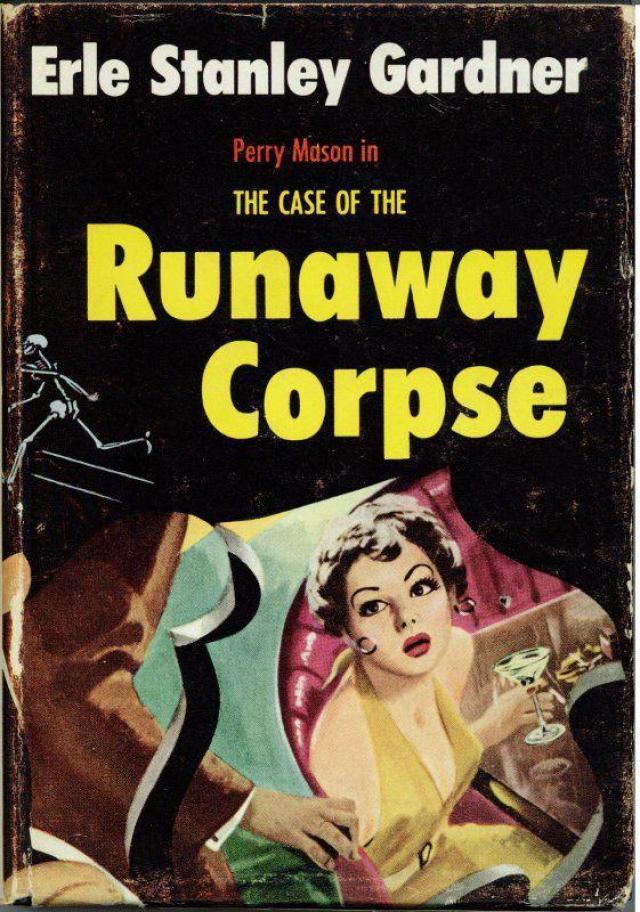
The Case of the Runaway Corpse,
p.2


“Eventually he did. He and I never got along too well. After Hortie died he changed his will.”
“You seem positive Miss Paxton’s death was a natural death.”
“Of course it was. She had this intestinal flu that’s going around. Only Hortie was so run-down she couldn’t fight it off.”
“Did you see her before her death?”
“Yes. I came there when I heard she was sick to see if I could help. I got there three or four days before she died, but I didn’t stay long after that.
“William Delano and I were fond of each other but he irritated me to death and I guess I clashed with him. Myrna insisted she could get along all right, what with the housekeeper and a practical nurse they called in, so I left.”
“And when did you return?”
“Shortly after William’s death.”
“Was there any autopsy at the time of Miss Paxton’s death?”
“Of course not. There was an attending physician and he signed the death certificate. She was buried and that was all there was to it until Ed Davenport started this talk of his. If you ask me the man simply isn’t all there. What’s more he’s trying to divert attention from what he’s done with Myrna’s money.
“Ed has these crazy ideas, and now he’s gone so far as to write that letter to be opened in the event of his death. The fool has high blood pressure. He may go any minute, and yet he’s written this dastardly letter. In the event of his death there’s no telling what may happen.”
“Where is that letter?”
“Up in his office somewhere.”
“Where’s the office?”
“In Paradise.”
“How’s that?”
“That’s the name of a place up near Chico in the northern part of the state. His office is in a house there. It’s the house where he and Myrna lived for a while after they came back from South America. Ed got hold of this mine on a shoestring deal. After he and Myrna came down to Los Angeles to live with William, Ed fixed the house up in Paradise as an office for his mining company.
“That is, he says it’s an office. Two rooms are fixed up as offices, but he has a bedroom and a kitchen. He spends a lot of time up there. He’ll be gone for a week at a time, sometimes two weeks. Since I’ve been with Myrna he’s spent most of his time up in that place he calls his office—and in gallivanting around the country, playing he’s an economic big shot, the great mining magnate.”
“May I ask,” Mason inquired, “how it happens that you are so intimate a part of the picture—that is, I take it there was no love lost between you and William Delano. You—”
“After all, I’m fond of Myrna. Under the new will, I own a one-fifth interest in that big house of William’s. I’m riot going to let Ed Davenport put me out of my own house. After I saw how he was treating Myrna I became terribly indignant, but I’ve tried to keep my place and not say anything. I haven’t, have I, Myrna?
“Then we got this telephone call this morning that Ed is in Crampton and—”
Mason said, “I gather he had been taken ill?”
“That’s what I’ve been trying to tell you—he’s dying and we only have a few minutes left. The very idea of any man writing a fool letter like that to be delivered to the authorities in the event of his death, accusing his own wife of murder.”
‘Is that what’s in the letter? ‘ ‘
“As nearly as we can tell, putting two and two together, that’s what’s in the letter.”
“And how do you know what’s in the letter, Mrs. Davenport?” Mason asked.
Myrna said in a voice that was so low it was difficult to understand her, “He said as much. He got mad and accused me of poisoning Hortie and said since I knew he knew what I’d done, he didn’t feel safe himself.”
“And Mr. Davenport is in Crampton now?” Mason asked.
“That’s right. He started down here from Paradise and got sick. He’s in a motel. The doctor is quite alarmed about him—thinks he won’t live.”
“And if he does live?” Mason asked.
Sara Ansel said, “Well, of course. I’m not one to give advice. Myrna can do just as she wants, but as far as I’m concerned Ed Davenport has been juggling her money, mixing it all up with his. I’m absolutely certain he’s going to try to cheat her out of it. I know what I’d do if I were in Myrna’s place.”
“And if Ed Davenport dies?” Mason asked.
Sara Ansel looked across at Myrna Davenport.
“If he dies,” Myrna Davenport said in her soft, almost inaudible voice, “that letter will be delivered to the district attorney and heaven knows what will happen.”
“And what do you want me to do?” Mason asked.
“Get the letter,” Sara Ansel snapped.
Mason smiled and shook his head. “I’m afraid I can’t help you there.”
“I don’t see why not.”
“I can’t steal that letter.”
“It contains slanderous matter,” Sara Ansel said.
“Nevertheless,” Mason said, “the letter is his property during his lifetime.”
“How about after his death?”
“Undoubtedly he left instructions for it to be mailed to the police.”
“As it happens,” Sara Ansel said, “all of the property that he has is community property. It was all acquired with Myrna’s money, regardless of the fact that Ed Davenport has been busily engaged trying to juggle funds around so that no one can tell where the money came from.”
Mason’s face showed interest.
“Now then, suppose he does die. Myrna, as the widow, is entitled to step into possession of the property. Isn’t that right?”
“For the purposes of administration and to conserve it for the administrator,” Mason said guardedly.
“Then she’s entitled to the possession of that letter.”
“Go on,” Mason said, smiling.
“I don’t think it’s fair for that letter to fall into the hands of the police and the district attorney without Myrna knowing what’s in it.”
“Of course,” Mason said, “a great deal depends on how the letter was written, or, rather, I should say, how the envelope is addressed—whether it’s addressed to the police to be opened in the event of his death, or whether it’s addressed to his secretary with instructions to her to mail the enclosure to the district attorney in the event of his death.”
“That would make a difference legally?” Sara asked.
“It might,” Mason said. “I’m not in a position to render an offhand opinion.”
Abruptly Sara Ansel got up from the chair. “Give me your key, Myrna.”
Wordlessly, Myrna opened her gloved hand, handed Sara Ansel a key. She, in turn, walked across and dropped it on the plate glass on Mason’s desk.
“What’s that?” Mason asked.
“The key to the office in Paradise.”
“And what do you want me to do with it?”
“In case Ed Davenport should die, we want you to get that letter.”
“Is there any element of truth in Ed Davenport’s accusations?”
“Don’t be silly! Myrna wouldn’t hurt a fly. She came there to help Hortie. Those two girls slaved their fingers to the bone. Hortie’s death was brought about purely and simply by overwork.”
“And Mr. Delano?”
“He had been dying for months. His heart was shot. The doctors gave him six months to live and he lived twelve. He’d have lived longer than that if it hadn’t been for Hortie’s death. That broke him all up.”
“Then why not let the letter be delivered?” Mason asked.
“If his charges are so absurd on their face why not simply explain to the police?”
The women exchanged glances, a brief flicker of an expressive signal that Mason was unable to interpret.
“Well?” he asked.
“It happens,” Sara Ansel said, “that the situation isn’t that simple. There are complicating factors.”
“In what way?” Mason asked.
“Someone telephoned the coroner. It was one of those anonymous calls. This person suggested the coroner had better check the death of Hortense Paxton.
“Of course it was just some busybody, unless it was Ed Davenport himself, but it may make trouble.”
Mason thought that over. “Myrna is Ed Davenport’s wife,” he said. “In case he should accuse her of poisoning Miss Paxton he might be jeopardizing the money his wife inherited—and which I understand he’s using. Have you thought of that?”
“We have. Ed hasn’t. He doesn’t think. He reacts. There’s no logic in what he does. Why would he write such a fool letter as that, particularly when he knows he may pop off any minute?”
Mason said, “He must be a psychopathic personality.”
“He’s a nut. You can’t tell what he’ll do. He may kill us both. If he had any idea we were here talking with you he certainly would.”
Mason reached an abrupt decision. “I’m going with you this far,” he said. “If Ed Davenport should die I’ll try to find out what’s in the letter. If, in my opinion, the letter is the work of a psychopath I’ll look into the case, and if everything seems to be in order I’ll surrender the letter to Mrs. Davenport. If, on the other hand, there is anything at all that’s suspicious about the case I’ll turn that letter over to the police, but I’ll try and do it under such circumstances that everyone gets a fair break.”
“If you only knew Ed Davenport,” Sara Ansel said. “He’s selfish, neurotic, completely engrossed in his own affairs, his own symptoms, his own feelings, and yet with it all he’s shrewd.”
“You haven’t known Mr. Davenport very long,” Mason pointed out.
“Well, I’ve known him long enough,” she snapped. “I’ve talked with Myrna, and I wasn’t born yesterday, Mr. Mason.”
Mason thought the matter over, then abruptly said to Della Street, “Della, dictate a letter which Myrna Davenport is to sign, giving me complete authority to represent her in connection with any matters pertaining to her domestic relations or her property rights and to take such action as I may see fit in connection with safeguarding these property rights. In the event her husband should die—and you’d better mention in the letter that it’s understood he is seriously ill at the moment—I’m to represent Mrs. Davenport in connection with the estate and all matters in connection with the estate. I am to act in her name and on her behalf in taking possession of any property of any sort, nature or description, and do whatever I think may be for her best interests.”
Mason glanced at Myrna Davenport. “You’re willing to sign such a letter?”
It was Sara Ansel who answered, “You bet she’ll sign it.”
Mason, however, continued to look at Myrna Davenport.
At length she met Mason’s eyes and said in a low voice, “Of course, Mr. Mason. My husband no longer loves me. He’s interested in my money, and he’s stealing that. Right now and as of this very moment he’s trying to scramble my property so completely we’ll never be able to straighten things out.”
Sara Ansel looked at her watch. “Well, what are we waiting for?” she demanded.
Perry Mason nodded to Della Street.
Chapter 2
Shortly after three o’clock that afternoon Mason’s switch board operator rang Della Street to announce that long distance from Crampton was calling Mr. Mason, insisting that it was on a matter of the greatest importance.
Mason nodded to Della Street. “I’ll take it, Della, but you’d better listen in on the call.”
Mason picked up his phone and when he had been connected through the switchboard heard the voice of Sara Ansel, urgent and impatient, arguing with the operator.
“This is Mr. Mason, Mrs. Ansel,” Mason cut in.
“Well, it’s about time!” she said. “Here we are in a jam and bull; your operator has been fiddling around—”
“Well, I’m on the line now,” Mason interposed. “What seems to be the trouble?”
“He’s dead.”
“Davenport?”
“Yes.”
There was a moment of silence.
“And,” Sara Ansel went on, “Myrna is in complete charge. He left a will leaving everything to her—certainly the least he could have done under the circumstances.”
“When did he die?” Mason asked.
“About fifteen minutes ago. It’s taken me all that time getting you on the telephone. That operator of yours—”
“Yes, yes,” Mason said. “Now the letter that you had reference to—”
“The address in Paradise is on Crestview Drive. You can get there by taking the Southwest Airways which goes to Chico. Rent a car at Chico and it’s only twelve miles over good, paved road. You won’t have much trouble finding the place but it’s a lot better if you don’t ask questions. So here’s the way you get there. Take the main street through town, then turn left on Oliver Road. At the foot of the grade make a sharp left turn onto Valley View for a very short distance, then turn left again onto Crestview Drive, and it’s the last place on the right-hand side.”
“There’s no one in the house?” Mason asked.
“There’s no one there. The secretary will be off duty.
You’ll find that—I’m sorry, there’s no opportunity to talk any more. Good-by.” She slammed up the telephone.
Mason hung up the telephone at his end of the line, glanced across at Della Street.
“Do you go to Paradise?” Della Street asked.
Mason nodded.
“And when you get there what do you do?”
“Represent Mrs. Ed Davenport’s best interests.”
“By finding that envelope?”
“Perhaps.”
“And then doing what?”
“That,” Mason said, “depends on what we find when we get the envelope. Find out about plane reservations, Della.”
Ten minutes later Della Street reported that by taking a direct plane to San Francisco it would be possible to pick up a Southwest Airways plane that would arrive at Chico at seven-fifty.
“Get two reservations, Della,” Mason said, “and let’s get started.”
“Two?” she asked.
He nodded. “Don’t think I’m going to walk into this without a witness.”
Chapter 3
The DC-3 puddle-jumped the bumpy air after it left Marysville, skimming over small communities mailed by clustered lights, over the dark spaces of fertile rice fields, past the glow that marked the location of Oroville, then swept low over Chico and into the landing field.
A taxicab took Mason and Della Street up to the center of town where Mason was successful in renting an automobile on a mileage basis. They found the road to Paradise and started climbing up the long grade.
Light from a three-quarter moon showed them something of the country, brought a startled gasp from Della at the sheer beauty of the scenery as the road skirted the edge of a lava cap and they looked down into the depths of a canyon, where crags of lava threw inky black shadows.
Mason glided past the group of stores which marked the center of the community, found the road where he turned left, and had no difficulty in locating the sharp curve which was the signal for another left-hand turn.
On each side of the road were modem, livable houses, among tall pines, bordered with green lawns. Up at this elevation all of the smoke and smog of the lower valley had vanished and, despite the moonlight, the brighter stars shone with steady splendor.
Della Street took a deep breath. “Just notice the air, Chief,” she said. “Pure and pine-scented, clear as crystal. And aren’t those beautiful homesites?”
Mason nodded.
“Do you suppose Ed Davenport’s place is like these?”
“We’ll know in a minute,” Mason told her, turning the wheel to the left.
They came to the end of pavement, crunched along on a groveled road past a neat house with a green fence, and then, as the road ended, turned right on the graveled driveway which swept them through a grove of pines, past thick manzanita, a few apple and pear trees, and brought them abruptly to the porch of a house which, despite the darkness within, seemed somehow to have a friendly, homey atmosphere.
Mason switched off the lights, turned off the ignition, walked around the car, and followed Della Street up on the porch.
“Suppose we’d better ring the bell just in case?” Della asked.
Mason nodded.
Della Street’s gloved thumb pressed against the bell button. Musical chimes sounded from the interior of the house.
“Ring once more,” Mason said after an interval, “and then we’ll try the key.”
Della Street rang the second time. After some ten seconds Mason inserted the key in the lock. The bolt clicked smoothly back. Mason turned the knob and the door swung open.
“Now what?” Della Street asked. “Do we use a flashlight or—?”
“We turn on lights,” Mason told her. “Using a flashlight would indicate a surreptitious visit. A surreptitious visit would indicate a consciousness of guilt. After all, Della, we’ve drawn cards in a game where we know very little about the other players and I’m darned if I know what the limit is.”
“But we’re playing for high stakes?” Della Street asked.
“Definitely,” Mason said, groping for a light switch.
The reception hallway flooded into brilliance, showing a hat rack made of deer horns and manzanita. A Navajo rug and two rustic chairs gave the place an atmosphere of sturdy simplicity. A big, oval, antique mirror hung on the wall. The aroma of good, strong tobacco clung to the place as though someone who lived there spent much time smoking a pipe.
Mason went through the door to the left, and switched on lights in a big living room. Della Street followed him through the house, taking one room at a time, switching on the lights until the long, rambling, one-story building had been fully illuminated.
“Now what?” Della asked.
“Ostensibly,” Mason said, “we’re simply taking charge on behalf of Mrs. Davenport. Actually we’re looking for a letter which may have been concealed somewhere in the premises. The question is where?”
“It seems such a silly thing to do,” Della Street said.