

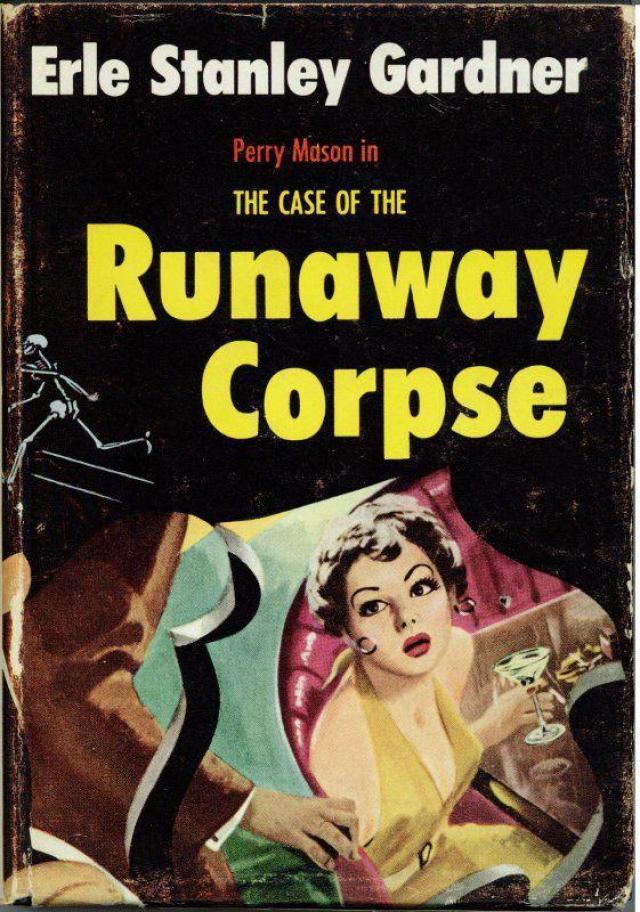
The case of the runaway.., p.18
The Case of the Runaway Corpse,
p.18


“Yes, sir.”
“And that when you left the man at somewhere around three o’clock in the afternoon he was dead?”
“Yes, sir.”
“Now then, if that is the case,” Mason said, “where did he get the meal of bacon and eggs that Dr. Hoxie found in the man’s stomach and which he estimated had been ingested shortly before death?”
“Do you want my opinion?” Dr. Renault asked.
“I’m asking you.”
“It is my opinion that his wife managed in some way, after I had left her alone with him, to get him to take some food, that that food caused his death.”
“In what manner?”
“I don’t know. I do know that I would not have approved a meal of that sort. The man was in a condition where he should have had liquids, no solids, nothing heavy. I had actually given him some intravenous nourishment.”
“How could a man who was dying from exhaustion and shock and debilitation sit up in bed and eat a meal of bacon and eggs?” Mason asked.
“I don’t know, I’m sure.”
“You can’t account for it?”
“I can’t account for it.”
“Would you say that the patient was in such a condition that he couldn’t have eaten bacon and eggs?”
Dr. Renault said, “There is no question but what the body on which the post-mortem was performed was that of the same man who had been my patient. I certainly would not have thought he could have eaten a meal of that sort. He undoubtedly was prevailed upon to do so. The meal was found in his stomach. Therefore he must have taken it. I simply wouldn’t have believed it was possible.”
“All right, let’s get certain things straight,” Mason said. “As a doctor you know that the man did not die of poisoning by cyanide of potassium?”
“I feel certain he did not.”
“You don’t know of your own knowledge that he ever ate any candy, do you?”
“Not of my own knowledge.”
“You don’t know of your own knowledge that he ingested any poison at all?”
“Well….well, I can’t swear to it, of course. I wasn’t there.”
“For all that you know of your own knowledge, Doctor, Edward Davenport may have contracted a typical case of food poisoning. He may have attributed that to poison which had been administered by his wife, and he may have been quite mistaken.”
“As far as I know of my own knowledge.”
“It is a frequent occurrence, is it not, Doctor, for a man to suffer food poisoning and to think that the food may have been deliberately poisoned rather than merely contaminated?”
“I suppose so.”
“Have you ever encountered such a case in your practice?”
“I—yes, I believe I have.”
“And you know that Edward Davenport didn’t die from cyanide of potassium poisoning?”
“I am certain he didn’t.”
“That’s all,” Mason said.
“Now just a moment,” Vandling said, as Dr. Renault started to leave the stand. “I want to question you, Doctor. I have talked with you before, have I not?”
“Yes, sir.”
“And at no time did you tell me that Mr. Davenport’s death was not due to cyanide of potassium poisoning?”
“You didn’t ask me specifically,” Dr. Renault said. “I will state by way of explanation that I felt his wife had administered poison, that the poisoning had been fatal, that in my opinion the man could well have died because of the after effects of that poison or that a second dose of poison could have been administered shortly before his death. I used the word poison. I did not say cyanide of potassium and you did not ask me. I told you specifically that in my opinion the man could have died solely because his system failed to rally from the shock of the effects of poison which had been administered in a piece of candy at about seven o’clock in the morning.”
“Yes, I guess you did,” Vandling admitted, “but you didn’t tell me specifically that he couldn’t have died from cyanide poisoning.”
“I wasn’t asked. I see no reason to come into conflict with some other physician unless the question is asked me under such circumstances that I cannot avoid answering. Mr. Mason asked me a specific question and I gave him a specific answer. I had determined that I would give that answer if the questions were asked and I couldn’t avoid it. I was with the man when he passed away. That death might have been due to some poison which acted upon the heart or it could have been due to the shock of the earlier poison, but the symptoms of death which I would have expected had cyanide of potassium been administered were not present, not at that time.”
“You know how much cyanide was found in the man’s stomach at the time of the autopsy?”
“I do,”
“And that was an amount sufficient to cause death?”
“Very definitely.”
“So that—now wait,” Vandling said. “If the man hadn’t died from cyanide poisoning he would have died from cyanide poisoning. I mean that he had enough cyanide in his system to have killed him even if you don’t think he died from cyanide poisoning.”
“I object to the question,” Mason said, “as being argumentative, as not being proper cross-examination, and as being completely ambiguous. The question is not what the man would have died from if he hadn’t died from something else. It’s a question of what caused his death.”
“I think so,” Judge Siler said. “I’ll sustain the objection to the question in that form.”
Vandling said, “Your Honor, this is a most peculiar situation. Dr. Hoxie is a very competent physician and toxicologist. He has testified to finding enough poison in the stomach of the dead man to have caused his death. He specifically names that poison as cyanide of potassium, a very quick acting, fatal poison. Dr. Renault now offers it as his opinion that the man did not die from cyanide poisoning. It is, of course, only his opinion.”
“He is a physician. He has given his opinion,” Judge Siler said.
“And he was your witness,” Mason added.
“Your Honor,” Vandling said, “I think under the circumstances the prosecution is justified in asking a continuance of this matter.
“I will state frankly that at this time the dismissal of proceedings in this case would not constitute a bar to a further prosecution. I could dismiss this complaint right now and arrest this woman on the same charge tomorrow.”
“Why don’t you do it?” Mason asked.
“I’m not ready to do it yet. I want to investigate the case a little further. I may state, Your Honor, that in a sense I am bound by the fact that, Dr. Renault is my witness. If I had simply placed Dr. Hoxie on the stand and shown the cause of death by the autopsy, if I had shown the presence of poison in the candy and the fingerprints of the defendant upon that candy, particularly after she had stated that she had never opened the box of candy, I would have established a prima facie case.”
“Do you want to ask me to bind the defendant over on the evidence in the case as it now stands?” Judge Siler asked.
“I don’t know, Your Honor,” Vandling said. “The situation is somewhat complicated. The record now shows that Dr.Renault was called as my witness and that he has now stated positively that in his opinion the man did not die from poisoning by cyanide.”
“And,” Mason pointed out, “your own doctor couldn’t find any evidence of chocolate candy in the stomach of the decedent.”
“I would like to withdraw Dr. Renault from the stand and ask Dr. Hoxie to return, and ask him one question,” Vandling said.
“Is there any objection?” Judge Siler asked.
Mason smiled. “No objection. Your Honor.”
“Step down, Dr. Renault, if you will, please. Dr. Hoxie, will you come forward? You have already been sworn, Doctor. I just want to ask you a question.”
Dr. Hoxie marched up to the witness stand. He was bristling with professional indignation.
“You have heard Dr. Renault’s testimony?” Vandling said.
“I have,” Dr. Hoxie snapped.
“Do you have any doubt as to the cause of death in this case?”
“None whatever. The man whom I autopsied died of poisoning by cyanide of potassium.”
“That is, there was enough cyanide of potassium in his stomach to have caused death?”
“Yes, sir.”
“Now I’m going to ask you another question. It’s rather farfetched and it may be rather gruesome. Would it be possible for a person to pump out the stomach of a cadaver?”
“Why, certainly.”
“All right. Would it be possible for a person to pump something else into the stomach of the cadaver?”
Dr. Hoxie hesitated. “Are you asking me now,” he said at length, “whether I think that that could have been done in this case?”
“I’m asking you as to a general possibility.”
“I presume it’s possible generally. I will state, however, that in my opinion Edward Davenport died of the effects of cyanide of potassium. Not only was the poison present, but there were symptoms present, the evidence of froth, the characteristic odor, the general symptoms. In my opinion the man died almost immediately after ingesting a very large dose of cyanide of potassium. He had been drinking for an hour or so before his death. He had also eaten bacon and eggs an hour or so before his death.”
Vandling explained to Judge Siler, “I am trying. Your Honor to get at the facts in this case. I want to get a solution of a seemingly contradictory situation.”
“There’s nothing contradictory as far as I am concerned,” Dr. Hoxie said. “In my opinion the man died of poisoning by cyanide of potassium. The conditions were all there. The poison was there. The man simply couldn’t have lived after having ingested the amount of poison that I found in his stomach. All of the conditions of cyanic poisoning were present. In my opinion it was the cause of death, regardless of what anyone else may say to the contrary.”
“Do you have any further questions or cross-examination?” Vandling asked Mason.
“Do you think the poison was ingested in a piece of candy?” Mason asked.
“I do not.”
“Would you say it was not?”
“I would say that I don’t think the poison was taken in candy. I think death was very rapid and I found no evidence of candy although I tried very carefully to find candy in the stomach content.”
“How do you think the poison was taken?”
“I don’t think it was taken in food. It may have been administered in whisky. There was whisky in the stomach and alcohol in the blood. I have one other theory which is a possibility which I don’t care to state.”
Mason thought that over, then said, “Is that theory that the dead man could have been given a straight dose of poison—let us say as a medicine?”
“Yes.”
“That’s all, Doctor,” Mason said, smiling.
“Just one question on redirect, Doctor,” Vandling said triumphantly. “Then, in your opinion, it is possible the defendant could have given Edward Davenport this poison under the guise of medicine?”
“No.”
“What? I thought you just said the cyanide could have been given as medicine.”
“I did, but not by Mrs. Davenport, because she wasn’t in the room within the necessary time limit. My opinion is that Edward Davenport lived less than two minutes after ingesting that poison.”
“Any more questions on cross-examination?” Vandling asked Mason.
“None whatsoever,” Mason said. “You’re doing fine. Go right ahead. It’s your omelette. Try to unscramble it.”
“I’d like to ask for a continuance,” Vandling said. “It is past the noon hour now, Your Honor. Court usually adjourns until two o’clock. I am going to ask the Court to adjourn until four o’clock this afternoon.”
“Does the defense have any objections?” Judge Siler asked.
“I think not, under the circumstances,” Mason said. “In fact we’ll grant a continuance until tomorrow morning at ten o’clock if the prosecution wishes.”
“I should like to have such a continuance provided it is stipulated that … I would prefer to have the motion come from the defendant,” Vandling said.
“I’ll make such a motion,” Mason said promptly.
“Very well,” Judge Siler ruled. “On the motion of the defendant case is continued until tomorrow morning at ten o’clock. The defendant will remain in custody. Court’s adjourned.”
Vandling looked across at Mason. “Well,” he said, “I had been warned to expect the unexpected in dealing with you, but this is the damnedest thing I’ve ever encountered in all my career.”
Mason smiled. “What are you going to do?”
“I don’t know,” Vandling said. “I can get her bound over, but in view of the testimony of Dr. Renault I’d have a hell of a time getting her convicted in front of a jury.”
“Well, at least you’re frank,” Mason told him.
“There’s no use trying to cover things up with you,” Vandling said. “You know as well as I do what would happen if a situation like this developed in front of a jury.”
“Are you going to dismiss the case?”
“I don’t think so. I walked into this thing with my eyes shut. I think probably I can put on a case before a jury without calling Dr. Renault, and force you to call him as your witness.”
“And then what?” Mason asked.
“Then,” Vandling said, lowering his voice, “I’d attack his professional competency. I don’t think he’s too highly regarded in medical circles here. He’s drifted around. He’s a mature man, yet he’s only practiced in Crampton for three years. I believe he was in trouble over narcotics at one time. That’s why Dr. Hoxie became so indignant at the idea of his findings being questioned by a man who had no more professional standing than Dr. Renault.”
“Dr. Renault seemed positive enough,” Mason said.
“He sure was positive enough.”
“And then, of course,” Mason went on, “you have the spectacle of the corpse climbing out of the window.”
Vandling frowned. “It’s a strange case. Someone might have pushed the corpse through the window, then impersonated the dead man. I asked for a continuance because I have a plan in mind. You might be surprised if you knew what I was thinking right now.”
“I may not know what you’re thinking,” Mason said, “but I’ll bet five dollars I know what you’re going to do.”
“What?”
“You’re going to call the district attorney of Los Angeles County and suggest that there are a few technical matters that are bothering you in this case up here, and that under the circumstances you think it would be better to have the Los Angeles grand jury indict Myrna Davenport for the murder of Hortense Paxton and try her down there on that charge first.”
Vandling threw back his head and laughed. “Well,” he said, “I’d been warned that you’d anticipate my every move. Well, if you’ll excuse me, I’ll go telephone.”
As Vandling walked away, Mason turned to the officer. “Just a moment, I want to confer with my client before you take her back to jail.”
He took Mrs. Davenport’s arm, took her over to a deserted corner of the courtroom and said, “What was this you were telling me, that you had never opened that box of candy?”
“Mr. Mason, I’m telling you the truth. I never opened that box of candy.”
“Your fingerprints got on the candy,” Mason said.
“There’s something wrong. Those can’t be my fingerprints. They have been forged in some way.”
Mason said, “The question of forged fingerprints comes up every once in a while, but so far as I know there’s never been a case on record where a jury has held that a defendant’s fingerprints were successfully forged. Not when the fingerprints were left in place. When they have been lifted there’s another angle to the case. These prints are in place.”
Myrna Davis lowered her eyes. “Well,” she said in her low voice, “those aren’t my fingerprints. They can’t be.”
“Because you didn’t open the box of candy?”
“Because I didn’t open the box of candy.”
Sara Ansel came bustling forward from the back of the courtroom where she had been seated as a spectator.
“Mr. Mason,” she said, “may I talk with you?”
Mason nodded.
She pushed her way through the swinging gate and entered the railed enclosure reserved for officers of the court.
“Mr. Mason. I know, I absolutely know that Myrna didn’t do any of those things they claim she did. She didn’t feed Ed Davenport any bacon and eggs. He didn’t eat a thing while we were there. He was barely conscious and could hardly talk and she didn’t enter that room after Dr. Renault had left. She—”
Myrna looked coldly at Sara Ansel. “Go away,” she said.
Sara Ansel said, “Myrna, my dear, I’m trying to help you.”
“You’ve done everything you could to betray me,” she said.
“Myrna, do you realize what you’re saying?”
“Of course I do.”
Sara Ansel said, “You can’t. You’re upset and excited. Now, Myrna, dear, I know how your prints got on the candy. You gave Ed a full box, all right. You put it in his suitcase. But there was another partially filled box in the living room. You and I had been eating candy. There were two boxes in the living room, both partially empty. You consolidated those two partially empty boxes. So your fingerprints were on some of those candies you handled. Ed must have taken that box you consolidated as well as the one you packed in his suitcase.
“Then while he was in Paradise he must have eaten that fresh box you had put in his suitcase. That left the other box in his suitcase—the one you had consolidated from the two partially empty boxes.
“I’m almost certain that box the officers have now is the one you fixed up from the two open boxes. I could almost swear to it.”
Without a word to Sara Ansel, Myrna turned to the officer. “Will you please take me back to jail?” she said. “I’m tired.”
The officer led Myrna Davenport away. Sara Ansel turned to Mason and said angrily, “Well, can you beat that!. Here I try to be of some help to her and I get slapped down like that.”















