The case of the runaway.., p.16
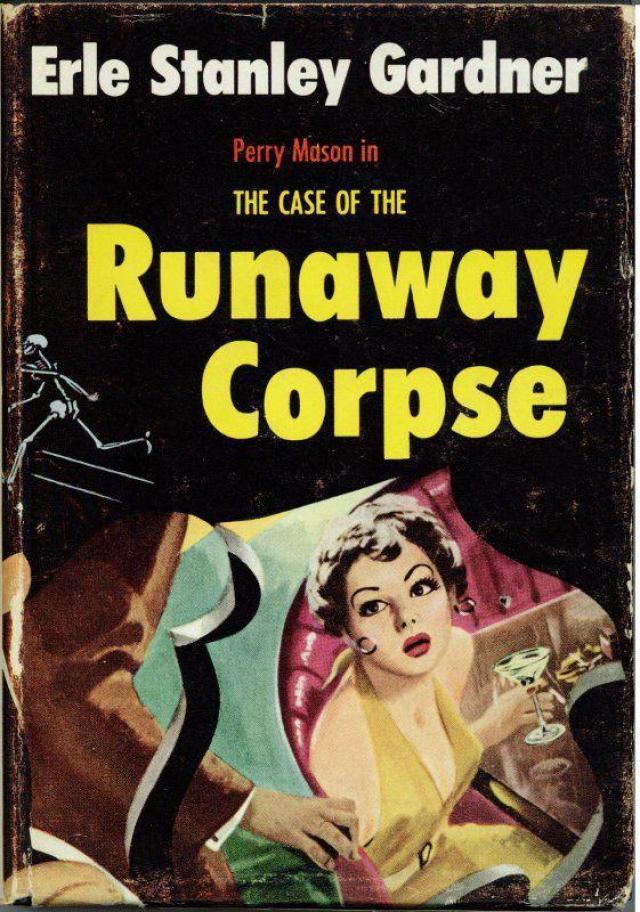
The Case of the Runaway Corpse,
p.16


“You had a conversation with her?”
“I did.”
“And generally what did the defendant state to you at that time with reference to a box of candy which had been produced?”
“She stated that she had purchased that box of candy and had placed it in her husband’s traveling bag, that the husband always carried a box of candy with him, that he was a heavy drinker and a periodic drinker. There were times when he felt the craving for alcohol and when he was able to eat candy, and by going on what she called a candy binge, could control the craving for alcohol.”
“She admitted to you that she had bought this box of candy?”
“Yes, sir.”
“Did you ask her at that time whether she had in any way opened the box or tampered with the chocolates?”
“She told me that she had simply purchased the box of chocolates and had placed it in her husband’s bag, unopened, as it came from the candy store. That she had taken off the outer wrappings because she had purchased two boxes at the same time, but that she had not disturbed the cellophane wrapper around the box.”
“Did you examine that box of chocolates?”
“Yes, sir.”
“For the purpose of determining latent fingerprints?”
“Yes, sir.”
“What did you discover?”
“I found two chocolates which had the prints of the defendant’s right thumb and right forefinger.”
“Were you able to photograph those prints?”
“Yes, sir.”
“Do you have the photographs with you?”
“I have.”
“Please show them to defendant’s counsel and then I’m going to ask that they be received in evidence.”
“No objection,” Mason said, hastily inspecting the photographs.
“Later on, were you present when those pieces of candy bearing the latent fingerprints were tested for poison?”
“I was.”
“And did you in some way designate those particular pieces of chocolate?”
“Yes, sir. We pasted a small piece of paper on the bottom of those chocolates, numbering one of them number one and the other number two. I placed my initials in ink on that piece of paper.”
“And those two chocolates in your presence were tested for poison?”
“Yes, sir.”
“Cross-examine,” Vandling said.
Mason said conversationally, “Do you know what was found with reference to the presence of poison in those two pieces of chocolate?”
“Only by hearsay.”
“That is hearsay from the toxicologist who performed the test?”
“Yes, sir.”
“But you were there at the time?”
“Yes, sir.”
“What did he say?”
“He said that both of those pieces of chocolate contained cyanide of potassium, that all of the other pieces of chocolate contained arsenic.”
“You know that arsenic usually produces death rather slowly?”
“Yes, sir.”
“And that cyanide produces it very rapidly?”
“Yes, sir.”
“Did you make any attempt as an investigating officer to determine why two pieces of candy containing poison which would bring about almost instantaneous death had been mixed with candy which would bring about a slow death?”
“No, sir. I asked the defendant about that and she insisted all of the time that she had not opened the box of candy, that she had never touched any of the chocolates.”
“That’s all,” Mason said. “No further questions.”
“I will now call Sara Ansel to the stand,” Vandling said.
Sara Ansel, who had been in the back of the courtroom, stood up and said belligerently, “I don’t want to be a witness in this case. I don’t know anything that would be of the slightest help to the prosecution. That young woman who is being tried is my sister’s niece and the poor girl is innocent.”
“Just come forward and be sworn,” Vandling said.
“I’ve told you that I don’t want to be a witness. I—”
“Come forward and be sworn, madam,” Judge Siler announced, and, as Sara Ansel still hesitated, said, “Otherwise you will be tried for contempt of court. This is a court of law. You were called as a witness. You are present. Now come forward.”
Slowly Sara Ansel marched down the aisle, through the swinging gate in the section reserved for attorneys and witnesses, and up to the witness box. She held up her right hand, was sworn, smiled reassuringly at Myrna, then sat down and glared at Vandling.
“You’re Sara Ansel?” Vandling said. “You are at the present time living in Los Angeles with the defendant in this case in a house which was formerly the property of William C. Delano. Is that right?”
“That’s right,” she snapped.
“How were you related to William C. Delano?”
“I wasn’t related, that is, not actually. My sister married William Delano’s brother.”
“They are both dead?”
“Both dead.”
“What relatives did Delano have at the time of his death?”
“He had none at the time of his death other than Myrna, unless you could call me a relative by marriage.”
“You were his sister-in-law?”
“In a way, yes.”
“He referred to you as such?’
“Yes.”
“You had seen William C. Delano several times in his lifetime?”
“Several times.”
“Now shortly before his death did you see him?”
“Yes.”
“How long before his death?”
“Approximately a month.”
“Now can you describe generally the condition of William Delano’s household during that month? Who was there?”
“I was there, and his niece, Hortense Paxton, was there, and Myrna and Ed Davenport. Myrna came to help with the work.”
“And what happened to Hortense Paxton?”
“She died.”
“And after that William Delano died?”
“Yes.”
“About how long after Hortense Paxton’s death was it that William Delano died?”
“A little over two weeks.”
“During that two weeks he was a very sick man?”
“Yes.”
“And he changed his will, that is, he made a new will during that time?”
“I don’t know.”
“Didn’t he tell you in the presence of the defendant, Myrna Davenport, that he was making a new will?”
“Not in so many words. Lawyers came to the house and he was executing a document. He was a very sick man.”
“Under the terms of that will you inherited some money, did you not?”
“That’s none of your business.”
“Under the terms of that last will you inherited some money, did you not?”
“Answer the question,” Judge Siler said.
“Yes, sir.” she snapped.
“How much?”
“A hundred thousand dollars and a fifth interest in his big house.”
“When did you first meet the defendant, Myrna Davenport?”
“When I came to visit William Delano.”
“Was she living there at the house at that time?”
“Not at that time. She was there helping with the work, helping Hortense, but—”
“Now just a moment. By saying that she was helping Hortense you mean she was helping Hortense Paxton, the niece who died?”
“Yes.”
“And Hortense Paxton was running the house, supervising the servants, waiting on William Delano?”
“Yes.”
“And had been for some time?”
“She’d been living with him for more than two years. She was his favorite. They were very close.”
“And shortly after you arrived at the house to visit William Delano, the defendant, Myrna Davenport, came to live with him? Isn’t that right?”
“Well, it wasn’t that simple. That is, you can’t divide it into periods like that. Myrna first came to visit and help Hoi-tie—”
“Now, by Hoi-tie you mean Hortense Paxton?”
“Naturally.”
“Very well, Go on.”
“She was there visiting and helping, and then she decided to move in, that—well, it may have been shortly before I came or shortly afterward, I don’t remember which, but in any event, she and Ed, that was her husband, did move in and take up their residence.”
“But Mr. Davenport still continued to maintain his office at the place he and Myrna Davenport had been using as a residence up in Paradise in this state?”
“Yes.”
“How much of the time?”
“Quite a bit of it.”
“After you came, and shortly after Delano’s death, Mr. Davenport started absenting himself from home, did he not?”
“What do you mean by home?”
“At that time it was the residence in which William Delano had passed away, was it not?”
“I guess so, yes.”
“That’s what I mean by his home. I will refer to the place in Paradise as his mining office.”
“Very well.”
“And shortly after you moved in you noticed that Mr. Davenport began to absent himself, did you not?”
She said, “I don’t know what you’re trying to get at, but I’ll tell you frankly that Ed Davenport and I didn’t get along. But that didn’t have anything to do with those trips of his. Ed Davenport didn’t like me. There wasn’t any secret made about that, although I was just as nice to him as I could be, but he thought I was turning Myrna against him. Actually all I was doing was trying to tell Myrna to wake up to what was happening.”
“What was happening?”
“He was mingling every cent of Myrna’s money he could get hold of with his money and mixing it all up and juggling the assets around so that a body couldn’t tell anything in the world about it. If you’d start asking him about his mining properties or what he was doing, or about how much money Myrna had, or what he was doing with it and where it was invested, he’d either clam up on you or jump up and leave the room. Then shortly afterward he’d take another of his ‘business trips.’ If you really tried to pin him down you’d get all sorts of evasive answers. You couldn’t tell which was which. I knew what he was doing and he knew I knew what he was doing.”
Sara Ansel glowered belligerently at Vandling.
“You knew what he was doing?”
“Certainly I knew what he was doing. I wasn’t born yesterday.”
“How did you know what he was doing?”
“Why, by asking him questions and getting his answers and seeing the way he was acting and all of that stuff.”
“And did he know that you knew what he was doing?”
“Certainly he did. I didn’t make any secret of it. That is, I asked him very pointed questions.”
“In front of his wife?”
“Naturally. She was the one I was trying to get to wake up.”
“And then you talked with his wife privately?”
“Yes.”
“And suggested that she should consult an attorney?”
“Yes.”
“And what else?”
“That she should hire private detectives to trail him. He was gallivanting around the country. He’d tell Myrna to pack up a suitcase for him, talking to her just as though she were a servant, and tell her he was going off to one of the mines. He wouldn’t even tell her which one. He’d say ‘one of the mines.’ “He had several?”
“He did after he began to get his hands on her money. That was when he started to expand. And. as I say, he just mixed transactions around so you couldn’t tell anything about anything.”
“He was using his wife’s money?”
“Of course he was. He didn’t have any money of his own. All he had were some mines he was buying and operating on a shoestring. As soon as William Delano died he started in being a big operator right away. He borrowed what money he could on the strength of the money that was coming to his wife. He got his wife to make a big loan at the bank and then he hurried through some kind of partial distribution of the estate so that Myrna could get money, and as soon as it hit Myrna’s bank account he drew it right out.”
“Do you know how he handled those transactions? Did he give Mrs. Davenport a note or anything?”
“Certainly not. He simply had her put money in a joint account. And all she could ever use that joint account for was just household expenses and an occasional dress or something.”
“So you warned Mrs. Davenport about this?”
“Certainly.”
“So at a time, say a week ago, Myrna Davenport had every reason to distrust her husband, to hate her husband and to wish him out of the way, did she not?”
“Now what are you getting at? You’re putting words in my mouth.”
“I’m simply summarizing what you’ve told me. You had told Mrs. Davenport that her husband was embezzling her money?”
“Yes.”
“That he was running around with other women?”
“I suspected it.”
“That he was simply trying to get his hands on her inheritance so that he could add it to his own funds and juggle things around so she would lose out financially?”
“Well, I didn’t use exactly those words.”
“But that was the idea you conveyed?”
“Yes.”
“Some ten days ago Edward Davenport announced that he was going to his office in Paradise?”
“Yes.”
“And asked his wife to pack his bag?”
“Yes.”
“Was anything said about candy?”
“He told her that he needed some fresh candy, that he had eaten up all but one or two pieces in the other box.”
“Do you know of your own knowledge what Mrs. Davenport did in connection with packing the bag or getting the candy?”
“Not of my own knowledge. I learned afterward that she bought two boxes of candy.”
“And that one box of candy was put in his suitcase?”
“I believe so. I didn’t see that with my own eyes.”
“Did you know anything about Mrs. Davenport having poisons?”
“She’s a great gardener and she did some experimenting with different sprays that she mixed up. She followed some sort of a recipe for plant sprays.”
“Did she have arsenic and cyanide of potassium?”
“I don’t know.”
“Did you talk with her about poison at any time?”
“Well, yes.”
“And did she tell you that she had arsenic and cyanide of potassium?”
“She told me that she had some things for sprays.”
“Did she tell you she had arsenic and cyanide of potassium?”
Mason said, “Your Honor, this seems to be an attempt on the part of counsel to cross-examine his own witness.”
“She’s a hostile witness,” Vandling said.
“Objection overruled,” Judge Siler said. “It’s quite apparent that she’s a hostile witness.”
“Did she tell you she had cyanide of potassium and arsenic?” Vandling asked.
“Yes.”
“Did she discuss with you the fact that she had tried to conceal those poisons and bury them so that the authorities couldn’t find them?”
There was a long silence.
“Answer the question,” Vandling said.
“Yes,” Sara Ansel said.
“And you actually saw her burying some of those packages containing poison?”
“She didn’t want to be subjected to a lot of inquiry and—”
“Did you actually see her burying those poisons?”
“I saw her digging a hole. I don’t know what she put in the hole.”
“Did she tell you what she put in the hole?”
“Yes.”
“What did she say she put in the hole?”
“Poisons.”
“Now then, directing your attention to Monday, the twelfth. You and Mrs. Davenport were at the Delano house?”
“Yes.”
“And at some time in the morning, around nine o’clock, you received a telephone call from a doctor in Crampton, did you not—a Dr. Herkimer C. Renault?”
“Yes. The call came through.”
“Did you talk on that call or did Myrna Davenport?”
“I did.”
“And what did Dr. Renault tell you?”
“He asked for Mrs. Davenport. I told him that I was Myrna Davenport’s aunt and that I could take any message to her. He said it was serious news concerning her husband.”
“Now as far as the telephone conversation itself was concerned,” Vandling said to Judge Siler, “I think that probably is hearsay evidence, but as far as what this witness told the defendant concerning that telephone conversation it goes to the defendant’s knowledge and state of mind—”
“I’m not making any objection,” Mason interrupted. “Go right ahead.”
“Very well. What did that conversation consist of?”
“Dr. Renault told me that Mr. Davenport, was in a motel in Crampton, that he was very seriously ill, very, very ill; that he understood the man had high blood pressure and hardening of the arteries, and that he thought it was advisable for Mrs. Davenport to get there just soon as possible.”
“Now I won’t waste time with a lot of details,” Vandling said, “but you and Mrs. Davenport promptly packed up, made arrangements to catch a plane which would get you into Fresno shortly after noon. You grabbed a taxicab and then you persuaded Mrs. Davenport that she should stop at the office of an attorney, and you did stop at the office of Perry Mason, did you not?”
“Yes, sir.”
“Now prior to that time you had some knowledge of the fact that Mr. Davenport had left a letter of some sort, to be delivered to the officers in the event of his death?”
“He had accused Myrna of—well, of lots of things, and he said that he had left a letter to be delivered to the officers in case anything happened to him.”
“And you went to the office of Perry Mason with Mrs. Davenport, and Mr. Mason was retained to go to Paradise and get that letter so that it would not be delivered to the officers in the event of Mr. Davenport’s death? Isn’t that true?”
“Now there, Your Honor,” Mason said, “I’m forced to interpose an objection because it calls for a confidential communication between a client and an attorney.”