

The case of the lucky lo.., p.17
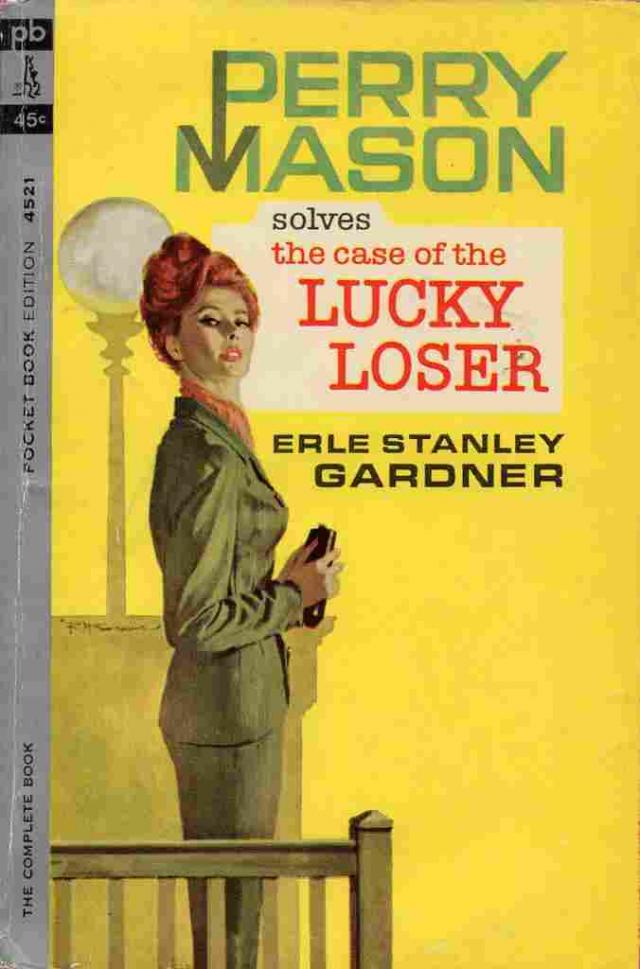
The Case of the Lucky Loser,
p.17


Judge Cadwell banged down his gavel, rose from the bench, and said, “I’d like to see counsel for both sides in chambers.”
CHAPTER 20
In Judge Cadwell’s Chambers an irate Hamilton Burger said, “What I want to find out first is why Perry Mason withheld and concealed this evidence.”
“Well, what I want to find out,” Judge Cadwell said, “is Mr. Mason’s theory of what happened in this case.”
“With ail due respect to Your Honor,” Hamilton Burger said, “I think Mr. Mason’s explanation should come first. I don’t think he is entitled to appear here in good standing until he has purged himself of this charge.”
“With all due respect to your opinion,” Judge Cadwell snapped, “this is a first-degree murder case. Mr. Mason seems to have a theory which accounts for this startling fingerprint evidence. I want to hear that theory.”
Mason grinned at the discomfited district attorney and said, “I think it’s quite simple, Your Honor. The rented car which was found at the Sleepy Hollow Motel was a car which had apparently been rented by Jackson Eagan, despite the fact that the records show that Jackson Eagan has been dead for some two years.
“That car actually was rented by Banner Boles. Obviously Boles must have been in Mexico when the body of Jackson Eagan was discovered. He took charge of Eagan’s papers. He knew that Eagan would have no further use for his driving license. He noticed that the physical description fitted his own physical description. Occasionally, when he was working on a job where he didn’t want to use his own name, or when he wanted to go on a philandering expedition, he knew that by renting a car and using the Eagan name, with the Eagan driving license as a means of identification, there was no way his real identity could be traced.
“I could have proved that Guthrie Balfour got off the train to follow his wife if the rules of evidence had permitted me to show a conversation Guthrie Balfour had with Florence Ingle. I couldn’t show that in court, but I can tell Your Honor that that’s what happened.
“Dorla Balfour was having an affair with none other than Banner Boles of Balfour Allied Associates.”
“Oh, bosh!” Hamilton Burger snapped.
Judge Cadwell frowned. “We’ll let Mr. Mason finish, Mr. Burger. Then you may have your turn.”
Mason said, “Florence Ingle had a conversation over the telephone with Guthrie Balfour. He was ready to divorce Dorla, he wanted to get evidence on her, so he couldn’t have to pay excessive alimony. She got off the train, as planned, at Pasadena and Guthrie Balfour got off the train as he had planned it all along, getting off on the other side of the train. He hurried to a car which he had rented earlier in the day and left there at the station so he could jump in it and drive off. He followed his wife to the place of rendezvous. He secured an adjoining cabin, set up a very sensitive microphone which recorded everything that took place in the adjoining cabin on tape. Then Dorla went home to get her suitcase and planned to return to spend the night.
“The tape recorder recorded all of the words that were spoken in the other cabin, but because of the extreme sensitivity of the microphone there was a certain distortion, and Guthrie Balfour still didn’t know the identity of the man who was dating his wife. After Dorla left, he determined to enter the cabin, act the part of the outraged husband, and get a statement.
“He entered the cabin. The lights were low. Banner Boles, who occupied that cabin, was waiting for Dorla to return. To his surprise and consternation, he saw the husband, who was not only the man whose home he had invaded, but who was one of the men he worked for.
“He knew that Guthrie Balfour hadn’t as yet recognized him, and he didn’t dare to give Balfour the chance. He dazzled Balfour by directing the beam of a powerful flashlight in the man’s eyes. Then, having blinded Balfour, he threw a chair and launched an attack, hoping that he could knock Balfour out and make his escape from the cabin before his identity could be discovered.
“Balfour drew his gun, and in the struggle the gun went off. That was when Banner Boles, acting with the rare presence of mind which has made him such a skillful trouble shooter, sank face down on the floor, pretended to be mortally wounded, then lay still.
“In a panic, Guthrie Balfour ran out, jumped into his rented car and drove home. He didn’t know what to do. He knew that his shot was going to result in a scandal. He wanted to avoid that at all costs. Then it occurred to him that no one really knew he had gone off the train, except the man whom he had every reason to believe was lying dead in the Sleepy Hollow Motel.
“In the meantime, Banner Boles got to his feet, ran to the telephone booth, and put through a call to Dorla at her home telling her exactly what had happened.”
“You know this for a fact?” Judge Cadwell asked.
“I know most of the facts. I am making one or two factual deductions from the things I know.”
“Using a crystal ball,” Hamilton Burger sneered.
“So,” Mason went on, “Guthrie Balfour planned to take the company plane to Phoenix, board the train there, and pretend that nothing had happened. He rang up Florence Ingle and asked her to go to Phoenix on a commercial plane and fly the company plane back. He felt that he could trust Florence Ingle. She was the only one in whom he confided. However, he overlooked the fact that Dorla Balfour was at home, that she had been warned that her perfidy had been discovered, that her house of cards was about to come tumbling down. She concealed herself. As soon as she heard his voice, she tiptoed to a point of vantage where she could hear what he was saying. While she was listening to that phone conversation, she suddenly knew a way by which she could extricate herself from her predicament.
“So Dorla waited until her husband had hung up, then rushed to him in apparent surprise and said, ‘Why, Guthrie, I thought you were on the train. What happened?’
“Balfour had probably placed Ted’s gun on the stand by the telephone. Dorla, still acting the part of the surprised but faithful wife, with her left arm around her husband, picked up the gun and probably said, ‘Why, dear, what’s this?’
“Then she took the gun and shot him in the head without warning.
“Then she telephoned Banner Boles at whatever place he had told her he’d be waiting, and asked him to come at once. So he grabbed a cab and joined Dorla. Then he took charge. Between them they got the idea of banging the body around so that the features would be unrecognizable, making it appear to be a hit-and-run accident and framing Ted with the whole thing, knowing that in case that didn’t work they could use Florence Ingle to make it appear Guthrie Balfour was the murderer and that he had resorted to flight.
“So Boles returned the car that he had rented in the name of Jackson Eagan and left it there at the motel. He hoped the hit-and-run theory would work and the corpse would remain unidentified, but if things didn’t work another anonymous tip to the police would bring Jackson Eagan into the picture. Boles wanted to have a complete supply of red herrings available in case his scheme encountered difficulties anywhere.
“Thereafter, as things worked out, it was relatively simple. Banner Boles returned to the Florence Ingle party. He managed to drug a drink so that Ted Balfour hardly knew what he was doing. Boles intended to take charge of Ted at that point, but Marilyn Keith saw Ted in an apparently intoxicated condition, so she drove him home and put him to bed.
“However, after she had gone home, the conspirators got the car Ted had been driving, took it out and ran it over Guthrie Balfour’s body, smashed up the headlight, left enough clues so that the police would be certain to investigate, and then, in order to be certain, arranged that there would be a witness, a Myrtle Anne Haley, who would tie in the accident directly with Ted Balfour. They arranged to have an anonymous tip send the police out to look at Ted’s car.
“It only remained for the conspirators to take the company plane, fly it to Phoenix and get aboard the train, using the railroad ticket which they had taken from Balfour’s body. Since Dorla had overheard her husband’s conversation with Florence Ingle, she knew that Florence Ingle would go to Phoenix and bring the plane back, feeling certain that she was helping Guthrie Balfour in his deception.
“Of course, the planning in this was part of the master-minding of Banner Boles. That’s been his job for years—to think fast in situations where another man would be panic-stricken, to mix up the evidence so that it would be interpreted about any way he wanted to have it interpreted. This was probably one of the high lights of his career.
“He crossed the border, taking out a tourist card as Guthrie Balfour. He was very careful not to telephone anyone who could detect the deception. For instance, he never telephoned Florence Ingle to thank her for what she had done or to tell her that everything had worked out according to schedule. He didn’t dare to do that because she would have recognized that the voice was not that of Guthrie Balfour. On the other hand, since I didn’t know Guthrie Balfour and had never talked with him. Boles was able to ring me up, disguise his voice slightly, tell me that he was Guthrie Balfour and that he was sending his wife to see me.”
“That’s all very interesting,” Judge Cadwell said. “How are you going to prove it?”
“I’m not going to prove it,” Mason said, “but I think that the police can prove it if they will go to the unit in the Sleepy Hollow Motel which was occupied by Banner Boles when he registered under the name of Jackson Eagan, and I think they’ll find there’s a small bullet hole in the floor which has hitherto been unnoticed. I think that if the police dig in there, they’ll find another bullet discharged from that gun belonging to Ted Balfour.”
“Very, very interesting,” Judge Cadwell said. “I take it, Mr. District Attorney, that you will put the necessary machinery in motion to see that this case is investigated at once.”
“If Mr. Mason is entirely finished,” Hamilton Burger said angrily, “I’ll now ask the Court to remember that I’m to have my inning. I want to ask Mr. Mason how it happened he was in possession of this evidence which he was concealing from the police.”
“I wasn’t concealing it from the police,” Mason said. “I was waiting for an opportunity to present it in such a manner that a murderer could be apprehended.
“For your information, when we were in that taxicab Banner Boles confessed the whole thing to me, except, of course, that he didn’t admit that he was the Beau Brummell who had been making love to Dorla Balfour. He offered me a fee of more than a hundred thousand dollars to see that the facts didn’t come out in court. Under the circumstances, I was entitled to hold the evidence until the moment when a disclosure would bring the real criminal to justice. I wasn’t concealing any evidence. I was waiting to produce it at the right time.
“However, Banner Boles got on the stand, committed perjury, and forced my hand. I had to surrender the evidence before I was ready.”
“Your word against that of Banner Boles,” Hamilton Burger said.
“Exactly,” Mason told him, smiling, “My word against that of a perjurer and accessory to a murder.”
“How are you going to prove that?” Hamilton Burger snapped. “You’ve come up here with a cockeyed theory, but how are you going to prove it?”
“You can prove it if you get busy and recover that extra bullet,” Mason said. “And you can prove it if you ask him how it happened that, under oath, he swore to a conversation with a man whose fingerprints show that he had been dead for some time before the conversation took place. You can also prove it by getting in touch with the Mexican government and finding the tourist card that was issued to Guthrie Balfour. You’ll find that that was in the handwriting of Banner Boles and you’ll find that when Banner Boles left Mexico, he surrendered that tourist card properly countersigned.”
Judge Cadwell smiled at the district attorney. “I think, Mr. District Attorney,” he said, “most of the logic, as well as all of the equities, are in favor of Perry Mason’s position.”
CHAPTER 21
Perry Mason, Della Street, Marilyn Keith, Paul Drake, and Ted Balfour gathered for a brief, jubilant session in the witness room adjacent to Judge Cadwell’s courtroom.
“Remember now,” Mason cautioned Ted Balfour, “at the moment you are jubilant because you have been released. But your uncle has been murdered. You had an affection for him. You’re going to be interviewed by the press. You’re going to be photographed, and you’re going through quite an ordeal.”
Balfour nodded.
“And then,” Mason said, “you’re going to have to get in touch with your Uncle Addison Balfour and explain to him what happened, and you’re going to have to see that Marilyn Keith is reinstated.”
“You leave that to me,” Balfour said. “I’m going to have a talk with him within thirty minutes of the time I leave this courthouse.”
A knock sounded on the door. Mason frowned. “I’d hoped the newspaper reporters wouldn’t find us here. I didn’t want to face them until we were ready. Well, we’ll have to take it now. I don’t want them to think we’re hiding.”
Mason flung the door open.
However, it wasn’t a newspaper reporter who stood on the threshold, but the bailiff of Judge Cadwell’s court who had arranged, in the first place, to have the witness room made available for the conference.
“I don’t like to disturb you, Mr. Mason,” he said, “but it’s a most important telephone call.”
“Just a moment,” Mason told the others. “You wait here. I’ll be right back.”
“There’s a phone in this next room,” the bailiff said.
“Better come along, Paul,” Mason said. “This may be something you’ll have to work on. You, too, Della.”
Della Street and Paul Drake hurried out to stand by Mason’s shoulder as Mason picked up the receiver.
“Hello,” Mason said.
A thin, reedy voice came over the line. “Mr. Mason, I guess you recognize my voice. I’m Addison Balfour. Please don’t interrupt. I haven’t much strength.
“I’m sorry that I was deceived about you. I shouldn’t have listened to others. I should have known that a man doesn’t build up the reputation you have built up unless he has what it takes.
“I’m all broken up about Guthrie but there’s no help for that now. We all have to go sometime.
“You have done a remarkable piece of work. You have, incidentally, saved the Balfour Allied Associates from a great scandal, as well as a great financial loss.”
“You know what went on in court?” Mason asked.
“Certainly I know,” Addison Balfour snapped. “I also know what went on in the judge’s chambers. I may be sick, but I’m not mentally incapacitated. I’ve had reports coming in every half-hour. Don’t think I’m a damn fool just because I acted like one when I let Banner Boles talk me into firing you, so he could try to get Mortimer Dean Howland to take over Ted’s defense.
“You send your bill to the Balfour Allied Associates for a hundred and fifty thousand dollars for legal services, and you tell that secretary of mine to get the hell back here on the job. I’m going to make a very substantial cash settlement with her to compensate her for the defamation of character connected with her temporary discharge. As for my nephew, you can tell him to stop worrying about his gambling debt now. I think he’s learned his lesson.
“And if you want to cheer up a dying old man, you people will get out here as soon as you can and tell me that I’m forgiven. That’s all. Good-by.”
Addison Balfour hung up the phone at the other end of the line.
Mason turned to find the anxious faces of both Paul Drake and Della Street.
“Who was it?” Della Street asked.
“Addison Balfour,” Mason told her, “He’s anxious to make amends. He wants us out there as soon as possible.”
“Well, then we’d better get out there as soon as possible,” Paul Drake said. “In fact, it would be a swell thing from a standpoint of public relations if the newspaper reporters had to interview us after we got out there.”
“We won’t be able to leave the building undetected”. Mason said. “We can tell the reporters that we’re going there, but we’re going to be interviewed within a few minutes, Paul.”
Mason pushed open the door to the witness room, then suddenly stepped back and gently closed the door.
“We’ll wait a minute or two before we go in,” he said, grinning, “I think the two people in there are discussing something that’s damned important—to them.”
About the Author
Courtesy of the Harry Ransom Center, The University of Texas at Austin
Erle Stanley Gardner (1889-1970) is a prolific American author best known for his works centered on the lawyer-detective Perry Mason. At the time of his death in March of 1970, in Ventura, California, Gardner was “the most widely read of all American writers” and “the most widely translated author in the world,” according to social historian Russell Nye. He was cited by the Guinness Book of World Records as the #1 Bestselling Writer of All Time. The first Perry Mason novel, The Case of The Velvet Claws, published in 1933, had sold twenty-eight million copies in its first fifteen years. In the mid-1950s, the Perry Mason novels were selling at the rate of twenty thousand copies a day. There have been six motion pictures based on his work and the hugely popular “Perry Mason” television series starring Raymond Burr, which aired for nine years and 271 episodes.















