

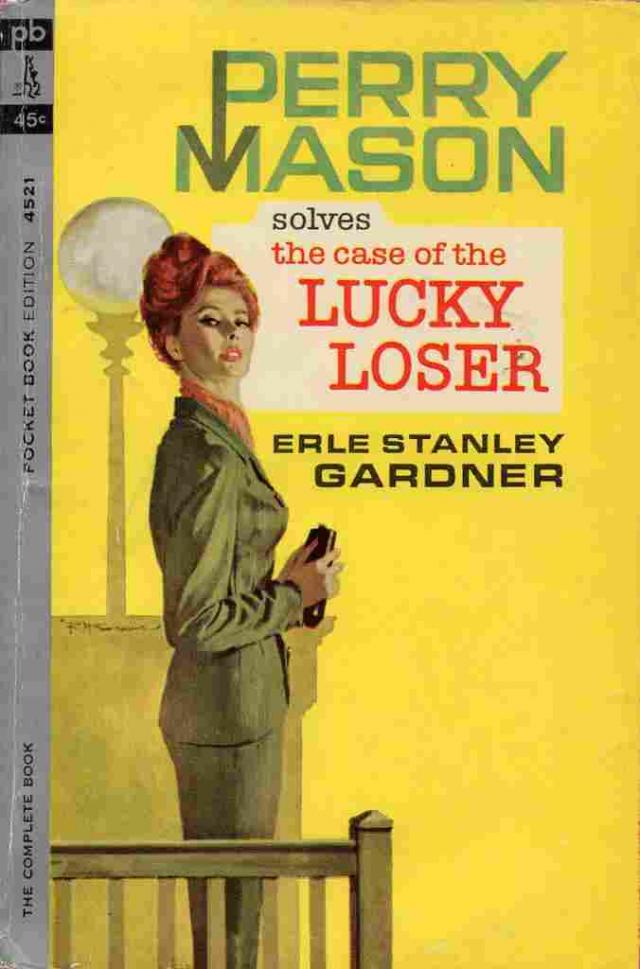
The case of the lucky lo.., p.3
The Case of the Lucky Loser,
p.3


“In a notebook?”
“Yes.”
“Where did you get that notebook?”
“From my purse.”
“You were driving the car?”
“Yes.”
“Was anyone with you?”
“No.”
“You took the notebook from your purse?”
“Yes.”
“And a pencil?”
“Not a pencil. A fountain pen.”
“And marked down the license number of the automobile?”
“Yes.”
“What was that license number?”
“GMB 665.”
“You have that notebook with you?”
“Yes, sir.”
“I would like to see it, please.”
The prosecutor smiled at the jury. “Not the slightest objection,” he said. “We’re very glad to let you inspect it.”
Howland walked up to the witness stand, took the notebook the witness gave him, thumbed through the pages, said, “This seems to be a notebook in which you kept a lot of data, various and sundry entries.”
“I don’t carry anything in memory which I can trust to paper.”
“Now then,” Howland said, “this number, GMB 665, is the last entry in the book.”
“That’s right.”
“That entry was made on September twentieth?”
“About twelve-thirty to one-thirty on the morning of September twentieth,” the witness stated positively.
“Why haven’t you made any entries after that?”
“Because, after I read about the accident, I reported to the police, the police took the book, and it was then given back to me with the statement that I should take good care of it because it would be evidence.”
“I see,” Howland said with elaborate politeness. “And how long did the police have the book?”
“They had the book for… I, don’t know. … quite a while.”
“And when was it given back to you?”
“Well, after the police had it, the district attorney had it.”
“Oh, the police gave it to the district attorney, did they?”
“I don’t know. I know the prosecutor was the one who gave it to me.”
“When?”
“This morning.”
“This morning?” Howland said, his voice showing a combination of incredulity and skeptical sarcasm. “And why did the prosecutor give it back to you this morning?”
“So I could have it on the witness stand.”
“Oh, so you would be able to say that you had the notebook with you?”
“I don’t know. I suppose that was it.”
“Now then, did you remember the license number?”
“Certainly I did. Just as I told you. It’s GMB 665.”
“When did you last see that license number?”
“When I handed you the book just a moment ago.”
“And when before that?”
‘This morning.”
“At what time this morning?”
“About nine o’clock this morning.”
“And how long did you spend looking at that number at about nine o’clock this morning?”
“I… I don’t know. I don’t know as it makes any difference.”
“Were you looking at it for half an hour?”
“Certainly not.”
“For fifteen minutes?”
“No.”
“For ten minutes?”
“I may have been.”
“In other words, you were memorizing that number this morning, weren’t you?”
“Well, what’s wrong with that?”
“How do you know that’s the same number?”
“Because that’s my handwriting, that’s the number just as I wrote it down.”
“Could you see the license number of the car ahead while you were writing this?”
“Certainly.”
“All the time you were writing?”
“Yes.”
“Isn’t it a fact that you looked at the license number, then stopped your car, got out your notebook, and—”
“Certainly not! It’s just as I told you. I took out my notebook while I was driving and wrote down the number.”
“You are right-handed?”
“Yes.”
“You had one hand on the wheel?”
“My left hand.”
“Arid were writing with your right hand?”
“Yes.”
“Do you have a fountain pen or a ball-point pen?”
“It’s a plain fountain pen.”
‘The top screws off?”
“Yes.”
“And you unscrewed that with one hand?”
“Certainly.”
“You can do that with one hand?”
“Of course. You hold the pen … that is, the barrel of the pen with the last two fingers, then use the thumb and forefinger to unscrew the cap.”
“Then what did you do?”
“I put the notebook down on my lap, wrote the number, then put the cap back on the pen and put the notebook and fountain pen back in my purse.”
“How far were you from the automobile when you were writing down this number?”
“Not very far.”
“Did you see the number all the time?”
“Yes.”
“Plainly?”
“Yes.”
“Did you write this number in the dark?”
“No.”
“No, apparently not. The number is neatly written. You must have had some light when you wrote it.”
“I did. I switched on the dome light so I could see what I was writing.”
“Now then,” Howland said, “if you had to memorize that number this morning after the prosecutor had given you your notebook, you didn’t know what that number was before he gave you the notebook, did you?”
“Well… you can’t expect a person to remember a number all that time.”
“So you didn’t know what it was this morning?”
“After I’d seen the book.”
“But not before that?”
“Well… no.”
Howland hesitated for a moment. “After you had written down this number you drove on home?”
“Yes.”
“Did you call the police?”
“Certainly. I told you I did.”
“When?”
“Later.”
“After you had read in the newspaper about this accident?”
“Yes.”
“That is, about the body having been found on this road?”
“Yes.”
“You didn’t call the police before that?”
“No.”
“Why did you write down this license number?”
Her eyes glittered with triumph. “Because I knew that the person who was driving the automobile was too drunk to have any business being behind the wheel of a car.”
“You knew that when you wrote down the license number?”
“Yes.”
“Then why did you write it down?”
“So I’d know what it was.”
“So you could testify against the driver?”
“So I could do my duty as a citizen.”
“You mean call the police?”
“Well, I thought it was my duty to make a note of the license number in case the driver got in any trouble.”
“Oh, so you could testify?”
“So I could tell the police about it, yes.”
“But you didn’t tell the police until after you’d read in the paper about a body having been found?”
“That’s right.”
“Even after you saw this mysterious blackout of the right headlight you didn’t call the police?”
“No.”
“You didn’t think there was any reason to call the police?”
“Not until after I’d read in the paper about the body.”
“Then you didn’t think there had been an accident when you got home, did you?”
“Well, I knew something had happened. I kept wondering what could have caused that blackout of that headlight.”
“You didn’t think there had been an accident?”
“I knew something had happened.”
“Did you or did you not think there had been an accident?”
“Yes, I realized there must have been an accident.”
“When did you realize this?”
“Right after I got home.”
“And you had taken this number so you could call the police in the event of an accident?”
“I took the number because I thought it was my duty to take it … yes.”
“Then why didn’t you call the police?”
“I think this has been asked and answered several times, Your Honor,” the prosecutor said. “I dislike to curtail counsel in his cross-examination, but this certainly has been gone over repeatedly in the same way and in the same manner.”
“I think so,” Judge Cadwell said.
“I submit, Your Honor, that her actions contradict her words, that her reasons contradict her actions.”
“You may have ample opportunity to argue the case to the jury. I believe the fact which you wished to establish by this cross-examination has been established,” Judge Cadwell said.
“That’s all,” Howland said, shrugging his shoulders and waving his hand as though brushing the testimony to one side.
“That’s all, Mrs. Haley,” the prosecutor said.
Mrs. Haley swept from the witness stand, marched down the aisle, seated herself on the aisle seat.
She turned to the young woman seated beside Perry Mason. “Was I all right?” Mrs. Haley asked in a whisper.
The young woman nodded.
Judge Cadwell looked at the clock, and adjourned court until two o’clock that afternoon.
CHAPTER 4
During The Afternoon Session the prosecution tied up a few loose ends and put on a series of technical witnesses. By three-thirty the case was ready for argument.
The prosecutor made a brief, concise argument, asked for a conviction, and sat down.
Mortimer Dean Howland, a criminal attorney of the old school, indulged in a barrage of sarcasm directed at the testimony of Myrtle Anne Haley, whom he characterized as “the psychic driver,” a “woman who could drive without even looking at the road.”
“Notice the driving activities of this woman,” Howland said. “When she first comes to our notice she is driving without looking at the road because she is getting her fountain pen and her notebook out of her purse. Then she is opening the notebook and making a note of the license number.
“Look at where she made this notation, ladies and gentlemen of the jury. She didn’t open the notebook at random and scribble the license number on any page she happened to come to. She carefully turned to the page which contained the last notebook entry; then she neatly wrote the license number of the automobile.
“Look at this exhibit,” Howland said, going over and picking up the notebook. “Look at the manner in which this number is written. Could you have written a license number so neatly if your eyes had been on the road while you were driving a car? Certainly not! Neither could this paragon of blind driving, this Myrtle Anne Haley. She was writing down this number with her eyes on the page of the notebook, not on the road.
“You’ll remember that I asked her on cross-examination if she had sufficient light to write by, and do you remember what she said? She said she turned on the dome light of the automobile, so that she would have plenty of light.
“Why did she need plenty of light? Because she was watching what she was writing, not where her car was going.
“If her eyes had been on the road, she wouldn’t have needed any light in the interior of the automobile. In fact, that light would have detracted from her ability to look ahead down the road. The reason she needed light, ladies and gentlemen, was because she was driving along, looking down at the page of the notebook as she wrote.
“She was driving at an even faster rate of speed than the car ahead because she admits she shot past that car. But, ladies and gentlemen, she didn’t have her eyes on the road.
“I’m willing to admit that some unfortunate person was struck by an automobile on that stretch of road. Who was more likely to have struck that person? The driver of the car ahead, or some woman who admits to you under oath that she was speeding along that road not looking where she went, with her eyes on the page of a notebook?
“And who was driving this automobile, the license number of which Myrtle Anne Haley was so careful to write down? The prosecution asked her all about the license number, but it never asked her who was driving the car! It never asked her even if a man was driving the car. For all we know, if she had been asked she may have said that a woman was driving the car.”
“Your Honor,” the prosecutor said, “I dislike to interrupt, but if the prosecution failed to cover that point, we ask to reopen the case at this time and ask additional questions of the witness, Myrtle Anne Haley.”
“Is there any objection?” Judge Cadwell asked.
“Certainly there’s an objection, Your Honor. That’s an old trick, an attempt to interrupt the argument of counsel for the defense and put on more testimony. It is an attempt to distract the attention of the jury and disrupt the orderly course of trial.”
“The motion is denied,” Judge Cadwell said.
Howland turned to the jury, spread his hands apart and smiled. “You see, ladies and gentlemen, the sort of thing we have been up against in this case. I don’t think I need to argue any more. I feel I can safely leave the matter to your discretion. I know that you will return the only fair verdict, the only just verdict, the only verdict that will enable you to feel that you have conscientiously discharged your sworn duty a verdict of NOT GUILTY—!”
Howland returned to his chair.
The prosecutor made a closing argument, the judge read instructions to the jury, and the jury retired.
Mason arose with the other spectators as court was adjourned, but Mortimer Dean Howland pushed his way to Masons side. “Well, well, well, Counselor. What brings you here?”
“Picking up some pointers on how to try a case.”
Howland smiled, but his eyes, gimleted in hard appraisal, burned under bushy eyebrows as they searched Mason’s face.
“You don’t need any pointers, Counselor. I thought I had glimpsed you in the crowd this morning, and then I was quite certain that you sat through the entire afternoon session. Are you interested in the case?”
“It’s an interesting case.”
“I mean are you interested professionally?”
“Oh, of course professionally,” Mason said with expansive indefiniteness. “I don’t know any of the parties. By the way, who was the person who was killed?”
“The body has never been identified,” Howland said. “Fingerprints were sent to the FBI, but there was no file. The person was evidently a drifter of some sort. The head had been thrown to the highway with a terrific impact. The skull was smashed like an eggshell. Then both wheels had gone completely over the head. The features were unrecognizable.”
“What about the clothing?”
“Good clothing, but the labels had been carefully removed. We thought, of course, that meant the decedent might have had a criminal record. But, as I say, there were no fingerprints on file.”
“Was this license number written in the notebook immediately under the other entries on the last page?” Mason asked.
“Come take a look,” Howland invited, placing a fraternal hand on Mason’s shoulder. “I’d like to have you take a look at that and tell me what you think.”
Howland led the way to the clerk’s desk. “Let’s look at that exhibit,” he said, “… the notebook.”
The clerk handed him the notebook.
Mason studied the small, neat figures near the bottom of the page.
“You couldn’t do that without a light to save your life,”
Howland said. “That woman wasn’t watching the road while she was writing down the figures.”
“I take it that you know the right headlight on her car wasn’t smashed,” Mason said.
“We know lots of things,” Howland observed, winking. “We also know that it’s an easy matter to get a headlight repaired. What’s your opinion of the case. Mason? What do you think the jurors will do?”
“They may not do anything.”
Howland’s voice was cautious. “You think it will be a hung jury?”
“It could be.”
Howland lowered his voice to a whisper. “Confidentially,” he said, “that’s what I was trying for. It’s the best I can hope to expect.”
CHAPTER 5
Mason sat at his desk, thoughtfully smoking. Della Street had cleaned up her secretarial desk, started for the door, returned for something which she had apparently forgotten, then she opened the drawers in her desk one after another, taking out papers, rearranging them.
Mason grinned. “Why don’t you just break down and wait, Della?”
“Heavens! Was I that obvious?”
Mason nodded.
She laughed nervously. “Well, I will wait for a few minutes.”
“The phone’s plugged in through the switchboard?”
“Yes. Gertie’s gone home. She left the main trunk line plugged through to your phone. In case this woman—”
Della Street broke off as the telephone rang.
Mason nodded to Della Street. “Since you’re here, better get on the extension phone with your notebook and take notes.”
Mason said, “Hello.”
The feminine voice which had discussed the matter of a retainer with him earlier in the day sounded eager. “Is this Mr. Mason?”
“Yes.”
“Did you get up to court today?”
“Certainly.”
“And what did you think?”
“Think of what?”
“Of the case.”
“I think probably it will be a hung jury.”
“No, no! Of the witness.”
“Which witness?”
“The redheaded woman, of course.”
“You mean Mrs. Myrtle Anne Haley?”
“Yes.”
“I can’t tell you.”
“You can’t tell me?” the voice said, sharp with suspicion. “Why that’s what you went up there for. You—”















