

The case of the lucky lo.., p.4
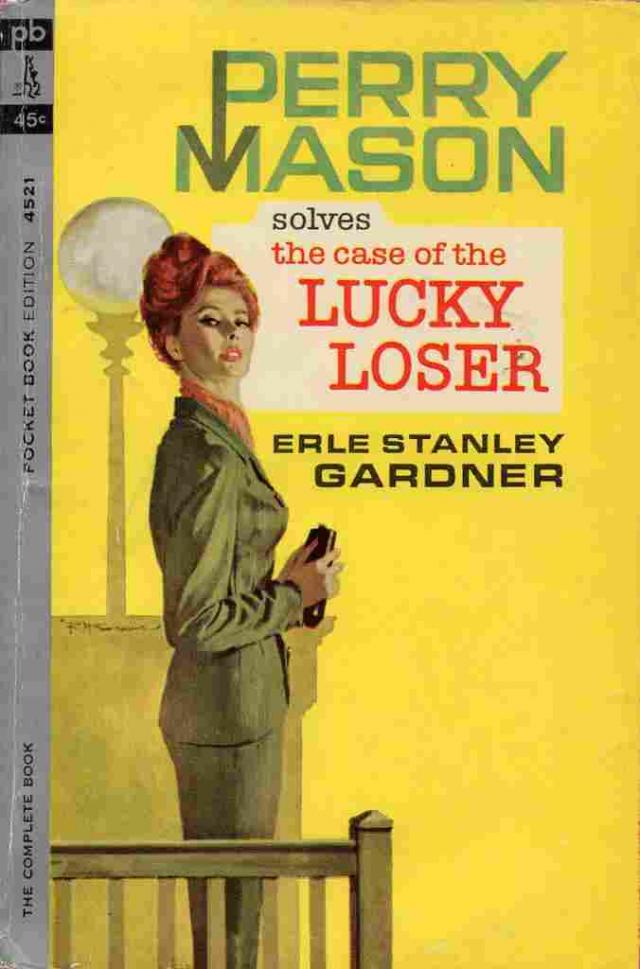
The Case of the Lucky Loser,
p.4


“I can’t discuss my opinion of Mrs. Haley’s testimony with a stranger,” Mason interrupted firmly.
“A stranger? Why, I’m your client. I—”
“How do I know you’re my client?”
“You should be able to recognize my voice.”
Mason said, “Voices” sound very much alike sometimes. I would dislike very much to have someone claim I had made a libelous statement which wasn’t a privileged communication.”
There was silence at the other end of the line, then the woman’s voice said, “Well, how could I identify myself?”
“Through a receipt that I gave the messenger who delivered the hundred dollars to me. When you produce that receipt, I’ll know that I’m dealing with the person who made the payment.”
“But, Mr. Mason, can’t you see? I can’t afford to have you know who I am. This whole business of using the messenger was to keep you from finding out.”
“Well, I can’t give my opinion of testimony unless I’m certain my statement is a privileged communication.”
“Is your opinion that bad?”
“I am merely enunciating a principle.”
“I … I already have that receipt, Mr. Mason. The messenger gave it to me.”
“Then come on up,” Mason said.
There was a long moment of silence.
“I took all these precautions so I wouldn’t have to disclose my identity,” the voice complained.
“I am taking all these precautions so as to be certain I’m talking to my client,” Mason said.
“Will you be there?”
“I’ll wait ten minutes. Will that be sufficient?”
“Yes.”
“Very well. Come directly to the side door,” Mason said.
“I think you’re horrid!” she exclaimed. “I didn’t want it like this.” She slammed the receiver at her end of the telephone.
Mason turned to Della Street, who had been monitoring the conversation. “I take it, Miss Street, that you have decided you’re not in a hurry to get home. You’d like to wait.”
“Try putting me out of the office,” she laughed. “It would take a team of elephants to drag me out.”
She took the cover off her typewriter, arranged shorthand notebooks, hung up her hat in the coat closet.
Again the telephone rang.
Mason frowned. “We should have cut out the switchboard as soon as we had our call, Della. Go cut it out now … Well, wait a minute. See who’s calling.”
Della Street picked up the telephone, said, “Hello,” then, “Who’s calling, please? … Where? … Well, just a moment. I think he’s gone home for the evening. I don’t think he’s available. I’ll see.”
She cupped her hand over the mouthpiece of the telephone and said, “A Mr. Guthrie Balfour is calling from Chihuahua City in Mexico. He says it’s exceedingly important.”
“Balfour?” Mason said. “That will be the uncle of young Ted Balfour, the defendant in this case. Looks like we’re getting dragged into a vortex of events, Della. Tell long distance you’ve located me and have her put her party on.”
Della Street relayed the message into the telephone and a moment later nodded to Mason.
Mason picked up the telephone.
A man’s voice at the other end of the line, sounding rather distant and faint, was nevertheless filled with overtones of urgency.
“Is this Perry Mason, the lawyer?”
“That’s right,” Mason said.
The voice sharpened with excitement. “Mr. Mason, this is Guthrie Balfour. I have just returned from the Tarahumare Indian country and I must get back to my base camp. I’ve received disquieting news in the mail here at Chihuahua. It seems my nephew, Theodore Balfour, is accused of a hit-and-run death.
“You must know of me, Mr. Mason. I’m quite certain you know of the vast industrial empire of the Balfour Allied Associates. We have investments all over the world—”
“I’ve heard of you,” Mason interrupted. “The case involving your nephew was tried today.”
The voice sounded suddenly dispirited and dejected. “What was the verdict?”
“As far as I know, the jury is still out.”
“It’s too late to do anything now?”
“I think perhaps it will be a hung jury. Why do you ask?”
“Mr. Mason, this is important! This is important as the devil! My nephew must not be convicted of anything.”
“He can probably get probation in case he’s convicted,” Mason said. “There are certain facts about the case that make it very peculiar. There are certain discrepancies—”
“Of course there are discrepancies! Can’t you understand? The whole thing is a frame-up. It’s brought for a specific purpose. Mr. Mason, I can’t get away. I’m down here on an archeological expedition of the greatest importance. I’m encountering certain difficulties, certain hazards, but I’m playing for big stakes. I..… Look, Mr. Mason, I’ll tell you what I’ll do. I’ll put my wife aboard the night plane tonight. She should be able to make connections at El Paso and be in your office the first thing in the morning. What time do you get to your office?”
“Sometime between nine and ten.”
“Please, Mr. Mason, give my wife an appointment at nine o’clock in the morning. I’ll see that you’re amply compensated. I’ll see that you—”
“The attorney representing your nephew,” Mason interrupted, “is Mortimer Dean Howland.”
“Howland!” the voice said. “That browbeating, loudmouthed bag of wind. He’s nothing but a medium-grade criminal attorney, with a booming voice. This case is going to take brains, Mr. Mason. This … I can’t explain. Will you give my wife an appointment for tomorrow morning at nine o’clock?”
“All right,” Mason said. “I may not be free to do what you want me to do, however.”
“Why?”
“I have some other connections which may bring about a conflict,” Mason said. “I can’t tell you definitely, but…well, anyway. I’ll talk with your wife.”
“Tomorrow at nine.”
“That’s right.”
‘Thank you so much.”
Mason hung up. “Well,” he said to Della Street, “we seem to be getting deeper and deeper into the frying pan.”
“Right in the hot fat,” Della observed. “I-” She broke off as a nervous knock sounded on the door of Mason’s private office.
Della crossed over and opened the door.
The young woman who had been seated next to Perry Mason in the courtroom entered the office.
“Well, good evening,” Mason said. “You weren’t very cordial to me earlier in the day.”
“Of course not!”
“You wouldn’t even give me the time of day.”
“I… Mr. Mason, you … you’ve jockeyed me into a position … well, a position in which I didn’t want to be placed.”
“That’s too bad,” the lawyer said. “I was afraid you were going to put me in a position in which I didn’t want to be placed.”
“Well, you know who I am now.”
“Sit down,” Mason said. “By the way, just who are you… other than Cash?”
“My name is Marilyn Keith, but please don’t make any further inquiries.”
“Just what is your relationship to Myrtle Anne Haley?”
“Look here, Mr. Mason, you’re cross-examining me. That’s not what I wanted. I wanted certain information from you. I didn’t want you even to know who I am.”
“Why?”
“That’s neither here nor there.”
Mason said, “You’re here and it’s here. Now what’s this all about?”
“I simply have to know the real truth—and that gets back to Myrtle Haley’s testimony.”
“Do you know the man who was killed?”
“No.”
“Yet,” Mason said, “you have parted with a hundred dollars of your money, money which, I take it, was withdrawn from a rainy-day fund, to retain me to listen to the case in court so you could ask me how I felt about the testimony of Myrtle Anne Haley?”
“That’s right. Only the money came from … well, it was to have been my vacation fund.”
“Vacation?”
“Mine comes next month,” she said. “I let the other girls take theirs during the summer. I had intended to go to Acapulco … I will, anyway, but… well, naturally I hated to draw against my vacation fund. However, that’s all in the past now.”
“You have the receipt?” Mason asked.
She opened her purse, took from it the receipt which Della Street had given the messenger, and handed it to him.
Mason looked the young woman in the eyes. “I think Myrtle Haley was lying.”
For a moment there was a flicker of expression on her face, then she regained her self-control. “Lying deliberately?”
Mason nodded. “Don’t repeat my opinion to anyone else. To you this is a privileged communication. If you repeat what I said to anyone, however, you could get into trouble.”
“Can you… can you give me any reasons for your conclusions, Mr. Mason?”
“She wrote down the license number of the automobile,” Mason said. “She wrote it down in her notebook in exactly the right place and—”
“Yes, of course. I heard the argument of the defense attorney,” Marilyn interrupted. “It sounds logical. But on the other hand, suppose Myrtle did take her eyes off the road? That would only have been for a minute. She didn’t have her eyes off the road all the time she was writing. She just glanced down at the notebook to make certain she had the right place and—”
Mason picked up a pencil and a piece of paper. “Write down the figure six,” he instructed Marilyn Keith.
She wrote as he directed.
“Now,” Mason said, “get up and walk around the room and write another six while you’re walking.”
She followed his instructions.
“Compare the two figures,” Mason told her.
“I don’t see any difference.”
“Bring them over here,” Mason said, “and I’ll show you some difference.”
She started over toward the desk.
“Wait a minute,” Mason said. “Write another figure six while you’re walking over here.”
She did so, handed him the pad of paper with the three sixes on it.
“This is the six that you wrote while you were sitting down,” Mason said. “You’ll notice that the end of the line on the loop of the six comes back and joins the down stroke. Now, look at the two figures that you made while you were walking. In one of them the loop of the six stops approximately a thirty-second of an inch before it comes to the down stroke, and on the second one the end of the loop goes completely through the down stroke and protrudes for probably a thirty-second of an inch on the other side.
“You try to write the figure six when you’re riding in an automobile and you’ll do one of two things. You’ll either stop the end of the loop before you come to the down stroke or you’ll go all the way through it. It’s only when you’re sitting perfectly still that you can bring the end of the six directly to the down stroke and then stop.
“Now, if you’ll notice the figure GMB 665 that Myrtle Anne Haley claims she wrote while she was in a moving automobile, with one hand on the steering wheel, the other hand holding a fountain pen, writing in a notebook which was balanced on her lap, you’ll note that both of the figures are perfect. The loops join the down strokes, so that the loops are perfectly closed. The chances that that could have been done twice in succession by someone who was in a moving automobile, going over the road at a good rate of speed under the circumstances described by Myrtle Anne Haley, are just about one in a million.”
“Why didn’t the defense attorney bring that out?” she asked.
“Perhaps it didn’t occur to him,” Mason said. “Perhaps he didn’t think he needed to.”
She was silent for several seconds, then asked, “Is there anything else?”
“Lots of things,” Mason said. “In addition to a sort of sixth sense which warns a lawyer when a witness is lying, there is the question of distance.
“If Mrs. Haley passed that car at the point she says she did, and then looked in the real-view mirror as she says she did, she must have been crossing State Highway when she saw the light go out. She’d hardly have been looking in her rear-view mirror while she was crossing State Highway.”
“Yes, I can see that,” the young woman admitted. “That is, I can see it now that you’ve pointed it out.”
Mason said, “Something caused you to become suspicious of Myrtle Haley’s testimony in the first place. Do you want to tell me about it?”
She shook her head. “I can’t.”
“Well,” Mason said, “you asked me for my opinion. You paid me a hundred dollars to sit in court and form that opinion. I have now given it to you.”
She thought things over for a moment, then suddenly got up to give him her hand. “Thank you, Mr. Mason. You’re … you’re everything that I expected.”
“Don’t you think you’d better give me your address now?” Mason said. “One that we can put on the books?”
“Mr. Mason, I can’t! If anyone knew about my having been to you, I’d be ruined. Believe me, there are interests involved that are big and powerful and ruthless. I only hope I haven’t gone so far as to get you in trouble.”
Mason studied her anxious features. “Is there any reason as far as you are concerned why I can’t interest myself in any phase of the case?”
“Why do you ask that question?”
“I may have been approached by another potential client.”
She thought that over. “Surely not Myrtle Haley!”
“No,” Mason said. “I would be disqualified as far as she is concerned.”
“Well, who is it?” she asked.
“I’m not free to tell you that. However, if there is any reason why I shouldn’t represent anyone who is connected with the case in any way, please tell me.”
She said, “I would love to know the real truth in this case. If you become connected with it you’ll dig out that truth … and I don’t care who retains you. As far as I’m concerned, you are free to go ahead in any way, Mr. Mason.” She crossed to the door in one quick movement. “Good night,” she said, and closed the door behind her.
Mason turned to Della Street. “Well?” he asked.
“She doesn’t lie very well,” Della said.
“Meaning what?”
“She didn’t dig into her vacation money just to get your opinion of Myrtle’s testimony.”
“Then why did she do it?”
“I think” Della Street said, “she’s in love, and I know she’s frightened.”
CHAPTER 6
Perry Mason latchkeyed the door of his private office, hung up his hat.
Della Street, who was there before him, asked, “Have you seen the morning papers?” She indicated the papers on Mason’s desk.
He shook his head.
“There was a hung jury in the case of People versus Ted Balfour. They were divided evenly—six for acquittal and six for conviction.”
“So what happened?” Mason asked.
“Apparently, Howland made a deal with the prosecutor. The Court discharged the jury and asked counsel to agree on a new trial date.
“At that time Howland got up, said that he thought the case was costing the state altogether too much money in view of the issues involved. He stated that he would be willing to stipulate the case could be submitted to Judge Cadwell, sitting without a jury, on the same evidence which had been introduced in the jury trial.
“The prosecutor agreed to that. Judge Cadwell promptly announced that under those circumstances he would find the defendant guilty as charged, and Howland thereupon made a motion for suspended sentence. The prosecutor said that under the circumstances and in view of the money that the defendant had saved the state, he would not oppose such a motion, provided the defendant paid a fine. He said he would consent that the matter be heard immediately.
“Judge Cadwell stated that in view of the stipulation by the prosecutor, he would give the defendant a suspended jail sentence and impose a fine of five hundred dollars.”
“Well, that’s interesting,” Mason said. “It certainly disposed of the case of People versus Balfour in a hurry. We haven’t heard anything from our client of yesterday, have we, Della?”
“No, but our client of today is waiting in the office.”
“You mean Mrs. Balfour?”
“That’s right.”
“How does she impress you, Della? Does she show signs of having been up all night?”
Della Street shook her head. “Fresh as a daisy. Groomed tastefully and expensively. Wearing clothes that didn’t come out of a suitcase. She really set out to make an impression on Mr. Perry Mason.
“Apparently she chartered a plane out of Chihuahua,” flew to El Paso in time to make connections with one of the luxury planes, arrived home, grabbed a little shut-eye and then this morning started making herself very, very presentable.”
“Good-looking?” Mason asked.
“A dish.”
“How old?”
“She’s in that deadly dangerous age between twenty-seven and thirty-two. That’s about as close as I can place her.”
“Features?” Mason asked.
“She has,” Della Street said, “large brown expressive eyes, a mouth that smiles to show beautiful pearly teeth—in short, she’s a regular millionaire’s second wife, an expensive plaything. And even so, Mr. Guthrie Balfour must have done a lot of window-shopping before he had this package wrapped up.”
“A thoroughly devoted wife,” Mason said, smiling.
“Very, very devoted,” Della Street said. “Not to Mr. Guthrie Balfour, but to Mrs. Guthrie Balfour. There’s a woman who’s exceedingly loyal to herself.”
“Well, get her in,” Mason said. “Let’s have a look at her. Now, she’s a second wife, so really she’s no relation to young Ted Balfour.”
“That’s right. You’ll think I’m catty,” Della Street observed, “but I’ll tell you something, Mr. Perry Mason.”
“What?”
“You’re going to fall for her like a ton of bricks. She’s just the type to impress you.”















