

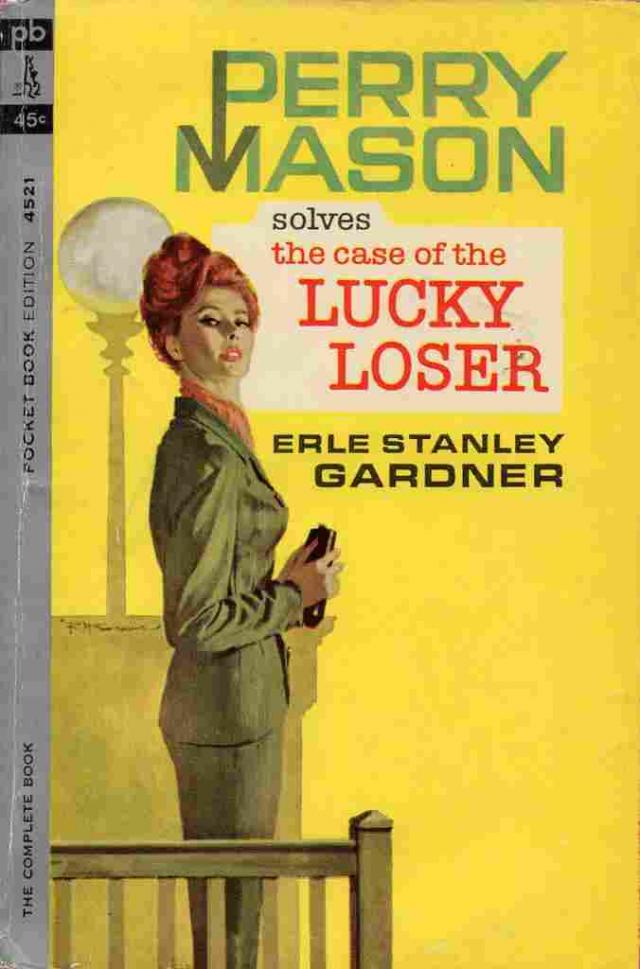
The case of the lucky lo.., p.8
The Case of the Lucky Loser,
p.8


“That should do it,” Mason said.
He continued prying the latch back with his knife, holding it in position with the point of the nail file until he could get another purchase on the lock with the knife point. After a few moments the latch clicked back and the door swung open.
Mason hurriedly inspected the small-caliber rifles, paying no attention to the shotguns or the high-powered rifles.
“Well?” she asked, as Mason smelled the barrels.
“None of them seems to have been freshly fired,” Mason said. “Of course, they could have been cleaned.”
He opened a drawer in the cabinet, disclosing half a dozen revolvers. He pounced on a .22 automatic, smelled the end of the barrel thoughtfully.
“Well?” Mrs. Balfour asked.
Mason said, “This could be it.”
He replaced the .22, pushed the drawer shut, closed the glass doors of the cabinet. The spring lock latched into place.
Mason opened the door to the tile bathroom, looked inside, opened the door of the medicine cabinet, opened the door of the closet, and regarded the long array of suits.
“There had been a going-away party in honor of your husband and you the night of September nineteenth?” Mason asked.
She nodded.
“That’s when Ted Balfour got—”
“Became indisposed,” she interrupted firmly.
“Became indisposed,” Mason said. “Do you know what clothes he was wearing that night?”
She shook her head. “I can’t remember.”
“Was it informal or black tie?”
“No, it was informal. You see, my husband was leaving on a train for Mexico.”
“You accompanied him?”
“Yes. He had intended to go alone and have me ride with him only as far as the Pasadena-Alhambra station. But at the last minute he changed his mind and asked me to go all the way. I didn’t have a thing to wear. I… well, I was a little put out.”
Della Street said, “Good heavens! I can imagine you would be annoyed, starting out without … You mean, you didn’t have a thing?”
“Not even a toothbrush,” she said. “I had a compact in my handbag and fortunately I had a very small tube of cream that I use to keep my skin soft when the weather is hot and dry. Aside from that, I just had the clothes I was standing in. Of course, it wasn’t too bad. I was able to pick up an outfit at El Paso, and then I got some more clothes at Chihuahua.
“My husband is an ardent enthusiast when it comes to his particular hobby. He had received some information on new discoveries to be made in the Tarahumare country in Mexico, Those Tarahumare Indians are very primitive and they live in a wild country, a region of so-called barrancas, which are like our Grand Canyon, only there are hundreds and hundreds of miles of canyon—”
“What’s this?” Mason asked, pouncing on a heavy, square package at the far end of the closet.
“Heavens! I don’t know. It looks like some kind of an instrument.”
“It’s a tape recorder,” Mason said, “and here’s something else that apparently goes with it. Does Ted go in for hi-fi?”
She shook her head. “Not unless it’s something new with him. He’s not much on music. He goes in more and more for outdoor sports. He wanted to go with my husband on this trip, and Guthrie almost decided to take him, but because of Addison’s condition and because my husband felt that Addison wouldn’t like having Ted go on the expedition, it was decided Ted should remain here. I now wish to heaven we’d taken him!”
“Ted didn’t like the decision?”
“He was very disappointed, Mr. Mason.”
“All right,” Mason said. “Let’s be brutally frank. Do you have an alibi for the night of the nineteenth?”
“Heavens, yes, the best in the world. I was on the train with my husband.”
“Well,” Mason said, “you may be asked—”
He broke off as chimes sounded through the house.
Mason said, “That may be the police. Are there back stairs?”
She nodded.
Mason said, “Well go down the back way. Della, you get my car, drive it around to the garage. I’ll get in the car in the garage. Don’t tell the officers anything about the stuff I’ve taken, Mrs. Balfour. You’d better go and talk with them yourself.”
Mrs. Balfour flashed him a smile. “We have the utmost confidence in you, Mr. Mason. The whole family does.” She glided out of the room.
“Still using her hips,” Della Street said.
“Never mind that,” Mason told her. “Grab that other package. I’ll take this.”
“Chief, are we supposed to do this?”
“It depends on how you look at it,” Mason told her. “Come on. Let’s get down the back stairs. I’ll walk over to the garage. Della, you walk around the front of the house very innocently and very leisurely. If there’s an officer sitting in the car out in front, flash him a smile. If the car is empty, as I hope will be the case, you can be in a little more of a hurry than you would otherwise. Drive back to the garage, pick me up and we’ll get out of here.”
Mason carried the heavy tape recorder down the back stairs. Della Street carried the smaller package.
They made an exit through the kitchen, down the steps of the service porch. Mason hurried out toward the garage. Della Street swung to the left around the house, her feet crunching gravel as she walked with a quick, brisk step.
“More casually,” Mason cautioned.
She nodded and slowed down.
Mason turned toward the garage, entered and waited until he saw the car, with Della Street at the wheel, come sweeping around the driveway.
“Police?” Mason asked.
She nodded. “It’s a police car. Red spotlight. Intercommunicating system and—”
“Anyone in it?”
“No.”
Mason grinned. “That’s a break.”
He opened the rear door of the car, put the tape recorder and the other square package on the back floor, slammed the door shut, jumped in beside Della and said, “Let’s go!”
Della Street swung the car in a swift circle, poured gas into the motor as she swept down the curving driveway.
“Okay,” Mason cautioned. “Take it easier now as we come out on this road. Don’t try to make a left turn. We may run into more police cars. Turn right and then make another right turn a mile or so down here. That’ll be Chestnut Street and that will bring us to Sycamore Road. We can get back on that.”
Della made a right turn as she left the driveway.
Perry Mason, looking back through the rear window of the car, suddenly whirled his head, settled down in the seat.
“Something?” Della Street asked.
“Two police cars just turning in from the State Highway,” Mason said. “Apparently we made it in the nick of time.”
CHAPTER 11
Back in his office Mason found a jubilant Paul Drake.
“We’re ahead of the police all the way. Perry.”
“How come?”
“That car Jackson Eagan rented,” Drake said, “there was a driver’s license number on the records.”
“What was it?”
“License number Z490553,” Drake said.
“Able to trace it?”
“There again we had success. I got in touch with my correspondent in Sacramento. He rushed a man down to the motor vehicle department. That is the number of a driver’s license issued to Jackson Eagan, who lives in Chico, a city about two hundred miles north of San Francisco in the Sacramento Valley.”
“You have the address?”
“I have the address,” Drake said. “I have the guy’s physical description from the driver’s license and our correspondent in Chico is checking on Jackson Eagan right now.”
“What’s the description?” Mason asked.
Drake read off his notes: “Male, age 35, height 5 feet 10 inches, weight 175 pounds, hair dark, eyes blue.”
“That helps,” Mason said. “Now tell me, Paul, what the devil is this?”
Mason removed the cover from the tape recorder.
“That’s a darn good grade of a high-fidelity tape recorder,” Drake said. “It has variable speeds. It will work at one and seven-eighths inches a second, or at three and three quarter inches a second. At one and seven-eighths inches a second it will run for three hours on one side of a spool of long-playing tape.”
“You understand how this particular model works?” Mason asked.
“Perfectly. We use them in our work right along. This is a high-grade model.”
“All right,” Mason said, “let’s see what’s recorded on this tape.”
“It’s the latest long-playing tape,” Drake said, plugging in the machine. “You get an hour on one of these spools at three and three-quarter inches to the second, or an hour and a half if you use the long-playing tape. At one and seven-eighths inches per second you get three hours on one side of the tape.”
“What’s the reason for the difference in speed?” Mason asked.
“Simply a question of fidelity. You use seven and a half inches for music, three and three-quarter inches for the human voice where you want high fidelity, but you can get a very satisfactory recording at one and seven-eighths.”
“Okay,” Mason said. “Let’s see what’s on the tape.”
“I guess the machine’s warmed up enough now,” Drake said. He threw a switch.
The spool of tape began to revolve slowly, the tape being taken up on the other spool, feeding through the listening head on the machine.
“Seems to be nothing.” Drake said after a moment.
“Keep on,” Mason said. “Let’s be certain.”
They sat watching the tape slowly move through the head of the machine for some three or four minutes.
Drake shook his head. “Nothing on it. Perry.”
Mason regarded the machine in frowning contemplation.
“Of course,” Drake said, “there might be something on the other side. This is a half-track recording. You record on one side of the tape, then reverse the spools and record on the other half of the tape. That is, the recording track is divided into two segments and—”
“Reverse it,” Mason said. “Let’s see if there’s something on the other track.”
Drake stopped the machine, reversed the spool. Again the tape fed through the head of the machine, again there was nothing until suddenly a woman’s voice coming from the machine said, “… fed up with the whole thing myself. You can stand only so much of this gilded—” There followed complete silence.
Drake manipulated the controls on the machine. There was no further sound.
“Well?” Mason asked.
Drake shook his head. “I don’t get it.”
“Let’s take a look at this other box,” Mason said. “What’s that?”
Drake opened the box. His eyes suddenly glistened with appreciation. “This,” he said, “is really something.”
“All right, what is it?”
“A wall snooper,” Drake said.
“What’s that, Paul?”
“A very sensitive mike with an electric boosting device. You fasten it to a wall and sounds of conversation in the next room that you can’t even hear come in on this mike, are amplified and go on the tape. Then you can plug in earphones, and as the tape goes through a second head, you can hear what’s been recorded.
“That’s the reason for what we heard on the tape, Perry. The device had been used for a snooping job, then the tape had been fed through the erasing head. They quit erasing on the last few inches of the second half-track and a few words were left.”
Mason thought that over. “Why would Ted Balfour have been doing a snooping job, Paul?”
“Perhaps a gag,” Drake said. “Perhaps a girl friend. It could be any one of a hundred things. Perry.”
Mason nodded. “It could even be that he was checking up on his uncle’s new model wife,” he said.
“And the job wound up in murder?” Drake asked.
“Or the job wound up by his having a murder wished on him,” Mason observed.
Knuckles tapped on the exit door of Mason’s private office.
“That’s my secretary,” Drake said, listening to the rhythm of the code knock.
Della Street opened the door.
“Please give this to Mr. Drake,” the secretary said, handing Della a sheet of paper on which there was a typewritten message.
Della Street handed it across to Paul Drake.
“Well, I’ll be damned,” Drake said.
“What is it?” Mason asked.
‘Telegram from my correspondent in Chico. Listen to this:
“JACKSON EAGAN WELL-KNOWN TRAVEL WRITER RESIDING THIS CITY. MOVED AWAY. HAD TROUBLE TRACING, BUT FINALLY FOUND RESIDED BRIEFLY AT MERCED THEN WENT TO YUCATAN, WHERE HE DIED TWO YEARS AGO. BODY SHIPPED HOME FOR BURIAL. CLOSED COFFIN. WIRE INSTRUCTIONS.”
Drake ran his fingers through his hair. “Well, Perry, now we’ve had everything. Here’s a case where the corpse died twice.”
Mason nodded to Della Street. “Get out blanks for a petition for habeas corpus,” he said. “We’re going to file a habeas corpus for Ted Balfour. I have a hunch that it’s up to me to work out a legal gambit which will keep the real facts in this case from ever being brought out.”
“How the hell are you going to do that?” Drake asked.
Mason grinned. “There’s a chance, Paul.”
“One chance in a million,” Drake said.
“Make it one in five,” Mason told him. “And let’s hope it works, Paul because I have a feeling that the true facts in this case are so loaded with explosive they could touch off a chain reaction.”
CHAPTER 12
Judge Cadwell assumed his seat on the bench, glanced down at the courtroom and said, “Now, this is on habeas corpus in the case of Theodore Balfour. A petition was filed, a writ of habeas corpus issued, and this is the hearing on the habeas corpus. I assume that the writ was applied for in connection with the usual practice by which an attorney who is denied the right to communicate with a client applies for a writ of habeas corpus to force the hand of the prosecutor.”
Roger Farris, the deputy district attorney, arose and said, “That is correct, Your Honor. We have now filed a complaint on the defendant, accusing him of the crime of murder of one Jackson Eagan, who was then and there a human being, the murder committed with premeditation and malice afore thought, making the crime first-degree murder.
“The prosecution has no objection to Mr. Perry Mason, as attorney for the defendant, interviewing the defendant at all seasonable and reasonable times.”
“I take it then,” Judge Cadwell said, glancing down at Perry Mason, “it may be stipulated that the writ can be vacated and the defendant remanded to the custody of the sheriff.”
“No, Your Honor,” Mason said.
“What?” Judge Cadwell rasped.
“No such stipulation,” Mason said.
“Well, the Court will make that ruling anyway,” Judge Cadwell snapped. “It would certainly seem that if this man is charged with murder—Now, wait a minute. The Court will not accept the statement of the prosecutor to that effect. You had better be sworn as a witness, Mr. Prosecutor, unless the facts appear in the return to the writ on file in this court.”
“They do, Your Honor. The facts are undisputed. Even if they weren’t, the Court could take judicial cognizance of its own records.”
“Very well,” Judge Cadwell said.
“May I be heard?” Mason asked.
“I don’t see what you have to be heard about, Mr. Mason. You surely don’t contend that where a petitioner has been formally charged with the crime of first-degree murder and has been duly booked on that crime that he is entitled to be released on habeas corpus, do you?”
“In this case, Your Honor, yes.”
“What’s the idea?” Judge Cadwell asked. “Are you being facetious with the Court, Mr. Mason?”
“No, Your Honor.”
“Well, state your position.”
“The Constitution,” Mason said, “provides that no man shall be twice put in jeopardy for the same offense. Your Honor quite recently reviewed the evidence in the case of People versus Balfour and found him guilty of involuntary manslaughter.”
“That was committed with an automobile,” Judge Cadwell said. “As I understand it, this is an entirely different case.”
“It may be an entirely different case,” Mason said, “but the prosecution is barred because this man has already been tried and convicted of the crime of killing this same Jackson Eagan.”
“Now just a minute,” Judge Cadwell said as the prosecutor jumped to his feet. “Let me handle this, Mr. Prosecutor.
“Mr. Mason, do you contend that because the People mistakenly assumed that this was a hit-and-run case and prosecuted the defendant under such a charge, the People are now barred from prosecuting him for first-degree murder—a murder which, so far as the record in the present case discloses, was perpetrated with a lethal weapon? I take it that is a correct statement, is it not, Mr. Prosecutor?”
“It is, Your Honor,” Roger Farris said. “It is our contention that Jackson Eagan was killed with a bullet which penetrated his brain and caused almost instant death. We may state that the evidence supporting our position is completely overwhelming. The bullet went into the head but did not emerge from the head. The bullet was found in the brain when the body was exhumed and that bullet has been compared by ballistics experts with a weapon found in the bedroom of Theodore Balfour, the defendant herein, a weapon which was the property of the defendant. The fatal bullet was discharged from that weapon.
“It was quite apparent what happened. An attempt was made to dispose of the victim by having it appear that the man had died as the result of a hit-and-run accident.
“We are perfectly willing, if Mr. Mason wishes, to move to dismiss the former charge of involuntary manslaughter against Mr. Balfour so that he can be prosecuted on a charge of first-degree murder.”
“I don’t request any such thing,” Mason said. “The defendant has been tried, convicted, and sentenced for the death of Jackson Eagan.”















