

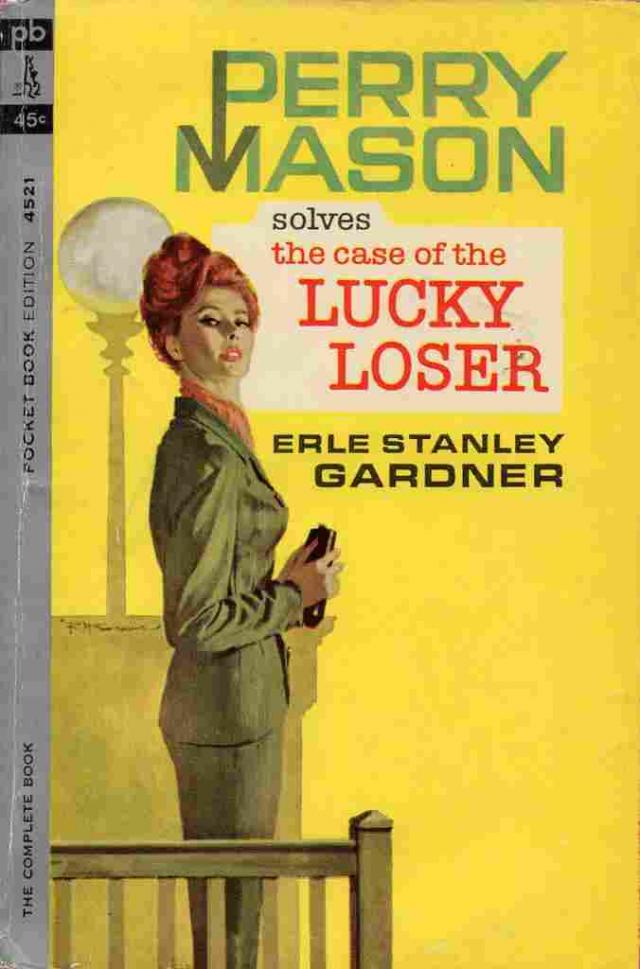
The case of the lucky lo.., p.6
The Case of the Lucky Loser,
p.6


“Ted was in his bedroom the next morning?” Mason asked.
“Apparently he was. He told me he became conscious at four thirty-five in the morning. Someone had taken him upstairs, undressed him, and put him to bed.”
“Or he undressed himself and put himself to bed,” Mason said.
“He was in no condition to do that.”
“Any idea who this girl was?” Mason asked.
“Not yet. Ted either doesn’t know or won’t tell. Apparently, she was some trollop from the wrong side of the tracks.”
Mason’s frown showed annoyance.
“All right, all right,” she said. “I’m out of order. I’m not a snob. Remember, Mr. Mason, I came from the wrong side of the tracks myself, and I made it, but I’m just telling you it’s a long, hard climb. And also remember, Mr. Mason, you’re working for me.”
“The hell I am,” Mason said. “You’re paying the bill, but I’m working for my client.”
“Now don’t get stuffy,” she said, flashing her teeth in a mollifying smile. “I had Ted write a check covering Howland’s fees in full and I explained to Mr. Howland that as far as Mr. Guthrie Balfour and I were concerned, we preferred to have all further legal matters in connection with the case handled by Mr. Perry Mason.”
“And what did Howland say then?”
“Howland threw back his head, laughed and said. ‘If it’s a fair question, Mrs. Balfour, when did you get back from Mexico?’ and I told him that I didn’t know whether it was a fair question or not, but there was no secret about it and I got back from Mexico on a plane which arrived half an hour past midnight, and then he laughed again and said that if I had arrived twenty-four hours sooner he felt certain he wouldn’t have had the opportunity to represent Ted as long as he did.”
“He was a little put out about it?” Mason asked.
“On the contrary, he was in rare good humor. He said that he had completed his representation of Ted Balfour, that the case was closed, and that if Mr. Mason knew as much about the case as he did, Mason would realize the over-all strategy had been brilliant.”
“Did he say in what respect?”
“No, but he gave me a letter for you.”
“Indeed,” Mason said.
She unfolded the letter and extended it across the desk.
The letter was addressed to Perry Mason and read:
MY DEAR COUNSELOR,
I now begin to see a great light. I trust your time in court was well spent, but don’t worry. There are no hard feelings. You take on from here and more power to you. I consider myself completely relieved of all responsibilities in the case of the People versus Ted Balfour, and I am satisfied, not only with the compensation I have received, but with the outcome of my strategy. From here on, the Balfour family is all yours. They consider me a little crude and I consider them highly unappreciative in all ways except insofar as financial appreciation is concerned. I can assure you that those matters have been completely taken care of, so consider yourself free to gild the lily or paint the rose in any way you may see fit, remembering only that it’s advisable to take the temperature of the water before you start rocking the boat.
With all good wishes,
MORTIMER DEAN HOWLAND
“A very interesting letter,” Mason said, handing it to Mrs. Balfour,
“Isn’t it?” she remarked dryly after having read it. She returned it to Perry Mason.
“Now, what do you want me to do?” Mason asked.
“The first thing I want you to do,” she said, “is to go and see Addison Balfour. He’s in bed. He’ll never get out of bed. You’ll have to go to him.”
“Will he see me?”
“He’ll see you. I’ve already telephoned for an appointment.”
“When?” Mason asked.
“I telephoned about thirty minutes ago. The hour of the appointment, however, is to be left to you. Mr. Addison Balfour will be very happy to see the great Perry Mason.
Mason turned to Della Street. “Ring up Addison Balfour’s secretary,” he said, “and see if I can have an appointment for three o’clock.”
CHAPTER 9
Some two years earlier, when the doctors had told Addison Balfour that he had better “take it easy for a while,” the manufacturing magnate had moved his private office into his residence.
Later on, when the doctors had told him frankly that he had but six months to live at the outside, Addison Balfour had moved his office into his bedroom.
Despite the sentence of death which had been pronounced upon him, he continued to be the same old irascible, unpredictable fighter. Disease had ravaged his body, but the belligerency of the man’s mind remained unimpaired.
Mason gave his name to the servant who answered the door.
“Oh, yes, Mr. Mason. You are to go right up. Mr. Balfour is expecting you. The stairs to the left, please.”
Mason climbed the wide flight of oak stairs, walked down the second floor toward a sign which said “Office,” and entered through an open door, from behind which came the sound of pounding typewriters.
Two stenographers were busily engaged in hammering keyboards. A telephone operator sat at the back of a room, supervising a switchboard.
At a desk facing the door sat Marilyn Keith.
“Good afternoon,” Mason said calmly and impersonally as though he had never before seen her. “I am Mr. Mason. I have an appointment with Mr. Addison Balfour.”
“Just a moment, Mr. Mason. I’ll tell Mr. Balfour you’re here.”
She glided from the room through an open doorway and in a moment returned.
“Mr. Balfour will see you now, Mr. Mason,” she said in the manner of one reciting a prepared speech which had been repeated so many times and under such circumstances that the repetition had made the words almost without meaning. “You will understand, Mr. Mason, that Mr. Addison Balfour is not at all well. He is, for the moment, confined to his bed. Mr. Balfour dislikes to discuss his illness with anyone. You will, therefore, please try to act as though the situation were entirely normal and you were seeing Mr. Balfour in his office. However, you will remember he is ill and try to conclude the interview as soon as possible.
“You may go in now.”
She ushered Mason through the open door, along a vestibule, then swung open a heavy oaken door which moved on well-oiled hinges.
The man who was propped up in bed might have been made of colorless wax. His high cheekbones, the gaunt face, the sunken eyes, all bore the unmistakable stamp of illness. But the set of his jaw, the thin, determined line of his mouth showed the spirit of an indomitable fighter.
Balfour’s voice was not strong. “Come in, Mr. Mason,” he said in a monotone, as though he lacked the physical strength to put even the faintest expression in his words. “Sit down here by the bed. What’s all this about Ted getting convicted?”
Mason said, “The attorney who was representing your nephew appeared to think that the interests of expediency would best be served by making a deal with the district attorney’s office.”
“Who the hell wants to serve the interests of expediency?” Balfour asked in his colorless, expressionless voice.
“Apparently your nephew’s attorney thought that would be best under the circumstances.”
“What do you think?”
“I don’t know.”
“Find out.”
“I intend to.”
“Come back when you find out.”
“Very well,” Mason said, getting up.
“Wait a minute. Don’t go yet. I want to tell you something. Lean closer. Listen. Don’t interrupt.”
Mason leaned forward so that his ear was but a few inches from the thin, colorless lips.
“I told Dorla—that’s Guthrie’s wife—that I’d disinherit Ted if he got in any trouble with that automobile. That was just a bluff.
“Ted’s a Balfour. He has the Balfour name. He’s going to carry it on. It would be unthinkable to have the Balfour Allied Associates carried on by anyone who wasn’t a Balfour. I want Ted to marry. I want him to have children. I want him to leave the business to a man-child who has the name of Balfour and the characteristics of a Balfour. Do you understand?”
Mason nodded.
“But,” Addison went on, “I want to be sure that Ted knows the duties and responsibilities of a Balfour and of the head of a damn big business.”
Again Mason nodded.
Addison Balfour waited for a few seconds as though mustering his strength.
Addison Balfour breathed deeply, exhaled in a tremulous sigh, took in his breath once more and said, “Balfours don’t compromise, Mr. Mason. Balfours fight.”
Mason waited.
“Lots of times you win a case by a compromise,” Balfour said. “It’s a good thing. You may come out better in some isolated matter by compromise than by fighting a thing through to the last bitter ditch.
“That’s a damn poor way to go through life.
“Once people know that you’ll compromise when the going gets tough, they see to it that the going gets tough. People aren’t dumb. Businessmen get to know the caliber of the businessmen they are dealing with. Balfours don’t compromise.
“We won’t fight unless we’re in the right. When we start fighting, we carry the fight through to the end.
“You understand what I mean, Mason?”
Mason nodded.
“We don’t want the reputation of being compromisers,” Balfour continued. “We want the reputation of being implacable fighters. I want Ted to learn that lesson.
“I’d told Guthrie’s wife that I’d disinherit Ted if he ever got convicted of any serious accident with that automobile. Scared her to death. She has her eye out for the cash. What do you think of her, Mason?”
“I’m hardly in a position to discuss her,” Mason said.
“Why not?”
“She’s somewhat in the position of a client.”
“The hell she is! Ted Balfour is your client. What makes you say she’s a client? She didn’t retain you, did she?”
“For Ted Balfour.”
“She did that because Guthrie told her to. How was the check signed?”
“Your brother’s name, Guthrie Balfour, per Dorla Balfour.”
“That’s what I thought. She wouldn’t give you a thin dime out of her money. Heaven knows how much she’s got! She’s milked Guthrie for plenty. That’s all right. That’s Guthrie’s business.
“Don’t be misled about money, Mason. You can’t eat money. You can’t wear money. All you can do with money is spend it. That’s what it’s for.
“Guthrie wanted a good-looker. He had money. He bought one. The trouble is, people aren’t merchandise. You can pay for them, but that doesn’t mean you’ve got ’em. Personally, I wouldn’t trust that woman as far as I could throw this bed, and that isn’t very damn far, Mason. Do you understand me?”
“I understand the point you’re making.”
“Remember it!” Balfour said. “Now, I want young Ted to fight. I don’t want him to start out by compromising. When I read the paper this morning I was furious. I was going to send for you myself, but Dorla telephoned my secretary and told her she’d made arrangements to have you step into the picture. What are you going to do, Mason?”
“I don’t know.”
“Get in there and fight like hell! Don’t worry about money. You have a retainer?”
“A retainer,” Mason said, “which at first blush seemed more than adequate.”
“How does it seem now?”
“Adequate.”
“Something happened?”
“The case has taken on certain unusual aspects.”
“All right,” Balfour said. “You’re in the saddle. Start riding the horse. Pick up the reins. Don’t let anybody tell you what to do. You’re not like most of these criminal lawyers. You don’t want just to get a client off. You try to dig out the truth. I like that. That’s what I want.
“Now remember this; If a Balfour is wrong, he apologizes and makes restitution. If he’s right, he fights. Now you start fighting.
“I don’t want you to tell Dorla that I’m not going to disinherit Ted. I don’t want you to tell Ted. I want Ted to sweat a little blood. Ted’s going to have to get in the business pretty quick, and he’s going to have to become a Balfour. He isn’t a Balfour now. He’s just a kid. He’s young. He’s inexperienced. He hasn’t been tempered by fire.
“This experience is going to do him good. It’s going to teach him that he has to fight. It’s going to teach him that he can’t go through life playing around on his dad’s money. Scare the hell out of him if you want to, but make him fight.
“Now I’ll tell you one other thing, Mason. Don’t trust Dorla.”
Mason remained silent.
“Well?” Addison Balfour snapped.
“I heard you,” Mason said.
“All right. I’m telling you. Don’t trust Doria. Dorla’s a snob. Ever notice how it happens that people who have real background and breeding are considerate, tolerant, and broad-minded, while people who haven’t anything except money that they didn’t earn themselves are intolerant? That’s Dorla. She’s got about the nicest figure I’ve ever seen on a woman. And I’ve seen lots of them.
“Don’t underestimate her, Mason. She’s smart. She’s chain lightning! She’s got her eye on a big slice of money, and Guthrie hasn’t waked up yet. That’s all right. Let him sleep. He’s paid for a dream. As long as he’s enjoying the dream, why grab him by the shoulder and bring him back to the grim realities of existence?
“Guthrie isn’t really married to Dorla. He’s married to the woman he visualizes beneath Dorla’s beautiful exterior. It’s not the real woman. It’s a dream woman, a sort of man-made spouse that he’s conjured up out of his own mind.
“When Guthrie wakes up he’ll marry Florence Ingle and really be happy. Right now he’s a sleepwalker. He’s in a dream. Don’t try to wake him up.
“I’m a dying man. I can’t bring up Ted. After Ted’s family died Guthrie and his wife took over. Then Guthrie’s wife died and he bought beauty on the auction block. He thought that was what he wanted.
“He knows I’ll raise hell if he neglects Ted’s bringing up. Dorla isn’t a good influence on Ted. She isn’t a good influence on anyone. But she’s smart! Damned smart!
“If she has to get out from under, she’ll trap you to save her own skin. Don’t think she can’t do it.
“Guthrie gave you a retainer. Don’t bother about sending him bills. Send bills to the Balfour Allied Associates. I’ll instruct the treasurer to let you have any amount you need. I know you by reputation well enough to know you won’t stick me. You should know me by reputation well enough to know that if you overcharge me it’ll be the biggest mistake you ever made in your life. That’s all now, Mason. I’m going to sleep. Tell my secretary not to disturb me for thirty minutes, no matter what happens. Don’t try to shake hands. I get tired. Close the door when you go out. Good-by.”
Addison’s head dropped back against the pillow. The colorless eyelids fluttered shut over the faded blue eyes.
Mason tiptoed from the room.
Marilyn Keith was waiting for him on the other side of the vestibule door. “Will you step this way, please, Mr. Mason?”
Mason followed her into another office and gave her Balfour’s message. Marilyn indicated a telephone and a desk. “We have strict instructions not to put through any phone messages to anyone who is in conference with Mr. Balfour,” she said. “But Miss Street telephoned and said you must call at once upon a matter of the greatest urgency.”
“Did she leave any other message?” Mason asked.
Marilyn Keith shook her head.
Mason dialed the number of the unlisted telephone in his office.
When he heard Della Street’s voice on the line he said, “Okay, Della, what cooks?”
“Paul’s here,” she said. “He wants to talk with you. Are you where you can talk?”
“Fairly well,” Mason said.
“Alone?”
“No.”
“Better be careful about what comments you make, then,” she said. “Here’s Paul. I’ll explain to him that you’ll have to be rather guarded.”
A moment later Paul Drake’s voice came on the line. “Hello, Perry.”
“Hi,” Mason said, without mentioning Drake’s name.
“Things are happening fast in that Balfour case.”
“What?”
“They secured an order for the exhumation of the corpse.”
“Go ahead.”
“That was done secretly at an early hour this morning.”
“Keep talking.”
“When police checked at the motel, back-tracking the car, they learned something that started them really moving in a hurry. Apparently someone in the motel had heard a shot on the night of the nineteenth. They dug the body up. The coroner opened the skull, something which had never been done before.”
“It hadn’t?”
“No. The head had been pretty well smashed up and the coroner evidently didn’t go into it.”
“Okay, what happened?”
“When they opened the head,” Paul Drake said, ‘they found that it wasn’t a hit-and-run accident at all.”
“What do you mean?”
“The man had been killed,” Drake said, “by a small caliber, high-powered bullet.”
“They’re certain?”
“Hell, yes! The bullet’s still in there. The hole was concealed beneath the hair and the coroner missed it the first time. Of course, Perry, they thought they were dealing with a hit-and-run death and that the victim was a drifter who had been walking along the road. The whole thing indicated a ne’er-do-well who happened to get in front of a car being driven by an intoxicated driver.”
“And now?”
“Hell’s bells!” Paul Drake said. “Do I have to draw you a diagram? Now it’s first-degree murder.”
“Okay,” Mason said. “Start working.”
“What do you want, Perry?”
“Everything,” Mason said. “I’ll discuss it with you when I see you. In the meantime, get started.”















