The friend of the family, p.26
The Friend of the Family,
p.26
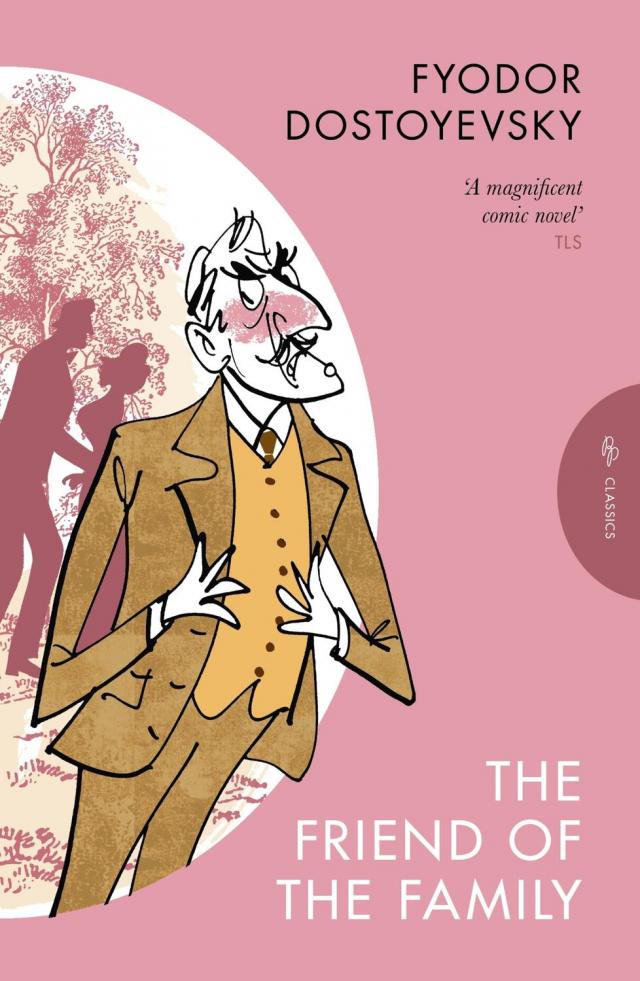


In the midst of these effusions Nastenka also approached Foma Fomich, and without further ado hugged him warmly and gave him a big kiss.
‘Foma Fomich!’ she said, ‘you are the benefactor; you’ve done so much for us that I simply don’t know how to repay you, but I know one thing only, I’ll always be the most gentle and loving of sisters to you …’
She was unable to finish; tears choked her words. Foma Fomich kissed her on the head and himself let fall a tear.
‘My children, children of my heart!’ he said. ‘Live, prosper and in moments of happiness spare an occasional thought for a wretched exile! As for myself, let it be said that misfortune may be the mother of virtue — Gogol’s words, if I’m not mistaken — that frivolous author sometimes not devoid of a grain of sense. Exile is misfortune! I shall now go out into the world, a wanderer leaning on my staff, and who knows, through my misfortunes I may yet attain new pinnacles of virtue! This thought is the last comfort left to me!’
‘But … where will you go, Foma?’ Uncle exclaimed in terror.
Everybody shuddered and rushed up to Foma Fomich.
‘Do you seriously expect me to stay in your house after what you did to me, Colonel?’ asked Foma Fomich, with a most dignified air.
But he was not allowed to speak: his words were drowned in general outcry. He was persuaded to sit down; everybody kept pleading with him, weeping over him, and heaven knows what else. Needless to say, he had never had the slightest intention of leaving ‘this house’ either now, or earlier in the day, or the previous day when he had been digging in the garden. He knew very well that people would piously try to stop him, and would cling to him, especially after he had brought them happiness, after everybody’s faith in him had been restored and everybody was ready to bear him aloft and considered it an honour and a privilege to do so. But it was probable that his cowardly return on taking fright in the thunderstorm niggled his pride and spurred him on to further display of heroics; and here indeed was another chance of acting the injured party, an irresistible temptation to hold forth and posture, to strut and make a show of his own virtues. It was a temptation he did not attempt to resist; he tried to break loose from those who would restrain him; he demanded his staff, he begged to have his freedom restored; to be allowed to go wherever he pleased, for ‘in this house’ he had been dishonoured and beaten; he insisted that the reason he had returned had been to bring about the happiness of the household, and that, finally, he could never be expected to remain in ‘a house of ingratitude and eat the soup that, however nourishing, was seasoned with beatings’. At last he ceased his struggles. He was again persuaded to take his armchair, but his eloquence was uninterrupted.
‘Tell me if I haven’t been insulted here!’ he yelled, ‘tell me if you haven’t been taunting me! Have you yourself, Colonel, not been pointing at me with fingers of derision, like the unruly offspring of the vulgar classes on the streets of the towns? Yes, Colonel, I stand by this comparison, for though you may not have been pointing at me with physical fingers of derision, you have done so in the moral sense; and moral fingers of derision are more offensive, on occasions, than physical ones. And I leave aside the beatings …’
‘Foma, Foma!’ cried Uncle, ‘spare me the memory! Have I not been telling you that all my blood would not suffice to wash away the offence? Show me your heart is in the right place! Forget and forgive and stay with us to witness our happiness! The fruits of your labours, Foma!’
‘… I want to love mankind, to love mankind,’ yelled Foma Fomich, ‘but people are being kept away from me, I am forbidden to love, they force people away from me! Give me, give me a man so that I may love him! Where is this man? Where has this man hidden himself? Like Diogenes with his lantern, I’ve been yearning to find one true soul all my life long, but in vain, and I can’t even begin to love anybody until I find that person. Woe to him who has turned me into a misanthropist! “Give me a man,” I cry, “that I may love him!” — and I’m fobbed off with a Falaley! Should I love Falaley? Would I wish to love Falaley? Could I love Falaley even if I wanted to? No! Why not? Because he is Falaley. Why do I hate mankind? Because mankind is made up of Falaleys, or beings like Falaley! I don’t want Falaley, I detest Falaley, I spit upon Falaley, I’ll make mincemeat of Falaley — and if you ask me to choose, I’d rather love the evil spirit Asmodeus than Falaley! Come here, come here, my eternal tormentor, come here!’ he screamed, suddenly turning on Falaley, who was standing on tiptoe and innocently peering out of the crowd that had gathered around Foma Fomich. ‘Come here! I’ll prove to you, Colonel,’ screamed Foma, pulling the terrified Falaley by the hand, ‘I’ll prove to you the justice of what I said about those perpetual taunts and fingers of derision! Tell me, Falaley, tell me truthfully: what did you dream about last night? There, Colonel, you are about to witness your handiwork! Well, Falaley, speak up!’
The poor boy, trembling all over with fear, desperately searched the room with his eyes for deliverance; but all present could only quiver in terror as they anxiously awaited his reply.
‘Well, Falaley, I’m waiting!’
In place of a reply, Falaley screwed up his face, opened his mouth wide and began to bellow like a calf.
‘Colonel! Observe the pig-headedness of this creature! Do you suppose it’s natural? I’m asking you for the last time, Falaley: what did you dream of last night?’
‘I dreamed of …’
‘Say you dreamt of me,’ said Bakhcheyev, trying to be helpful.
‘Of your virtues!’ whispered Yezhevikin in his other ear.
Falaley rolled his eyes.
‘I dreamed of … of your vir … of the white b-bull!’ he finally brought out, bitter tears streaming down his face.
Everybody gasped. But Foma Fomich was in a rare state of magnanimity.
‘At least I appreciate your honesty, Falaley,’ he said, ‘honesty which I fail to detect in others. God be with you. If you’ve been taught by others purposely to annoy me with this dream, God will reward you and the rest according to your deserts. If not, I respect you for your honesty, for even in the basest of creatures, such as you, I’ve taught myself to recognize the image and likeness of God … I forgive you, Falaley! My children, embrace me, I’m staying! …’
‘He’s staying!’ everybody exclaimed in a transport of joy.
‘I’m staying and all is forgiven. Colonel, give Falaley a lump of sugar: I can’t bear to see him cry on such a day of universal joy.’
Naturally such magnanimity was greeted with amazement. To be so concerned, at a time like this — and on whose behalf? For Falaley! Uncle rushed to carry out the order for sugar. In a flash, God only knows how, the silver sugar bowl appeared in Praskovya Ilyinichna’s hands. Uncle put out a trembling hand to extract two pieces, then three, then dropped them, realizing that he was too excited to do anything.
‘Ah now!’ he exclaimed, ‘on a day like this! Wait, Falaley!’ and he poured out the whole contents into the crook of Falaley’s arm.
‘That’s for being so honest,’ he added by way of moral justification.
‘Mr Korovkin,’ Vidoplyasov announced, suddenly appearing in the doorway.
A comparatively slight commotion ensued. Korovkin’s arrival was clearly ill-timed. Everybody looked to Uncle for explanation.
‘Korovkin!’ Uncle exclaimed in some embarrassment. ‘I’m delighted, to be sure …’ he added, casting a meek glance at Foma Fomich. ‘But, well, I don’t know, should I invite him now — at a time like this? What do you think, Foma?’
‘Never mind, never mind!’ replied Foma Fomich affably. ‘Do invite Korovkin too; let him participate in the general happiness too.’
In short, Foma Fomich was in saintly mood.
‘May I have permission to report,’ Vidoplyasov remarked, ‘that Korovkin is deemed not to be in a presentable state.’
‘Not in a presentable state? What are you talking about?’ Uncle exclaimed.
‘Just so: he is not in a sober frame of mind, sir.’
But the mystery was solved even before Uncle had time to open his mouth again, blush, register the shock, and almost die of embarrassment. Korovkin appeared in the doorway, brushed Vidoplyasov aside and stood in front of the flabbergasted company. He was a short, thick-set man of about forty, with dark, greying, closely cropped hair and a round rubicund face with small bloodshot eyes; his dress comprised a close-fitting hair-cloth necktie fastened by a buckle at the back, the shabbiest of tail-coats covered in pieces of fluff and hay and with a huge gash under one armpit, a pair of pantalons impossibles and, held at arm’s length, an extraordinarily greasy cap. This gentleman was completely drunk. Having stumbled into the middle of the room, he stopped unsteadily, his head swaying back and forth with fuddled deliberation; then slowly his features melted into a wide grin.
‘My apologies, ladies and gentlemen,’ he said. ‘I … er …’ (with these words he gave his shirt collar a smart flip) ‘have done it again!’
The General’s Lady immediately assumed a pose of injured dignity. Foma Fomich, seated in his chair, looked the eccentric guest up and down ironically. Bakhcheyev regarded him with puzzlement not devoid of a certain degree of compassion. However, Uncle’s embarrassment knew no bounds; he suffered heart and soul for Korovkin.
‘Korovkin!’ he began, ‘listen!’
‘Attendez,’ Korovkin cut him short. ‘At your service: a child of nature … But what’s this? There are ladies present … Why didn’t you tell me, you swine, that there were ladies here?’ He looked at Uncle with a roguish grin. ‘Never mind! Courage! … Let us introduce ourselves to the fair sex … My wonderful ladies!’ he continued, moving his tongue with difficulty and stumbling over each word, ‘behold one who is unfortunate enough … well, and so on and so forth … The rest is best unsaid … Musicians! A polka!’
‘How about some sleep?’ Mizinchikov asked, calmly walking up to Korovkin.
‘Sleep? Do you intend to insult me?’
‘Not at all. Just the thing after a journey …’
‘Never!’ Korovkin replied indignantly. ‘Do you suppose I’m drunk? Not a bit … On second thoughts, where do they sleep here?’
‘Come along, I’ll lead the way.’
‘Where to? The barn? No, my friend, you won’t make a fool of me. I’ve spent one night there already … On second thoughts, lead on … Seeing as you’re a good sort, why the hell not? No need for a pillow; a military man doesn’t need a pillow. Fix me up a couch, a couch, my friend … And listen,’ he added, coming to a halt, ‘I can see you’re a good fellow — fix me up with … you know what! a toddy, a toddy, just enough to drown a fly in … just to drown a fly in, just a thimbleful.’
‘All right, all right!’ Mizinchikov replied.
‘Good … Don’t rush me, I’ve got to say good-bye … Adieu, mesdames et mesdemoiselles! … You have, as it were, pierced … But enough! We’ll talk later … One other thing, wake me up when it all gets going … or even five minutes before … only see you don’t start without me! Do you hear? Not without me!’
And the merry gentleman disappeared after Mizinchikov. No one spoke a word. Consternation continued. Finally Foma Fomich began to chuckle softly to himself; his mirth gradually gathered strength until it became full-blooded laughter. Seeing this, the General’s Lady brightened up a little too, though she still preserved her aspect of outraged dignity. Involuntary laughter was gathering strength all round. Uncle alone remained dumbfounded, blushing and, for a time, quite inarticulate.
‘Good Lord!’ he muttered at last, ‘Who could have known? But after all … after all, it could happen to anyone. Foma, I assure you he’s honest, gentlemanly, and in addition, exceptionally well read, Foma … you’ll see for yourself! …’
‘Quite, quite,’ replied Foma Fomich, choking with laughter. ‘Exceptionally well read, extraordinarily well read!’
‘You ought to hear him talk about the railways!’ Yezhevikin remarked sotto voce.
‘Foma! …’ Uncle was about to launch forth, but his words were drowned in a general peal of laughter. Foma Fomich was splitting his sides. Watching him, Uncle too burst out laughing.
‘Well, what of it!’ he said with abandon. ‘You’re a noble soul, Foma, you have a great heart — I owe my happiness to you … You’ll bear no grudge against Korovkin.’
Nastenka alone did not join in the laughter. She regarded her intended with eyes suffused with love as if to say: ‘Aren’t you wonderful and kind and sweet, and how I love you!’
6
Conclusion
The triumph of foma fomich was complete and unassailable. Truly nothing would have come to pass without his intervention, and the accomplished fact stifled all doubts and objections. The gratitude of the blissfully happy couple knew no bounds. Uncle and Nastenka simply refused to listen to me when I tentatively hinted at the chain of events which had led Foma to agree to their marriage. Sashenka kept shouting: ‘Good, kind Foma Fomich — I’ll embroider a cushion for him in wool!’ And she put me to shame for my hard-heartedness. The newly converted Stepan Alekseyich would probably have readily strangled me had I dared to utter a disrespectful word towards Foma Fomich in his presence. He now followed Foma like a faithful dog, his eyes full of devotion, repeating as he went: ‘You’re the noblest of them all, Foma! You’re a scholar, Foma!’ As for Yezhevikin, he was beside himself with joy. The old man had been aware for a long time that Nastenka had turned Yegor Ilyich’s head, and he had never ceased to hope and pray for the two to be wed. He had clung to his hope to the very last, only abandoning it when it had been impossible not to do so. Foma Fomich had changed matters. Of course, for all his elation, the old man could see right through Foma. It was clear that Foma Fomich would rule this household forever and that his tyranny would know no end. It is well known that even the most objectionable, the most capricious people relax, at least for a time, once their desires have been gratified. Not so Foma Fomich, who would become ever more fatuous and arrogant as his fortunes improved. Just before dinner, he appeared in a fresh change of clothes, sat down in his chair, summoned my uncle and in front of the whole family proceeded to read him a new sermon.
‘Colonel!’ he began, ‘you are about to be legally married. Are you aware of the responsibilities? …’
And so on, and so forth; imagine a sermon stretching for ten pages, in the format of the Journal des Débats, in the smallest print and filled with the most arrant nonsense, which had nothing to do with responsibilities but simply paid unabashed homage to the intellect, humility, integrity, courage and generosity of Foma Fomich himself. Everybody was hungry and wanted dinner; however, no one dared to object and everyone felt obliged to listen deferentially until he reached the end of his ravings; even Bakhcheyev, with his prodigious appetite, sat stock-still through the whole session in an attitude of the most profound respect. Pleased with his own eloquence, Foma’s spirits rose and he got a little the worse for drink at dinner, which caused him to propose some very extraordinary toasts. These he followed by quips and jokes, mostly at the expense of the newly betrothed. Everybody laughed and applauded, but some of the jokes were so obscene and unambiguous that even Bakhcheyev was embarrassed. At last Nastenka jumped up from the table and ran away. At this Foma Fomich went wild with delight; but he immediately pulled himself together, in a few brief but well-chosen words depicted Nastenka’s virtues, and proposed her health in her absence. Uncle, who a moment before had felt distressed and embarrassed, was now ready to embrace Foma Fomich. On the whole, both bride and bridegroom behaved as though they were slightly uneasy in each other’s presence and overwhelmed by their good fortune. I noticed too that not a single word had passed between them since they had received their blessing, and they were even avoiding each other’s eyes. As everyone was rising from the table, Uncle suddenly left the room. I went out to look for him and wandered onto the terrace. There, sitting in a chair over a cup of coffee, Foma Fomich was holding forth, very much the worse for drink. Standing by him were Yezhevikin, Bakhcheyev and Mizinchikov. I stopped to listen.
‘Why,’ shouted Foma Fomich, ‘would I be ready to go to the stake this minute for my convictions? And why would none of you be prepared to go to the stake? Why, why?’
‘Wouldn’t it be overdoing it somewhat, Foma Fomich, I mean to go to the stake!’ Yezhevikin was pulling his leg. ‘What’s the point? First, it would be painful, and secondly, you’d go up in flames — what would remain of you?’
‘What would remain of me? A handful of sacred dust would remain of me. But how can I expect you to understand, to appreciate me! You, for whom great men don’t exist apart from Caesar or Alexander the Great! And what have your Caesars ever done? Whom have they made happy? What has your famous Alexander the Great ever accomplished? He conquered the whole world, did he? Well, you give me an army like his and I’ll conquer it too, and so will you, and so will he … But he killed the worthy Clitus and I never killed the worthy Clitus … The brat! The rogue! I’d give him a good birching instead of celebrating him in the history of the world … and the same goes for Caesar!’
‘Spare Caesar, Foma Fomich!’
‘He was a fool!’ cried Foma.
‘Well spoken!’ Stepan Alekseyich chimed in, also under the influence, ‘don’t spare them; they’re all a bunch of whippersnappers pirouetting on one leg! Sausagemongers all of them! Who was it the other day that tried to set up a scholarship? And what’s a scholarship! The devil knows what it is! Bound to be some new trick or other! And that one who came strutting into polite society swaying on his feet and asking for rum! Nothing wrong with having a drink, I say! Have all the drink you want, but stick to your own side of the fence, then have another one if you like … No need to spare any of them. They’re all scoundrels! You’re the only learned man about, Foma!’