The friend of the family, p.27
The Friend of the Family,
p.27
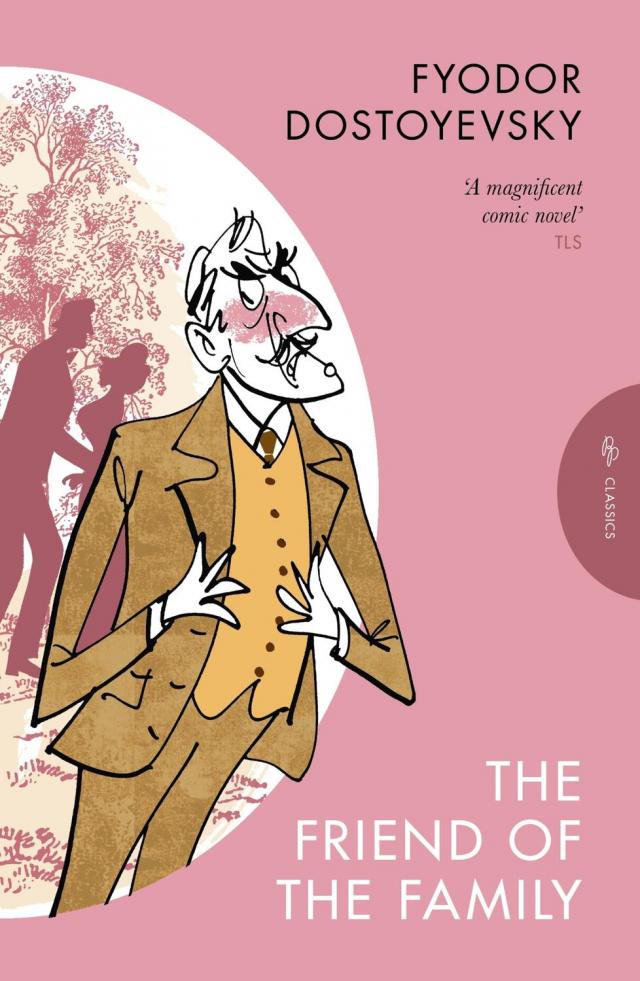


Once Bakhcheyev had sided with somebody, he did it heart and soul.
I found Uncle in the garden in the most secluded spot, by the pond. Nastenka was with him. As soon as she saw me, she dashed out of sight into the bushes as though overcome by guilt. Uncle came forward to meet me, his face beaming and tears of exultation in his eyes. He took both my hands and clasped them warmly.
‘My boy!’ he said, ‘I still can’t believe my good fortune … nor can Nastenka. We can only marvel, and praise the Almighty. She was crying just now. And believe me, I’m still not myself: I believe it and yet I don’t believe it! Why should it be me? Why? What have I done? What have I done to deserve it?’
‘If anyone deserves it, it must be you, dear Uncle,’ I said with warmth. ‘I’ve never met such an honest, such a wonderful, good-natured person as you …’
‘No, Seryozha, no, you’re exaggerating,’ he replied in a note of chagrin. ‘That’s just the trouble — we’re good (I’m speaking only of myself, you understand), just as long as all is well with us; but the minute things go wrong, nobody must come near us! I was discussing it with Nastenka just now. No matter how much Foma Fomich used to shine, you know, I didn’t quite believe in him until today, even though I had been trying to convince you of his perfection; and even yesterday, when he refused my gift, I still wasn’t absolutely convinced of his true merit. Shame on me! My heart shudders when I think back to this morning! But I lost control of myself … When he talked about Nastenka it was like a stab in the heart. I went out of my mind and turned on him like a tiger …’
‘It can’t be helped, Uncle, it was only natural.’
Uncle waved his hands in protest.
‘No, no, my boy, don’t say that! It’s simply my corrupt nature which is to blame for everything; I’m such a base, selfish, lascivious brute — I will let my passions run away with me. Foma said so too. (What could I say to that?) You’ve no idea, Seryozha,’ he continued with deep feeling, ‘the number of times I’ve been short-tempered, cruel, unjust, arrogant — and not only towards Foma! You see, now it all comes back to me, and I’m ashamed that so far I’ve done nothing to deserve my good fortune. Nastenka feels the same about herself, though I really don’t know what sins she could have committed — she’s an angel, without a human fault! She said to me, we’re deeply beholden to God and must try to improve ourselves and be forever charitable … If only you had heard how passionately, how beautifully she put it all! My God, what a girl!’
He paused, overcome with emotion. A moment later he continued: ‘We’ve decided, my boy, to be especially considerate towards Foma, Mamma and Tatyana Ivanovna. Dear Tatyana Ivanovna! Isn’t she the noblest creature that ever was! Oh, I’ve been so bad to everybody! To you too … But just let anyone hurt Tatyana Ivanovna … Still, never mind! … Must do something for Mizinchikov too.’
‘Yes, Uncle, I’ve changed my opinion of Tatyana Ivanovna! One can’t help respecting and feeling sorry for her.’
‘Exactly so, exactly so!’ Uncle snapped up my words eagerly, ‘one can’t help respecting her! Take Korovkin, for example; I’m sure you’re laughing at him,’ he added, looking timidly into my eyes, ‘and weren’t we all laughing at him? That’s unforgivable of us, you know … perhaps he’s altogether the nicest, kindest person you could imagine — it’s just his fate … the misfortune he has endured … You don’t believe me, but it could very well be so, I assure you.’
‘No, Uncle, why shouldn’t I believe you?’
And I began to explain with fervour that even the most degraded people still manage to retain the loftiest human feelings, that the depths of man’s soul are unfathomable, that we should not despise the fallen, but on the contrary should seek them out and raise them up, that the commonly held standards of goodness and morality are false, and so on and so forth — in short, I got carried away and even touched upon the Natural School; in conclusion I quoted the poem: ‘When from the darkness of depravity …’ Uncle was delighted.
‘My dear boy, my dear boy!’ he said, profoundly moved, ‘you understand me perfectly, you’ve put it better than I could ever have done. Precisely, precisely! God! Why should man be wicked? Why is it that I’m so often wicked if it’s such a pleasure, such a joy to be kind? Nastenka said the same thing just now … But look — what a glorious spot this is,’ he added, looking around. ‘What a countryside! What a picture! Look at that tree! You couldn’t get your arms round it! All the sap! The foliage! The sunshine! How joyful and washed everything looks after the storm! … I’m sure trees have understanding and feelings and know what joy it is to be alive … They do, don’t they — eh? What do you think?’
‘It’s very possible, Uncle. In their own way of course …’
‘Quite right, in their own way … Marvellous, marvellous Creator! … Surely, you remember this garden, Seryozha: the way you played and romped about when you were small! You know, I can still remember you as a child,’ he said, looking at me with eyes full of inexpressible love and happiness. ‘One thing you weren’t allowed to do on your own was to go near the pond. Remember one evening when Katya — bless her soul — called to you and began to cuddle you … you were all hot and rosy from running in the garden; you had such fair, curly locks of hair … She stroked them and played with them and then said: “I’m glad you brought the little orphan here.” Do you remember?’
‘Just about, Uncle.’
‘It was evening, I remember, but there was still plenty of sunshine, and it shone on you both, and I was sitting in a corner puffing my. pipe, watching you … I go to town to visit her grave every month, Sergey,’ he added in a lower voice, which betrayed great emotional stress. ‘I was telling Nastenka about this just now — she said in future we’ll both go together …’
Uncle stopped in an effort to suppress his agitation.
Vidoplyasov came up to us at this moment.
‘Vidoplyasov!’ Uncle exclaimed with a start. ‘Have you come from Foma Fomich?’
‘No, sir, it’s more on my own account.’
‘Ah, splendid! Do tell us about Korovkin. I meant to ask you a while ago … I told him to keep an eye on Korovkin, you see, Sergey. Well, Vidoplyasov, what’s wrong?’
‘If I may be so bold as to remind you, sir, of your promise yesterday to consider my request to intercede on my behalf, sir, in regard to the insults to which I’m subjected daily.’
‘It’s not about your surname again, is it?’ Uncle exclaimed, horrified.
‘What’s to be done, sir? There’s no end to the insults.’
‘Oh, Vidoplyasov, Vidoplyasov! What am I to do with you?’ said Uncle, disheartened. ‘What insults are you talking about? You’ll drive yourself out of your mind and end up in a lunatic asylum!’
‘I’m sure, as regards my sanity —’ Vidoplyasov began to retort.
‘All right, all right,’ Uncle interrupted, ‘I didn’t mean any harm — I was thinking of your own good. There now, who on earth would want to insult you? It’s just some nonsense again!’
‘They’re the poison of my life!’
‘Who?’
‘Everybody, but Matryona’s the worst. She’s made my life a misery, sir. You see, sir, discriminating people, people who have known me from childhood, they agree I have a foreign look about me, largely due to my features. Well, sir, because of this I have no peace at all now. Everywhere I go, I get called all sorts of awful names — even the little children, they ought to be thrashed … They jeered at me again as I was coming here … I just can’t take any more, sir. Help and protect me, sir!’
‘Oh, Vidoplyasov! … What exactly do they say? Probably something so stupid it’s not worth bothering about.’
‘It wouldn’t be decent to repeat.’
‘Come on, what is it?’
‘It’s really too awful!’
‘Go on, say it!’
‘Grishka the monk, he sat on my trunk.’
‘There you are! And I thought it really was God knows what! Why don’t you just take no notice?’
‘I tried, it was even worse.’
‘Listen, Uncle,’ I said, ‘he’s saying that it’s not much of a life for him in this house, so why don’t you send him to Moscow, for a time at any rate, to stay with that calligrapher of his? You did say he had been staying with a calligrapher.’
‘Well, my boy, that one came to a tragic end.’
‘Really?’
‘The gentleman in question, sir,’ replied Vidoplyasov, ‘had the misfortune to appropriate property not belonging to him for which, his talent notwithstanding, he was confined to gaol, sir, where he perished most irrevocably …’
‘All right, all right, Vidoplyasov, you calm down and I’ll sort it all out,’ Uncle said, ‘it’s a promise! Now what about Korovkin? Still asleep, is he?’
‘No, sir. The gentleman’s just departed. This is what I came to report.’
‘What do you mean, departed? What are you talking about? How could you have let him go?’ Uncle exclaimed.
‘I didn’t have the heart not to let him go, sir; it was a most pitiful sight. When he woke up and recalled last night’s proceedings, he beat his brow and bawled his head off, sir …’
‘Bawled his head off …?’
‘To put it more graciously: he uttered a variety of lamentations, sir. He cried: “How can I face the fair sex now?” And then he said: “I’m not worthy of belonging to the family of man!” And carried on most pitifully, in the most delicate words, sir.’
‘There’s a sensitive soul for you! What did I tell you, Sergey … But how could you let him go, Vidoplyasov, after being specially told to look after him? My God, oh my God!’
‘It was more than my heart could bear. He begged me to keep it secret. His coachman fed and harnessed the horses himself. As for the sum he was lent three days ago, he instructed me, sir, to convey his profoundest thanks together with his assurance that the loan would be returned by the earliest post.’
‘What sum is he talking about, Uncle?’
‘He mentioned twenty-five rubles in silver,’ said Vidoplyasov.
‘I lent it to him at the station, my boy. He found himself a little short. Of course, he’ll send it back by the first post … Oh my God, what a pity! What about sending after him, Sergey?’
‘No, Uncle, I think it would be better not to.’
‘So do I. You see, Seryozha, I’m no philosopher, of course, but it seems to me there’s far more good in every person than appears on the surface. Same with Korovkin: he just couldn’t face the disgrace … Anyway, let’s go and see Foma! It’s time we did; he might take offence at our ingratitude and neglect. Let’s go to him. Oh, Korovkin, Korovkin!’
My story is finished. The lovers were united and the genius of goodness, in the shape of Foma Fomich, was installed in the house. A number of convenient reasons could be given for this, but in the light of present circumstances all such reasons would be wholly superfluous. Such is my opinion at any rate. Instead, I merely propose to say a few words about the subsequent fate of my heroes, without which, as is well known, no tale can be considered complete; anyway, it is required of me by prescribed procedure.
The nuptials of the ‘happy pair’ took place six weeks after the events described above. It was a quiet family affair without undue pomp or too many guests. Mizinchikov was Uncle’s best man, while I was charged with looking after Nastenka. Of course there were guests. But the principal and most important personage was, naturally, Foma Fomich. Everybody danced attendance on him. However, it so happened that at the height of the festivities he was missed out in a champagne round. There was immediately a scene — reproaches, wailing and shouting. Foma Fomich dashed upstairs to his room and bolted the door, shouting that he was being despised, that ‘new people’ had been installed in the family circle and he had therefore been reduced to nought, to mere flotsam. Uncle wrung his hands in despair; Nastenka was in tears; the General’s Lady went into convulsions as usual. The wedding festivities began to assume a funereal air. Seven more years of such life with their benefactor Foma Fomich fell to the lot of my hapless Uncle and poor Nastenka. Right up to the moment of his death (he passed away last year) Foma Fomich dissembled, sulked, shammed, raged, swore, but the veneration in which he was held by the ‘happy pair’ not only did not diminish but grew in direct proportion to his caprices. Yegor Ilyich and Nastenka were so wrapped up in their own happiness that they were even apprehensive of their good fortune, considering that the Good Lord had been altogether too generous to them, and that before long they would have to bear the cross of suffering to atone for the happiness which they did not deserve. Of course, Foma Fomich was able to do whatever he liked in this docile household. And he certainly indulged himself to the full during those seven years. The mind boggles at the resourcefulness of his corrupt, idle, degenerate mind in inventing the most refined, morally Lucullean caprices. Three years after Uncle’s wedding the General’s Lady died. The orphaned Foma was beside himself with grief. To this day people in the house still speak with awe of his condition at this time. When it came to the burial, he struggled and begged to be interred with her. For a month or more he was given neither knife nor fork; and on one memorable occasion his mouth had to be forced open for the extraction of a pin which he was trying to swallow. One observer maintained that in the course of the struggle Foma Fomich had a thousand opportunities of swallowing this pin and yet he missed every one of them. However, this suggestion was greeted with frank indignation and its author was soundly condemned for callousness and indecency. Nastenka alone kept her peace, and even could not hold back a little smile, which caused Uncle to look at her with some anxiety. Generally speaking it must be owned that, although Foma Fomich continued to be as full of himself and as capricious as ever in my uncle’s house, he no longer indulged in quite the same despotic extravagances towards Uncle as previously. He moaned, wept, reproached, complained, ridiculed, but he no longer showed his former cruelty — there were no more ‘Your Excellency’ scenes, and this, it would appear, was thanks to Nastenka. Almost imperceptibly she managed to compel Foma to make a concession here, to submit to the will of others there. She refused to see her husband humiliated, and succeeded in getting her way. Foma Fomich realized very well that he held almost no secrets for her. I say almost, because Nastenka too venerated him, and supported her husband wholeheartedly whenever he chose to praise his mentor. She wished to see her spouse respected by everyone in all regards, and for this reason openly supported his attachment to Foma Fomich. I am equally convinced that in the sweetness of her heart Nastenka had long since forgotten all former wrongs and bore no further malice against Foma Fomich in gratitude for uniting her with Uncle; and furthermore, she probably fully embraced Uncle’s belief, in all seriousness, that too much ought not to be expected of a former ‘martyr’ and jester, that on the contrary, one ought to give succour to his heart. Poor Nastenka, herself from the ranks of the insulted, had endured suffering, and memories of it were still fresh in her mind. Within a month or so of the wedding, Foma became quieter, meek and even amiable; but then he began to have entirely new and unexpected fits, and to fall into trances, which terrified every member of the household. One moment he would be talking happily, or even laughing, and the next he would stop dead, paralysed, in precisely the same posture in which he had been a split second before the fit; if, for example, he had been laughing, then the expression would remain, a smile fixed on his lips; if he happened to be holding something in his hand, say a fork, it would remain in his extended hand, suspended in mid-air. Of course, eventually the grin would relax and his hand would be lowered, but Foma Fomich would have no feeling or recollection of anything, including dropping his hand. He would sit staring in front of him, occasionally blinking his eyes but saying not a word, hearing and understanding nothing. An hour would then sometimes pass, the whole household tiptoeing about with bated breath, in fear and trembling and in tears. At last Foma Fomich would come to, utterly debilitated, and quite refusing to admit that he had been aware of anything untoward during all this time. To what unimaginable lengths of posing did the man go in subjecting himself to hour-long, self-imposed torture merely in order to say later: ‘Look at me, my feelings are more exalted than yours!’ Eventually the day came when Foma Fomich condemned Uncle outright for his ‘continued insolence and disrespect’ and moved out to live with Mr Bakhcheyev. Stepan Alekseyevich, who after Uncle’s marriage quarrelled with Foma Fomich on numerous occasions, though he always begged his pardon in the end, now took his side with enormous fervour, greeted him with open arms, entertained him to a splendid meal, and offered on the spot formally to sever all ties with Uncle, promising for good measure to take out a writ against him. There was somewhere a small plot of land disputed between them, which, to be sure, they never quarrelled about because Uncle was always quite ready to cede it to Mr Bakhcheyev. Without further ado Stepan Alekseyevich requested his calash to be made ready and galloped off to the town where he made out a claim for the land to be formally adjudged to him together with full compensation for costs and damages in meet punishment for peremptory behaviour and rapacity. Meanwhile Foma Fomich, having the very next day become thoroughly bored at Mr Bakhcheyev’s, decided to let bygones be bygones, granted Uncle his pardon when the latter came to see him to offer his apologies, and returned with him to Stepanchikovo. Mr Bakhcheyev’s rage, on his return from the town, to find Foma Fomich gone, beggars description; but three days later he suddenly turned up at Stepanchikovo offering his sincere apologies and, tears streaming down his face, begged Uncle for forgiveness with assurances that he had withdrawn his claim. The same day, Uncle persuaded Mr Bakhcheyev and Foma Fomich to make it up between them, and Stepan Alekseyevich once again began to follow Foma about like a dog, repeating after his every word: ‘You’re a wise man, Foma! You’re a learned man, Foma!’