Aphrodite, p.2
Aphrodite,
p.2
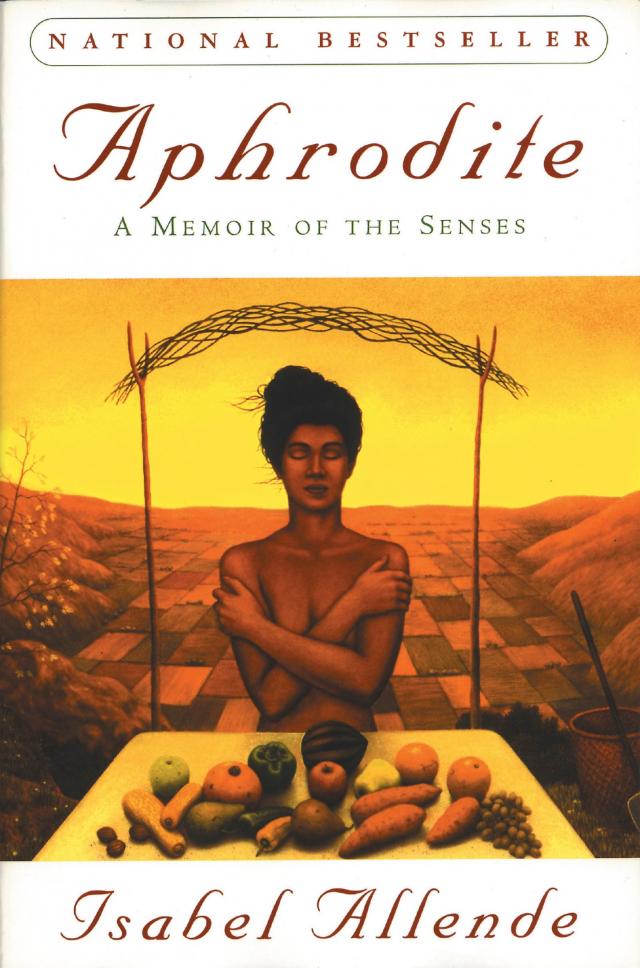


Robert Shekter actively participated in the development of this project with his drawings, Panchita Llona with her recipes, and Carmen Balcells as agent. Participating passively were some fifty authors whose texts I consulted without asking their permission and whom I have no intention of mentioning, because bibliographies are a bore. Copying one author is plagiarism; copying many is research. And many of my friends participated innocently, all those who to please me lent themselves to testing the recipes and telling me their experiences, even though they were convinced that this book would never see the light of day.
Out of pure poetic inclination, it occurred to Robert Shekter to package the book with a CD of erotic music and to divide the topics into the Four Seasons, after Vivaldi, but that turned out to be more confusing than we could handle. Panchita tried to create her dishes while keeping in mind the produce of the seasons, but when Robert also asked her to give them musical names, she told him to shove off. It seems that most musical terms are in Italian, and you can’t call a burrito with chilis allegro ma non troppo. So if in these pages you find some Italian musical phrase or other that may have been overlooked, don’t pay any attention: it’s a mere artist’s caprice. The idea of the CD faced a similar fate because we couldn’t agree about what constitutes erotic music. Panchita leaned toward Ravel’s Bolero, Robert toward Bach, and I voted for the sound of an organ grinder that drifted in through the window one summer afternoon when . . . But that’s another story.
Robert is a scientist. He did not allow me any novelist’s tricks; he demanded precision. I had to show him the mountain of books I used in my research, and we had to evaluate the aphrodisiac power of Panchita’s recipes using a method of Robert’s invention. We called on volunteers of both sexes and diverse races, subjects over forty years old, since even a cup of chamomile tea turns on the young, which would have skewed our statistics. After inviting our guests to dinner and observing their conduct, we took painstaking measurements and noted down the results. They were quite similar to those I had obtained years ago when I was working as a journalist and had to write a report on the efficacy of black magic in Venezuela. Subjects who knew they were the target of voodoo rites began to rave and expel demonic humors; pimples erupted in their throats and their hair fell out. In contrast, subjects who remained in happy ignorance went on as prosperously as before. In the case of this book, friends who as they enjoyed the aphrodisiacs were informed of their power confessed to delicious thoughts, winged impulses, fits of perverse imagination and secretive behavior, while those who knew nothing about the experiment devoured their fare without visible change. Twice it was enough to leave the manuscript on the table, with the title in full view, for the aphrodisiac to take effect; table companions began nibbling each other’s ears even before we served dinner. From which I deduce that, as in the case of black magic, it is a good idea to notify the participants. That way you save time and effort.
Once we had our plan, each of us got to work, and to the degree that nymphs, satyrs, and other mythological creatures streamed from Robert’s pen, fabulous dishes from Panchita’s kitchen, mathematical calculations from Carmen’s fertile brain, and my investigations from the library, our spirits changed. Robert’s aches and pains diminished, and he’s thinking of buying a sailboat. Panchita stopped saying her beads, Carmen gained a few pounds, and I tattooed a shrimp on my navel. The first manifestations of concupiscence appeared when we outlined the list of subjects. By the time we tasted the first aphrodisiac mouthfuls, we already had one foot in an extended orgy. Robert is a bachelor, so I prefer not to ask how things have been going for him. Carmen Balcells’s skin is like porcelain after taking her weekly baths in chicken broth. Panchita’s husband and mine have a bounce in their step and leap out at us from behind doors with a wicked gleam in their eyes. If these dishes have been that successful with old codgers like us, what might they do for you?
Toward the end, when I thought we were finished and in the last round of revisions, I realized that among all the aphrodisiacs, from shellfish with herbs and spices to lace chemises, rose-colored lights, and aromatic bath salts, there was one, the most powerful of all, I hadn’t included: stories. In our long lives as appreciators of pleasure, Robert, Panchita, Carmen, and I had ascertained that the greatest enhancement to eroticism, as effective as the most knowing caresses, is the story, told between freshly ironed sheets, that leads to love—as demonstrated by Scheherazade, the prodigious storyteller of Araby who for 1,001 nights captivated a cruel sultan with her golden tongue.
He had returned from the field of battle without warning—an unpardonable error that has produced a multitude of tragedies—and found one of his wives, his favorite, happily frolicking with her slaves. He had her decapitated and then, with clear masculine logic, decided to possess a virgin every night and deliver her to the executioner at dawn to have her beheaded. That would leave no opportunity for her to be unfaithful to him. Scheherazade was one of the last available damsels in that nightmarish kingdom. She was not so much beautiful as wise, and she had the gift of words and an overflowing imagination. The first night, after the sultan had taken her without giving it much thought, she arranged her veils and began to tell him a long and fascinating story that lasted several hours. With the first light of dawn, Scheherazade discreetly fell silent, leaving the monarch in such suspense that he granted her one more day of life, even at the risk that she would deceive him in her thoughts, for considering her heavy guard, she could not deceive him any other way. And so, story after story, night after night, the girl saved her neck from the scimitar, relieved the sultan’s pathological insecurity, and achieved immortality.
Once an exquisite dinner has been prepared and served, once the secret warmth of the wine and tickle of the spices are coursing through the bloodstream and the anticipation of caresses turns the skin to a rosy glow, it is the moment to pause for a few minutes, postponing the encounter so that the lovers may regale each other with a story or a poem, as in the most refined traditions of the East. A story may also reawaken passion after the first enfolding, when lucidity and breath return and the couple is resting, well satisfied. Storytelling is a good way to keep the man awake, who tends to drop as if anesthetized, and to divert the woman when she begins to feel bored. That story or those verses are unique and precious: no one has told them or will ever tell them in that tone, at that rhythm, with that particular voice or precise intent. It isn’t at all the same as a video, please, I beg you. If both lack a natural talent for making up stories, they can call upon the enormous, titillating repertoire of world literature, from the most exquisite erotic books to the most vulgar pornography—as long as it’s kept to a minimum. The skill lies in prolonging pleasure by reading an exciting but brief excerpt; the amorous impetus won with the meal should not be misspent in literary excess. We are talking about how something as trivial as sex can be turned into an unforgettable occasion.
In my book The Stories of Eva Luna, there is a prologue that evokes the power of storytelling, something I couldn’t have written had I not lived it. Forgive the arrogance of quoting myself, but I believe it illustrates my point. The lovers, Eva Luna and Rolf Carlé, are resting after impassioned lovemaking. In Rolf’s photographic memory, the scene resembles an ancient painting in which a man’s lover is lying beside him, her legs drawn up, a silk shawl over one shoulder, her skin still moist from love. Rolf describes the painting this way:
The man’s eyes are closed; one hand is on his chest and the other on her thigh, in intimate complicity. That vision is recurrent and immutable; nothing changes: always the same peaceful smile on the man’s face, always the woman’s languor, the same folds in the sheets, the same dark corners of the room, always the lamplight strikes her breasts and cheekbones at the same angle, and always the silk shawl and the dark hair fall with the same delicacy.
Every time I think of you, that is how I see you, how I see us, frozen for all time on that canvas, immune to the fading of memory. I spend immeasurable moments imagining myself in that scene, until I feel I am entering the space of the photograph and am no longer the man who observes but the man lying beside the woman. Then the quiet symmetry of the picture is broken and I hear voices very close to my ear.
“Tell me a story,” I say to you.
“What about?”
“Tell me a story you have never told anyone before. Make it up for me.”
Mea Culpa of the Culpable
Photograph, William Gordon.
ROBERT SHEKTER
In a neighborhood bookstore, one of those places with beautiful wood floors and antique chairs that remind me of my grandparents’ house, I met Robert Shekter. I go nearly every morning to that bookstore, drawn by contradictory emotions. On the one hand, I love plunging into that atmosphere filled with spirits and stories escaped from the pages of its books, but on the other, I find it exceedingly depressing to see the stunning number of new titles that appear every day. All that competition takes the wind out of my sails. To lift my spirit, nothing better than a fragrant croissant and a double cappuccino, mainlined; they temporarily alleviate the shock.
I was impressed by Robert Shekter the moment I saw him because his profile is identical to my grandfather’s, God rest him. That aquiline nose, those steel-colored eyes, and slightly cruel lips intrigued me, and I learned to love the man secretly long before we exchanged our first words. I suppose that he couldn’t help but notice my insistent glances, and like the fine Swiss gentleman he is, he resigned himself to take the initiative and say hello. That was the beginning of a friendship based on cups of coffee, croissants, and a discreet raillery that flows between us like a powerful current. Someone has said that conversation is sex for the soul.
One of those mornings of coffee and crunchy calories, I confessed to my friend one of my strange erotic dreams, in which I was one of Rubens’s matrons, only older, bounding about naked, an obese fairy in an enchanted garden lush with asparagus as tall as trees, fleshy mushrooms, awesome eggplants, and an array of morbid fruit dripping a heavy golden honey. There were also animals in that prodigious oasis: duck à la orange, roast pheasant, lapin au vin, glazed pigs, and, here and there, squid in garlic sauce. As I was describing these fakir’s hallucinations, Robert discreetly wiped the sweat from his brow and, perhaps to distract himself, he removed the splints he wears on his hands when the pain in his joints becomes unbearable, and with fingers stiff as eagle’s claws, he picked up a pencil and on a paper napkin, with marvelous ease, sketched a chubby nymph. That’s my future if I don’t go on a diet, I admitted, blushing. Then I saw a galloping satyr flow from his pencil, and there was no need to explain that despite the infirmity that had contorted his bones this was how he felt inside. And so were born on that napkin the characters that would enhance the protagonists of these pages: bold nymphs and mischievous satyrs.
“Why do I have these nightmares, Robert?” I asked. “I’ve spent half a century jousting with the demons of flesh and chocolate.”
“I have bad news for you,” he replied, “I’m seventy-two and I feel the same way. The temptation endures, but the execution flags.”
From there the conversation drifted quite naturally toward the theme of aphrodisiacs, while we drank another cappuccino and joked about my transparent nightgowns, which with every day that passes are less and less effective in luring my husband from his computer, and about Robert’s legs, which no longer oblige him in chasing women . . . or escaping from them. “When all’s said and done, everything is sex.” Robert sighed sadly.
Talking about aphrodisiacs, my friend called on his knowledge of medicine and began drawing up a list from memory, but I, somewhat more modern, went to the bookstore’s shelves to look up texts on the subject. We discovered that there is less information than one would expect and attributed it to the fact that as we approach the millennium, people no longer pant and puff in love skirmishes, they prefer getting out of breath in a gym. That was a hasty conclusion, however; in fact, there is still the same interest in aphrodisiacs that distinguished the chefs of Lucrezia Borgia, whose fame as a poisoner, we might add in passing, has unjustly clouded her talents as a great hostess.
As soon as Robert and I began questioning friends and acquaintances, we were buried under an avalanche of advice. Everyone wanted to enlist to test the recipes. Later, when we got the project going, we had squadrons of volunteers who devoured Panchita’s cooking with militant vigor. Afterward, they would call at ungodly hours to report their erotic feats.
Without Robert Shekter’s friendship, it would have been hard to create this book. Without his humor and his wisdom, I would be a straitlaced grandma writing tragic stories.
PANCHITA LLONA
Little by little, I worked up a list of everything that according to my own experience and the knowledge accumulated through centuries in different cultures enhances the passionate life, or just life in general. As is only natural, food headed the list. The moment the word food came up, I thought of Panchita Llona, the best cook I know, and from Robert’s magical hands emerged a companion for the nymphs and satyrs: a sorceress with all the paraphernalia attending the witchcraft of cuisine and love potions. I suppose that so there will be no misunderstandings I should clarify that Panchita is my mother. If I’m going to put my time and effort into something like this, I’d rather to do it with someone I trust. In the many years of my friendship with this splendid woman, I have never seen her serve the same dish twice; she always introduces some variation and garnishes her creations with such originality that in her hands a common cabbage is transformed into a work of art, like an ikebana, one of those Japanese floral arrangements with two chrysanthemums and a twisted branch. Triumph of aesthetics over paucity.
Photograph, Marcia Lieberman.
My mother has an elegant, coquettish, and ironic air that at first sight could be mistaken for frivolous inattention. Not at all: she is supremely lucid. When something interests her, she studies it with the concentration of an astronomer, but since she does so without any visible fuss, we are always tremendously surprised when she appears one day converted into an expert on something no one in the family suspected her of caring about. That’s how it was, for example, with the Italian Renaissance, Impressionist painting, and twentieth-century literature. Cuisine is one of her strong points. All she has to do is taste a dish, however elaborate, to know immediately what ingredients it contains and in what proportions, how long it was cooked, and how she can improve it. That was how she developed her famous almond torte, starting with a recipe that was the secret another family had guarded like a saint’s relic since colonial times in Chile. Nothing escapes her nose, her taste buds, and her instincts as a master cook, not the hidden mysteries of cod à la vizcaína coddled over a country cook fire in Bilbao, or the musk sweets served on tiny mother of pearl plates at a funeral in Damascus, or least of all the ingenuous recipes of nouvelle cuisine—especially as practiced in California—which she sniffs at with an expression of deep scorn. To accompany my mother to a restaurant is a mortifying experience. When we go in, she looks over the tables, checking out what other people are eating, sometimes so closely that she alarms the diners. She reads the menu with excessive attention and torments the waiter with malicious questions that force him to go the kitchen and return with written answers. Then she urges us to all order something different, and when the food arrives she takes photos with the Polaroid camera she always carries in her purse. The rest is easy; she takes a bite from each plate and with that taste knows how to interpret it later at home. Her culinary art has been a determining factor in her fate. I’m witness to that.
My mother has lived a storybook romance. When she fell in love with my stepfather, our incomparable Tío Ramón, more than half a century ago, no one would have bet a penny on the chances for that tortuous relationship. Each was married to a different partner, between them they had seven children, and they lived in the most devout and conservative surroundings possible to imagine, a place where, as the last straw, divorce did not exist. Chile is the only country in the galaxy where still today, well in sight of the year 2000, couples are legally bonded for eternity. Nevertheless, my mother and Tío Ramón found a way to share their lives and to make of that clandestine attraction a legendary romance that their seven children, envious tongues, and the limited resources of a public servant could not destroy or corrupt. We believe that the solid pillar of that relationship was the happy balance between eroticism and good food, but in our family that is never mentioned; we prefer to say that this pair of great-grandparents are joined by deep spiritual affinity. In any case, I called my mother in Chile, invited her take part in this project, and just as I had expected, she was immediately hooked. It seemed, though, that at the mention of the word aphrodisiac I heard a meaningful pause from the southern part of the American continent, but my mother is too loyal to deny her daughter a small caprice.