Aphrodite, p.4
Aphrodite,
p.4
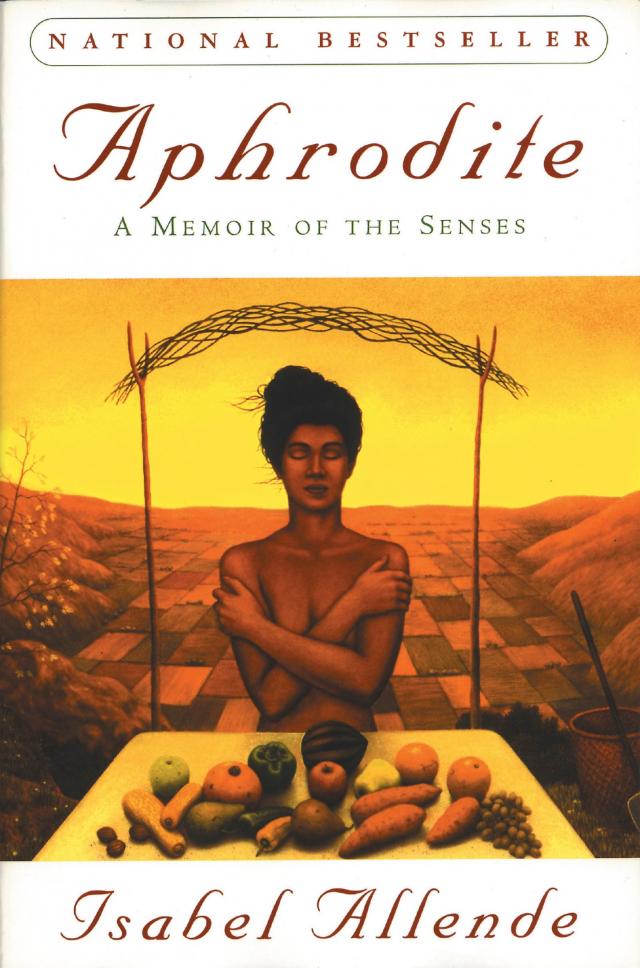


In cultures in which eroticism has the standing of art, there are lengthy illustrated manuals for people who marry and want to wander the paths of love with good spirits and success. Most of these tomes place a great deal of emphasis on the ins and outs of positions, including some that are anatomically improbable. Only we humans can grant ourselves this luxury, because we are the only mammals capable of making love face-to-face; that’s what they say, although I can imagine that a porcupine would prefer that position, and dolphins, which spend a third of their lives in sensual play, surely have discovered that pleasure. All other creatures perform the act rapidly, and from the rear, thus enabling the female to make a fast escape should danger arise. No need to wear ourselves out making up fantasies, since every possibility has already been invented and tried; all that is required to incorporate exquisite variation into what might otherwise become routine are a curious mind and a little erotic literature on the night table.
If cookbooks make up part of your library, books on eroticism should, too. Among the most celebrated manuals are the Kama-sutra of India, the Chinese pillow books, and the shungas of Japan (which were written and illustrated primarily by monks in monasteries), but there are many others; nearly all peoples have pondered the spice of variety, among them Asians, Arabs, Polynesians, and Africans—inhabitants of nearly any place in the world exempt from religious stigmas that castigate pleasure. In Europe, in the midsixteenth century, Giulio Romano painted on the walls of the Vatican a series of positions that Pietro Aretino immortalized in sonnets. Two centuries later those sixteen sketches were still used as an integral part of the sexual education of young aristocrats. Some positions in those exotic handbooks, especially the Indian ones, are too acrobatic for bourgeois taste: elbows and knees bending in reverse configurations, heads turning 180 degrees, and a swirl of arms and legs so intricate that without the aid of a chiropractor, I don’t know how they could be untangled. I can no longer knit my legs behind my head, wiggle my ears, or touch my nose with the tip of my tongue, so I have no choice but to renounce a sizable part of such capers. Neither am I overly entranced with trapezes and other circus apparatus. I suffer from vertigo, and besides, all that twirling around can be fatal if you swallow your tongue or get strangled by a rope.
More than one of us have been frightened when faced with variants on the love act. A good friend of mine, a burly, bearded descendant of Quaker blacksmiths, a poet and beekeeper by profession, was once invited to dinner—for the obvious purpose of seduction—by a woman who admired his verses and his bee honey. At the end of a gala meal served beside a warm fireplace in the pale glow of scented candles, as the hostess was uncorking the second bottle of wine and unbuttoning the third button of her blouse, my friend discreetly excused himself to go to the bathroom. On his way there, he glanced into the woman’s bedroom to get an idea of the layout and plot his strategy—it’s always a good idea to case the territory before you lift a woman in your arms and stagger blindly toward an unfamiliar bed. That night, when he peered in, he saw twinkling lights, mirrored walls, and a trapeze above the bed. Horrified, the poet fled through a window and was never again seen in those parts.
In one of his letters, my friend commented that our obsession with variety has a lot to do with having lost the gift of savoring a simple tomato, with our inability to exist in the world of the senses. In our desire to compensate for those losses, there are some who go to such extremes as that inoffensive swing, to say nothing of real perversions. He told me about a friend of his named Tom, who always carried a small notebook in his pocket so he could make a mark for each woman he had “possessed.” And what were their names? This easy rider had forgotten to write them down; he did not “possess” them even in memory. In his exhausting career of one-night stands, Tom had learned less than other men who have loved only one woman and known her in every sense of the word. His obsession is like that of compulsive eaters who gulp their food without tasting it or those who drink to excess without ever discovering the mystery of the grape; like people who accumulate money and belongings with insatiable thirst and never experience plenitude.
Howard Hughes, a famous playboy and one of the richest men of all time, who at his death had more money than the gross national product of most countries, died of hunger in a Las Vegas motel, completely alone, reduced to skin and bone, looking like a wraith in a concentration camp, terrified of germs and bacteria, wearing shoe boxes for shoes because he had the finger- and toenails of a mandarin. He died of poverty. Poverty of the senses and spirit. A few radishes pulled from the earth and a few sips of water would have saved him. So much wealth and so little abundance! We are obsessed with an insatiable appetite for ever more vivid sensations, because in our haste to devour everything we see, we separate body from soul. A subtle caress, the pleasure of skin against skin or of sharing a peach, is not enough anymore; we demand a cosmic euphoria that nothing—not drugs, not cinematic violence, not the most brutal pornography—can provide. Searching for relief from boredom, we raise cruelty to the level of art . . . or a joke. (Enough of that! I’ve been a mother for so long that preaching just rolls out on its own.)
The Good Table
People who write about cuisine come naturally from a long tradition of culinary refinement; they have been born and have grown up in evocative locations such as the French provinces or an Italian villa, where their mothers and grandmothers cultivated an art as delicate as it is succulent. The finest wines daily graced their tables, and while the father, napkin knotted around his neck, solemnly cut a huge country loaf, clasping it to his chest like someone slitting the throat of a rival, the mother with her gaze directed a parade of robust serving girls bearing steaming china soup tureens from the kitchen, trays of quintessential ragouts, boards of country cheeses, and platters with pyramids of fruits and sweets. These were copious feasts that daily united an extended family in the leisurely ceremony of the meal. On those tables, always laid with cloths of starched damask, glittered crystal goblets, cruets of purest olive oil and balsamic vinegar, and vases of flowers and silver candelabra, mute witnesses to several centuries of excellent cuisine. Maybe in those dining rooms only pleasant matters were discussed, such as the incomparable texture of the pâté with truffles, the taste of roast venison, the sensuality of a cherry soufflé, and the perfume of a new coffee sent from Brazil by an explorer friend. It is such an ambiance, surely, that produces celebrated cooks and gourmets, expert wine tasters, authors of cookbooks, and, finally, the aristocrats of food who set the standards for the palates of that tiny percentile of humanity who can eat every day. I fear I possess no such credentials.
I come from a family in which disdain for earthly pleasures was a virtue and asceticism in habits considered a boon to good health. The only acceptable values were those having to do with the mind and, in a few cases, the spirit. My grandfather, who throughout his life was fascinated with advances in science and technology, with Olympian disregard ignored hot water and central heating until the middle of the twentieth century. With him it was a matter of arrogance—he placed himself above comfort and other such bourgeois customs—but other members of our clan adopted the same attitude for reasons of saintliness, madness, avarice, or mere fogginess—which was the case with my grandmother. While other ladies of her age and social status were overseeing the details of the household and the behavior of their heirs, mine was occupied with learning to levitate. My early childhood spent with her must have been very happy, but what dominates my memory are the years after her death when the house lost its light and joy. I remember a large, dark house in which my grandfather reigned like a severe although always just Zeus, amid countless relatives, protégés, and servant girls who passed through those high-ceilinged rooms like characters in a novel, all with their own dramas, passions, and eccentricities. My grandmother’s absence left a tremendous void in my life that to this very day, in the full autumn of my years, is a source of deep grief. She was a legendary woman about whom improbable stories are told, and who spent her life on an intermediate plane between reality and dream, more concerned with extrasensory phenomena and charitable works than with the vulgar realities of this world. Domestic chores and maternal duties interested her very little; she delegated those responsibilities to the many nannies she always had around.
Table with Candle and Fruit Above, painting by Remedios Varo, © 1997, Artists Rights Society (ARS)/VEGAP, Madrid.
Just as my grandmother would put on the first dress that came to hand, indifferent to style or season, she would eat anything set before her. The question of food, like so many connected with the body and its functions, she considered in bad taste, and therefore it was not mentioned in her presence. Never hungry, she sat at the table out of habit, thinking of the prankish ghosts that visited her in her weekly séances or concentrating on receiving telepathic messages from her spiritist friends. Her too pale face emphasized large black eyes that lent her an absent air; for the same reasons, her ready laughter and sense of irony were a constant surprise. Perhaps because we didn’t believe she was entirely human, we had never thought she was susceptible to death, but one day this wondrous grandmother drew a deep sigh of farewell and departed, without explanation, for the other world. With her parting, we all lost our way, first among us, her husband, unable to forgive her for abandoning him thirty years before the time he had planned.
After my grandmother’s death, it fell to my mother, who was still very young, separated from her husband, and caring for three small children, to take charge of running that huge house. At her disposal were several elderly employees little inclined to obey her orders and a fearsome cook whose duties included the thankless jobs of drowning the newborn kittens of the cats that populated the rooftops, wringing the necks of the hens and ducks in the back patio, and fattening the other creatures only later to chop off their heads and toss their remains into her pots. The martinet ruled in the kitchen, a spacious, shadowy, badly ventilated room with wooden furniture permeated with the grease of a thousand meals. From hooks in the ceiling hung metal utensils so blackened by use that they had lost their original outlines. While my grandmother had been alive, the cook made her decisions in the back of the house where the servants, children, and animals lived. No one would have dared contradict her, much less make an unfavorable comment about her dubious concoctions. Every day she served formidable plates of Chilean foods that are delicious when prepared with love but that she turned into boarding-school pap: peas and lentils morning and night, country hashes and soups, heavy potato or corn pies, predictable beef goulash, and, for dessert, always that quince jelly jiggly as a toad’s belly. Cooking that delightful, gelatinous treat was a summer ceremony in which all the maids took part, gloved, faces protected by kerchiefs, taking turns stirring the copper kettle where the fruit was bubbling. If guests were invited for dinner, the cook would grudgingly open a jar of chestnuts in syrup and tromp off, key in hand, to the cellar to choose a wine corresponding to the status of the visitors.
My mother, who through one of those incomprehensible genetic accidents had in the midst of that Spartan tribe been born with a refined sensibility, tried to make some improvements in the style of our lives, but the cook, who had watched her grow up, was not disposed to take her suggestions. A silent war broke out between them.
My mother made every effort to modernize the family’s customs, while the cook clung to her ancient manias with the tacit support of the men of the house, who had no intention of complicating their lives with any Frenchified ideas. Regarding food, my grandfather held to an unassailable position: he would not try anything new; he would not mix ingredients; the eggs of his Spanish omelet had to be served on one plate and the potatoes on another; he shook salt and pepper onto his food by the spoonful before tasting it because he believed it was good for the intestines; desserts were for sissies; and instead of wine, he drank large glasses of gin with his meal. When one of my uncles returned from India turned into a fakir, dressed in a breechcloth and chewing every mouthful of food sixty times, my grandfather found the perfect pretext for not eating at home. He left the house early in the day and did not return until late at night—except on Sundays, when he gathered the family together in Pantagruelian feasts.
For a while my mother continued to try to institute change, but in the end she stopped because of her relatives’ jibes, the sloth of the servants, and the tyranny of the cook. Instead, she made up a set weekly menu, with slight variations according to the season, to be served year-round. There were no surprises, except for the Sunday and holiday empanadas and pastries. To that unholy regimen must be added the fact that I was educated in English schools, where abominable food was one element of an educational philosophy for strengthening student character. There was a heart-rending clarity in the moral principles of English schools of those days. Ah, the Thursday soups! A dark liquid in which floated unrecognizable gray globs, possibly yesterday’s leftovers. Lifting each spoonful to one’s lips under the compassionate but unyielding gaze of the headmistress required so much self-control that at the end of the meal I was suffused with a spiritual satisfaction comparable only to erotic pleasure. I know, I know, this is fodder for a psychiatrist. Let’s just say that now everything I eat tastes like the manna of the gods—except for beet root, which I can’t bear. I am proud of my deep loathing of beet root. After all, there is an ethic even in loathing.
Over the following years, my childhood home sank into oblivion. The ferocious cook died, along with a goodly number of my extraordinary relatives, my grandfather was turning into an ancient, twisted oak, and my mother married a diplomat. In her long journey from embassy to embassy, she at last had the opportunity to develop her domestic genius, and I say genius because here we are talking about a supreme and spontaneous talent, apparently effortless, which she did not learn through any systematic training or inherit from any known ancestor. Her house and her kitchen are models impossible to emulate, and I don’t even have a complex about it, although daughters of mothers like mine are supposed to. At her side I learned the value of a pinch of spices, a dash of liquor, a dab of salt, a soupçon of mustard, a handful of herbs, a cloud of powdered sugar, and other subjective measures of culinary art. Nevertheless, many years would pass before the kitchen ceased to be a spectacle coordinated by my mother and came to interest me personally. That happened when I realized that among the few things that men and women have in common is sex and food. Then I undertook the adventure of exploring both. It was a long journey through the senses that eventually led to the genesis of these pages.
Cooking in the Nude
I once heard a celebrated designer say, while draping a little semitransparent, seven-thousand-dollar chiffon over the bones of a bulimic model, that the most flattering thing a woman can wear is a radiant smile. Sometimes that is all that is needed, although, unfortunately, I discovered that rather late, after having spent years of my life standing frothing at the mouth before my closet, and at an age when it is not flattering to go around stark naked.
Everything cooked for a lover is sensual, but it is even more so if both take part in the preparation and seize the opportunity to naughtily shed a garment or two as the onions are peeled or leaves stripped from the artichokes. To my sorrow, my husband is a good cook but not a tease. It would be so entertaining to watch him laboring amidst his pots and pans as articles of clothing go flying through the air. I’ve told him about the Adamites, an eleventh-century Christian sect whose members went around naked, with the idea that they could recapture the innocence of Adam before the original sin, but he is not a man to pick up on a hint, and until now I’ve never quite succeeded in getting get him out of the greasy blue jeans he wears when exercising his unquestionable authority in the kitchen. There are few virtues a man can possess more erotic than culinary skill. The first thing that attracted me to my husband was his incredible life story—which he was willing to tell me at our first meeting, and which was the inspiration for my fifth book, The Infinite Plan—but I actually fell in love with him several hours later as I was watching him prepare dinner for me. The day after we met, he invited me to dinner at his house. At the time, he was living with several monsters I later learned were his children and a collection of detestable pets including neurotic mice that spent their miserable existences in a cage biting one another’s tails, a dog that had lost all control of its sphincter, and a tank of agonizing fish. That spectacle would have terrified any normal woman, but I had eyes only for the man moving about so easily among skillets and saucepans. That’s an experience very few Latin American women have had; usually the machos of our continent consider any household activity a danger to their perpetually threatened virility. I admit it: while he was cooking, I was mentally taking off his clothes. When my Amphitryon lighted the coals of the grill and with one cruel stroke of his cleaver split a chicken in half, I felt a mixture of vegetarian terror and primitive fascination. Then when he cut fresh herbs from the garden and selected a variety of spices from a kitchen cupboard, I knew that I was in the presence of a potential candidate gifted with excellent raw material, who would, after a few years with me, be polished into a jewel. And when he took a kind of scimitar from the wall and with four samurai passes transformed an insignificant lettuce into a hearty salad, my knees buckled and my head swam with lewd images. That still happens a lot. It has kept our relationship at a constant simmer.