Aphrodite, p.21
Aphrodite,
p.21
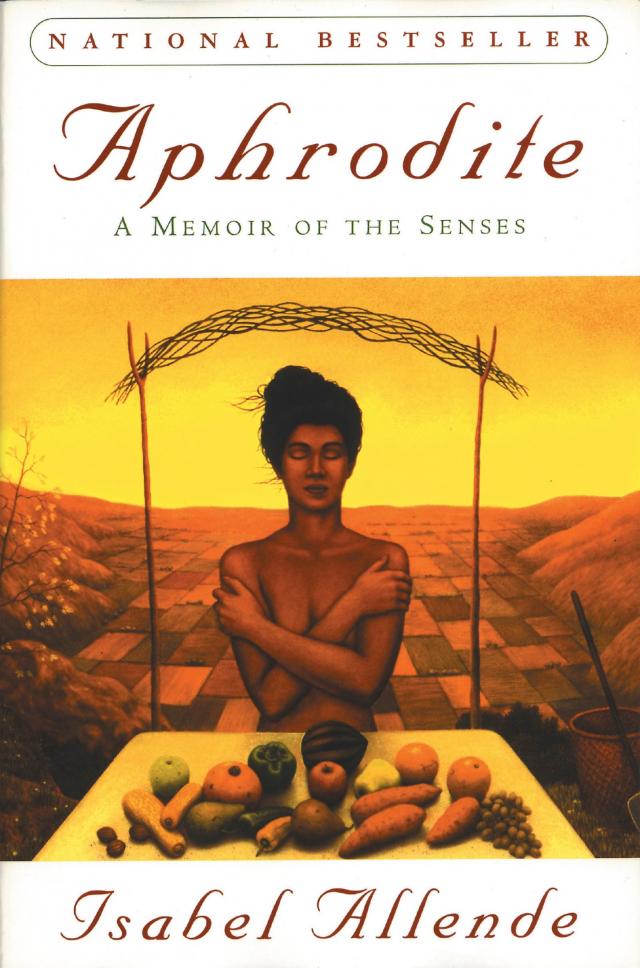


Muses of Fall, painting by Angel López © 1997.
The taste, the nutrients, and the aphrodisiac power of vegetables and grains are directly related to their freshness. (I can’t say that sexual attraction in humans depends on their freshness, because that would be politically incorrect. As this century nears its end, it is expected that we will be sensual whatever our age—How exhausting! my mother would say.) Returning to our vegetables, the ideal is to rip them from the earth and run directly with them to the pan, but for most of us, urban creatures that we are, that is no longer possible. The modern tendency is to buy in quantity and keep perishable products crammed into the refrigerator, a justifiable method when trying to feed a family, but it seems probable that if you are interested in erotic cuisine, it’s because your children have flown the nest, you still are not caring for grandparents, and you enjoy enough peace of mind to take pleasure in the ingredients of your cooking. No Italian mamma would use a shriveled zucchini or wrinkled tomato. Imagine what her neighbors would say! We suggest you imitate those indefatigable matrons when it comes to your aphrodisiac recipes. Buy fresh vegetables in the market, and choose them with care to be sure they are at their peak. If you can’t find what you’re looking for, don’t fall into the temptation of substituting something from a can; better to change the menu.
In the game of food and erotic play, the most desirable shapes, for obvious reasons, are phallic and rounded: carrots and peaches; fleshy, moist textures, like tomatoes and avocados; the sensual colors of skin and the most personal orifices, pomegranates and strawberries; and lingering scents like mangos or garlic. Many edible plants used and abused in erotic literature owe their reputation as aphrodisiacs to their appearance. I’ve read a dozen stories about schoolgirls and young nuns sinning with cucumbers. I’m surprised they haven’t been forbidden by religious decree, a precautionary measure the sultans of Arabia imposed on their harems. Men don’t like to be compared. Other vegetables recall female forms, round and smooth like breasts and hips. No one who has lived to adulthood and has held a fresh tomato in the palm of his hand and bitten into it, feeling its flesh in his mouth as juice streams down his chin, can escape the temptation to compare it with other oral pleasures.
Robert Shekter is one of those immovable vegetarians, but at least he isn’t motivated by puritanical rigor. Robert treats veggies with the passionate devotion others feel for oysters. I have seen him bite a humble carrot with all the appetite of a legendary glutton, and I know that in times of necessity, when Annette, the woman of his erotic dreams, comes to visit, he prepares with his own hands an authentic French ratatouille, one of the most stimulating vegetable recipes in the universal culinary repertoire.
Shekter’s Vegetarian Aphrodisiac
Robert takes eggplants (4 for each of the other components), onions, peppers, tomatoes, garlic, coriander, parsley, sweet basil, bay leaf, cayenne pepper, salt and pepper, slices the vegetables with all the finesse his arthritic fingers allow, fries the eggplant in olive oil for 5 minutes as he hums “O Sole Mio,” adds the other ingredients, covers the casserole with a lid, and cooks it for 1 hour over a very low heat. While it’s cooking, he showers, puts on his best shirt, and welcomes Annette with a rose between his teeth. Then he lifts the lid, stirs well, and lets his infallible ratatouille sit for 10 minutes before charming her with it. It is also delicious served cold the following morning, for restoring spent energies.
Subjective List of Aphrodisiac Vegetables
I apologize for errors and omissions in this list. After consulting a number of volumes, I concluded that there is no accord in regard to the stimulating power of vegetables and grains. Bad news for vegetarians.
Artichoke Of a person who goes from love affair to love affair it is said that he (or she) has a “heart like an artichoke,” scattering leaves right and left. This vegetable is eaten with the fingers, slowly; there is something ritualistic about the process of stripping the artichoke, removing its leaves one by one to dip them in a dressing of oil, lemon, salt, and pepper and share them with your lover.
Asparagus Those with thick stems, pale color, and a tip somewhere between rose and purple are the most aphrodisiac. They look like anemic phalluses. Green asparagus is the most popular but the least erotic-looking. In Sheikh Nefzawi’s The Perfumed Garden we find several recipes for reviving the enthusiasm of the exhausted lover: “He who boils asparagus and then fries them in fat, adding egg yolks and powdered condiments, and eats this dish daily, will see his desire and his powers considerably fortified.”
The best thing about this vegetable is its simplicity: from the pot straight to the lovers’ mouths. It must be firm. No one likes his spear wilted. To achieve that it is a good idea to cook your asparagus with the tips up; that way the stems, which are tougher, are cooked longer and the tips remain crisp. You eat them, naturally, with your fingers, slathered with salted melted butter. Could anyone miss the metaphor?
Bean To Teutons and Romans the bean was a stimulant and its flower symbolized sexual pleasure. Bean soup had such a high reputation for being erotic that in the seventeenth century beans were banned from the Convent of Saint Jerome in order to prevent inopportune excitation, but since nuns have discarded the habit, that reputation has been lost.
Carrot This root, vulgarly called “widow’s consolation,” began to be cultivated in Europe during the sixteenth century and was brought to America by the first English colonists. Because of its vitamin A content and its shape, it is ascribed the power to feed sexual appetites, but to tell the truth I don’t know anyone who gets excited over a carrot (strictly in terms of consumption, of course).
Celery Madame Pompadour invented a celery soup to inflame Louis XV when the fires of passion had cooled to dismal ashes, but in fact its good name as an aphrodisiac dates from the time of the Greeks and Romans.
Corn Sacred plant of the Indians of America, it symbolizes fertility and abundance. The poorer the indigenous peoples, the more extraordinary their culinary creativeness in ways to use these kernels.
Cucumber The only thing erotic about it would seem to be its shape. Its virtues are questionable; while in some regions it is considered a stimulant, in others it is regarded as having the opposite effect.
Eggplant Thought to be a native of India that arrived in Europe with the incursion of the Arabs into Spain. Classed as a stimulant, especially when combined with other erotic ingredients such as garlic, onion, pepper, and various spices. In Turkey there is a classic recipe called imam bayildi, whose origins go back to an imam, who swooned with pleasure when his concubine served him this dish. We like to think that he recovered from his faint with renewed vigor. In Bali, on the other hand, men don’t eat it because they believe it kills desire, proof enough that eroticism depends more on illusion and faith than on physiology.
Endive, escarole, lettuce In some European texts all varieties of lettuce are listed as stimulants. In other regions, however, an infusion brewed from lettuce leaves is calming and antiaphrodisiac.
Garbanzo In The Perfumed Garden the young Abu El Heidja fulfills the Herculean task of deflowering eighty virgins in a single night, all thanks to the boost received from a succulent dinner of garbanzos, meat, onions, and camel milk. I have to doubt this story; there never were that many available virgins. Except for the camel milk, these are some of the same ingredients contained in Carmen Balcells’s famous Catalan soup.
Garlic Essential for the kitchen. It is thought to be sacred, erotic, medicinal, and restorative and was for that reason given to athletes during the Olympic Games in Greece. So many curative properties are credited to it—even in cases of cancer—that it is sold in capsules for those who can’t abide the taste. Garlic has been used as an aphrodisiac from time immemorial, and the one condition in using it is that, as with onion, both lovers eat it, because you can smell it even on the skin. I don’t mind it; to the contrary, nothing excites me as much as garlic in the hands of a man who cooks. (And by the way, today it is known that the chemical substance that causes garlic’s odor is also present in a woman’s sexual secretions.)
Leek In ancient Rome and Greece leeks were imputed to have aphrodisiac value, possibly for their resemblance to the phallus. The emperor Nero ate leek soup every day to improve his voice, but there is no solid evidence that it had the least effect.
Mushroom Because of its look, color, and scent, it is reminiscent of the head of an atrophied penis—oh, very atrophied indeed. The simpler its preparation, the more intense the flavor. All you need do is sauté it in a little olive oil with garlic, pepper, salt, and a few tablespoons of wine, and then serve it on toast as a preamble to an impromptu assignation. There’s not always time for a Pharaonic production. (See our recipe for Reconciliation Soup.)
Onion Fundamental in all kitchens, from the most erotic to the most chaste. A native of Asia. Chaldeans, Egyptians, Romans, Greeks, and Arabs all considered it aphrodisiac before Europeans ever knew of its existence. Sheik Nefzawi assures us in The Perfumed Garden, written in the sixteenth century, that after Abu el Heiloukh ate onions, his member remained erect for thirty uninterrupted days.
Pepper and/or chili Universally considered aphrodisiac, especially the hot red pepper rich in the alkaloid capsiacina. The flavor and name varies from one region to another, but under any name the pepper is a fiery component of all those exotic dishes that leave your mouth aflame and your imagination and appetite for love roundly stimulated.
Rice A symbol of fertility. When with greatest innocence we throw rice at the bride and groom as they leave the church, few people know that the gesture represents the ejaculation of semen. Just as well. In regard to the aphrodisiac properties of rice, Robert, Panchita, and I have held discussions as Byzantine as those debating how many angels can dance on the head of a pin. Some of us argue that it is impossible to excite anyone with a bowl of rice, but my mother maintains that the best proof of the efficacy of this grain is the overpopulation of China.
Spinach Native to Persia, rich in vitamins and minerals, it strengthens the body and the longing to make love.
Tomato Native to America, the tomato should be catalogued among the fruits. The Spanish took it back to Europe under the names “Peruvian apple” and “love apple.” The red, juicy, sensual flesh created a scandal; so much credence was given to its powers that fortunes were paid for a single tomato. Virtuous women refused to eat it, but not their counterparts, who could then blame their peccadilloes on the irresistible tomato.
Truffle Called “testicle of the earth,” this fungus has an intense scent and flavor and for that reason is used in small quantities. Of proven reputation as an aphrodisiac, it is indispensable in traditional French cuisine, especially in foie gras and in the preparation of certain meats and fowl.
Turnip It can be said that along with onion and garlic, the turnip is the aphrodisiac of the poor. This humble vegetable is an excellent source of sustenance.
Watercress Small leaves—innocuous in appearance and somewhat sharp in taste—the Romans called “shameless” for their supposed stimulating values. They grow near stagnant water, which is why it is recommended that they be washed thoroughly before being included in your salad.
Wheat The oldest and most loyal form of human nourishment; like rice, it represents fertility. The shape of the wheat head is considered phallic, which proves that human imagination knows no limits. Long, long ago, loaves of bread were baked in the shape of genitals for Dionysian ceremonies. Not a bad idea at all.
Colomba in Nature
And now that we’re on the subject of bucolic plants, there comes to mind the true story of a friend of mine whose name I will not mention, because if I did, she’d kill me. Let’s say that she’s called Colomba. She was at the time of the incident a rosy-cheeked girl with voluminous pink, freckled flesh and long hair of that reddish tint that Titian made fashionable during the Renaissance and today you buy in a bottle. Her delicate, nymphlike feet could barely sustain the stout columns of her legs, her tumultuous buttocks, the perfect melons of her breasts, her neck with its sensual double chins, and her round Valkyrie arms. As often happens in such cases, my plump friend was a vegetarian. (Because they spurn meat, these people fill up on carbohydrates.)
Colomba had an art professor at the university who couldn’t keep his eyes off her, maddened by her milky skin, her Venetian hair, her billowing flesh, the dimples that peered from beneath her sleeves and others that he imagined in the torment of sleepless nights lying in the matrimonial bed he shared with his tall, dried-up wife, one of those distinguished women whose clothes always drape gracefully over their bones. (I hate them.) The poor man enlisted all his knowledge in the cause of his obsession and spoke so often to Colomba of Rubens’s Rape of the SabineWomen, Rodin’s The Kiss, Picasso’s Lovers, and Renoir’s After the Bath, read so many chapters of Lady Chatterley’s Lover aloud to her, and placed so many boxes of candy in her lap, that finally she, a woman, after all, accepted his invitation for a pastoral picnic. Could there be anything more innocent? Ah! But the professor wasn’t a person to let an opportunity like that slip by him.
He laid his plans with all the cunning of a Machiavelli. He deduced that Colomba would never agree to go to a hotel on their first meeting, and there might never be a second: he would have to play his cards in one masterful stroke. All he had at his command was a Deux Chevaux, one of those painted tin cans that France made fashionable among the middle class in the sixties, a vehicle that was a cross between a biscuit tin and a wheelchair, in which only a contortionist dwarf could make love. To seduce a person of Colomba’s size in a car that size was out of the question. So a picnic offered a solution that was romantic and practical at the same time.
The professor’s strategy was to attack his student’s defenses at the weakest point: her gluttony. Using a thousand pretexts and circumlocutions, he collected a list of his beloved’s favorite foods and, not allowing her vegetarianism to stand in the way, he filled a beautiful basket with aphrodisiac delicacies: two bottles of the best rosé wine, well chilled; hard-boiled eggs, French bread, a mushroom quiche, celery and avocado salad, cooked artichokes, tender roast corn, aromatic fruits of the season, and an assortment of sweets. As reinforcement, should he have to resort to extreme measures, he carried a small tin of beluga caviar that had cost him two weeks’ salary, a bottle of chestnuts in heavy syrup, and two joints. A meticulous man—being a Virgo—he also brought a pillow, a blanket, and insect repellent.
On a corner of the Plaza de los Libertadores, Colomba awaited, dressed in filmy white and crowned by an Italian straw hat with a wide silk ribbon. From afar, she looked like a vessel under full sail—actually she looked the same when one got close. When he saw her, the professor felt the weight of years, the memory of his distinguished wife, his fear of dire consequences all melt away; nothing in this world existed but that delicious flesh swathed in virginal voile that trembled with every movement, triggering a savage surge of lust that came from where he could not imagine. He was an academic, a man of letters, a student of art, a husband, and, not least by any means, a theoretician! Of raw lust he knew nothing, until then.
Eve, 1981, painting, © Fernando Botero, (Courtesy Marlborough Gallery, New York), photograph: Christie’s Images, New York.
Colomba squeezed herself into the fragile, perilously tilting Deux Chevaux, which for a moment seemed in danger of being forever embedded in the asphalt, but after a brief bucking and swaying, the noble conveyance started off in the direction of the city outskirts. Along the way they spoke of art and food—more the latter than the former. And so, made giddy by their conversation and the splendid morning, they finally reached the spot the professor had earlier selected, a beautiful, lush green pasture beside a small stream bordered with weeping willows. It was a solitary nook, with no one to witness their love games but the birds in the branches of the willows and a placid cow munching on flowers at some distance away. The professor leaped from the automobile, and Colomba, with more difficulty, also alighted. While he diligently busied himself spreading out the blanket in the shade, fluffing the pillow, and displaying the treasures of his basket, his student removed her shoes and was taking timid little hops along the bank of the stream. She was a vision of delight.
The professor did not long delay in installing Colomba upon the blanket, half reclining against the pillow, or in arranging before her the mouthwatering contents of the basket. He poured the cool wine to refresh her and peeled a boiled egg, which he then handed her to eat as he twiddled the toes of her plump feet, reciting: “This little piggy bought a little eggy; this little piggy peeled the little eggy; this little piggy said, ‘But won’t you sup?’; this little piggy said, ‘Oh, please beg me!’; and this BIG FAT piggy ate-it-all-up!”
Colomba giggled and shrieked, and the professor, emboldened, proceeded to feed her, one by one, all the leaves of an artichoke, and then after she had eaten both, he purveyed the mushroom quiche, then the strawberries, followed by figs and grapes, all the while teasing her with little touches here and there, and reciting, sweating with impatience, the most impassioned verses of Pablo Neruda’s love poems. Colomba’s head was whirling from the sun, the wine, the poetry, and one of the joints that the professor had lighted as soon as they finished the last of the caviar under the indifferent gaze of the cow, which by then had moved closer.
That was when the first ants appeared, which the professor had been eagerly awaiting; this was the excuse he needed. He assured Colomba that where there are ants there soon will be bees and mosquitoes but that she had nothing to fear because that was precisely why he had brought the repellent. He did not, naturally, want to stain her exquisite dress with insecticide. Did she by any chance remember the famous Impressionist painting Le Déjeuner sur l’Herbe? That picnic where the women were naked and the men clothed? No, Colomba didn’t know what he was talking about, so he had to describe it in detail, taking advantage of the telling to undo, one by one, the buttons of that fine voile dress.