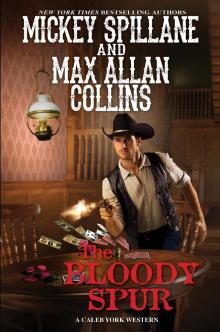
The bloody spur, p.11
The Bloody Spur,
p.11


Toward the rear, and consuming much of the space, was a cast-iron and wood contraption as big as a buckboard, with a central drum, levers, gears, and springs. Silent now, the printing press looked like it could make a hell of a racket in motion, like some ancient beast that might come lumbering toward you.
No bell over the door had announced York, but the editor soon sensed his presence, anyway, and turned toward him with a guarded smile, a nod, and “Sheriff.”
“Mr. Penniman. I have a story for you.”
“Come. Take a seat.” A smile flickering under the perfectly trimmed mustache, he gestured to a nearby chair, which York went over and filled.
“I admit I’m surprised to see you, Sheriff. I rather got the impression that your opinion of me and my paper was, well, less than entirely favorable.”
“I really have no opinion either way,” York said. “But it does seem a bit on the shady side that you don’t advertise your silent partner.”
“What silent partner would that be?” the editor asked too innocently.
“The Santa Fe Railroad. But we’ve covered that. And, anyway, if I have a story that needs putting in front of the public, where else could I go but the Enterprise?”
Penniman studied the sheriff for a moment, then shrugged and grabbed a new piece of paper, pencil poised. “All right, then. What news is it you have for our readers?”
“George Cullen has been murdered.”
The editor stiffened, looking up from the as yet unwritten-upon paper. “Well, that’s a shock. Terrible to hear. You’re . . . you’re sure of this?”
York nodded, then gave him a superficial account, just the bare facts and none of the doctor’s medical opinions.
Penniman frowned. “But . . . that sounds as if he was thrown from his horse . . . ?”
York gestured to Penniman’s paper.
Then he said, “ ‘Sheriff Caleb York, formerly a detective with Wells Fargo, considers the circumstances highly suspicious and is handling the tragedy as a murder investigation. The body apparently was moved and arranged to suggest accidental death. The deceased’s reluctance to support the Santa Fe Railroad’s proposed branchline, the sheriff says, is a possible motive.’ You get all that?”
Hunkered over again, Penniman was still writing. Then he said, “I got it. Want to hear it?”
“Yes.”
The editor read it back. He had it word for word.
“You’re talking to possible suspects, I assume,” Penniman said.
“Yes. For example, where were you this morning between sunup and ten?”
The editor straightened a little. “So I’m a suspect, then?”
“You and the Santa Fe Railroad . . . but you don’t have to quote that if you aren’t so inclined. Where were you, Mr. Penniman? This morning?”
The editor’s dark eyes flared. “Right here! You can talk to Mr. Jones there, and he’ll confirm it. I took an early breakfast at the hotel and was at the office by seven thirty.”
“Mr. Jones might be inclined to back up his boss.”
“What, and risk being charged as a murder accomplice? Sheriff, based upon what you’ve said, I would need a buckboard to accomplish this foul deed, one of which I do not own. Here, I don’t even own a horse. And the only place I could have rented either buckboard or steed would be the livery, and you can check there and find that I didn’t.”
York nodded, rose. “I’ll do that. Add to the story, if you please, that the sheriff would appreciate any information about this possible murder that your readers might be able to share. All right, sir?”
Penniman frowned—almost scowled—but he nodded before returning to his foolscap.
The front windows of the next business Caleb York visited displayed two well-crafted mahogany caskets with brass fittings and a small dignified sign that said:
C. P. PERKINS
CABINETMAKER
& UNDERTAKER.
Such fancy coffins were only for those well-off citizens to whom life, if not death, had been kind. This display at times had made way for the remains of such outlaws as the late sheriff Harry Gauge and various members of the Rhomer clan, who’d had a grudge against the current sheriff.
If York ever ended up on the wrong end of a gunfight, he knew his next stop would surely be this window.
York entered into a showroom of sorts, with less ostentatious caskets at right and various cabinets, dressers, tables, and chairs at left—death on one hand, life on the other. A desk off in a corner was not for sale; this was Undertaker Perkins’s work area, though he was not seated there. Hammering from in back sent York in that direction.
The back room was a workshop, with stacked lumber, a tool-strewn workbench, and the smell of sawdust. The barn-style doors at the rear of the building allowed the storing of a funeral wagon, its black, feathery plumes and glass windows protected by a tarpaulin. Skinny, bald, mustached Perkins, without his usual Abe Lincoln high hat, looked even smaller than he usually did. But in his BVD top he showed off a surprising musculature as he hammered away at his latest creation.
On a nearly upright wooden framework—almost certainly the undertaker’s own work—the coffin in progress rested as he nailed its pieces together. This was a strictly functional pine box, a world—a lifetime—away from the brass-fitted eternal beds in the window.
Perkins had not seen him step in, and York waited for a pause in the hammering before announcing himself.
“Adding some inventory, Mr. Perkins?”
A ghost of a smile flickered on the solemn face as he looked back at York. “There could be a need.”
“Because of the Preacherman and the two sinners he rides with?”
Another ghostly smile. “A possibility, wouldn’t you say?”
“No question.”
Perkins set down his hammer on a small battered table and came over to York, who was only a few paces into the workshop. “What brings you around, Sheriff? I don’t imagine you came to window-shop.”
“No. I’d be fine with one of these pine boxes. No need for anything fancy, considerin’ the destination.”
The slight yet muscular figure shrugged. “A man of practical considerations. But I’m pleased your attitude isn’t widely held. The more civilized men become, the more they want to go out in style.”
“I stopped by to tell you that you have a new customer. He’s over in Doc Miller’s surgery.”
“Ah,” he said solemnly. “Someone I know?”
This wasn’t as facetious as it might sound: few of the many cowhands on the surrounding spreads would be familiar to the undertaker, although everyone in the town proper would.
York told Perkins about Cullen’s passing, including that he believed it to be murder and why.
“And you,” the undertaker said, “are assuming those of us who challenged him last night regarding his wrongheaded views about the Santa Fe spur are key suspects. And that would include me.”
“It would.”
Another shrug, more elaborate this time. “I have no alibi. No wife or children, and I work here alone.”
York gestured to the covered funeral wagon. “And you also have a ready means of transportation.”
“Without horses,” Perkins said with a sly smile, “I most certainly do not. And if you haven’t checked at the livery already, you’ll find when you do that I haven’t rented any horses in some weeks. Will that suffice as an alibi, Sheriff?”
“Guess it will have to,” York said and took his leave, while the undertaker returned to his hammering.
After all, even a man as brave as Caleb York didn’t find much to like about hanging around an establishment like this.
CHAPTER NINE
Willa Cullen—in the same plaid shirt, jeans, and boots in which she’d found her dead father under a tree a few hours before—led her calico, Daisy, to the grooming stall in the horse barn. Daisy was good about not wandering away, but Willa tied the animal up, anyway.
The barn was cool but not cold, and she had it to herself—stable hand Lou Morgan was off exercising her papa’s buggy ponies, which didn’t get used every day. She supposed the stable smell would have put some females off, but she rather relished the unique aroma of various parts leather, hay, grain, manure, urine, mud, grass, wood, and tack polish.
She filled her mind with nothing but tending to her tri-colored pinto, white with black and brown spots, white mane, brown tail. A curry brush, moved in a circular manner, loosened up the dirt on Daisy’s coat, but the brush was too coarse for the animal’s face.
The loping jangle of spurs and the crunch of boots on hay announced the approach of unwanted company. The last thing she needed right now was sympathy or talk of what next. But she understood that wish was unrealistic, and smiled back at Whit Murphy, hoping it didn’t look forced.
“Morning, Whit,” she said. “It is still morning, isn’t it?”
The foreman, high-beamed Carlsbad hat in hand, came to a stop a respectful distance away and stood outside the stall, slumped, head hanging, his whole face, his whole body as droopy as his mustache. The work shirt, bandana, and shotgun chaps seemed to hang on him like laundry on a line.
“You needn’t trouble yourself with such work, time like this, Miss Willa. I can give Lou a holler. He’ll give that little pinto any attention she might crave.”
Willa smiled faintly as she continued brushing. “I’m not troubling myself, Whit. I’m keeping my mind off things. Keeping busy.”
He took a tentative step forward. “I just want you to know, Miss Willa, that iffen there’s any way I can help . . . anything a’tall I can do . . .”
People always said such things at times like this. But what could Whit Murphy do to help? What was there that anyone could do?
Still, she knew Whit wasn’t just another friendly acquaintance, trying to say the right thing—Whit had almost been like a son to her daddy. She and Papa couldn’t have run the ranch half as well without him after the rancher’s eyesight failed.
Nor was she unaware that the shy cowpoke was sweet on her.
“Just keep things runnin’ nice and smooth, Whit,” she told him. “The way Papa would want it.”
She used a dandy brush to remove dirt from Daisy’s coat in quick, short strokes in the direction of the hair, flicking off dirt from the calico’s coat. Daisy just stood there, basking in the attention, giving up not a whinny, just the occasional proud shake of the head.
When Whit spoke again, she was almost surprised he was still there.
He said, “Would you like me to ride into town, Miss Willa, and talk to Reverend Caldwell? Make arrangements and all?”
That almost irritated her. In what world did such things fall to a ranch foreman? But she knew he only wanted to help.
“No,” she said. “This afternoon I’ll ride in and see the reverend myself. Not looking to have a service at Missionary Baptist, just a graveside gathering.”
It would have to be soon. Undertaker Perkins did not have embalming available, like some Civil War–trained members of his trade. She shivered at the thought of her father being just so much meat that would soon spoil.
“Thank you, though, Whit. You’re kind.”
She smiled at him again and nodded in a way that tried to tell him nicely that this conversation was over. But he lingered, turning the hat in his hands like a wheel.
“Don’t you worry yourself none,” he told her. “I’ll keep the Bar-O runnin’ steady till, uh . . . till you get around to makin’ your mind up.”
She frowned at Daisy’s side, but any crossness was gone when she glanced back at the cowhand again. “Make it up about what, Whit?”
His head remained lowered, but his eyes gazed up at her, like those of a dog fearing a swat from its mistress. “Whether or not to sell the Santa Fe right of passage for that there branchline.”
She kept brushing. “You have an opinion?”
“Is it my place to?”
“You as much as anybody.”
His chin came off his chest. “I say stick with what your daddy wanted. You know what his wishes was. Otherwise the Santa Fe wins.”
Now she looked right at him. “It’s not a contest, is it?”
“No, ma’am, but the way I see it, it’s our way of life against theirs.”
“How so?”
“Well, like your papa said, it’d give the competition a leg up and turn little Trinidad into Sodom or Gomorrah.”
She managed not to smile. “Well, we wouldn’t want that, would be, Whit?”
“No, miss.”
He gave her a shy, respectful nod, tugged the hat on, and shuffled off, spurs jingling. Then she heard him stop, say, “Sir,” and move on. She stepped out of the stall for a look, and big Burt O’Malley was approaching, that lazy, loping way of his compromised by an expression clenched with concern.
“Uncle Burt,” she said with a nod and returned to the stall and her work.
With a body brush, Willa began applying long, even strokes to Daisy’s coat, smoothing out her hair, getting off any residue of dirt.
O’Malley was at the mouth of the stall now, arms folded, a grave expression carved into the oblong, salt-and-pepper-bearded face. “That help, child? Workin’ yourself to a frazzle like that?”
Her eyes were on her efforts. “You prefer I go cry my eyes out in my room?”
“Might,” he admitted, approaching. “Might. Bottlin’ it up won’t do you a lick of good. You don’t let sorrow out, it festers.”
Her back was to him. “I don’t see what good crying would do. If I was a son, not a daughter, would you say such things to me?”
Daisy’s coat was getting nice and shiny.
“I believe I would,” O’Malley said. “A son would cry. Behind closed doors, maybe. But grieving is natural. Not a male or female thing.”
“I’ll do it in my own way, then.”
He drew closer but didn’t crowd her. She was using a mane comb now, untangling Daisy’s tail. Such work required a gentleness, and she sometimes paused to use her fingers for untangling.
The big man said, “I overheard some of what Whit had to say.”
“Did you? Eavesdropping doesn’t become a man. More a woman’s thing, don’t you think?”
Why did she feel so angry? Why was she treating Uncle Burt like this?
But O’Malley ignored her rudeness. “You’re the Bar-O now, Willa. Your father didn’t have a son, so a daughter’ll have to do. Whit’s opinion ain’t worth spit. Mine neither. It’s all down to you, girl.”
She shifted to a dandy brush to bring further softness to Daisy’s tail, but she dropped the thing in the process. O’Malley was right there to pick it up and hand it to her, both of them on their haunches, looking right at the other.
They stood.
The irritation was out of her tone as she said, “I’m in a bad place, Uncle Burt.”
He placed a gentle hand on her shoulder. “Of course you are, child. I ain’t in the sunshine my own self. All these years and I finally get my old partner back, and now he’s lost to me forever. Ain’t nohow easy.”
She sighed. Moved away, returning to Daisy. She kept working, and O’Malley just stood and watched. She used the brush on the animal’s mane, and the beast almost purred. Finally, she began cleaning Daisy’s hooves, standing next to her, bending, and supporting one hoof at a time. With a hoof pick, she worked out rocks and turf there, scraping away from herself, not particularly wanting any of that stuff to get flung in her face.
“You know your way around horseflesh,” O’Malley said.
“I should. I lived on this ranch all my life. Was riding before I could walk.”
“You want to tell me?”
“Tell you what?”
“Why it is you’re in a ‘bad place.’ I don’t mean losing your daddy. I mean the position that losin’ your daddy has put you in.”
She leaned against the side of the stall. He came over and leaned in next to her, their backs to the wood.
“I never told Papa,” she said, almost whispering, as if her late parent might overhear, “but we didn’t see eye to eye on the Santa Fe spur.”
He frowned, studying her. “You mean . . . you were in favor of it?”
She nodded. “No reason not to be. You can’t keep the future from your door. Times change whether you want ’em to or not.”
“No kiddin’,” the big man said with a grin and a deep chuckle. “I hardly recognized the Bar-O when that buckboard brought me out here. Trouble was, I think, once his outside vision left him, your papa’s inside vision left him, too. By which I mean his ability to see the possibilities that lay ahead.”
She looked at him curiously. “I thought you were on Daddy’s side of this, Uncle Burt. Heard you tell him myself how you agreed with him about blocking the spur.”
His grin wore embarrassment. “Would you think less of me, child, if I admitted I told him what he wanted to hear? Last thing I was after was to ride in and get on the wrong side of that beautiful, stubborn old man.”
“You wanted your friendship back.”
He nodded. “I wanted my friendship back. I’d have stood with him on any side of about any issue he wanted me to. Some of that was selfish. Your papa was my way into respectability after wastin’ so much of my life behind bars.”
She shook her head. “You didn’t have to play that game with him, Uncle Burt. He would have been glad to help, in any case. Like I’ll be glad to help.”
Something pixieish came into the white-beard-framed smile. “Well, then, why don’t we put that Cullen/O’Malley partnership back together, girl? Instead of sellin’ me one of them smaller spreads, let me sink all that money your daddy put away for me back into the Bar-O itself.”
“Uncle Burt . . .”
He raised a gentle hand. “Now hear me out. With George Cullen gone, don’t you think Willa Cullen could use a strong male right hand? And I don’t mean Whit Murphy, who makes a decent foreman, I’m sure, but is sure as hell no George Cullen, forgive my language.”