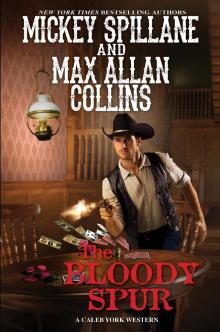
The bloody spur, p.3
The Bloody Spur,
p.3


And her papa sat.
“Mr. Cullen,” Prescott said through a strained smile, “with your cattle holdings, you will benefit as much as anyone—more than anyone—by having a railhead in your backyard. In addition, during the construction of the spur, we will need beef. I am more than happy, sir, to make arrangements with you to have our men fed. And, of course, the Santa Fe will pay generously for the right of passage. That remains for private negotiation, naturally, but do know that we are prepared to pay handsomely for these rights.”
Without rising, Papa said, “If I was to do business with you and the Santa Fe Ring, I am the one who would pay ‘handsomely.’”
The Santa Fe Ring her father referred to was a powerful cabal of attorneys and land speculators, with ties to the railroad, who had made a fortune in New Mexico through political corruption and fraudulent land deals.
Papa was saying, “Not only would your branchline disrupt my range, it would make it easier for my competitors to the south, from Texas to Mexico, to compete with the Bar-O.”
“Sir—”
“No, sir. Right now the Bar-O has a short, two-day cattle drive to Las Vegas, and that gives us a market advantage that I have no intention of giving up. My fellow ranchers here should keep that in mind. At any rate, I’m quite satisfied to have things stay as they are.”
Her father stood forcefully, and Willa rose, as well, then took his arm and guided him down the aisle between chairs, though truth be told, he was the one creating the forward motion.
She had seen him through the store and outside, down to where the buckboard waited, and had even helped him up into his seat when she noticed Caleb York had followed. He stood on the boardwalk, in the blue shadow of its overhang, at the edge of the steps down to the street, hat still in his hand.
Why exactly she went to him, she couldn’t say. He hadn’t called out to her or even motioned, but she knew that he wanted a word.
She came over to the foot of the steps and looked up at him. Tall as he was, he fairly loomed over her.
Quietly, almost whispering, he said, “Is the old boy all right?”
Her father, up on the buckboard, was visibly trembling.
Sotto voce, she said, “He’s fine. He’s just mad, that’s all.”
“I don’t blame him.”
She glanced over her shoulder at her father and then back up at York with a frustrated frown, speaking softly. “Caleb, the thing is . . . I’m not sure I agree with Papa. I haven’t spoken a word about it to him as yet, because I know how much it riles him . . . but he may be wrong about this.”
“That so?”
She shook her head, and a yellow tendril came loose and dangled over an eye. “The railroad’s the future, Caleb. There’s no escaping it, and . . . and I’m not sure we should if we could. The branchline really will be a boon to Trinidad.”
“Future’s hard to avoid,” York admitted. “And towns like this one either grow or fade.”
Her frown turned confused. “I thought you didn’t much care for what that railroad man was peddling.”
He shrugged. “I just don’t like being sold a bill of goods. There’s generally two sides to things, and it’s best to consider both. Anyway, there’s a whiff of snake oil about that big bug Prescott.”
She nodded.
Then an awkwardness settled in.
“Well,” she said. “I should be getting back to the Bar-O.”
“Well,” he said. “Suppose you should.” He smiled a little, gave her a respectful nod, and headed back inside.
For a moment there, it had been as if they were on speaking terms.
For a moment.
She got up on the buckboard and drove her father out of town.
* * *
When Caleb York returned to the meeting at the rear of Harris Mercantile, the discussion had broken up into groups of three and four. One such group included the Santa Fe man and three of the small-ranch owners. Perhaps Prescott figured he might be able to assemble a passageway through those lesser spreads.
York doubted that was a possibility. Cullen land had grown to include what had been the Gauge properties, when Willa’s late fiancé had left his holdings to her. The other ranches formed a patchwork quilt that only rarely intersected and represented a small proportion of range at that.
The only straight shot at a pathway to Las Vegas from this part of the world was through the Bar-O.
Mayor Hardy was speaking with his fellow Citizens Committee members in the farthest corner, clumped together like the conspirators they were. The mayor noticed that York had returned, and waved him over.
York complied.
“Sheriff,” the mayor said, “I hope your comments today don’t find us at odds. Because the Citizens Committee is very much in favor of the Santa Fe spur.”
“I can’t say I’ve formed an opinion,” York admitted.
“Then why did you make those comments?”
York shrugged. “It just seemed like Mr. Prescott was stacking the deck a mite.”
Mercantile man Harris, eyes glittering, said, “Prescott isn’t exaggerating when he says that branchline will mean great things for Trinidad—thriving economy, growing population. . . .”
“That doesn’t sound like your words, Newt.” York grinned at his host. “Or is there an echo in here from when Prescott was talking?”
Seeming to change the subject, Davis, the druggist, said, “Tell me, Sheriff, are you still considering that position with the Pinkertons in San Diego?”
“I assured you gents I’d stay at least till the end of the year,” York reminded them.
“That’s less than two months!” Mathers blurted, his muttonchops fairly bristling.
“We just thought,” the mayor said with a nervous smile, “that you might stop to consider what this spur would mean to you . . . personally.”
York grinned again. “You mean, I wouldn’t have to wear my horse out whenever takin’ a trip to Las Vegas?”
His Honor seemed about to put a hand on York’s shoulder, then reconsidered it.
“What I mean is,” Hardy said, “if that branchline comes through, we could offer you a healthy raise . . . a raise up to the level of what Pinkerton promises, and more. All kinds of perquisites commensurate with what that office would be. How would you like to live in a house, not a hotel room? A house the city would provide!”
Already they were thinking of themselves as a city, not a town.
York said, “That all sounds just fine. Would you throw in a housekeeper?”
“We could do that!” Mathers said.
But the mayor could tell York was having some fun with them.
“We’re quite serious about this, Caleb,” Hardy said. “Think of your fees for tax collecting in a city ten times our size. You’d have regular office hours, with a staff of deputies, and not just some old stable bum . . . meaning no disrespect to Mr. Tulley.”
“Obviously not. But aren’t you fellas forgetting one small detail here?”
The four men traded looks that said, Are we?
York opened a hand. “The most efficient and maybe only way that spur goes in is if George Cullen sells the right-of-way. Perhaps you missed it, but I didn’t think he seemed all that enthusiastic about the prospect.”
The mayor smiled so broadly that his handlebar mustache seemed to smile its own self. “That’s where you come in, Sheriff.”
“Do I?”
Harris took York by the arm. “Old Man Cullen likes you, Sheriff, respects you. You got rid of that evil bastard Harry Gauge, saved the old man and his daughter’s lives out to the way station last year. That carries weight!”
Mathers said, “He’ll listen to you, Sheriff.”
York sighed, nodded. “He might.”
The mayor said, “We need you to intercede for us with that hardheaded old fool.”
That got a frown out of York. “George Cullen is no fool.”
Hardy realized he’d misspoken. “Of course he isn’t. But he’s one of these self-made pioneer types who came to this country and carved out a place for himself. He sees the rest of us as newcomers, interlopers, and doesn’t understand that times are changing and civilization is coming.”
Giving York a patronizing smile, Davis said, “A man who’s thinking about moving to San Diego and taking a job with the Pinkertons isn’t a man who fears change. Isn’t a man who ducks the future.”
The mayor said, “Just talk to him. Reason with him. That is, assuming you agree with us and consider the branchline the path to the future for our little town.”
So it was a town again. City would come later.
“I’ll have a talk with Mr. Cullen,” York said, gave the men a nod, and turned to go before he had to endure their self-satisfied grins.
On York’s way out, Oscar Penniman, the newspaperman, stepped in his path. York considered sweeping by and knocking him down in the process, then reconsidered. Probably best to maintain good relations with the press.
“Trouble you for a quote, Sheriff?” The editor’s voice was casual, but his eyes were sharp, and the notebook was in hand, pencil poised. “My readers would, I’m sure, find your views on this subject of most interest.”
“Not today, Mr. Penniman.”
York slipped past the man, who tagged after.
“At the meeting you sounded skeptical of what might come of a branchline coming to town. Can I assume you’ll take a stand against the railroad?”
“No.”
“Then you’re for it?”
“No, you can’t assume anything. Quote what I said in there, if you like. Now excuse me.”
They were outside now.
“Sheriff!”
The newspaperman’s footfalls clattered along the boardwalk as he tried to keep up with the lawman’s greater stride.
“Could you give me a quote on how you came to save that young man’s life yesterday? You could have easily shot down that callow youth.”
York stopped and turned, and the little man almost ran into him.
“He could have easily shot me,” York said. “That’s how gunfights work. And why they should be avoided.”
The editor was scribbling in his notebook now, allowing the sheriff to make his getaway.
What York might have said was how he hated the idea of civilization squeezing all the life out of the Southwest. But why bother having any opinion on that subject? Change was coming. And a man might as well learn to live with it. Even a man like George Cullen.
Even a man like Caleb York.
CHAPTER THREE
The sun was well along on its western descent behind the Sangre de Cristo Mountains when Willa Cullen and her father rolled in under the rustic log arch with its chain-hung Bar-O plaque—a straight line above the B, imitating the Cullen brand.
Though their acreage had almost doubled in size, thanks to the Gauge holdings, which were now theirs, nothing about the ranch itself had changed a jot—corrals left and right, two barns, rat-proof grain crib, log bunkhouse, cookhouse with hand pump. The ranch building itself was mostly logs with some stone add-ons, the central wooden structure having been built by her father in the early days. Right now the cowpokes were still out with the beeves, the only sign of life a corkscrew of smoke emanating from the cookhouse chimney.
She brought the buckboard to a stop in front of the house, where her calico, Daisy, was tied at the hitch rail out front. Lou Morgan, the lanky old wrangler who looked after the barns, ambled up, spitting tobacco, as she was helping her father down. The crusty stockman took charge of the rig and began driving it over to the barn, where he’d unhitch the horses and guide them to their stalls.
Papa almost bounded up the steps he knew so well, propelled perhaps by his anger at the Santa Fe Railroad. She stopped to give Daisy a nuzzle, then went up the broad wooden steps to the plank porch to join Papa. That was when she noticed they had company.
Rising almost endlessly from one of the rough-wood chairs that graced the porch came a tall, sturdy-looking stranger who was perhaps fifty, with an easygoing smile that seemed to claim the right to do so. He wore a blue shirt and a brown vest with a red bandana at his neck; a dark brown Boss of the Plains hat was in his hand. He wore Levi’s, and no gun rode his hip.
The clothes looked new, but their guest seemed weathered. That friendly face was oblong, trimly salt-and-pepper bearded, and the eyes in it were a dark blue that caught the light and reflected it.
“Don’t you recognize me, you old reprobate?” their guest asked Papa in a voice both casual and rough edged. “Have I changed so doggone much?”
Her father froze at the front door, then wheeled toward the visitor, who was sauntering over to him with a jangle of spurs.
“Burt?” Papa said, his voice hushed, his eyebrows high. Then he said, “Burt!”
And lunged forward to thrust out a hand for the visitor to find, which he did, grasping it, shaking it. The man’s friendly expression vanished, and sadness took its place, as the blindness of his host became clear by way of those milky eyes.
“George,” the man said softly, “I hadn’t heard of your . . .”
“My affliction?” her father said, grinning, their hands still clasped. “Seems age finally caught up with me. Anyway, I seen enough in my lifetime to last me two. And leastways I don’t have to see what’s become of you.”
The easy grin broadened. “You’ll just have to believe me, old friend, when I say I still cut a mighty strikin’ figure.”
They shared laughter.
The man called Burt turned toward her, releasing Papa’s hand.
“You must be what become of that ornery tyke Willa,” he said and shook his head and made a “tch” in a cheek. “Now look at you, so much like your mother.”
“I’m Willa,” she admitted. Suddenly her plaid shirt and jeans didn’t seem feminine enough.
The visitor approached her and rather shyly said, “I’m Burt O’Malley. You wouldn’t remember me—you were just a slip of a thing when I, uh, left. But maybe your daddy mentioned me.”
She was lying, but it seemed right to say, “Oh, of course I remember you, Mr. O’Malley. And Papa has spoken of you often, and so fondly.”
The latter, at least, was true enough.
The visitor raised an almost benedictory palm. “There’ll be none of that ‘Mr. O’Malley’ nonsense. I’ll accept Burt or Uncle Burt, and general terms of endearment . . . but no ‘mister.’”
She took both of his hands in hers. “Uncle Burt it is. How did you get out here? I don’t see a horse.”
“I came by stage this morning to Trinidad and hired a man at the livery to drive me out in his buckboard. I’m afraid I’ve taken some liberties. . . .”
He gestured over to where he’d been sitting—next to the wooden chair was a carpetbag.
O’Malley said, “I kind of assumed I’d have a place to stay out at the Bar-O, least till I got my feet under me.”
Papa was next to their guest now and slung an arm around the taller man’s shoulder. “Today, tomorrow, and always, you’re welcome here. Ain’t you the O in Bar-O?”
She opened the cut-glass and carved-wood front door for them, and Papa gently nudged his old friend to go in first. Both men hung their hats on the wall pegs just inside to the right, then the sightless host led his friend into the sprawling central area of the house.
Like that fancy front door from Mexico, the living room retained her mother’s touch, finely carved Spanish-style furniture mingling with her father’s hand-hewn, bark-and-all carpentry. This was more her papa’s domain than the late Kate Cullen’s, however, with its beam ceilings, hides on the floor, and mounted antler heads. A formidable stone fireplace seemed protected by a Sharps rifle at left and a Winchester at right, each supported by mounted upturned deer hooves.
Papa had come west with that Sharps, and buffalo hunting had provided the funds that built this ranch. The Winchester was the tool of the spread’s early days.
But George Cullen had not been alone in building the Bar-O. There had been Raymond Parker, who a decade and a half ago had sold out his share and was now a successful businessman in Denver. And there had been Burt O’Malley, as well, almost a legendary figure around here....
Willa played hostess and made tea for the two men, who soon were sitting, sipping at china cups, in the twin rough-wood chairs with Indian blankets serving as cushions. She got a fire going in the fireplace they were facing. Then, as she often did when inserting herself into the affairs of the men who dropped by to speak with her daddy, Willa perched on the stone lip of the hearth, positioned between the two men, with views of both.
They were reminiscing about buffalo-hunting days—that was when and where Papa, Parker, and O’Malley had met—when a lull came along, and she filled it, telling their guest that she had beef stew on the stove and that there was plenty enough for him.
“Very kind,” O’Malley told her, “but the kitchen smells waftin’ in done give you away. I’m happy to sit at your table, and I’m hopin’ you Cullens can put up with me for a day or two, till I can line up lodgings in town.”
“Nonsense,” her father said. “We’ve a guest bedroom that is yours as long as you want it.”
Sitting forward, Willa said, “And don’t be embarrassed about asking for a helping hand. I’m sure Papa will stake you to—”
But Papa raised a palm, like an Indian chief in greeting, only what he meant was, Silence.
“Daughter, there’s something I’ve kept from you,” Papa said. “It was wrong of me, particularly since you have grown into such a strong young woman and, I am embarrassed to say, the real rancher on this spread. But you were just a slip of a thing when I made this decision, and I assure you your mother approved.”
Willa leaned forward even farther, her brow creased with confusion. “Papa, whatever are you talking about?”
O’Malley was frowning, and he, too, sat forward. “George, are you saying your daughter has no idea what you’ve been doin’ for me all these years?”
Papa sighed deep and, as he exhaled, nodded. “I’m afraid so. So much time passed, and it was just a . . . well, kind of a routine business matter, in a way.”